
The Step 1 pass/fail era is not the end of your shot at a top residency. But it absolutely changes where you’ll be judged and how programs will filter you.
If you are aiming at derm, ortho, plastics, neurosurgery, optho, ENT, or any of the other bloodbath specialties, you need to understand this clearly:
Step 1 going P/F did not make things easier. It just moved the battlefield.
Let me walk you through what really matters now, how programs are actually behaving, and what you should do differently if you’re gunning for a highly competitive match.
1. The blunt answer: will Step 1 P/F hurt your chances?
For most applicants: no, by itself it will not hurt you.
For competitive-specialty applicants: it will hurt you if you do not compensate aggressively in other areas—especially Step 2.
Here is the core reality:
- Programs lost their favorite early filter (Step 1 numeric score).
- They replaced it with:
- Step 2 CK numeric score
- School reputation and clinical evals
- Research output
- Letters and home/institutional connections
- Signals (where applicable) and “fit”
So the question isn’t “Did Step 1 P/F hurt my chances?”
The real question is “Did I adjust my strategy to the new rules?”
If you treat Step 1 P/F like a free pass to be “good enough” and coast, then yes, you’ve hurt your own chances. If you treat it like a chance to build a stronger overall application and crush Step 2, it can actually help you.
2. What competitive programs are really doing now
I’m going to strip out the fluff and tell you what I’ve seen and heard from PDs, residents on recruitment committees, and med school deans.
Here’s the short list of what has become more important since Step 1 went P/F:
- Step 2 CK score
- Clinical grades (especially core clerkships)
- School reputation and home program strength
- Research and meaningful scholarly work
- Strong, specific letters of recommendation
- Networking and “known quantity” status (sub‑Is, home rotations)
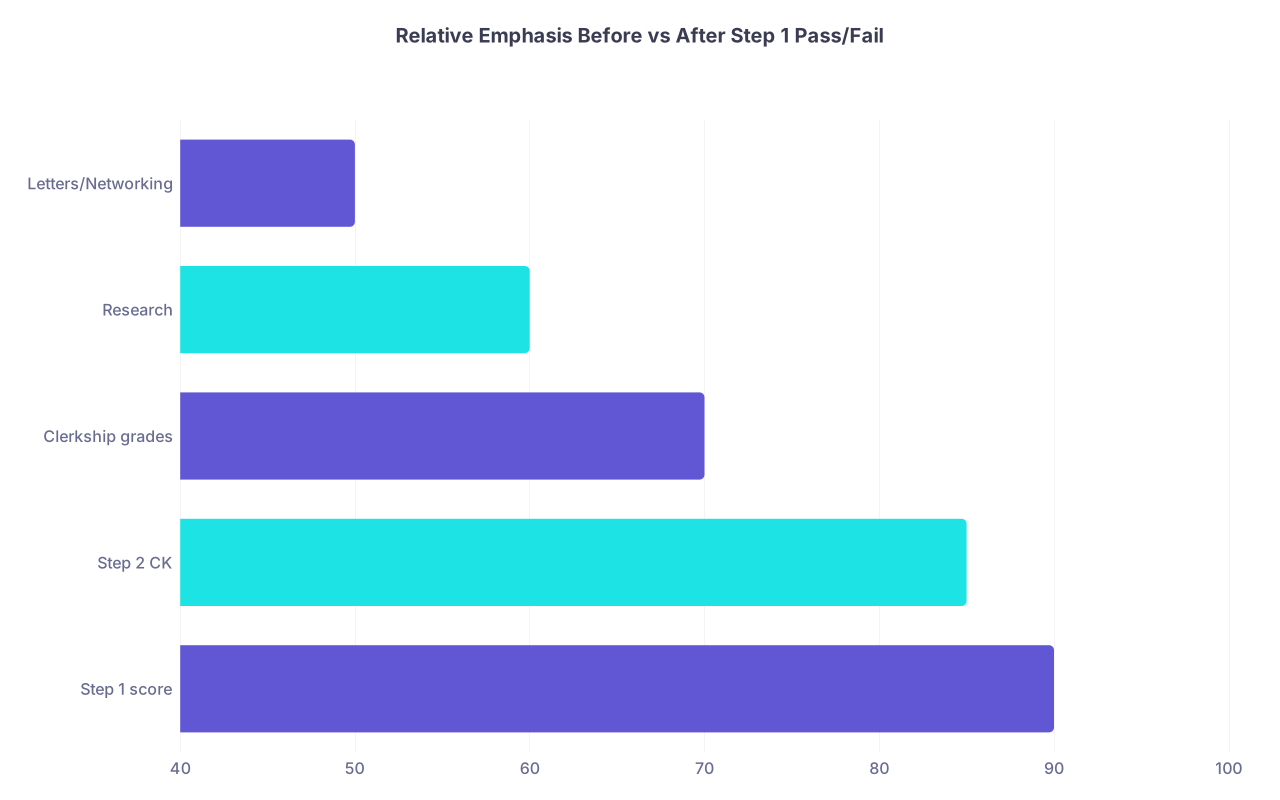
| Category | Value |
|---|---|
| Step 1 score | 90 |
| Step 2 CK | 85 |
| Clerkship grades | 70 |
| Research | 60 |
| Letters/Networking | 50 |
Interpretation: Step 1 numeric used to be the king. Its fall pushed everything else up, with Step 2 now sitting on the throne.
How committees are actually screening
In competitive fields, early screens now often look like this:
- First pass: Step 2 CK cutoffs (informal but real)
- Parallel filter: school type (US MD vs DO vs IMG) and “known” med schools
- Secondary sort: research volume/quality, AOA/Gold Humanism, clerkship honors
- Last sort: letters, personal statements, and “fit”
So no, Step 1 P/F didn’t kill your chances at a top program. It just removed the one number you could use early to offset a weaker school or limited research. Now you must build a stronger, more well-rounded—and more time-consuming—application.
3. Step 2 CK: your new make-or-break exam
If you remember nothing else, remember this:
For competitive residencies, Step 2 CK is now what Step 1 used to be.
This does not mean other things do not matter. It means if your Step 2 is mediocre, the rest of your shiny stuff will be fighting uphill.
What counts as “competitive” Step 2?
I’ll give ballpark numbers (these vary by year and program, but they’re roughly right):
| Specialty Group | Roughly Competitive Step 2 CK Range |
|---|---|
| Ultra-competitive (Derm, Plastics, ENT, Ortho, Neurosurg, Ortho) | 250+ (higher is better) |
| Competitive (EM, Anesthesia, Rad, Gas, Cards-path fields) | 245+ |
| Moderately competitive (IM at good places, OB/Gyn, Gen Surg) | 240+ |
| Less competitive (FM, Psych, Peds at broad range of programs) | 230+ |
Could someone match derm with a 243? Yes. With heavy research, a strong home program, and glowing letters. But those are exceptions, not strategy.
Strategy shift for you
Before:
Students killed themselves for Step 1, then coasted more on Step 2.
Now:
Smart students treat Step 1 like a high-yield foundation and Step 2 like the actual scoreboard.
So if you’re in preclinical or early clinical years in the P/F era:
- Use Step 1 as a long runway: truly learn path, pharm, and physiology.
- Take Step 2 timing seriously—don’t push it too late if you’re competitive-specialty bound. Programs often see it before rank lists.
4. What Step 1 still signals—even as P/F
Even as pass/fail, Step 1 is not meaningless.
Program directors think in patterns. Here’s what a Step 1 “pass” still quietly communicates:
- You can handle standardized testing at a national benchmark.
- You likely have basic science fundamentals.
- You did not have catastrophic issues (test-taking, health, life chaos) that led to a fail.
What hurts you is not “Step 1 P/F” in itself. What hurts is:
- Step 1 fail → pass: big red flag for competitive specialties
- Step 1 pass + weak Step 2 CK: suggests plateau at a lower test level
- Step 1 pass + spotty clinical performance: suggests weaker work ethic or consistency
If you failed Step 1 then passed and want a highly competitive field, you aren’t dead in the water, but you’re in the “needs a very compelling story + exceptional rest of the app” category. That’s just reality.
5. Other levers that matter more now
Since programs can’t stack‑rank you by a single 3-digit Step 1 score anymore, the rest of your file is under a harsher spotlight.
Clinical grades and narrative comments
Those “mid-clerkship feedback” comments? Attendings scribbling “hard-working, prepared, pleasant to work with”? Those matter more now.
You want your clinical record to say:
- Honors in key rotations relevant to your specialty (e.g., surgery for ortho or plastics, medicine for cards or GI).
- Consistent narrative of: prepared, reliable, good team member, cares about patients, teaches others.
Bad story: “Smart but disengaged,” “comes in late,” “not a team player.”
Those are interview killers.
Research and scholarly work
Especially for derm, rad onc, plastics, neurosurg, ENT, ortho at big academic centers, the arms race has shifted harder into research.
You do not need 15 pubs to be taken seriously. You do need to show:
- Sustained involvement (not 2 months of “I helped a little”).
- At least a couple of tangible outcomes:
- Poster at a real conference
- Pub or accepted manuscript
- Active projects you can discuss concretely
Pick one or two mentors and attach yourself early. The best applications tell a coherent story, like: “I’m interested in cutaneous oncology; I’ve been working with Dr. X since MS1; we’ve done A, B, and C.”
Letters and networking
With Step 1 scores gone, the “I know this student well and I would rank them highly” letter became even more valuable.
You want:
- At least one letter from a big name or respected person in your specialty.
- Letters that are specific: telling stories about you managing complex patients, following through on work, being a reliable team member.
Networking is not sleazy if done right. Away rotations, conferences, Zoom research meetings—all of those are ways to become a known name, not just an ERAS file.
6. DO vs MD vs IMG in the P/F era
Step 1 P/F did not erase systemic differences. It changed the calculus.
Here is the harsh version:
- US MD: still default-advantaged, especially for top academic and ultra-competitive specialties.
- DO: Step 2 and clinical performance now matter even more if you want the top or most competitive programs. Strong DO applicants with 250+ Step 2 and robust research can absolutely match into competitive fields, but they must “overperform” more consistently.
- IMGs: The absence of a Step 1 numeric score removed one of the clearest ways to stand out. You now need excellent Step 2, strong US clinical experience, and preferably research at a US institution to compete seriously for high-tier, competitive specialties.
So for DO/IMG: Step 1 P/F doesn’t “hurt” you by itself. But it removes an easy, objective brag line if you would have crushed it. That means your margin for a mediocre Step 2 is basically zero if you’re aiming very high.
7. Practical game plan if you want a highly competitive residency
Let me lay this out as a straight stepwise plan. No fluff.

| Step | Description |
|---|---|
| Step 1 | Preclinical MS1-2 |
| Step 2 | Solid Step 1 Pass |
| Step 3 | Early Specialty Exploration |
| Step 4 | Start Research with One Mentor |
| Step 5 | Crush Core Clerkships |
| Step 6 | High Step 2 CK Score |
| Step 7 | Sub I in Target Specialty |
| Step 8 | Strong Specialty Letters |
| Step 9 | Strategic ERAS + Signals |
| Step 10 | Interview Prep and Ranking |
Phase-by-phase priorities
Preclinical (MS1–MS2):
- Use Step 1 as your foundation-building phase, not your final goal.
- Learn with Step 2 in mind: clinical reasoning, not just brute memorization.
- Start exploring specialties—not 10, just 2–3 likely interests.
Step 1 window:
- Do not aim for “barely pass.” That mindset bleeds into Step 2.
- Aim for a comfortable pass reflecting good, not minimal, understanding.
- If you struggle badly, get serious help early (tutors, dedicated schedules, disability support if needed).
Early clinical (core clerkships):
- Treat every clerkship like an audition, even if it is not your specialty.
- Ask explicitly: “What can I do to perform at the honors level on this rotation?”
- Rack up strong evals and at least some honors.
Step 2 CK:
- Plan your study window like this actually matters more than Step 1. Because for your future specialty, it does.
- Set a target score using realistic specialty benchmarks.
- Do tons of questions. UWorld is still king; NBME forms are reality checks.
- Do not take Step 2 “just to get it done” if your practice scores are weak; adjust timing strategically (within your school’s rules and ERAS deadlines).
Sub‑Is and away rotations:
- Choose places aligned with your competitiveness level but stretch for a couple of reach programs if your app is strong.
- Your goal: be the student everyone says, “We’d be happy if they came here for residency.”
- Follow through on work, be present, be the person residents can trust at 2 a.m.
Application season:
- Build a school list with ranges: reach, realistic, and safety programs.
- Use preference signaling wisely where specialties allow it.
- Make your personal statement and experiences tell a coherent story, not a random collection of activities.
8. So, will Step 1 P/F hurt you specifically?
Here’s the real diagnostic:
It will hurt you if:
- You assume P/F means you can underprepare for Step 1 and still magically crush Step 2.
- You think “good enough to pass” is an acceptable academic mindset in a hypercompetitive environment.
- You ignore research, letters, and clinical excellence and hope you’ll “explain it in my personal statement.”
It will not hurt you—and might even help—if:
- You would have been “middle of the pack” on Step 1 but can put in the work to be above average on Step 2.
- You use the breathing room from not chasing a 260 on Step 1 to build a strong research and clinical portfolio.
- You understand that holistic review is real—but only once you clear the objective screens.
So stop asking if the system is fair. It isn’t. It never was.
Instead, ask: “Given the rules now, where do I have leverage?”
Your next step today: write down three things you will do in the next 3 months to strengthen your Step 2 readiness and your specialty-specific profile. Not vague goals—actual tasks.
Open a note, title it “Competitive Residency Plan,” and list:
- One concrete Step 2 prep step (e.g., “Finish UWorld pass of medicine by [date]”).
- One research or scholarly step (e.g., “Email Dr. X about joining their project by Friday.”).
- One clinical performance step (e.g., “On my next rotation, explicitly ask for mid-rotation feedback and adjust.”).
Then actually do the first one this week.
FAQ (exactly 7 questions)
1. If Step 1 is P/F, do programs still care about when I took it or how many attempts I needed?
Yes. Attempts still show, and a fail is a serious concern for competitive specialties. The pass/fail change removed the score, not the history. A one-time fail followed by a strong Step 2 and otherwise stellar application can still match, but you’ll be fighting uphill.
2. Should I delay Step 2 CK to improve my score if I’m not ready?
If your practice scores are significantly below your target specialty range, delaying can be smart—within reason and within your school’s rules. But delaying without fixing your study strategy is pointless. Use NBME and UWSA scores honestly to decide, then adjust your schedule early, not three days before your exam.
3. I’m at a lower-ranked med school. Did Step 1 P/F hurt me more?
It made it harder to stand out purely by testing, yes. But you still have Step 2, research, and clinical performance. If you’re not at a big-name school, you simply have less room for anything mediocre. Aim for a higher Step 2 and deliberately seek research and strong mentors in your chosen field.
4. How many publications do I need for a competitive specialty now?
There is no magic number. For ultra-competitive fields, successful applicants often have several abstracts/posters and a few publications. But programs care more about depth and relevance than a padded CV. One or two substantial projects you can talk about intelligently beats 10 shallow “name only” lines.
5. Does AOA still matter in the Step 1 P/F era?
Yes. AOA (where it exists) is effectively a shorthand for “top clinical and/or academic performer at this school.” In competitive fields, it’s still a positive signal. If your school does not have AOA, strong clinical grades and other honors play the same signaling role.
6. I’m a DO/IMG aiming for a highly competitive specialty. Is it still realistic?
It can be, but you must be exceptional on multiple fronts: high Step 2 CK, strong US clinical experience, ideally research in that specialty, and powerful letters from known faculty. You can’t count on “holistic review” to save a mediocre metric profile. People do it every year—but they’re the outliers who overperform, not just “good enough.”
7. If I already passed Step 1, is there anything I can do retroactively to improve how programs see me?
No way to change Step 1 now, but you can absolutely change the story: crush Step 2, honor your key clerkships, step up your research, and secure better letters. When your file is read, the narrative becomes “strong clinical student, high Step 2, good teammate, clear interest in X specialty”—not “some random pass on Step 1.” Your control is forward-facing. Use it.