
Step 1 going pass/fail did not break the system. It just moved the screening burden squarely onto your clerkships.
If you treat third year like a box-checking exercise, you will get screened out. Not immediately. Quietly. In rank meetings, in selection committee whispers, in that vague “lukewarm” feeling you never see in writing.
The good news: clerkships give you far more levers to pull than a single three-digit test score ever did. But you have to approach them like a deliberate signaling campaign, not a series of random rotations.
This is how you do that.
1. Understand What Replaced Step 1 in the Eyes of Programs
Programs lost an easy filter: a single number that let them sort hundreds of applications in 10 minutes. They did not just shrug and say “we will be holistic now.” They substituted other signals.
Here is what effectively replaced Step 1 as primary screens (varies by specialty, but this is the real hierarchy I see):
| Signal | Strength (General) | How Much Clerkships Influence It |
|---|---|---|
| Step 2 CK score | Very High | Moderate |
| Core clerkship grades/Honors | Very High | Direct |
| Narrative comments/MSPE | High | Direct |
| Letters from core rotations | High | Direct |
| Home/away sub-I performance | Very High (target) | Direct |
The pivot:
Step 1 used to be your standardized, “objective” measure. That slot is now shared by:
- Step 2 CK
- Your clerkship record and narrative
You cannot fully control Step 2 CK once you hit clinical year pace. But you can systematically turn clerkships into a powerful signal of:
- Work ethic
- Clinical reasoning
- Team compatibility
- Reliability under pressure
- Specialty commitment
Programs read that off your evaluations, your MSPE, and what attendings say about you in emails and on the phone.
Your job is to make those outputs non-random.
2. Build a Clerkship Strategy Before You Start Third Year
Going into clerkships without a plan is the academic version of showing up to a code without knowing where the crash cart is.
You need three things written down before day 1 of your first core:
- Target signal – What are you trying to communicate to residency programs?
- Target specialty bandwidth – One, two, or “still deciding”?
- Non-negotiable constraints – Family, geography, health, need to work, etc.
Step 1: Define your “signal package”
Pick 2–3 attributes you want every evaluator to be able to say about you without thinking:
- “Top 10% work ethic, extremely dependable”
- “Exceptionally strong clinical reasoning for level of training”
- “Outstanding teammate, low drama, high initiative”
Write them down. Those will dictate how you act when you are tired, frustrated, or ignored. That is when reputations are actually formed.
Step 2: Order clerkships with intention (if you can)
Not everyone gets a choice. If you do, use it. As a rule of thumb:
Put one of Medicine or Surgery in your first three rotations
Why: They are heavily weighted, but you also want time to adapt.Do not put your intended specialty as your absolute first rotation
You will be clumsy, slow, and unsure how to function on a team.
Better pattern for most students:
- “On-ramp” rotation (Family Med, Psych, Neuro, or Peds)
- Major core (Medicine or Surgery)
- Other major core
- Your likely specialty or a closely related one
5–6. Remaining cores + elective
You want your performance curve to be “solid → strong → very strong” with your target specialty in the strong/very strong window.
3. Turn Every Rotation Into a Deliberate Signal
Step 1 signaled “can grind independently and master content.”
Clerkships signal “can we trust you with our patients and our residents’ sanity?”
Here is how you deliberately broadcast “yes” on almost every team.
A. The first 48 hours: set your baseline signal
The first two days decide how your team categorizes you. That category rarely changes fully.
Your goals in the first 48 hours on any clerkship:
Show you are reliable.
- Arrive before the earliest resident. Not ridiculous, but 15–20 minutes early.
- Ask where they prefer notes, how they like presentations, how they handle sign-outs. Then match it.
Signal teachability. Say, once, to your senior:
- “I want to get better at X and Y on this rotation. Please tell me if something I am doing makes your life harder.”
And mean it.
- “I want to get better at X and Y on this rotation. Please tell me if something I am doing makes your life harder.”
Clarify expectations explicitly. Ask:
- “What did the best student you worked with on this rotation actually do day to day?”
- “How often do you want me to check in versus work independently?”
Write their answers down. That is your playbook.
B. Daily behavior that builds “strong clerkship” narrative
Here is the short list I have seen consistently differentiate Honors-level performance from “meh”:
Pre-round like it matters.
Have updated vitals, labs, overnight events, and at least one specific question for each patient.Do not present from the chart.
You talk, then refer to numbers. Eye contact first. Data second.Close loops.
If you say “I will follow up on X,” you update someone the same day. Senior. Intern. Attending if appropriate.Volunteer for real work, not just “I can write that note.” Examples:
- “I will call the outside hospital and get those op notes faxed.”
- “I will sit with the family to go over the medication list and update the chart.”
-Protect your attitude.
You will be exhausted and sometimes treated poorly. The student who stays net-positive and non-complaining when things are unfair stands out a lot more than the student who nails a single pimp question.
This is boring, unsexy advice. It is also what turns into MSPE lines like “the team frequently forgot she was a student” or “functioned like an intern” – which are insanely strong signals now that Step 1 is pass/fail.
4. Use Clerkship Assessments as Feedback Loops, Not Autopsies
Most students treat evaluations as post-mortems. Too late, nothing to fix. That is a mistake.
You want real-time micro-corrections.
Mid-rotation feedback: make it unavoidable
Do not wait for someone to remember. Create a structure.
Around the midpoint of every rotation, tell your senior or attending:
“We are about halfway through. Could you give me two specific things I am doing well that I should keep doing, and two things I should change to be a better team member?”
Two things you do well. Two to change. Force specificity.
Common patterns you will hear:
- “You are a hard worker, but your presentations are too detailed / too disorganized.”
- “You are friendly, but you vanish in the afternoons. Be more visible.”
- “You are reading, but it does not show. Bring 1–2 literature points for your patients.”
Then you:
- Write that feedback down that same day.
- Change your behavior visibly within 48 hours.
- Explicitly loop back:
- “You mentioned my assessments were light. I have been focusing on that this week; is this closer to what you had in mind?”
That last step is what flips: “Has potential, needs to improve” into “Improved rapidly over the course of the rotation” in your written evaluation.
5. Translate Clerkship Work into Step 2 CK and Knowledge Signal
Step 2 CK is the closest thing you now have to the old Step 1 “number.” It is not optional to do well if you are aiming at competitive specialties.
You can either let clerkships drain your capacity to study, or you can use them as the fastest spaced-repetition system you will ever have.
Daily “knowledge consolidation” protocol (30–45 minutes)
During any core rotation:
Pick 2–3 patients per day.
For each:- Identify the primary diagnosis or major management question.
- Do 5–10 UWorld questions on that topic the same day (or that evening).
- Read one UpToDate or equivalent summary snip (5–10 minutes, not an hour).
Make one “clinical pearl” per patient you keep.
Write it in a running note on your phone or notebook:- “COPD exacerbation – when to give BiPAP vs intubate (ABG thresholds, mental status).”
- “New AFib – compare rate vs rhythm control, CHADS-VASc, anticoag thresholds.”
Teach something brief to the team once or twice a week. Nothing formal. Just:
- “I read about X last night; mind if I summarize something interesting I found?”
This does three things simultaneously:
- Improves your on-rotation performance and questioning.
- Builds mental hooks that make Step 2 content stick.
- Signals – very clearly – that you put in intellectual work beyond scut.
You are converting clinical experience directly into test relevance. That is how you “replace” part of the Step 1 signal.
6. Engineer Strong Letters of Recommendation Out of Clerkships
Step 1 used to carry a big part of the “this student is high potential” message. Now, letters and narrative comments do much of that heavy lifting.
Random letters are weak letters. You want to design who writes your key letters and what they will remember about you.
Identify “letter opportunities” early
On each rotation, ask yourself in week 1–2:
- Is there an attending or senior resident here who:
- Works closely with me (not just at a distance)?
- Seems invested in teaching?
- Has some reputation in the department?
If yes, you treat that relationship as a priority.
That means:
- Being reliably prepared whenever they are on.
- Asking 1–2 higher-level questions per day they are present.
- Requesting explicit feedback and acting on it.
By the last week, if things have gone well, you can say:
“Working with you has been one of the most formative parts of this year for me. I am strongly considering [specialty X / related fields]. If you feel you know my work well enough, I would be honored to have you as a letter writer.”
If they hesitate even slightly, back off gracefully. That hesitation will show up in the letter. Go for people who say some version of “Absolutely.”
Make writing a strong letter easy
After they agree, send:
- CV
- Brief statement of your interests and what you learned on that rotation
- Concrete examples you remember (patients, projects, specific feedback you integrated)
You are not writing the letter for them. You are jogging their memory so they can describe you with specifics like:
- “Improved markedly over the rotation after asking for feedback about presentations.”
- “Took ownership of complex patients and often anticipated resident needs.”
That concrete pattern is what programs use to substitute for “this person had a 250.”
7. Use Sub-Internships and Away Rotations as Your New “Super Signal”
Sub-Is (acting internships) and away rotations are now the closest thing you have to a live audition. In a Step 1 pass/fail world, they carry more weight than ever.
You should treat every sub-I or away as:
- A high-stakes interview
- A month-long “Step 1 score” you can actively influence
Choose them with strategy, not ego
- Do a home sub-I in your target specialty if at all possible.
- For away rotations, choose:
- Realistic target programs (not only ultra-reach)
- Places you would genuinely be happy to match
- Programs known to value student performance heavily
Do not stack three aways “just because everyone else is.” Two solid ones are generally plenty, and they will drain you.
Behave like a safe intern, not a try-hard student
Your signal on sub-I is simple: “Could we put this person in the intern schedule tomorrow?”
You show that by:
- Owning your patients fully: orders, notes, follow-up, family updates.
- Pre-charting and pre-planning before rounds.
- Proactively re-checking labs, imaging, and consults without needing to be told.
- Being conservative and asking for help when you are out of depth.
You do not show it by:
- Pimping yourself with arcane knowledge.
- Staying until midnight every day “to impress” but then making mistakes.
- Talking excessively about how much you love the specialty.
At the end of a good sub-I or away, you want people in the workroom saying some version of: “I keep forgetting she is not a real intern.” That phrase is basically gold now.
8. Fixing a Weak Rotation Before It Poisons Your File
You will have at least one rotation that goes sideways. Personality mismatch, illness, family emergency, bad timing, or just bad performance.
One mediocre rotation will not kill you. How you respond might.
Do damage control in real time
If you sense things are not going well by week 2–3:
Ask for blunt feedback from your senior or attending:
- “I get the sense I am not meeting expectations. Could we talk frankly about what I need to fix in the next two weeks?”
Repeat back what you heard.
- “So you are concerned that I am slow to pick up tasks and my notes are too long. I will focus on those two things this week.”
Fix one visible behavior within 48 hours. Make sure they see it.
If there are real external factors (health, family), loop in your clerkship director early, not after grades are submitted.
Contextualize – do not hide – the weak spot
If you end up with a Pass in one major core:
- Crush subsequent rotations in related areas.
- Get strong letters that explicitly mention growth or later performance.
- Use your MSPE meeting to calmly explain context, if there was legitimate context.
Programs care more about trajectory than perfection. A Step 1 “low score” used to follow you forever. A single weak clerkship in a clearly improving arc does not.
9. Put It All Together: Your Clerkship-to-Signal Blueprint
Let me make this painfully concrete. Here is what a deliberate, Step-1-replacement clerkship year looks like.
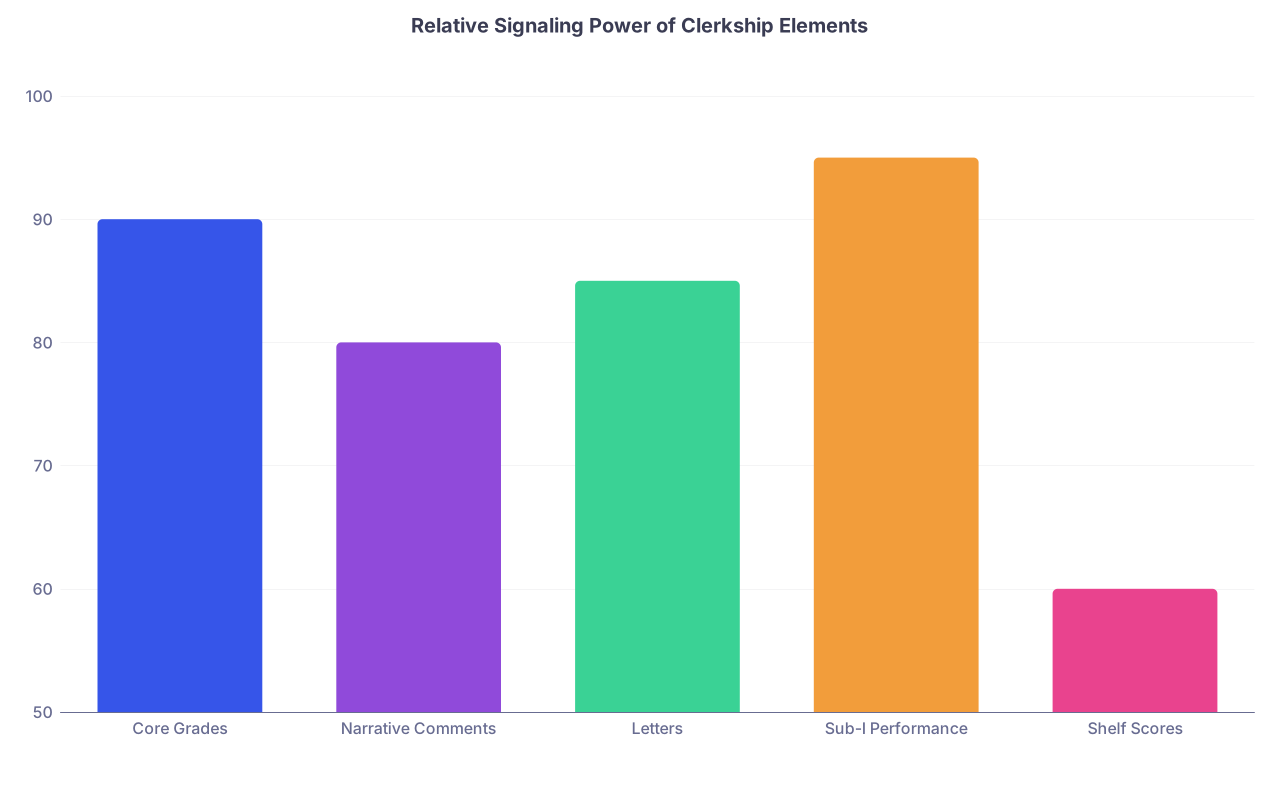
| Category | Value |
|---|---|
| Core Grades | 90 |
| Narrative Comments | 80 |
| Letters | 85 |
| Sub-I Performance | 95 |
| Shelf Scores | 60 |
Early third year (first 2 rotations)
- Focus: Learn how to be a functional team member.
- Actions:
- Aggressive feedback seeking.
- Build reliable daily routines (pre-rounding, notes, follow-ups).
- Start minimal but consistent daily UWorld.
Middle third year (rotations 3–4)
- Focus: Convert from “pleasant” to “high performer.”
- Actions:
- Improve efficiency and independence on wards.
- Identify 1–2 potential letter writers and invest deeply in those relationships.
- Start formal Step 2 CK plan, anchored in rotation topics.
Late third year (rotations 5–6 + early 4th year)
- Focus: Lock in your specialty signal.
- Actions:
- Excel on rotations related to your target specialty.
- Schedule and dominate home sub-I.
- Do 1–2 aways where strong performance could lead directly to an interview.
Done right, your file will now say, very clearly, to any program director:
- “This student consistently performed at the top of their class clinically.”
- “Multiple attendings and residents would happily work with them again.”
- “They improved quickly when challenged and functioned like an intern on sub-I.”
- “Their Step 2 CK score confirms the clinical performance.”
That composite is far more powerful than a single Step 1 number ever was.
10. One-Page Clerkship Action Plan You Can Start Today
You want something you can actually implement, not just think about. Here is a simple one-page plan.
A. Before clerkships start
Write these down:
My 3 core signals:
My tentative specialty interest(s):
My non-negotiable constraint(s):
Rotations where I want to be “letter-level strong”:
B. For every new rotation
Day 1–2 checklist:
- Ask expectations: “What did your best students do?”
- Clarify preferred presentation and note style.
- Tell your senior your goals for the rotation.
- Decide who you might want as a potential letter writer if things go well.
Week 2–3 checklist:
- Ask for “2 strengths, 2 changes” feedback from at least one evaluator.
- Adjust behavior visibly and quickly.
- Start 30-minute daily UWorld + quick reading tied to your patients.
Final week checklist:
- Ask for summative feedback: “Have I met your expectations for this level?”
- If appropriate, request a letter from 1 person you worked closely with.
- Write down 2–3 patient stories from this rotation you can reference in personal statements or interviews.
If you actually do this on every rotation, you will not be the student wondering “Did Step 1 pass/fail ruin my chances?” You will be the student programs fight over because your file radiates one message:
“We know exactly what we are getting. And it is good.”