
What makes a program director roll their eyes and say, “Yep, another post–Step 1 pass/fail CV”?
You and your classmates are in a strange transition era. Step 1 is pass/fail, but the culture and selection machinery of residency have not caught up. That mismatch is causing a very predictable problem: students are overcorrecting. Trying so hard to “replace” Step 1 that your CV becomes bloated, distorted, and frankly, annoying to read.
I have seen PDs scroll through ERAS saying the same phrases over and over:
- “This is not a CV, it is a brag scrapbook.”
- “Everyone is ‘President’ of something now. Sure.”
- “If everything is a priority, nothing is.”
You do not want to be in that pile.
Let’s walk through the most common “pass/fail era” CV mistakes your cohort is making—and how to avoid looking like you are gaming the system instead of growing as a future resident.
1. Turning Your CV into a Step 1 Replacement Frankenstein
The worst mistake in this era: treating your CV as a one-to-one replacement for a 3‑digit Step 1 score.
You cannot “build” a 250 out of scattered line items. PDs know that. When they see an applicant obviously trying to brute-force this, the reaction is not, “Wow, so impressive.” It is, “Wow, they are compensating.”
Here is what that overcorrection looks like:
- 30+ “activities,” most of them trivial or overlapping.
- Every committee meeting listed as “leadership.”
- Every case report framed as “major research output.”
- “Productivity” clearly valued over depth and continuity.
What PDs actually think when they see this:
- “This person did not have a guiding north star. They just collected lines.”
- “How much of this is real vs inflated?”
- “Are they going to bring this same box-checking mentality to residency instead of actual patient care?”
You are trying to send the message: “I am a strong candidate despite pass/fail Step 1.”
You are actually sending: “I am terrified of being average and I will do anything to look special.”
Avoid this mistake by:
- Picking 2–3 genuine pillars: research, teaching, leadership, service, quality improvement. Not all of them.
- Showing continuity (2–3 years in one area) instead of 15 disconnected one-offs.
- Cutting dead weight. If you cannot explain why it matters in 1–2 sentences, do not list it.
2. Inflating Weak Experiences to Look “Impressive”
Pass/fail Step 1 has made students hypersensitive to “optics.” That leads straight to experience inflation.
You know exactly what I mean:
- A one-time health fair becomes “Director, Community Health Initiative.”
- Co-writing one IRB leads to “Primary researcher on multiple clinical trials.”
- Shadowing morphs into “Clinical experience” with vague, padded descriptions.
PDs are not stupid. They read thousands of applications per cycle. They recognize CV inflation from three words into a bullet point. And it is one of the fastest ways to lose their trust.
The subtle errors:
- Using “led,” “directed,” “managed,” when you were a helper, not a leader.
- Listing yourself as “author” on a project that is nowhere close to submission.
- Calling something “ongoing research” that has already died in the group chat.
- Vague outcomes: “This work will improve patient care.” How? Where? For whom?
One PD I know in IM at a mid-tier academic program said it bluntly:
“If they exaggerate their role in a student interest group, why should I trust them about anything else?”
How to avoid looking dishonest:
- Describe your actual role, not the fanciest possible version. “Team member,” “contributor,” “data abstractor” are perfectly respectable.
- Tie your bullet to a concrete outcome: number of patients, number of learners, status of the manuscript, conference name, etc.
- If an abstract is “submitted,” label it as “submitted,” not “accepted.” If it is “planned,” usually do not list it at all.
- If your title sounds grander than your responsibilities, fix the wording in your description so the reality is clear.
Overcorrection trap: thinking PDs want maximal gloss.
Reality: PDs want honest, coherent, and credible.
3. Overstacking Research Because “Scores Are Gone Now”
There is a widespread myth in the pass/fail era: “Scores are gone; research is the new Step 1.”
Wrong. For some competitive specialties, research has always mattered. Now it is just more visible as a differentiator. But you can absolutely sabotage yourself by trying to look like a mini-PhD when that is not who you are.
The common errors:
- Joining 6–8 projects at once, contributing almost nothing meaningful to any of them.
- Listing 10 “in progress” items with zero accepted abstracts or publications.
- Touting “research productivity” while your role was email-checking and data entry.
PDs now know that many med students saw pass/fail and sprinted into low-yield, poorly guided “research.” They are actively looking for:
- Depth over volume
- Clear role over fancy topic
- Finished work over speculative projects
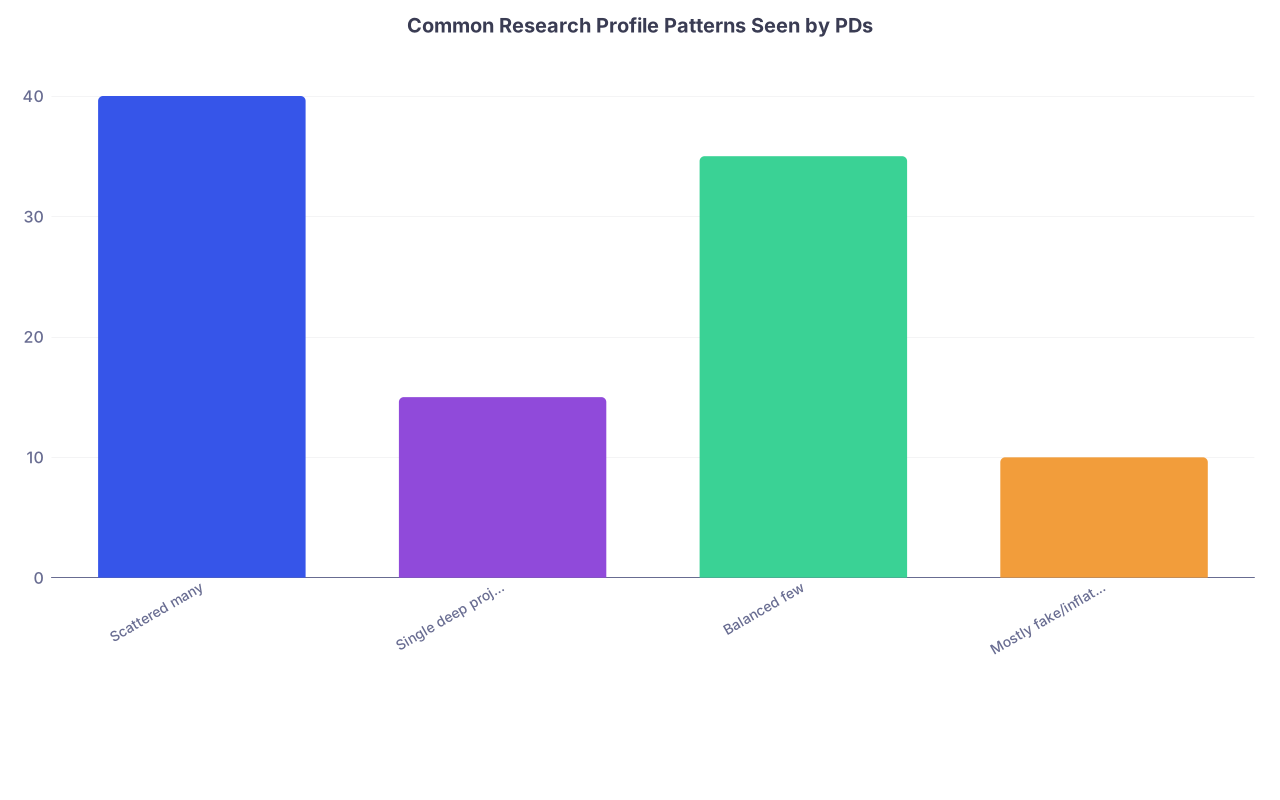
| Category | Value |
|---|---|
| Scattered many | 40 |
| Single deep project | 15 |
| Balanced few | 35 |
| Mostly fake/inflated | 10 |
The pattern above is not official data, but it mirrors what faculty complain about: lots of scattered “participation,” not much completed scholarship.
How to avoid the research overcorrection:
- Aim for 1–3 solid projects with clear, definable outcomes (poster, abstract, publication, protocol, clear QI change).
- Put your strongest 3–5 outputs at the top of your research section; weaker or minor involvements can be summarized or left out.
- Do not join projects where no one can tell you who owns the manuscript, who will mentor you, or what the realistic timeline is.
- If you are not pursuing a research-heavy specialty (derm, rad onc, neurosurg, etc.), stop acting like you need a PubMed page that rivals a fellow.
The mistake is not doing research. The mistake is doing research performatively, then plastering it all over your CV in a way that screams anxiety.
4. Overstuffing “Leadership” and “Service” to Look Holistic
With Step 1 pass/fail, schools and advisors started pushing the “holistic” narrative even harder. Fine. Holistic review is real. But your cohort is turning that into a bloated leadership and service section that PDs simply do not buy.
Here is the pattern PDs recognize instantly:
- 5–7 “leadership” roles that all started the same year.
- Short, 3–6 month “presidencies” of tiny groups.
- Random new initiatives every semester that never went anywhere.
This is not leadership. It is title collecting.
Similarly, your service section can become a graveyard of one-off events:
- “Volunteer, blood pressure screening event.” 1 Saturday.
- “Participant, health fair.” Walked around and handed out flyers.
- “Member, service club.” Attended two Zoom meetings.
Do PDs value leadership and service? Yes.
Do they have time to play detective to figure out what you actually did? No.
What impresses them more:
- 2–3 years with a free clinic, with progressively more responsibility.
- A single interest group where you clearly built or improved something.
- A specific population you stuck with (refugee clinic, addiction recovery, homeless shelter) instead of dabbling everywhere.
| Pattern | Red Flag Example | Strong Signal Example |
|---|---|---|
| Number of positions | 6 new roles in MS2 alone | 1–2 roles per year, sustained |
| Role description | “Led initiatives to improve patient care” | “Coordinated 6 events, 120 attendees total” |
| Time commitment | 3 months per role | 1–2 years in same organization |
| Outcome clarity | Vague “impact” language | Specific metrics or changes implemented |
| Alignment with specialty | Totally random to chosen specialty | Logical fit with specialty interests |
If your leadership and service sections feel like a résumé for student government and not medicine, you have overcorrected.
5. Turning Your CV into a Word Salad of Buzzwords
Another very visible pass/fail-era problem: everyone is trying to sound like a polished health-policy-research-advocacy-education guru. On paper.
You know the buzzwords:
- “Health equity”
- “Interdisciplinary collaboration”
- “Systems-based practice”
- “Advocacy”
- “Innovation”
- “Quality improvement”
- “Patient-centered care”
None of those are bad. The problem is when they appear everywhere, without substance.
Example of what PDs hate reading:
- “Led a health equity initiative improving access for underserved populations by leveraging interdisciplinary collaboration to promote systems-based practice.”
What did you actually do? No idea.
You are not being evaluated on your ability to write grant application fluff. You are being evaluated on:
- Did you show up?
- Did you take real responsibility?
- Did something change because you were there?
Fix this with ruthless clarity:
Bad: “Advocated for health equity in vulnerable populations.”
Better: “Coordinated transportation vouchers for 25 low-income clinic patients, reducing no-show rate from 40% to 20% over 6 months.”
Bad: “Participated in interdisciplinary QI initiative.”
Better: “Collected post-op pain scores on 80 surgical patients to evaluate effect of new order set; findings presented at department QI meeting.”
You do not need to sound like a policy brief. You need to sound like a person who does things, finishes them, and can describe them simply.
6. Misusing “Honors,” “Awards,” and “Distinctions” to Compensate
Step 1 going pass/fail pushed students to obsess more over other quantifiable metrics—honors, AOA, GHHS, clerkship grades. Naturally, some of you are trying to pad those sections too.
Common pass/fail era mistakes:
- Listing routine scholarships (e.g., basic institutional financial aid) as “merit awards.”
- Creating your own “award” language for small internal recognitions.
- Hiding lack of honors with vague headings like “Academic achievements” filled with generic bullets.
PDs already know how honors work at your school. They have spreadsheets, historical patterns, and the AAMC documents. You are not breaking new ground by overlabelling minor items.
Be cautious about:
- Overemphasizing small, internal teaching awards that no one outside your school recognizes.
- Adding “nominations” for things that are not actually competitive.
- Dumping routine dean’s list–type mentions that do not move the needle for residency.
You want your awards section to look clean, honest, and meaningful. 3–6 strong entries beat 15 lines of fluff.
7. Obsessive Micro-detailing to “Prove” Work Ethic
Another predictable overcorrection: if you cannot show a Step 1 score, you try to show “how hard you work” directly on the CV.
That leads to:
- Listing hours for every activity in an absurd amount of detail.
- Multiple lines describing tiny tasks: “Answered emails,” “Prepared slides,” “Scheduled meetings.”
- Overly granular experiences: splitting one role into 4 separate entries to inflate volume.
This is noise. PDs do not have time for noise.
They are not calculating “total hours worked” like you are applying for a W-2 job. They are looking for patterns:
- Did you stick with things?
- Did you grow in responsibility?
- Did you show initiative somewhere beyond just “showing up”?
If they see 25 micro-inflated items, the message is not “Look at my work ethic.” It is, “I do not understand what matters.”
Better approach:
- Group similar experiences under one entry (e.g., “Free clinic volunteer – 2019–2022” instead of 6 separate “free clinic” lines).
- Focus on outcomes and responsibilities, not every task.
- Accept that not all your hustle needs to be written down; some of it simply makes you a better, more prepared human.
8. ERAS-Specific Traps in the Pass/Fail Era
Pass/fail Step 1 has made students treat ERAS like a personal website they must “maximize.” That mindset leads to some predictable, program-director–infuriating behaviors.
Common ERAS overcorrections:
- Filling every activity slot “because empty space looks bad.” No. Empty space looks honest.
- Marking almost every activity as “most meaningful.” It stops meaning anything.
- Copy-pasting identical paragraphs across multiple entries.
- Using the experiences section as a second personal statement.

| Step | Description |
|---|---|
| Step 1 | New ERAS activity |
| Step 2 | Do not list it |
| Step 3 | Summarize or combine |
| Step 4 | Include with clear, concrete description |
| Step 5 | Is it truly substantial? |
| Step 6 | Does it add something unique? |
If PDs feel like you are using ERAS to “perform” rather than to inform, they stop reading carefully. That is the last thing you want.
Rules of thumb for ERAS in the pass/fail era:
- It is fine to leave slots empty. PDs do not have a magic “slot expectation” number.
- Limit “most meaningful” tags to the experiences you could speak about for 10 minutes without padding.
- Do not repeat the same story in multiple sections (research, leadership, personal statement, “most meaningful” all on the same clinic).
- Remember: clarity beats volume. Always.
9. Misreading What Actually Replaced Step 1
Here is the uncomfortable truth most students do not want to hear: Step 1 going pass/fail did not create a vacuum that your CV now fills.
What has quietly filled that space, in most programs:
- Step 2 CK
- Clinical performance (especially shelf exams and narrative comments)
- The perceived reliability of your school’s grading system
- Letters of recommendation that say something concrete
Your CV is still important. But it is background, not the lead actor. Overcorrecting by trying to make your CV do the work of your knowledge, professionalism, and bedside manner is a losing strategy.
You avoid this big-picture mistake by accepting a more boring reality:
- You still need to know medicine. Step 2 matters more than your ninth poster.
- You still need to perform on the wards. Comments like “pleasant but unreliable” will kill you faster than a thin research section.
- You still need to be teachable. PDs smell arrogance and insecurity through your CV fluff.
Your CV should support the story that your evaluations and letters are already telling. Not fight with them.
FAQs
1. Should I list every research project I have joined, even if it is early-stage or stalled?
No. That is exactly the kind of overcorrection PDs expect from the pass/fail Step 1 era. List projects where you had a clear role and there is a realistic, defined outcome: abstract, poster, manuscript, implemented QI change. If the project has been idle for a year, or your role was negligible, either summarize it in one combined line or leave it off.
2. Is it bad to have “only” a few activities on my CV if they are long-term and meaningful?
It is not bad. It is actually preferable. Depth, continuity, and increasing responsibility are far more convincing than a giant wall of shallow entries. Three years at the same clinic, with a leadership role added in your last year, will impress more programs than eight short-lived titles that mean very little.
3. How many “in progress” publications or abstracts is too many?
If more than half your research entries are “in progress,” you are sending a signal that you overcommit and under-complete. One or two well-described “in progress” items with a realistic status (e.g., “manuscript drafting under mentor supervision”) is reasonable. A dozen vague “in preparation” bullets looks like you are trying to manufacture productivity that is not there.
4. Should I try to show exact hours for every activity to prove my work ethic?
You can give approximate time frames when the system asks, but obsessively detailing hours is a trap. PDs are not computing hourly totals. They are scanning quickly for genuine commitment and outcomes. You do not earn points for “300 hours of committee work” if they cannot tell what changed because of your involvement.
5. How do I know if an activity is “CV-worthy” or just padding?
Ask yourself three blunt questions: Did I show up consistently? Did I hold real responsibility or make a specific contribution? Did something concrete come out of it (a change, an event, a product, a measurable impact)? If the answer to all three is “not really,” it is probably padding. And PDs have seen enough pass/fail-era padding to recognize it instantly.
Key points to walk away with:
- Do not turn your CV into a Step 1 replacement project. Overstuffing, inflating, and buzzword-padding are all transparent.
- Depth, honesty, and clear outcomes beat volume, titles, and vagueness every single time.
- Your CV is support, not salvation. Let it reinforce your real strengths instead of trying to compensate for everything at once.