
The idea that making Step 1 pass/fail “leveled the playing field” is a comforting myth. Programs just replaced one sorting weapon with three others—and they did it fast.
I sat in on those meetings when the change was announced. Chairs, PDs, APDs, coordinators. Nobody said, “Great, we’ll start reading every application holistically.” What they actually said was stuff like:
- “We need a new way to screen 4,000 ERAS files with the same number of staff.”
- “We’re not opening every application. That’s fantasy.”
- “Fine, they took Step 1 away. We’ll lean on Step 2 and school name.”
Let me walk you through how pass/fail Step 1 is really being used—and what replaced your three-digit safety blanket.
Step 1 Pass/Fail Didn’t Remove a Filter. It Removed a Shield.
Before pass/fail, a 260 Step 1 from an average school could drag you into serious consideration at places that otherwise wouldn’t blink at your name. Now? That crutch is gone.
Here’s the part nobody prints in FAQ pages: a PASS on Step 1 is now treated as baseline hygiene. Like a normal creatinine. Nobody celebrates it. They just move on.
Where Step 1 used to be a ranked variable (“Is this 260 better than that 245?”), now it’s a gate:
- Fail? You go in a separate bucket, if you’re considered at all.
- Late pass? You trigger concern about timeline and test-taking ability.
- Early pass with strong Step 2? Nobody cares beyond, “Ok, no red flag.”
So what took its place in the hierarchy? Program directors didn’t guess. They adapted structurally.
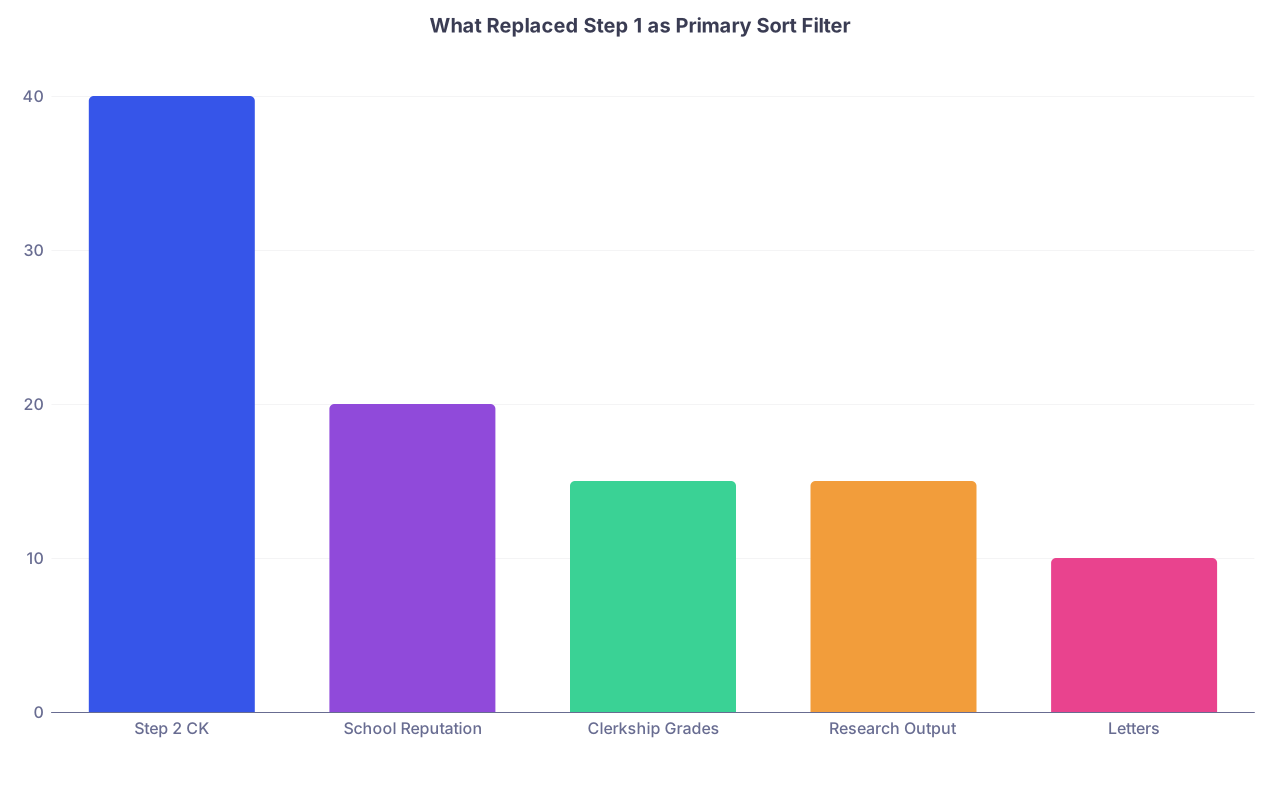
| Category | Value |
|---|---|
| Step 2 CK | 40 |
| School Reputation | 20 |
| Clerkship Grades | 15 |
| Research Output | 15 |
| Letters | 10 |
Those percentages aren’t from a glossy NRMP report. They’re roughly how mental weight actually gets assigned in the early sort at many mid-to-high-tier programs.
Step 1 pass/fail just forced PDs to slide the weight onto Step 2 CK, school prestige, and your clinical record. The game didn’t get nicer. It just got blurrier.
The First Cut: How Your File Gets Treated the Second It Hits ERAS
Let’s be blunt. At many academic programs, nobody “holistically reviews” 4,000 applications. That’s a marketing term. What actually happens looks more like a triage algorithm with occasional overrides.
Here’s the usual behind-the-scenes workflow:
- Coordinator pulls the full app pool.
- They apply hard filters: must have Step 1 status, often Step 2 CK score, sometimes graduation year cutoffs.
- Remaining pile gets sorted by Step 2 CK, school, and sometimes home/away rotation status.
- Only then do PDs and faculty actually click into individual files.
This is why the Step 1 status still matters, even without a score.
“Passed Step 1, Step 2 CK available” by September
You’re considered “clean” from a timing standpoint. No one dwells on it.“Passed Step 1, no Step 2 CK yet” by mid-October
Risk flag, especially in competitive specialties. I’ve literally heard:
“If they’re aiming at us and still don’t have Step 2, that’s either poor planning or they’re hiding a bad score.”“Failed Step 1 once, then passed”
This gets you parked in a review-later or “maybe” bucket at many places—unless you have a strong counterweight (great Step 2, home rotation, known faculty advocate).

| Step | Description |
|---|---|
| Step 1 | ERAS Submission |
| Step 2 | Auto Reject at Many Programs |
| Step 3 | Flagged for Extra Review |
| Step 4 | Sort by Step 2 CK |
| Step 5 | Hold Until Score Arrives |
| Step 6 | Faculty or PD Review Shortlist |
| Step 7 | Step 1 Status |
| Step 8 | Step 2 CK Available |
| Step 9 | Specialty Competitiveness |
Nobody is sitting there saying, “They passed Step 1, that shows resilience and basic science mastery.” That kind of line lives on med school advising blogs, not in PD offices.
How PDs Actually Think About a “Pass” on Step 1
Here’s the insider truth: a pass on Step 1 is neutral. It neither helps nor hurts, unless there’s context around it.
The nuances PDs really look at:
1. Timing
You’d be surprised how many PDs know exactly when their own med school’s students tend to take Step 1.
If your school usually pushes Step 1 at the end of M2 and you barely squeak by in late M3, they notice. They might not have your exact test date, but they can infer from when your Step 2 appears and from your timeline.
I’ve heard comments like:
- “Our students take it in February. Why is this one not until May?”
- “If they needed extra time just to pass a now-pass/fail exam, how are they going to handle boards in residency?”
Is that always fair? No. But it’s what’s actually said.
2. First-time vs repeat
ERAS flags multiple attempts. That flag matters.
One clean pass? Nobody cares.
One fail then pass? Most competitive programs will move you to a lower-priority bucket unless:
- You have a 250+ Step 2 that screams “fixed it.”
- You did a rotation there and impressed everyone.
- A trusted faculty calls or emails and says, “Do not overlook this person. The fail had context.”
Two fails? At a lot of university programs, that’s functionally a silent screen-out unless you have deep connection or an extreme redemption arc.
3. School context
Some PDs absolutely adjust expectations based on school.
Blunt version:
- From Harvard/Stanford/JHU/USC Keck and the like: a pass is assumed. Anything less than a clean pass is a major eyebrow raise.
- From a newer or lower-resourced school: a pass is fine, Step 2 becomes the main academic signal.
Nobody writes this policy down. But I’ve watched PDs flip through lists and say, “From there, I just want them to have passed both steps and be a normal human on rotations.”
The New King: How Step 2 CK Became Your De Facto Step 1
If you want to know where most of the discarded Step 1 weight went, it landed on Step 2 CK. Hard.
Look at how PDs talk now in rank meetings:
- Old way: “Their Step 1 is a little low for us.”
- New way: “Step 2 only 228. I’m not comfortable with that for our boards pass rate.”
I’ve literally watched one PD build an Excel sheet with color-coding:
- Green: Step 2 CK > 250
- Yellow: 235–249
- Orange: 220–234
- Red: < 220
Then sort the whole applicant pool by color before looking at anything else.
| Tier Label | Step 2 CK Range | How PDs Commonly Treat It |
|---|---|---|
| Green | 250+ | Safe for any interview, bolsters weaker areas |
| Yellow | 235–249 | Solid, rarely a problem for most specialties |
| Orange | 220–234 | Borderline for competitive or academic programs |
| Red | < 220 | Needs strong context or connections to get looked at |
None of that is in the brochure. But it’s how decisions actually get made when everyone’s trying to protect their “resident board pass rate” which, by the way, is a huge political metric inside departments.
So when advisors tell you “Step 1 is pass/fail now, you can relax a bit,” that’s half-true. What they often fail to add is: “If you relax and then stumble on Step 2, you’ve used up your margin at the exact wrong time.”
Where Step 1 Still Hurts You: Red Flags and Edge Cases
Even without a score, Step 1 can still sink you in subtle ways.
1. Failure patterns
A single Step 1 fail, Step 2 later strong: fixable.
But combine any of these and your file turns into a “risk” case:
- Step 1 fail + mediocre Step 2
- Step 1 pass, Step 2 borderline low, and weak clinical comments (“needs supervision,” “below level of training”)
- Step 1 delay + any hint of professionalism issues (LOA, “personal reasons” gap with vague explanation)
Programs are terrified of onboarding residents who will:
- Fail Step 3 multiple times
- Struggle with in-service exams
- Eat faculty time with remediation and jeopardize accreditation metrics
So they use Step 1 history as one of several early warning lights.
2. Late testing and delayed scores
If your Step 1 or Step 2 appears unusually late and there’s no narrative explaining why, people assume the worst unless proven otherwise. That’s the reality.
If you had illness, family crisis, visa issues—you need that explained somewhere. Not a sob story. Just a clean, factual line in your MSPE or personal statement. When there’s no explanation, they fill in the gap themselves.
3. Certain specialties still care more than they admit
Derm, ortho, plastics, ENT, neurosurgery, radiation oncology—these fields live and die on “objective” metrics because they’re drowning in super-strong applicants.
Officially, they say they treat Step 1 pass/fail as a threshold only. Unofficially?
- Anyone with a fail is almost automatically out unless they’re an internal known quantity.
- Even a clean pass doesn’t help if your Step 2 is not elite.
- They lean harder on research productivity, school name, away rotations, and whispers from faculty.
Step 1 still functions as a silent gatekeeper in those specialties. You just don’t see the gate.
How ERAS Filters and Spreadsheets Are Quietly Deciding Your Fate
Here’s the dirtiest little secret: a lot of your fate is determined before a human ever reads your name.
Programs use:
- ERAS filters (US vs IMG, Step status, grad year, visa need, etc.)
- Spreadsheets parameterized by Step 2 CK and school
- Internal tags for “home student,” “rotated here,” “faculty referral”
Step 1 shows up in this ecosystem only as:
- “Does this person have a clean pass and by when?”
- “Is there a prior fail that needs justification if we advance them?”
Coordinators will sometimes have three piles:
- Auto-advance – meets all basic criteria, no red flags.
- Conditional review – something “off” (older grad, visa, Step 1 fail).
- Filtered out – missing prerequisites, multiple fails, too old graduation date.
That second pile is where Step 1 problems live. And PDs only have so much energy for “maybe” files. Especially when there are 600 clean ones still unread.
What You Should Actually Do About All This
You cannot change the pass/fail policy. You can adjust how you play the board exam and application game in this new reality.
Some blunt, practical guidance:
1. Treat Step 1 like a pass/fail landmine, not a formality
Your only job with Step 1 is:
- Pass.
- Pass on time.
- Don’t scare anyone.
If you’re not a naturally strong test-taker, you don’t get the luxury of coasting “because it’s just pass/fail now.” A fail on a pass/fail exam looks worse psychologically than a 208 did in the old world.
2. Front-load Step 2 CK preparation
Smart students are doing this:
- Using Step 1 prep to build deep foundations, not just to scrape a pass.
- Keeping momentum rolling into Step 2, taking it earlier in M4 or late M3.
- Targeting a strong Step 2 because that’s now the scoreboard PDs actually sort by.
If you wait until late fall of application year to take Step 2 CK, a lot of programs will just not bother waiting for you.
3. If you fail Step 1, manage the narrative ruthlessly
If you’re already in the “Step 1 fail” camp, here’s the play:
- Crush Step 2 CK. That’s not optional anymore.
- Get concrete, glowing clinical letters that say “excellent fund of knowledge” and “top of the class.”
- Make sure your MSPE or personal statement gives a brief, adult explanation: what happened, what changed, how your later performance proves it’s resolved.
I’ve watched applicants with a Step 1 fail but 250+ Step 2 and strong rotations match solidly into IM, peds, even anesthesia. It’s doable. But not with vague hand-waving.
4. Know which specialties actually give you a fair shot
If you’ve got Step 1 baggage, you’re fighting uphill in the ultra-competitive fields. That’s just honest.
Internal medicine, peds, psych, FM, neurology, pathology—they’re more flexible. If your Step 2 is strong and everything else looks good, a single Step 1 stumble is not a career death sentence.
The mistake I see? Students with a Step 1 fail still swinging for derm/ortho without home support or a monster Step 2 and then acting surprised when 80 applications yield zero interviews. That’s not bias. That’s predictable.
Your Real Leverage in the Pass/Fail Era
Pass/fail Step 1 removed one clear variable and increased the value of everything clinical and contextual:
- Your clerkship performance.
- Your Step 2 CK.
- Your letters.
- Your rotations and how much people want to go to bat for you.
You cannot impress anyone with “I passed Step 1.” The bar moved. PDs are now asking:
- “Can this person pass boards on the first try?”
- “Are they going to be safe and reliable in July?”
- “Is there anything ugly hiding in their record?”
Pass/fail Step 1 is basically a screen for “no obvious disaster.” That’s it. The rest of your application carries the weight.