
The way most applicants request letters of recommendation in the pass–fail Step 1 era is lazy and ineffective. You are leaving signal on the table that could have compensated for your missing score.
You cannot fix Step 1. You can weaponize your letters.
This is not about “asking nicely” or “reminding your attendings.” It is about engineering LORs so they replace what Step 1 used to tell programs:
- How hard you work
- How you think
- How reliable you are under pressure
If you do not explicitly design your LOR requests to highlight those things, you are gambling with your application.
Let me walk you through how to fix that.
1. Understand What Missing Step 1 Numbers Took Away
Before Step 1 went pass–fail, programs skimmed one brutal line:
- “248 – probably fine.”
- “221 – borderline for derm here.”
- “199 – auto-screened.”
Crude, yes. But efficient.
Now that line is gone. Programs still want that information. They just dig for it in different places. Primarily:
- Step 2 CK
- Class rank / AOA
- Clerkship narratives
- Letters of recommendation
If your Step 2 is not a clear home run, or your school does not rank, or your clerkship comments are bland, your LORs become critical. They must answer three questions Step 1 used to suggest:
- Can this person handle the cognitive load of residency?
- Will they grind when tired, or vanish?
- Are they safe and dependable around patients?
A generic “pleasant to work with, solid knowledge base” letter does none of that. You have to aim your writers at these targets.
2. Choose Letter Writers Strategically (Not Politely)
Stop asking for letters just from whoever “seems nice” or “is famous.” That is not strategy. That is vibes.
You want letter writers who can substitute for your missing numeric signal in specific ways.
The 4 Types of Writers You Actually Need
You cannot always get all four, but this is the blueprint:
Clinical supervisor who saw you grind
- Examples: IM ward attending, surgery chief, sub-I attending.
- Role: Replace “work ethic” signal that Step 1 grind used to show.
- What they can credibly say: number of patients you carried, notes you wrote, procedures you did, hours you stayed.
Someone who can vouch for your cognitive rigor
- Examples: research PI, academic mentor, pre-clinical course director, QI project lead.
- Role: Replace “study stamina and reasoning” that Step 1 suggested.
- What they can say: complex projects, independent problem-solving, data analysis, self-directed learning.
Specialty-specific champion
- Examples: PD or APD in your target specialty, high-volume attending, fellowship director.
- Role: Tell their colleagues, “I work with tons of applicants. This one will not embarrass you.”
- What they can say: compare you to prior successful residents, comment on fit for the field.
Character and reliability validator
- Examples: longitudinal clinic preceptor, continuity mentor, primary care attending.
- Role: Replace “trust factor” programs previously half-inferred from Step 1 discipline.
- What they can say: patient trust, follow-through, owning mistakes, professionalism issues you handled well.
| Scenario | Priority Writers |
|---|---|
| Strong Step 2, average clinical evals | Clinical supervisor, specialty champion |
| Average Step 2, strong research | Research PI, clinical supervisor |
| No rank and pass–fail pre-clinical | Clinical supervisor, character validator |
| Switching specialties late | New specialty champion, prior supervisor |
If you are weaker academically (borderline Step 2, mid-class rank), you double down on people who saw you:
- Show up early
- Pre-round thoroughly
- Handle a sick patient without falling apart
Those letters can soften concern about your raw test-taking horsepower.
3. Stop Sending Vague Requests – Script The Letter You Need
Most students send emails like:
“Could you please write me a strong letter of recommendation?”
That is not a request. That is outsourcing your strategy to a busy attending who will write whatever generic thing is easiest.
You are going to send targeted, structured requests that clearly tell them:
- Why you are asking them specifically
- What aspects of you matter most in the pass–fail Step 1 era
- What concrete behaviors they might mention
No, you are not writing the letter for them. You are giving them a blueprint.
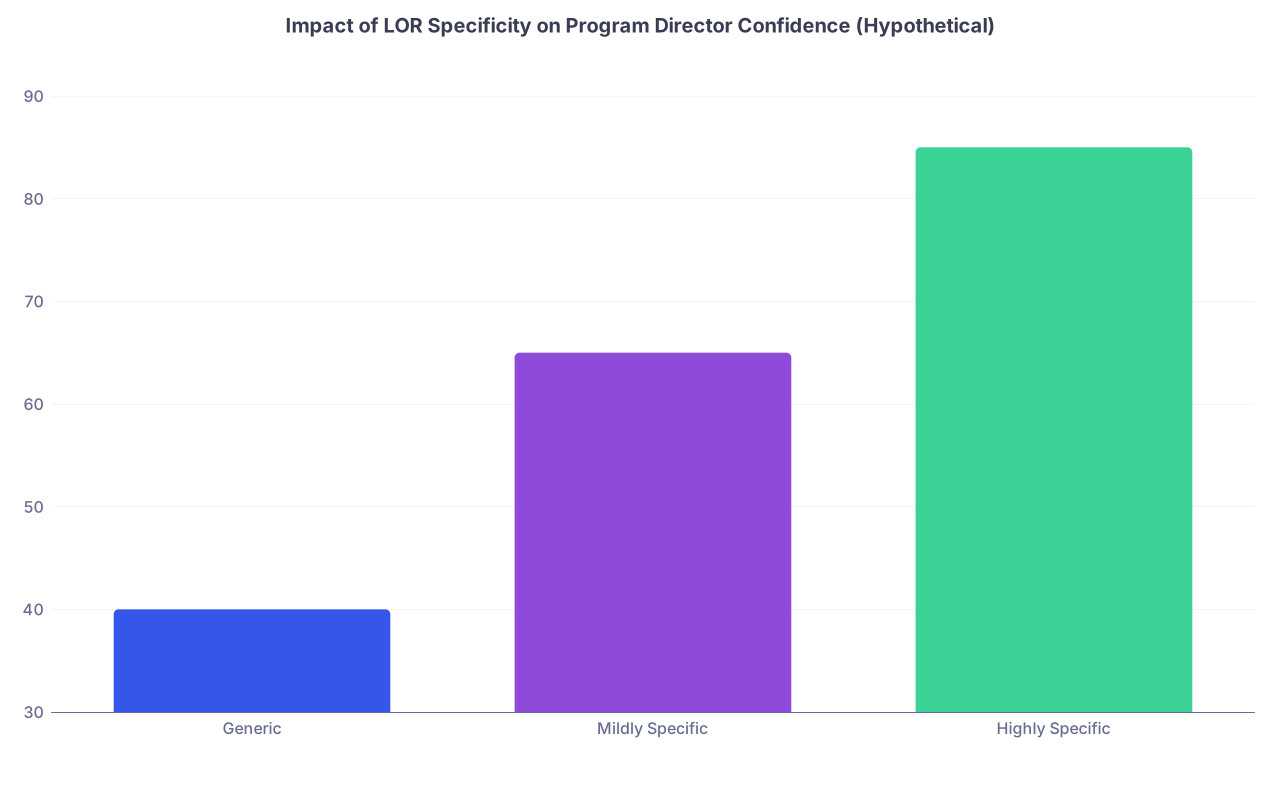
| Category | Value |
|---|---|
| Generic | 40 |
| Mildly Specific | 65 |
| Highly Specific | 85 |
Core Components Of A High-Yield LOR Request
Your email or meeting request should contain:
Direct ask + opt-out
- Respectful but clear, gives them a way to decline if they cannot be strong.
Short reminder of context
- When you worked with them, setting, any notable projects or patients.
Diagnosed “gap” that letters should address
- Missing Step 1 score, average Step 2, no class rank, etc.
- Not whining. Just factual: “Programs have less numerical data, so letters are carrying more weight for…”
Three to five specific behaviors to highlight
- Concrete behaviors, not adjectives.
- Example: “Led family meetings,” “Prepped detailed handoffs,” “Reviewed primary literature for unusual cases.”
Packet of supporting material
- CV
- Personal statement draft or specialty interest paragraph
- Bullet-point list of specific examples they might recall
4. Exact Email Templates You Can Adapt
Here is what this looks like in real life, not in vague advice land.
Template 1: Clinical Letter to Compensate for Missing Step 1 Score
Subject: Letter of Recommendation Request – [Your Name], [Rotation / Dates]
Dr. [Name],
I wanted to ask if you would feel comfortable writing a strong letter of recommendation for my [specialty] residency applications.
I worked with you on the [service] rotation in [month/year], where I:
- Carried [X] patients on the team
- Helped manage [brief memorable patient or situation]
- Presented at [case conference / morning report] on [topic]
In the current Step 1 pass–fail era, programs are relying heavily on clinical letters to understand how students perform on the wards. Because I do not have a numeric Step 1 score, I would be especially grateful if you could comment, where appropriate, on:
- My work ethic and reliability on busy ward days
- My clinical reasoning and ability to manage complex patients
- How I functioned under pressure and responded to feedback
To make this easier, I have attached:
- My CV
- A draft of my personal statement
- A short list of specific patients and situations from the rotation that might help jog your memory
If you do not feel you can write a strong letter, I completely understand and would appreciate your honesty.
Thank you for considering this and for everything I learned on your service.
Best regards,
[Your Name]
[School, Year]
[Contact info]
Template 2: Research Letter To Replace “Academic Rigor” Signal
Subject: Residency Letter Request – Highlighting Research and Analytical Skills
Dr. [Name],
I am applying to [specialty] residency this cycle and wanted to ask if you would be willing to write a strong letter of recommendation based on our research work together.
We worked together on the [project title] between [dates], where I:
- [Designed/analyzed] [brief description]
- Presented [poster/oral] at [conference]
- Contributed to [manuscript, abstract, database build, etc.]
In the pass–fail Step 1 era, programs have less standardized data on applicants’ test-taking and analytical abilities. Because of that, letters describing rigorous academic work have become more important. If you feel comfortable, it would help me greatly if you could comment on:
- My ability to manage complex data or protocols
- Independence, follow-through, and ability to learn new methods
- How my performance compares to other students or residents you have mentored
I have attached my CV and a brief paragraph describing my interest in [specialty] to give additional context.
If for any reason you do not feel you can write a strong letter, I completely understand and appreciate your candor.
Thank you again for your mentorship and for considering this.
Best,
[Your Name]
Use these as scaffolding. Edit so it sounds like you, not like you fed it to a machine ten minutes ago.
5. What To Put In The “Helpful Bullet List”
You want to make it stupidly easy for them to write a sharp letter in 15–20 minutes. That means sending bullets that look like this, not a generic CV reprint.
Example Bullet List For A Medicine Attending
- On call nights, I routinely pre-rounded on my own patients and had plans ready before rounds.
- Managed the initial evaluation and plan for [patient with DKA/sepsis/GI bleed], including fluid resuscitation, insulin protocol setup, and serial reassessments.
- Took initiative to call family for updates and led at least two family meetings with your supervision.
- When my assessment was off on [specific patient], I reviewed primary literature that evening and adjusted my plan the next day based on your feedback.
- Consistently stayed late to ensure notes and orders were correct and sign-out was thorough.
These bullets are how you compensate for that missing “248” line. They show grind, judgment, and learning curve. Programs love that far more than another “pleasant and hardworking” sentence.
6. Timing And Logistics: Do Not Sabotage Yourself With Chaos
You want your writers thinking, “This student is organized and serious,” not “Why is this email at 11:59 pm the night before ERAS opens?”
When To Ask
- Ideal: 2–4 weeks after finishing the rotation or project
- Absolute latest: 6–8 weeks before ERAS submission
Ask early enough that:
- They still remember you
- They are not drowning in other letters
- You have time to course-correct if someone declines or disappears
How Many Reminders Are Acceptable?
- One reminder 2–3 weeks after initial ask if they have not replied at all
- One follow-up 2–3 weeks before the deadline if they agreed but have not uploaded
If they go completely silent, you move on. A reluctant or rushed letter is worse than having fewer letters.
Tracking System (Use Something Simple)
Do not keep this in your head. Use a small spreadsheet or note:
| Writer | Type | Date Asked | Confirmed? | Due Date | Uploaded? |
|---|---|---|---|---|---|
| Dr. Smith | Clinical | 06/01 | Yes | 09/15 | Pending |
| Dr. Lee | Research | 05/20 | Yes | 09/15 | Uploaded |
| Dr. Gomez | Specialty | 06/10 | No reply | 09/15 | N/A |
If this feels like overkill, ask yourself: would you rather spend 10 minutes now, or panic on September 14 because one “for sure” letter never appeared?
7. How To Bring Up The Step 1 Pass–Fail Issue Without Sounding Defensive
You do not need a confession monologue about your test scores in every email. But you do need to calibrate your writers to the current landscape.
Here is the clean way to do it:
“In the current Step 1 pass–fail era, programs rely more heavily on letters to understand applicants’ clinical performance and academic rigor. Because I do not have a numeric Step 1 score, letters that speak specifically to my work ethic and clinical reasoning are particularly helpful.”
Straight. Neutral. You are not asking for pity. You are telling them where to aim.
If you also have a Step 2 that is fine but not stellar, you might add:
“My Step 2 score is solid but not in the very top tier for [specialty], so detailed letters describing how I function clinically will be important context for programs.”
Be factual. No drama. Attendings who sit on selection committees know exactly what you are talking about.
8. In-Person Ask Script (For When You Have Face Time)
Do not overcomplicate this. Here is a simple, direct script you can adapt when you have them in front of you:
“Dr. [Name], I have really appreciated working with you this month. I am applying into [specialty] and wanted to ask if you would feel comfortable writing me a strong letter of recommendation. With Step 1 now pass–fail, programs are putting a lot more weight on clinical letters to understand how students perform.
If you feel you have seen enough of my work ethic and clinical reasoning to comment, I would be very grateful. And if you feel you cannot, I completely understand—I want to make sure my letters are truly strong.”
If they say yes, follow immediately with:
“Thank you. I will email you my CV, personal statement, and some bullets summarizing specific patients and situations we worked on together. Is there anything else that would make the process easier for you?”
That last line is where you signal you are not here to be spoon-fed. Attendings remember that.
9. Align Letters With Your Overall Application Story
Letters are not independent essays floating in space. They should reinforce the same core narrative as:
- Your personal statement
- Your experiences section
- Your interview answers
Especially when Step 1 is pass–fail, programs look for consistency.
Example: “Slow Burn High Performer” Narrative
Maybe you were not a test-taking machine in pre-clinicals. But now you are strong on the wards and improving fast. Your application should show:
- Personal statement: focus on growing through feedback, thriving with real patients.
- Clinical letter: concrete examples of you turning feedback into better performance within weeks.
- Research letter: comments on your persistence and ability to handle long, complex tasks.
The missing Step 1 number becomes less important if every data point screams the same story: “This person starts solid and ends up excellent when given responsibility.”
10. Common Mistakes That Quietly Cripple LOR Impact
I see these constantly. Fix them and you immediately jump above the average applicant.
Mistake 1: Asking The “Big Name” Who Barely Knows You
A department chair who spent 20 minutes with you will often write:
“[Student] was pleasant and inquisitive, and I am confident they will make an excellent resident.”
The PD reading it will shrug and move on. A mid-level attending who watched you grind for four weeks is better nine times out of ten.
Mistake 2: One-Size-Fits-All Request Email
Different writers should emphasize different things. Sending your research PI the same email you sent your ICU attending wastes potential. Tailor the 3–5 bullet points to what they actually saw.
Mistake 3: Zero Guidance On Competencies
If you do not tell them what matters in this era—workload tolerance, reasoning, reliability—they will default to adjectives. Programs do not care about adjectives. They care about behaviors.
Mistake 4: No Follow-Up Materials
“I’d be happy to write—send me your CV and a reminder of what we did together.”
If you do not send those within 24–48 hours, you have signaled that organization is not your thing. That colors how they write about you, whether they mean to or not.
11. A Simple LOR Request Workflow You Can Copy
Here is the zero-fluff checklist. Use it as your playbook.

| Step | Description |
|---|---|
| Step 1 | Identify Target Programs and Specialty |
| Step 2 | List Needed Letter Types |
| Step 3 | Select Specific Writers |
| Step 4 | Prepare CV, PS, Bullet Lists |
| Step 5 | Ask In Person When Possible |
| Step 6 | Send Follow Up Email With Materials |
| Step 7 | Track Status in Spreadsheet |
| Step 8 | Send Polite Reminders |
| Step 9 | Confirm Upload Before Deadline |
You can run this on a weekend and then spend the rest of the season not freaking out about letters.
12. Example Of Turning A Weak Signal Into A Strong LOR
Here is a real pattern I have seen.
- Student: Step 1 pass, Step 2 around median for their specialty.
- Clinical evals: “Hardworking, quiet, solid knowledge.”
- Risk: PD glances at stats and sees “average applicant, nothing special.”
They execute the strategy above:
- Choose: medicine wards attending, subspecialty attending, research PI.
- Send targeted requests emphasizing work ethic, reasoning, growth.
- Resulting letters include lines like:
- “One of the most prepared students I have had in the last five years.”
- “Handled a patient load typical of our interns by the final week.”
- “Outperformed several junior residents on our research team in terms of independence and reliability.”
Now the same stats look very different:
- “Average numbers, but multiple independent faculty saying this student already works at intern level.”
That is how you compensate for the missing score line. Not by praying. By engineering your letters.
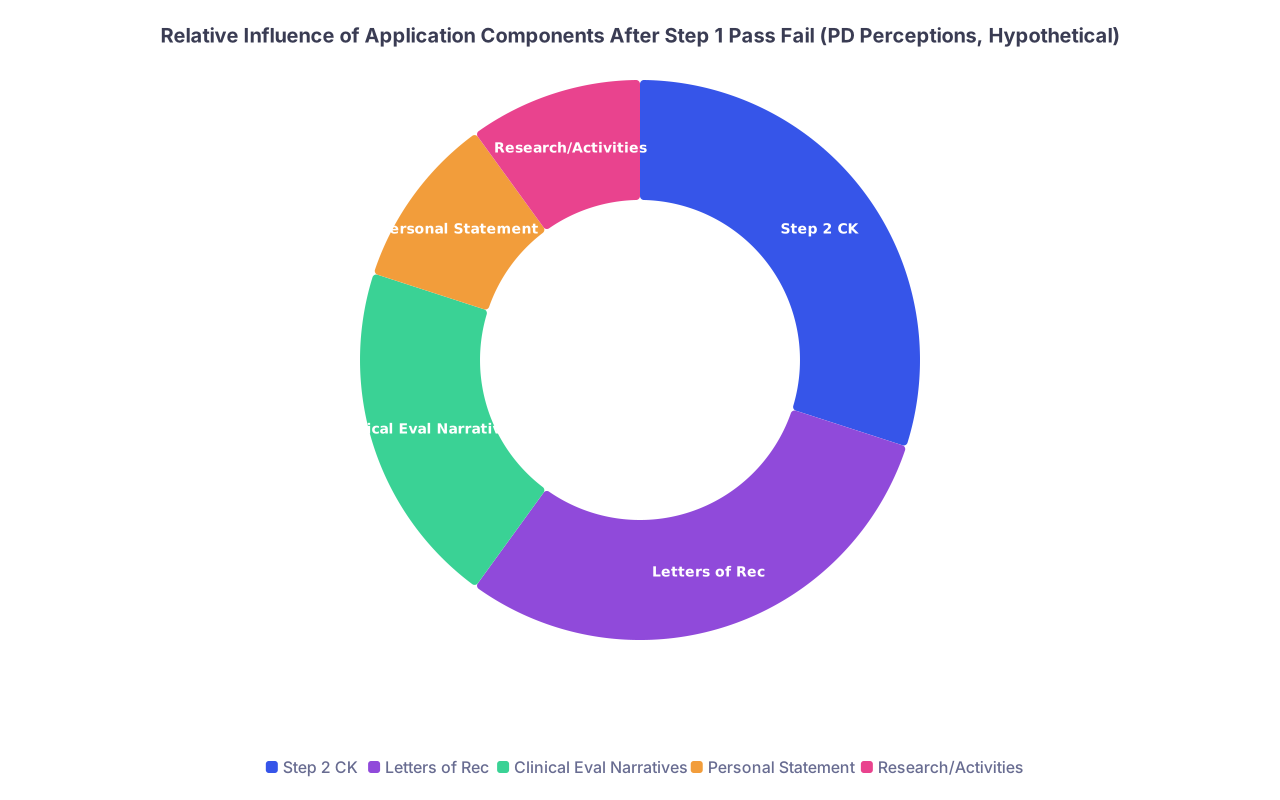
| Category | Value |
|---|---|
| Step 2 CK | 30 |
| Letters of Rec | 30 |
| Clinical Eval Narratives | 20 |
| Personal Statement | 10 |
| Research/Activities | 10 |
FAQ (Exactly 3 Questions)
1. Should I mention explicitly to my letter writers that my Step 2 score is not top tier?
Only if it is relevant and you can do it without sounding apologetic. A line like, “My Step 2 score is solid but not at the very top end for this specialty, so detailed clinical letters will be especially helpful context,” is fine. Do not send them a paragraph of anxiety. Give them a clear reason to lean into specifics about your strengths.
2. Is it ever appropriate to draft my own letter for an attending to sign?
Programs dislike ghostwritten letters, and so do most honest faculty. What you can and should do is send a bullet-point list with specific examples and accomplishments. That gives them raw material while keeping the voice and judgment theirs. If someone explicitly asks you to draft the whole letter, you can offer instead to expand your bullet list into a more detailed outline.
3. How many letters do I actually need in this era to be competitive?
The typical range is 3–4 letters for most specialties, with some (like EM) using standardized SLOEs on top. Quality beats quantity. Three sharp, specific, behavior-rich letters are more valuable than five generic ones. Aim for at least: one strong clinical letter in the specialty (or closest match), one additional clinical or longitudinal mentor letter, and one research or academic letter that speaks to your cognitive rigor.