
It is March. You just got your Step 1 result: “Pass.” No three‑digit score. No dopamine hit from a number you can flex. Just a binary line on a PDF.
Meanwhile:
- Classmates are talking about 250+ Step 2 goals.
- Your advisor says, “Step 2 is the new Step 1 now.”
- Reddit threads make it sound like your entire career hinges on the next exam.
You feel two things at once:
- Relief that Step 1 is over.
- A very real panic that you have no clear metric to stand on.
Here is the reality: in the pass/fail era, Step 2 is the objective number programs will actually look at. If you are serious about a competitive match (or just not closing doors you do not need to close), Step 2 is now your primary standardized weapon.
You need a pivot. Not more random questions. Not “study harder.” A deliberate, structured move from “I survived Step 1” to “I will own Step 2.”
Let us build that.
Step 1 Pass/Fail Changed the Game – Here Is What You Are Up Against
You cannot design a good plan if you do not understand the new rules.
What programs actually see now
They see:
- Step 1: “Pass” or “Fail”
- Step 2 CK: A three‑digit score
- Clerkship grades and narrative comments
- MSPE, LORs, research, etc.
For a lot of programs, Step 2 has quietly become the main sorting metric. Is that fair? Not always. But it is happening.
Here is how Step 2 tends to weigh out across specialties:
| Specialty | Step 2 Importance | Notes |
|---|---|---|
| Dermatology | Very High | Often Step 2 cutoffs |
| Orthopedic Surgery | Very High | Screened heavily |
| Plastic Surgery | Very High | Step 2 must be strong |
| Internal Medicine | Moderate–High | Big programs care a lot |
| Family Medicine | Moderate | More holistic but still used |
No score on Step 1 means:
- If you crush Step 2 → you stand out.
- If you bomb Step 2 → there is no “But my Step 1 was great” to save you.
So your strategy has to shift from:
“General board prep for two exams”
to
“Use Step 1 experience as a springboard to engineer a peak performance on one exam that actually has a number.”
Step 2 vs Step 1: Stop Studying Like It Is the Same Test
If you prepare for Step 2 like you did for Step 1, you are leaving points on the table. Period.
How the exams actually differ
| Feature | Step 1 | Step 2 CK |
|---|---|---|
| Focus | Basic science | Clinical decision making |
| Style | Mechanism-heavy | “Next best step”, management |
| Vignettes | Short–medium | Longer, more data-dense |
| Resources | Path/phys heavy | Guidelines, algorithms, practice |
| Timing | Dedicated preclin | During/after clerkships |
Translation:
If your Step 1 prep was all about:
- “What is the mechanism of this drug?”
- “Which interleukin is involved here?”
Step 2 will be:
- “You are in clinic. Vitals are X. Labs are Y. What do you do right now?”
- “You have limited time and money. Which test is appropriate, which is overkill?”
So your study must:
- Pivot from memorization to pattern‑recognition with priorities.
- Stop obsessing over obscure biochem and start obsessing over “what do I do first, second, and never?”
Step 1 Result Triage: What Your “Pass” Actually Means for Step 2
A “Pass” is not a personality trait. But the way you got there matters.
You need to be brutally honest about your Step 1 journey, because that determines how aggressive your Step 2 strategy must be.
Ask yourself four questions
How did you actually do on Qbanks (honestly, not Instagram-honestly)?
- Were you consistently:
65–70% on UWorld for Step 1?
- Or grinding at 50–55% and barely squeaked by?
- Were you consistently:
How strong is your test‑taking stamina?
- Did you crash by block 6?
- Did your performance drop significantly after lunch?
What killed you on Step 1 practice?
- Timing?
- Reading sloppily and missing “EXCEPT”?
- Weak content areas (pharm, micro, renal, etc.)?
What is your specialty target?
- “Keep options open, maybe IM / EM / Peds.”
- Or “I want derm / ortho / neurosurgery.”
Your Step 2 plan should match your risk profile. Let me make it concrete.
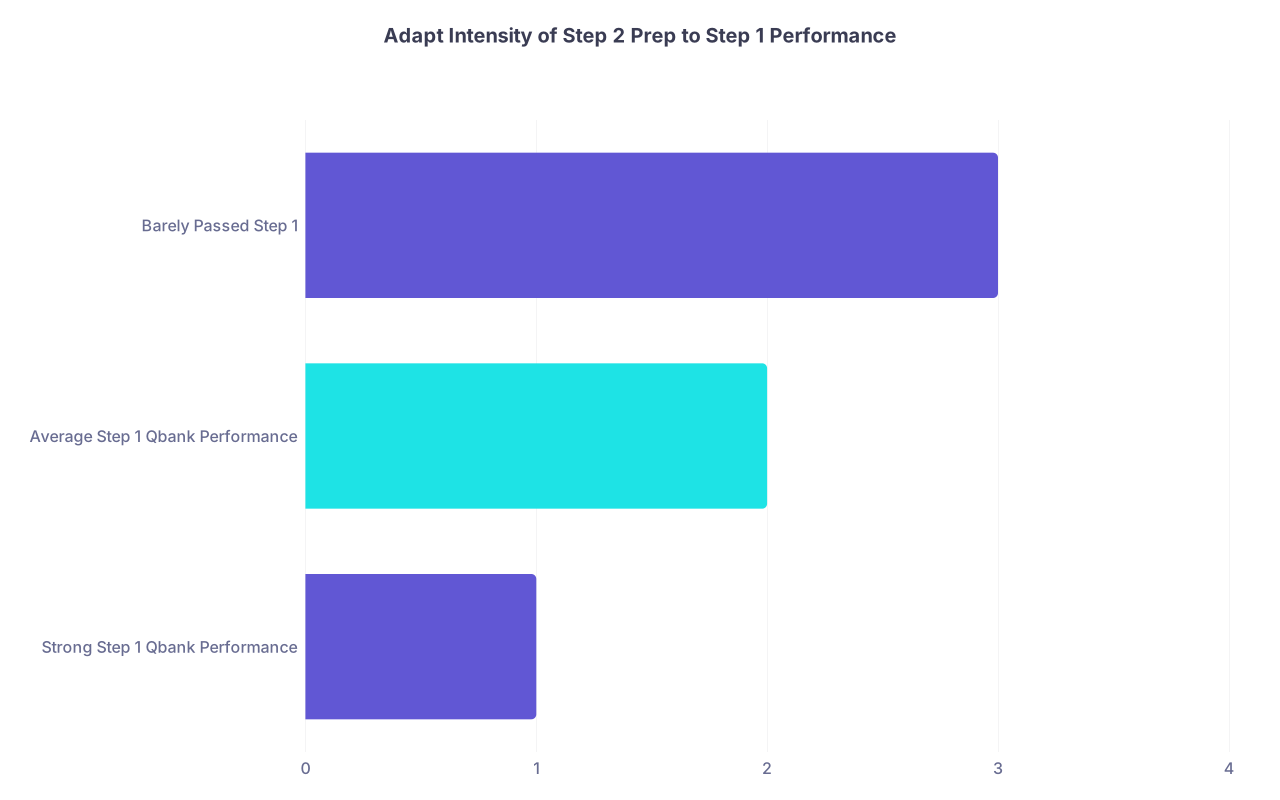
| Category | Value |
|---|---|
| Strong Step 1 Qbank Performance | 1 |
| Average Step 1 Qbank Performance | 2 |
| Barely Passed Step 1 | 3 |
Interpretation:
- 1 = Moderate pivot needed
- 2 = Strong pivot needed
- 3 = Full rebuild and aggressive Step 2 strategy
If you:
- Crushed Step 1 Qbanks but just never got a score report: You mainly need to adjust format and update content to clinical.
- Barely survived Step 1: You are not doomed, but you do not get to wing Step 2. You need structure, consistency, and a serious practice volume.
Blueprint: A 3‑Phase Pivot from Step 1 to Step 2 Mastery
You are not looking for inspiration. You want a plan you can actually run tomorrow.
Here is a framework I use with students who went through the Step 1 pass/fail era and then needed a big Step 2 score.
We will break it into 3 phases:
- Phase 0 (1–2 weeks): Diagnostic and rebuild
- Phase 1 (8–12 weeks overlapped with rotations): Integrated clinical studying
- Phase 2 (4–6 weeks dedicated): Full‑throttle Step 2 push
Phase 0 (1–2 weeks): Diagnostic and rebuild
Goal: Get a brutally clear map of where you stand and fix core weaknesses before you start “grinding.”
Step 1: Run an honest baseline
- Take:
- A NBME Step 2 practice exam (if timing allows) or
- A half‑length UWorld self‑assessment under real conditions:
- Timed
- No breaks except what the test allows
- No pausing, no checking answers during the test
You are not chasing a number yet. You are looking for:
- Patterns of misses (content vs reasoning vs rushing)
- Which clerkships and systems are weakest
Step 2: Autopsy your baseline
Do not just look at the score and move on. That is how people stay stuck.
For every block:
- Tag each miss:
- Content gap
- Misread question
- Poor strategy (“changed right answer to wrong one”, “did not use vitals/labs,” etc.)
- Count them. Literally.
You want something like:
- 40 total misses
- 20 content
- 10 misread
- 10 strategy
If more than 40–50% of your misses are strategy/timing, content review alone will not fix you. You need to practice “how you think” under test pressure, not just “what you know.”
Step 3: Decide your core resource stack
Stop collecting resources. That is how people waste months.
Pick:
- 1 primary Qbank: UWorld. Non‑negotiable.
- 1 secondary Qbank (optional, after you finish UWorld once): Amboss or Kaplan.
- 1 main text / video resource:
- OnlineMedEd videos and notes or
- Master the Boards style book (yes, still useful) or
- Step‑Up to Medicine + targeted resources for other fields.
- For OB/GYN, Surgery, Peds, Psych: pick 1 concise, clinically oriented resource per clerkship (not 3 half‑used ones).
Write this stack down. Commit to it. Everything else is “only if I finish my core plan.”
Phase 1 (8–12 weeks): Integrate Step 2 Prep Into Rotations
You are not a full‑time student anymore. You are working. That is the trap.
Step 2 prep cannot be this imaginary future project after rotations. If you try that, you will be behind and burned out.
Here is how to actually integrate it.
Weekday structure (during clerkships)
Aim for 40–60 quality questions per weekday. Not 20 questions while scrolling on your phone.
Basic template:
Before hospital (30–45 min)
- 10–15 timed questions (tutor mode OFF) in the specialty you are on.
- Goal: Warm‑up, build pattern recognition.
After hospital (60–90 min)
- 20–40 questions, mixed by system or by shelf topic.
- Full review:
- Why is the right answer right?
- Why are each of the wrong answers wrong?
- How would the question change if the patient were older, pregnant, immunosuppressed, etc.?
Commute / downtime
- 10–15 flashcards (Anki) on:
- Algorithms (HTN, DM, ACS, COPD, asthma, thyroid, etc.)
- Must‑know diagnostic criteria
- Drug of choice ladders
- 10–15 flashcards (Anki) on:
If this sounds aggressive, good. Step 2 is not polite.
Weekend structure
Weekends are where you separate yourself from just “passing the shelf” to “training for Step 2.”
- Saturday
- 2–3 full blocks (40 Q each) timed, mixed.
- 2–3 hours review.
- Sunday
- Lighter:
- Clean up missed concepts from Saturday.
- Watch 1–2 high‑yield videos (e.g., OME on topics you keep missing).
- Maintenance Anki (~30–50 cards).
- Lighter:
Total weekly target: 200–300 questions with real review. That volume, sustained, is where scores move.
Phase 2 (4–6 weeks): Dedicated Step 2 Push
This is your replacement for “Step 1 dedicated.” You need a window where Step 2 is your main job.
If your school allows, try to protect 4–6 weeks without a brutal rotation. An easier elective, research, or a pure study block.
Daily schedule template (adjust for your life, but keep the structure)
Morning (3–4 hours)
- 2 blocks (80 questions) timed, mixed.
- Short break.
- Immediate high‑yield review (big misses, patterns).
Midday (2–3 hours)
- Targeted content:
- Review weak systems: OB, peds, psych, surgery, biostats, ethics.
- Use concise resources (not starting new 40‑hour video courses).
- Targeted content:
Afternoon (2–3 hours)
- 1–2 more blocks (40–80 questions) OR
- A NBME / UWSA on designated days.
Evening (1–2 hours)
- Anki.
- Quick skim of algorithms, tables, and “if this, do that” charts.
- Light review of notes from the day.
Total per day: 120–160 questions on heavy days; 80–120 on lighter days. Yes, that is a lot. People who score well on Step 2 usually have done 2–3 full passes through UWorld and some additional questions elsewhere.
Clinical Reasoning: The Skill Most Students Ignore and Then Regret
Your Step 1 pass tells me you can memorize enough. Step 2 will expose whether you can think clinically.
You need to deliberately train clinical reasoning, not just absorb facts.
The 3 questions you must answer for almost every Step 2 vignette
What is the most likely diagnosis?
Not a differential list. Pick the one.What is the next best step right now?
- Diagnose? Treat? Observe? Reassure? Refer?
- Outpatient vs inpatient?
- Cheap and simple vs invasive and expensive?
What is the worst thing that could happen if I am wrong or delay?
That risk often drives why the exam expects a more aggressive step than your attending might pick on a slow Tuesday.
Start forcing yourself to articulate these 3 in your question review. Out loud or in writing. It feels slow. It makes you faster on test day.
Fixing the Usual Failure Points You Probably Recognize
Let us be blunt. I keep seeing the same three problems:
- You do questions, but your review is lazy.
- You crush easy questions, but collapse on long vignettes.
- Your test day execution is poor even though you “knew” the content.
Here is how to fix each.
1. Lazy review: “I just scroll the explanations”
This is useless. You feel productive and stay mediocre.
Instead:
- For each missed question:
- Write one sentence:
- “Missed because I forgot X.”
- “Missed because I did not read the stem carefully.”
- “Missed because I did not connect symptom A with lab B.”
- If it is content:
- Make 1 Anki card or a micro‑note. Not a novel. Prompt: “Next best step in suspected ectopic pregnancy with these vitals?”
- If it is strategy:
- Write a “rule”:
- “Do not pick imaging before a pregnancy test in women of reproductive age.”
- “Always check vitals and stability before tests.”
- Write a “rule”:
- Write one sentence:
You are training your future self to not repeat the same type of error 100 times.
2. Long vignettes: drowning in details
Step 2 questions can feel like short stories with lab novels attached. You do not need everything.
Try this method:
- First 5 seconds: Look at the last line of the question.
- “Most appropriate next step?”
- “Most likely diagnosis?”
- “Best initial test?”
- Then:
- Scan vitals.
- Scan age, gender, pregnancy status.
- Then read the stem with a purpose: which details actually matter?
Practice pattern:
- Do one block / day where your goal is not to maximize score. It is to:
- Reduce rereads.
- Identify the question type early.
- Answer with your gut, then justify it.
You are training processing speed and orientation. Content comes after.
3. Test‑day execution: good prep, bad performance
If you:
- Finish blocks with 10+ minutes left
and - Make a ton of “I knew that” mistakes,
You are either:
- Rushing from anxiety.
- Changing answers without evidence.
- Failing to reset between questions.
Fixes:
- One training block per day at normal test pace (90 minutes / 40 questions).
- Force yourself to:
- Spend at least 60–90 seconds on hard questions.
- Only change answers if you find clear evidence in the stem you previously missed.
- After each block:
- Count how many answers you changed from right to wrong vs wrong to right.
- If your net result is negative, you have a changing‑answers problem. Train yourself to trust your first well‑reasoned choice.
Score Targets, Timelines, and When to Reschedule
Let us talk numbers because that is what everyone actually cares about.
Rough correlation: UWorld / NBME to real Step 2
No table will be perfect, but here is a ballpark from what I have seen repeatedly.
| Metric | More Like… | Likely Outcome |
|---|---|---|
| UWorld % (first pass) < 55% | Underprepared | Risky for high score |
| UWorld % 58–65% | Solid | Often 240s–250s with good NBMEs |
| UWorld % 65–75% | Strong | 250s–260s possible |
| UWSA/NBME < 220 (late) | Concerning | Consider delaying |
| UWSA/NBME 235–245 (late) | Reasonable target | Likely mid‑240s +/- |
| UWSA/NBME > 250 (late) | Strong | Often similar or slightly lower |
Key point:
A single bad NBME early on does not mean anything. A pattern of low scores close to your exam date does.
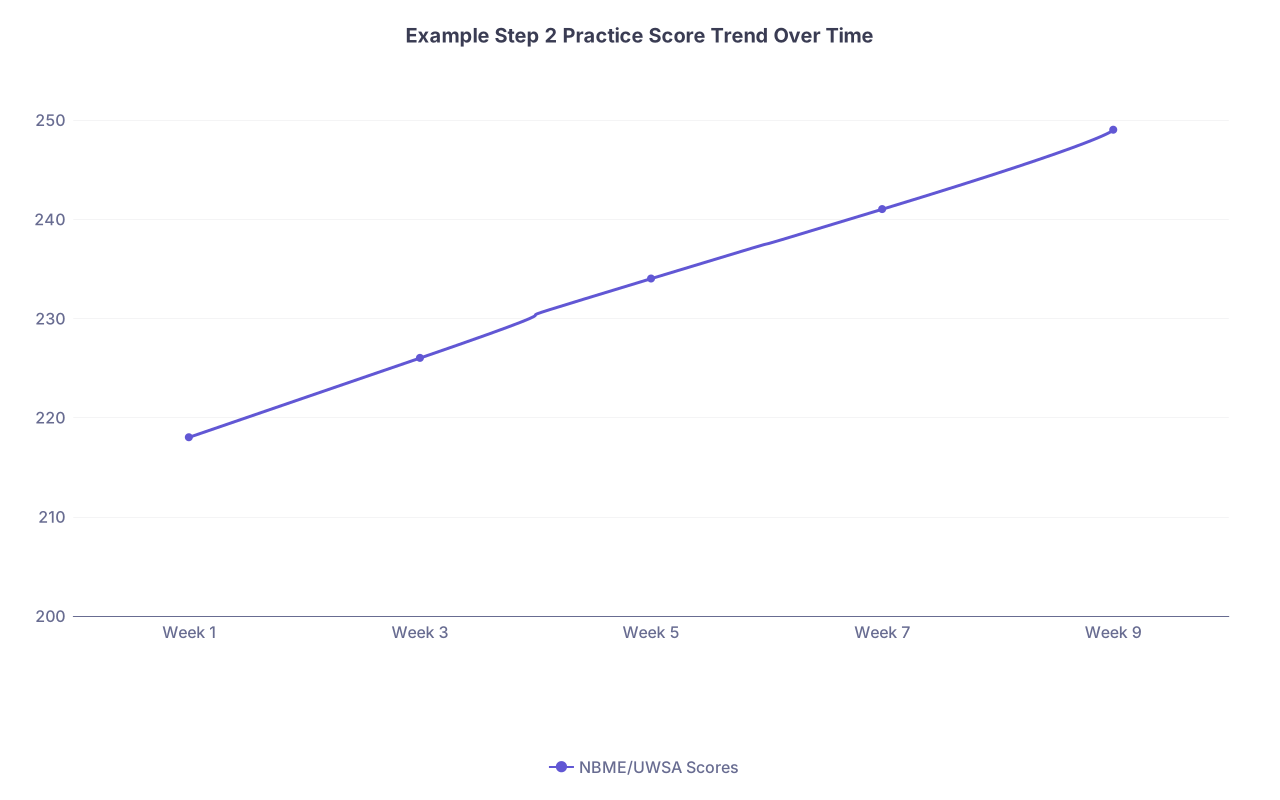
| Category | NBME/UWSA Scores |
|---|---|
| Week 1 | 218 |
| Week 3 | 226 |
| Week 5 | 234 |
| Week 7 | 241 |
| Week 9 | 249 |
If your curve looks like that → good. Keep going.
If your curve is flat or going backward → you need to intervene, not “hope it is fine.”
When you should seriously consider delaying
Ask these three questions 2–3 weeks before your test date:
- Are two recent NBMEs/UWSAs both below the score you realistically need?
- Is your UWorld performance not improving (or getting worse)?
- Are you mentally wrecked and unable to execute your daily plan?
If:
- You are aiming for competitive specialties and your last two practice scores are < 235–240 → delaying can be wise.
- You just need to pass and are already scoring >220 on multiple NBMEs → delaying probably does not buy you much.
Delaying without changing your plan is just procrastination with a prettier name. If you delay, commit to:
- More weeks of structured, higher‑volume practice.
- Fixing specific weaknesses you have identified, not just “more time.”
Using Your Step 1 “Pass” Strategically in Your Narrative
You cannot change Step 1 being pass/fail. You can absolutely control how Step 2 fits into your story.
Here is how I coach students to think about it.
Best‑case narrative
- Step 1: Pass.
- Strong shelves during clerkships.
- Step 2: Excellent score relative to your target field.
Story to programs:
“I built strong clinical skills across rotations and when there was finally a scored exam, I performed at a high level.”
That is exactly what PDs want to see.
Middle‑case narrative
- Step 1: Pass.
- Mixed clerkship performance.
- Step 2: Solid but not spectacular (say 230–240).
You are not doomed. But you:
- Need strong letters.
- Need to align application breadth with your numbers.
- Should lean into strengths: research, leadership, unique background, etc.
Worst‑case narrative (still fixable)
- Step 1: Pass (barely).
- Step 2: Near fail or fail.
If you are still pre‑Step 2: this is what you are avoiding by taking the pivot seriously.
If you already have a bad Step 2 outcome:
- You need:
- A structured remediation / tutoring plan.
- Clear documentation of improvement.
- A retake with a significantly higher score.
- And then you frame it:
“I had a setback, I addressed the root causes specifically, and my retake shows the result of that work.”
Programs care a lot about patterns. One bad event, followed by clear growth, is survivable. A string of unforced errors is not.
A Visual of Your Pivot Path
Sometimes it helps to see the whole thing laid out.

| Step | Description |
|---|---|
| Step 1 | Step 1 Pass |
| Step 2 | Phase 0 Diagnostic |
| Step 3 | Phase 1 Integrated Study |
| Step 4 | Intensive Rebuild |
| Step 5 | Phase 2 Dedicated Prep |
| Step 6 | Take Step 2 |
| Step 7 | Delay + Adjust Plan |
| Step 8 | Strong Step 2 Score |
| Step 9 | Baseline OK? |
| Step 10 | Recent NBMEs On Target? |
Your job is simple: keep moving along that path honestly. No denial. No magical thinking.
What You Should Do Today
Not “someday this month.” Today.
Schedule a practice exam.
- Book a NBME or UWSA within the next 7 days. Put it on your calendar.
Commit to a resource stack.
- Write down:
- Primary Qbank
- Main content resource
- Anki or not (pick one, stop halfway doing it)
- Write down:
Plan this week’s question volume.
- Decide:
- Weekdays: how many questions per day (realistic but not soft).
- Weekend: how many blocks and hours of review.
- Decide:
Open your last Step 1 Qbank performance report.
- Circle your bottom 3 systems.
- Those are your first targets when you review Step 2 practice test results.
Block dedicated time.
- Look at your rotation schedule.
- Identify a 4–6 week window before your Step 2 date you can protect for heavy study. Email whoever you need to email.
You do not need a perfect plan. You need a clear, honest one that you actually execute.
Open your calendar right now and put a 3‑hour block this week labeled:
“Step 2 Baseline + Plan.”
When that block hits, no phone, no social media, no “just one more email.” It is you, your data, and your pivot.