
You are sitting with your advisor. You want a competitive specialty: dermatology, ortho, plastics, ENT, urology, maybe radiology. Your Step 1 is pass/fail. Your advisor says some version of: “Well, just get a great Step 2, strong letters, and see what happens.”
That is not a plan. That is wishful thinking.
You need a safety net profile. Not “backup dream” nonsense. A real, engineered strategy that:
- Keeps you in play for competitive fields.
- Gives you credible, matchable options if those doors do not open.
- Limits the chance you end up SOAPing into something you never wanted.
Let me show you how to actually build that.
Step 1: Get Clear on What a “Safety Net” Profile Really Is
A safety net profile is not just “apply to some less competitive programs.” It is:
- A deliberately constructed alternate identity that:
- Still looks strong and coherent.
- Fits a different, more attainable specialty.
- Is believable to PDs. Not obviously “I am only here because derm rejected me.”
Think of having two parallel but overlapping narratives:
Primary narrative – Competitive field target
- Example: Dermatology with strong research, away rotations, derm-focused mentors.
Safety narrative – Matchable, realistic target
- Example: Internal Medicine with a focus on rheumatology or complex medical dermatology.
- Or General Surgery with an interest in wound care, burn, or community surgery.
The trick: Both narratives are factual. You are not lying. You are curating.
| Aspect | Competitive Target (e.g., Derm) | Safety Net (e.g., IM) |
|---|---|---|
| Research Focus | Derm clinical / basic science | IM, rheum, QI, outcomes |
| Sub-I Rotations | Derm away + home elective | IM wards + subspecialty |
| Mentors/Letters | Derm attendings | IM core faculty |
| Personal Statement | Skin disease, outcomes, policy | Chronic disease, systems |
| Program List | High derm density | Broad IM, mix of tiers |
Goal: If someone only saw your “safety net” application set, they would believe you have always been serious about that specialty.
Step 2: Accept the New Reality: Step 2 Is Your Non-Negotiable Anchor
With Step 1 pass/fail, Step 2 CK is now the quantitative gatekeeper. For competitive fields, you already know that. But for your safety net, Step 2 still makes or breaks you.
Here is the reality I have seen repeatedly:
A strong Step 2 (≥ 250):
- Keeps you in play for competitive fields (derm, ortho, ENT, uro, rads, ophtho via SF if applicable).
- Also makes your safety net specialty very safe (IM, Peds, Neuro, Psych, Anesthesia).
A mid Step 2 (235–249):
- Competitive fields possible but risky. You must offset with research and connections.
- Safety net needs to be carefully selected. You may not be competitive at top-tier IM or GS, but you can do fine at mid/community.
A lower Step 2 (< 235):
- Your safety net is now your primary reality. You must build a profile aligned with moderately competitive or less competitive specialties and target programs appropriately.
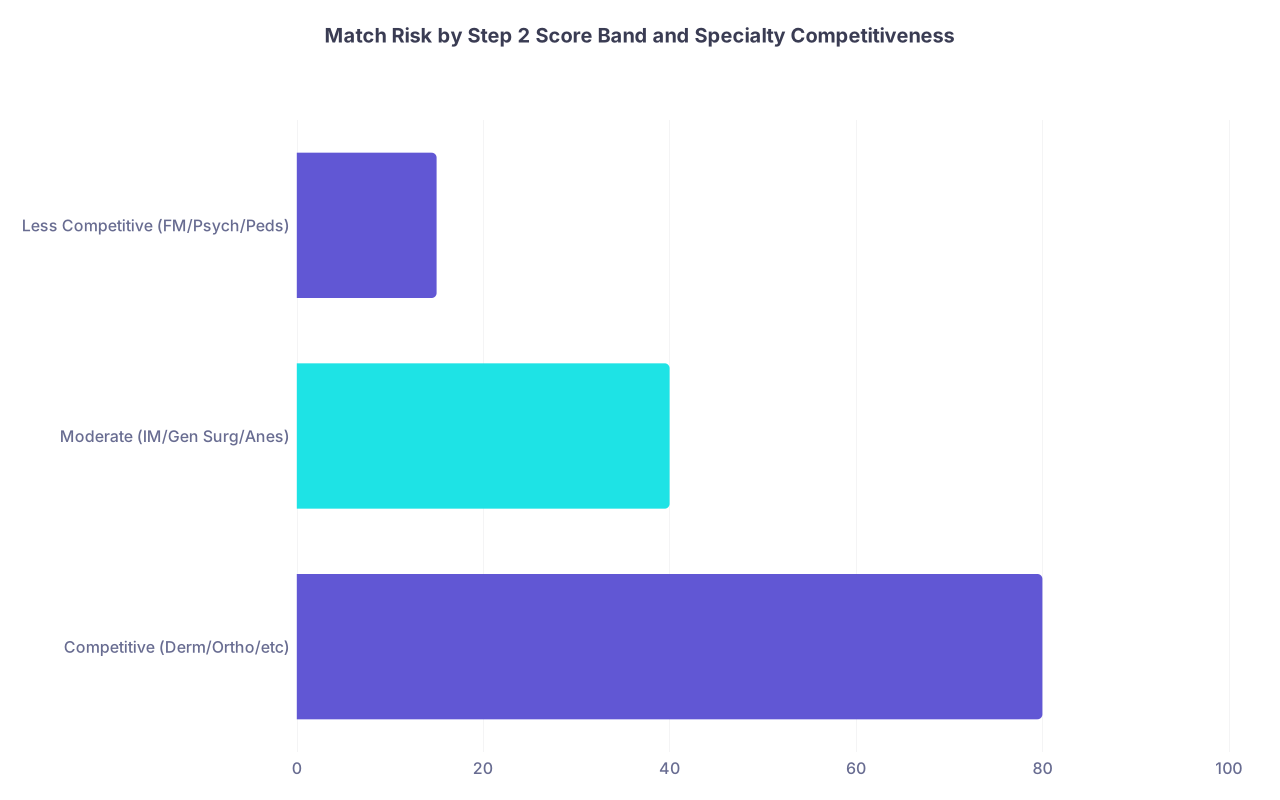
| Category | Value |
|---|---|
| Competitive (Derm/Ortho/etc) | 80 |
| Moderate (IM/Gen Surg/Anes) | 40 |
| Less Competitive (FM/Psych/Peds) | 15 |
(Values here = approximate “relative risk” of going unmatched at lower scores—competitive fields are far less forgiving.)
Your protocol:
- Stop pretending Step 2 “will be fine.”
- Set a clear target range based on your fields:
- If your heart is set on a very competitive field: Aim ≥ 250.
- If your realistic safety net is moderate (IM, GS, Anes): Aim ≥ 240.
- Study with test-day mindset:
- 4–6 weeks of serious, board-style prep minimum.
- At least 3–4 NBME/Comprehensive practice tests.
- If your NBME practice tests are not trending into your target range:
- Delay Step 2. Protect your score. The calendar is secondary to the number that will follow you for years.
No safety net strategy survives a bad Step 2 unscathed. Build everything else, but anchor it with this.
Step 3: Choose an Actual Safety Net Specialty (Not a Vague Concept)
“Maybe I will just do IM if derm does not work out” is not a strategy. It is avoidance.
You need to pick a specific safety net specialty by early-to-mid third year. Latest by:
- End of core clerkships.
- Before you choose your sub-Is and aways.
How to choose intelligently:
A. Align with your competitive target
You want overlap, so nothing looks fake. A few combinations that work well:
| Competitive Target | Strong Safety Net Options |
|---|---|
| Dermatology | IM (rheum/allergy), FM, Path |
| Orthopedics | General Surgery, PM&R |
| Plastic Surgery | General Surgery |
| ENT | General Surgery, Anesthesia |
| Urology | General Surgery, IM (onc focus) |
| Radiology | IM, Neurology |
| Ophthalmology | IM, Neurology, FM |
These pairings share patient types, disease categories, or skills. That helps you build a coherent story.
B. Match competitiveness to your real metrics
- If you are average-to-strong academically but light on research:
- IM, Anesthesia, Peds, Psych, Neuro are all reasonable nets.
- If you have serious red flags, multiple fails, or lower Step 2:
- FM, Psych, Peds make more sense.
- You can still have a niche interest (e.g., FM + sports medicine for the former ortho dream).
C. Talk to actual residents and PDs
Not just your classmates and vague “mentors.” You want to ask:
- “If a student was initially aiming for [competitive specialty] but ended up here, what made their application credible to you?”
- “What are the biggest red flags that make you think ‘this is just a backup applicant’?”
You will hear the same themes: lack of home rotation, generic letters, personal statements that read like rewrites of a derm/ortho essay. Avoid those.
Step 4: Design Parallel Experiences Without Wasting Time
You have limited rotations, limited months, and limited bandwidth. You cannot live two full lives. But you can architect overlap.
Here is a practical rotation blueprint for someone targeting a competitive field + a serious safety net:
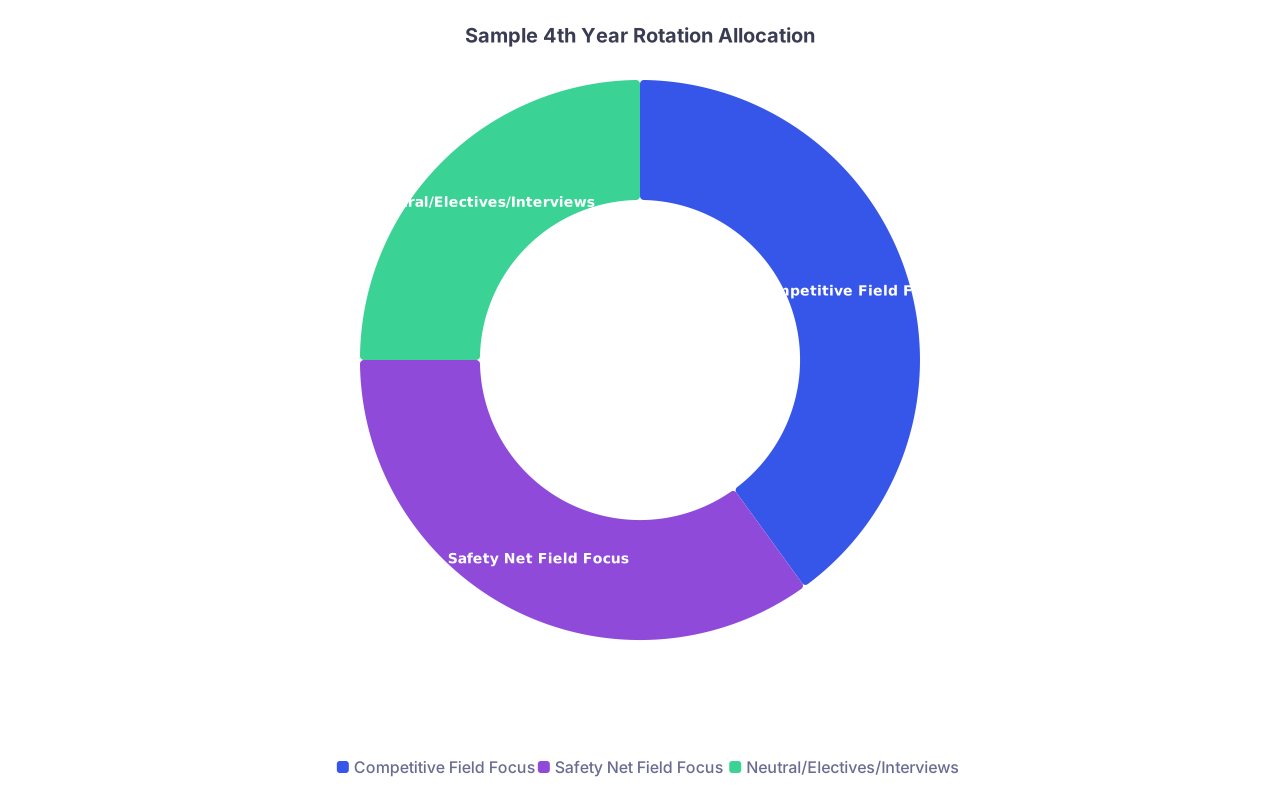
| Category | Value |
|---|---|
| Competitive Field Focus | 40 |
| Safety Net Field Focus | 35 |
| Neutral/Electives/Interviews | 25 |
Example: Derm primary, IM safety net
4th year framework:
Sub-I in Medicine (ward month)
- This is mandatory for nearly everyone. Make it count.
- Behave like a future IM applicant: own patients, communicate, seek feedback.
Derm elective at home institution
- This supports your primary goal. No surprise.
Derm away rotation (if institutionally feasible)
- Only do this if your school and calendar allow it without damaging your IM story.
IM subspecialty elective that dovetails with derm
- Rheumatology, allergy/immunology, heme-onc (cutaneous lymphomas), or ID (HIV, skin infections).
- Ask to see complex autoimmune or derm-overlap cases.
General EM or ICU month
- Neutral but strengthens both narratives: shows you can handle sick patients, systems-level thinking.
One flexible slot
- Can become:
- Additional derm exposure if interviews look weak.
- Additional IM or subspecialty exposure if you pivot.
- Can become:
Your actions during these rotations:
- On IM:
- Verbally state interest in IM + rheum/complex autoimmune disease. Often.
- Ask for feedback and letters from people who know you as a medicine applicant.
- On Derm:
- Behave like you are 100% all-in. No talk about backup or “maybe I will just do IM.”
Do this well, and you are holding two strong, believable options in parallel.
Step 5: Build Research and CV Entries That Can Flex Either Way
You do not need double the research. You need smartly branded research.
Strategy for dual-usable research
Pick topics that can be framed from both lenses.
Dermatology + IM example:
- Psoriasis and cardiovascular risk.
- SLE with cutaneous manifestations.
- Drug rash in oncology patients.
- Atopic dermatitis and asthma/allergy overlap.
For ortho + PM&R:
- Chronic low back pain.
- Post-op rehab protocols.
- Outcomes in joint replacement.
On your CV, structure things so the title does work for you.
- Instead of: “Skin issues in hospitalized patients”
- Use: “Patterns of dermatologic consultation in hospitalized medical patients”
That sounds both derm-oriented and medicine-relevant.
Be honest, but selective in what you highlight:
- For your competitive specialty:
- Talk about the derm/ortho/ENT angle in your personal statement.
- For your safety net:
- Emphasize the systems-based, longitudinal, or outcomes angle (chronic management, rehospitalizations, QI).
- For your competitive specialty:
Where students screw this up
They do three derm posters, two derm retrospectives, and one derm case report. Then when they panic-apply to IM, they have:
- No IM letters.
- No IM rotations.
- An application that screams, “I am only here because derm did not work out.”
You want at least:
- 1–2 projects that clearly cross over into your safety net field.
- Evidence you understand clinical work in that domain, not just shadowing.
Step 6: Letters of Recommendation – Engineer Two Sets
Letters are where your “backup” often gets exposed. PDs are not dumb. They read between the lines.
You want at least two strong letters for your safety net specialty, even if your heart is elsewhere.
Baseline letter structure you should aim for
For a safety net like IM/Gen Surg/Anes:
- 1 letter from a core rotation in that field (Sub-I or heavy inpatient rotation).
- 1 letter from a subspecialty within that field or a respected faculty member who worked closely with you.
- 1 departmental or chair letter if the field typically expects it (some surgery/IM programs).
Simultaneously, for your competitive specialty:
- 2–3 strong letters from faculty who see you as “one of us” in that field.
- At least one from an away if you did one, provided they genuinely liked you.
Critical point:
Do not ask faculty for letters before you know how they view you. Ask for honest feedback first:
- “If I were to apply in [specialty], do you feel comfortable writing me a strong letter?”
If they hesitate or qualify (“I can write you a letter” with no “strong” in there) – that is a no.
Step 7: Personal Statements and ERAS Application: Two Versions, One Truth
This is where people get themselves into trouble ethically and strategically.
You are allowed to write different personal statements for different specialties. ERAS supports this. The key is that both are truthful, just oriented differently.
How to do this without being fake
Identify 3–4 core themes that are true about you:
- You like longitudinal relationships vs procedures vs diagnostics.
- You care about chronic disease vs acute resuscitation.
- You value visual pattern recognition vs biomechanical problem-solving.
For the competitive statement:
- Lean into the aspects that align most with that field.
- Use field-specific cases, mentors, and experiences.
For the safety net statement:
- Use overlapping cases, but show how the medicine/anesthesia/IM/FM aspects resonated.
- Example:
- Same patient: Severe psoriasis with metabolic syndrome.
- Derm version: Focus on managing biologics, cutaneous impact, quality of life.
- IM version: Focus on chronic disease coordination, cardiometabolic risk, multi-morbidity.
For ERAS experiences:
- For derm-facing programs: you might highlight derm-related entries at the top.
- For IM-facing programs: you emphasize ward leadership, complex inpatient management, or QI work.
You are not inventing anything. You are choosing which true angles you foreground.
Step 8: Application Strategy – Tiered Lists, Not Chaos
You cannot apply everywhere to everyone. You will run out of money, sanity, and interview days.
You need a tiered application plan that bakes in your safety net from day one.
A simple, blunt structure
Example for a student aiming for Derm with IM safety net:
Derm Applications
- 40–60 programs (depending on your metrics and budget).
- Mix of:
- Home and regional programs where you have connections.
- A few aspirational academic centers.
- Adequate number of community or newer programs.
IM Applications
- 40–70 programs (range depends on Step 2, school prestige, research).
- Tiered:
- 10–15 “stretch” academic programs.
- 20–30 solid mid-tier academic/community.
- 10–20 geographic or community backups where your stats are above their typical range.
Timing
- Submit both specialties at the same time.
- Do not wait for derm rejections to start IM apps. By then, IM invites are already drying up.
For someone targeting orthopedics with a General Surgery safety net, similar structure:
- Ortho: 70–90 programs if you are serious (competitive field, lots of variability).
- Gen Surg: 40–60 programs distributed like above.
You want to look at NRMP data and your school’s match list. Then choose numbers accordingly. Guessing is lazy.
Step 9: Decide When to Pivot – Before It Is Too Late
Students usually wait too long to pivot from “dream” to “safety net.” Then they are in the SOAP wondering what happened.
You need pre-defined pivot points:
Pivot checkpoints
After Step 2 score returns
- If your score is significantly below what your field usually interviews:
- Meet with faculty and get candid feedback.
- If every honest advisor is nervous, you should at least build a very robust safety application.
- If your score is significantly below what your field usually interviews:
Late summer / early fall (before ERAS submission)
- If you have:
- Weak research for a research-heavy field.
- No home department support.
- No interview signals / communication.
- That is a red flag. Do not single-specialty yourself into a corner.
- If you have:
Interview season – November/December
- If you are seeing:
- < 5 interviews in a hyper-competitive field and few pending.
- You must mentally treat the safety net as your primary path. Rank lists should reflect reality, not fantasy.
- If you are seeing:
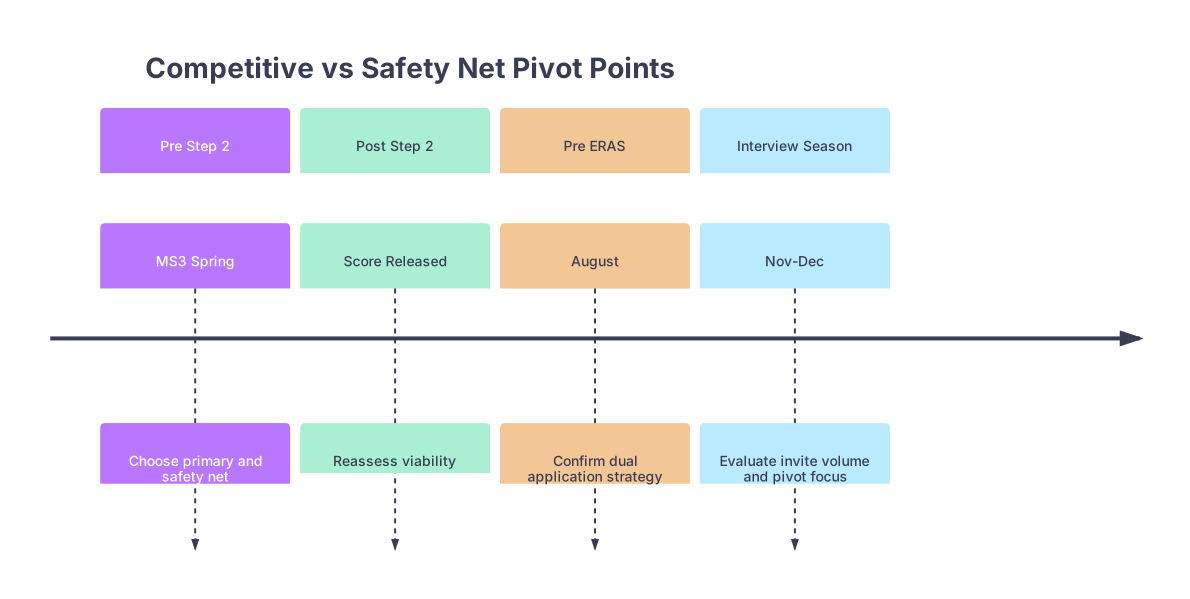
| Period | Event |
|---|---|
| Pre Step 2 - MS3 Spring | Choose primary and safety net |
| Post Step 2 - Score Released | Reassess viability |
| Pre ERAS - August | Confirm dual application strategy |
| Interview Season - Nov-Dec | Evaluate invite volume and pivot focus |
The mistake I see: people wait for a miracle email that never comes. A plan is better than hope.
Step 10: Protect Your Mental Health and Your Reputation
There is one more layer people ignore: how you talk about your plan.
If you constantly say, “I am doing derm but I can always just do IM,” guess what:
- Derm people hear you are not serious.
- IM people hear you consider them the default consolation prize.
Do not do that.
A better script:
- To derm folks:
- “I am committed to dermatology. I have really enjoyed my medicine rotations as well, especially the autoimmune and complex chronic disease aspects, but my long-term goal is derm.”
- To IM folks:
- “I have been drawn to complex immune-mediated disease and chronic care. I explored derm because of the skin manifestations, but I realized I value longitudinal management and systems-based care, which is why I am applying in Internal Medicine.”
Both are true. Neither signals disrespect.
Also: protect your own mental bandwidth. Dual-path planning is stressful. So:
- Limit who you confide in. You do not need every classmate weighing in.
- Pick 2–3 senior people you trust as your “war council” for decisions.
- Decide up front: you will not judge yourself as a person based on which field you end up in. This sounds soft, but it keeps people from making irrational, late-stage choices.
Putting It All Together: A Concrete 12-Month Action Plan
Let’s consolidate into something you can literally follow.
Assume you are MS3 spring right now, thinking about a competitive specialty (call it “Field A”) with a safety net (Field B).
Months 1–3
- Decide on Field A (competitive) and Field B (safety net).
- Meet with:
- At least one faculty mentor in Field A.
- At least one faculty mentor in Field B.
- Start/continue 1–2 research projects that straddle both fields.
- Begin serious Step 2 prep planning (test date, resources, practice test cadence).
Months 4–6
- Take Step 2 with a reasonable buffer before ERAS.
- Schedule:
- Sub-I in Field B (medicine, surgery, etc.).
- Elective/away in Field A.
- On Sub-I:
- Work like this is your primary field.
- Request feedback and identify potential letter writers.
Months 7–9
- Receive Step 2 score:
- If on-target: Continue dual-track plan.
- If below-target for Field A: strongly weigh pivot to Field B as primary.
- Draft:
- Two personal statements (Field A and Field B).
- Tailored CV entries emphasizing relevant angles.
- Secure letters:
- 2–3 from Field A.
- 2 from Field B.
- Identify your application numbers and tiering by specialty and program type.
Months 10–12
- Submit ERAS with both sets of applications on day one if possible.
- Respond promptly to interview invites.
- Track invite patterns:
- If Field A interviews are sparse and Field B is strong → shift your focus: prep more thoroughly for Field B interviews, and emotionally re-center.
- Build realistic rank lists that reflect:
- Where you interviewed.
- Where you would actually be willing to train for 3–7 years.
Your Specific Next Step Today
Open a blank document and write two headings:
- “Competitive Target – Why I Genuinely Fit”
- “Safety Net – Why I Genuinely Fit”
Under each, force yourself to list at least five concrete reasons (experiences, traits, cases, mentors) that make that specialty a believable home for you.
If you cannot get to five for your safety net, that is your signal: you do not have a real safety profile yet.
Then use that list to:
- Pick one research project, one rotation, and one potential letter writer you can pursue in the next 4–6 weeks that strengthen the safety net side of the page.
Do that, and you are no longer just “hoping” your path works out. You are building a real contingency plan.