
What if every PD and screener is looking at your “PASS” and mentally replacing it with “probably a 205”?
Because that’s the fear, right? Not just “I passed,” but “Everyone will assume I barely scraped by while they had 250s.”
Let me say this bluntly so we can actually talk about it: you’re not crazy for worrying about this. The messaging around Step 1 changing to pass/fail has been a complete mess. Older residents brag about their 260s. Some attendings still say things like, “Back when Step 1 mattered…” as if yours doesn’t. You scroll Reddit and see people flexing old scores and you’re just… sitting there with “PASS.”
And it feels like bringing a water gun to a gunfight.
Let’s break this down like someone who’s actually lying awake at 2 a.m. replaying what program directors might think when they see that one word.
The Ugly Fear: “They’ll Think I’m Dumb”
You know the internal monologue:
- “They had data. I have vibes.”
- “How are they supposed to know if I’m strong or weak with just ‘PASS’?”
- “Programs are gonna default to assuming my Step 1 was bad.”
- “If they had a number, maybe I’d stand out. Now I’m just… average forever.”
Here’s the part that stings: some programs did rely heavily on Step 1 scores in the numeric era. I’ve heard attendings say out loud in a selection meeting: “What’s their Step 1?” like it was the applicant’s entire personality. It was a brutal filter.
But your reality is different:
- You literally cannot show them a Step 1 score.
- PDs know this. They weren’t blindsided. They’ve had years to think (and complain) about it.
- They’re annoyed too, honestly. But they’re adapting because they have to.
Will some old-school people quietly assume your “PASS” = mediocre? A few. People who live in 2014. But the idea that every program is sitting there doing mental lowball conversions for every pass/fail examinee? No. They don't have that kind of time, and your file has a lot more data in it than you’re giving yourself credit for.
The other harsh truth: many students with very high Step 1 scores still struggled in clinical performance, professionalism, or communication. PDs know that. They’ve had residents with 260s blow up on the wards. They’ve learned—painfully—that numbers don’t save them from problem residents.
Your anxiety is making Step 1 the main character of your application story… in a world where it got demoted from lead to supporting cast.
What PDs Actually See When They See “PASS”
Let’s zoom out and be uncomfortably honest.
Here’s what a PD or screener actually has in front of them now:
- Step 1: PASS
- Step 2: a real number (or pending)
- Clerkship grades
- Narrative comments (“Hardworking, prepared, reliable…” or “quiet, disengaged, often late”)
- School reputation and grading scheme
- Research / publications
- MSPE (Dean’s letter)
- LORs
- Any red flags
Your fear is: “They’ll stare at the PASS and think: meh.”
Reality: They’re scanning your file and using everything else to triangulate where you might fall compared to their past residents.
Here’s a comparison that might actually help pull your brain out of the doom spiral:
| Era | What Jumped Out First |
|---|---|
| Old numeric Step 1 | Step 1 score, then rest |
| Transition years | Step 1 + Step 2 together |
| Current pass/fail | Step 2, clerkships, MSPE, LORs |
The scary shift is obvious: before, the first impression was a number. Now it’s a pattern.
Is that more ambiguous? Yes. Which is exactly why your anxious brain hates it. But ambiguous doesn’t automatically mean “they think I’m weak.”
It means they’re forced to ask:
- Does this student have strong Step 2?
- Do their clinical evals say they’re reliable, teachable, not a nightmare?
- Do their letters sound generic or glowing?
- Do their experiences match the specialty they’re applying into?
If you’re imagining them holding two piles—“250+” and “everyone else”—that’s outdated. Now it’s more like:
- “Looks like a solid, safe resident.”
- “Could be great, but unknown in some areas.”
- “Red flags/too many unknowns.”
And that categorization is not based on Step 1 anymore. For you, that ship has sailed.
The Step 2 Shadow: Your New “Number”
Here’s where the pressure moved: Step 2.
You know it. PDs know it. Everyone quietly shifted their obsession over. Nobody really says it nicely, but they absolutely treat Step 2 as the new “proof” you can handle boards-style material.
So when you say “I’m terrified my Step 1 pass looks weak next to old numeric scores,” what you usually mean underneath is:
“I’m scared Step 2 is now my only chance to prove I’m not below average.”
And that’s… kind of true. Not in a fatalistic way, but in a practical one.
Programs that used to screen by Step 1 cutoffs? A lot of them now do it with Step 2, especially in competitive fields. They’re not going to invent a fake number for your Step 1. They’re going to stare at your Step 2 and say:
- “Okay, this person is in the range that’s worked for us historically.” or
- “This is lower than what usually succeeds here.”
That’s how they protect themselves. Not by punishing you for a pass/fail system you didn’t choose, but by grabbing the nearest objective tool that does still exist.
So your real levers now:
- Step 2 score
- Clerkship honors / strong narrative comments
- Concrete specialty fit (research, electives, interest)
- No professionalism red flags
The “pass” itself? It just confirms you didn’t fail. That’s it. No bonus points. But not a minus either.
Here’s a visual just to hammer home where the real differentiation shifted:
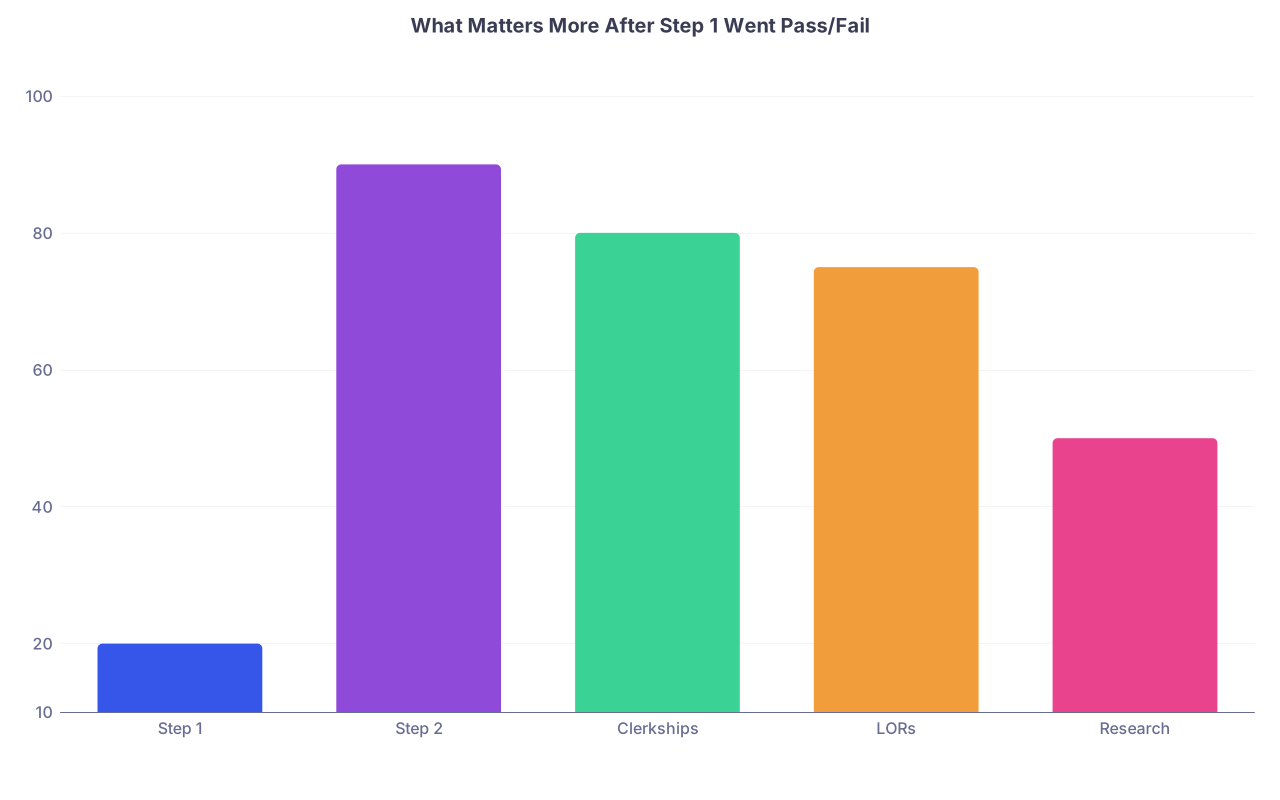
| Category | Value |
|---|---|
| Step 1 | 20 |
| Step 2 | 90 |
| Clerkships | 80 |
| LORs | 75 |
| Research | 50 |
No one’s building a whole story about your intelligence out of one word: PASS. They just note it, then move on to the stuff that actually separates you from everyone else.
Comparing Yourself to the Numeric Era Is a Rigged Game
Let me be blunt: you’re trying to compete in an exam format that literally doesn’t exist for you. That’s a losing mental trap.
You picture an applicant from 2018:
- Step 1: 252
- Step 2: 250
- AOA
- Some research
And your brain goes: I only have a PASS and then one number. I look weaker by default.
But if that same exact 2018 applicant were magically transported into your cohort, what would they have?
- Step 1: PASS
- Step 2: 250
- The same other stuff
You’d never know their 252. Neither would the programs. They’d just look like: “Oh, strong Step 2, good student.” Same as you could.
You’re comparing your worst assumptions about your performance against the absolute highlights of someone else’s. That’s not analysis. That’s self‑sabotage dressed up as “being realistic.”
PDs can’t see your old Step 1 percentiles, scaled scores, or anything. You don’t have a secret “low score” hiding somewhere on NBME that gets transmitted. You just have PASS.
Your anxiety is inventing ghost data that doesn’t exist.
The Harsh Question: “What If I Did Barely Pass?”
Let’s not sugarcoat. Maybe your NBMEs were shaky. Maybe you needed an extension. Maybe you walked out of your Step 1 exam convinced you failed, then got the PASS by some miracle margin.
So you’re thinking:
“If they knew my real score, they’d probably throw my app out. So won’t they assume the worst?”
No.
Because here’s how actual selection conversations go when it’s someone in the pass/fail era:
- “Step 1: pass.”
- “Okay, how about Step 2?”
- “Clerkships?”
- “Any concerns in the Dean’s letter?”
If your Step 2 is solid and your clinical performance is good, they are not going to go on a forensic mission to imagine whether your Step 1 was a 196 or a 270. They don’t have time, and it doesn’t change their decision.
If your Step 2 is weak or your clinicals are meh, then yeah—they might worry about your test-taking or knowledge base. But again, that’s about what they can see, not about an invisible Step 1 number they’ll never know.
Here’s the brutal truth you probably need to hear:
If you barely passed Step 1 but go on to:
- Score decently (or even strongly) on Step 2
- Perform well clinically
- Get good letters
Then your low Step 1 would’ve been a blip in the numeric era anyway. PDs loved upward trends. “Rough Step 1, strong Step 2” is a narrative they already understood.
The difference now? The “rough” part is invisible.
The Prestige Trap: Worried You’re Done for Competitive Specialties
This is where the panic really spikes.
“What if I want derm / ortho / plastics / ENT / neurosurg? They used Step 1 so heavily. My pass looks like nothing. I’m dead.”
You’re not dead. You’re just playing by their new rules:
- They’re leaning hard on Step 2 score ranges now.
- They’re dissecting research productivity much more.
- They’re watching who did away/audition rotations with them.
- They’re combing through letters for phrases like “top 5%” or “best student I’ve worked with.”
So if you want those competitive fields, your Step 1 being pass/fail isn’t what hurts you. What hurts (or helps) is:
- Whether your Step 2 is actually competitive for that field
- Whether your research matches their usual expectations
- Whether you made yourself visible via electives/aways
- Whether your letters scream “We trust this person with high-stakes stuff”
Your pass doesn’t block you from those fields. It just doesn’t give you easy points either. That part is annoying but not fatal.
You’re imagining PDs saying, “Oh, in the old days, this person would’ve needed a 250+, so I’ll assume they’re 230 and toss them.” That’s Reddit fantasy. Real PDs say stuff like:
“Do they look like the people who usually succeed here?”
“Will they pass our boards and not make our lives harder?”
“Are they serious about this field, or are we a backup?”
Your Step 1 is not answering those questions for them. Your file has to answer them in other ways. That’s the game now.
How to Stop Letting “PASS” Psychologically Sabotage You
You can’t change that your Step 1 is pass/fail. But you can decide how much mental real estate you give that word.
Here’s the mental shift I’ve seen help people:
Treat Step 1 like a prerequisite, not a flex.
You passed the gate. You’re allowed to keep walking. That’s it.Anchor your self-worth on Step 2 + clinicals, because that’s what programs are actually doing now.
If Step 2 is still ahead: this is your shot at objective redemption.
If Step 2 is done: this is your actual data point, not the phantom Step 1 score you keep obsessing about.Build a single, coherent story across your app.
Programs need a clean narrative, especially now that they can’t lean on Step 1:
“Solid test-taker, good clinician, reliable teammate, and actually interested in our specialty.”Stop apologizing for pass/fail in your head.
You didn’t choose it. It’s not your fault. You don’t need to grovel for having the system you were handed. Nobody’s impressed by applicants who act ashamed of stuff they can’t control.
Here’s the thing no one tells you: the more you obsess over that “PASS,” the more you neglect the parts of your application that actually move the needle now.
You don’t get extra pity points for being anxious about the exam format. You only get points for what’s on paper.
What You Can Actually Do Today
Do this right now. Not later. Today.
Open your CV or ERAS draft and your transcript/MSPE (whatever you have access to). Ask yourself, without sugarcoating:
“If Step 1 didn’t exist at all, would this file convince a stranger I’m a strong, safe, and serious future resident for my chosen specialty?”
If the answer is anything short of “yeah, probably,” don’t spiral about Step 1. Pick one lever you can move:
- If Step 2 is upcoming: pull up a UWorld block and set a concrete daily question target.
- If Step 2 is done but weak: plan for shining on rotations, getting killer letters, and casting a realistic but still ambitious net.
- If you’re early: map out which rotations, mentors, and projects will make your story cleaner.
Then actually act on it.
Open your Step 2 study schedule, clerkship plan, or ERAS document right now and change one thing that makes your future application stronger. Just one. Your “PASS” isn’t going anywhere—but everything else is still in play.