
A program director once leaned back in his chair after a long interview day, looked at a file, and said, “Honors in everything. I don’t believe a word of it.” He flipped a few pages, found the Step 2 score, nodded once, and moved the applicant into the “likely rank” pile.
That’s the game you’re playing now: Step 1 is pass/fail, and the spotlight has shifted. You’re stuck between two messy signals—clerkship grades and Step 2—and behind closed doors, PDs have gotten very blunt about which one they actually trust.
Let me walk you through what they really say when you’re not in the room.
The New Hierarchy After Step 1 Went Pass/Fail
When Step 1 went pass/fail, every dean and committee chair had the same public line: “We’ll take a more holistic approach.”
Behind the scenes, PDs met in conference rooms and on Zoom and said something very different: “We need another hard number.”
Here’s the current reality at most mid-to-large academic programs, whether they admit it or not:
- Step 2 CK is the new primary standardized filter.
- Clerkship grades are a noisy, political, and school-dependent filter.
- Narrative comments and the MSPE (Dean’s Letter) are the tiebreakers.
At multiple PD meetings I’ve sat in on, the same pattern comes up. Someone pulls up a spreadsheet of applicants:
- Name
- School
- Step 2 score
- Class rank (if available)
- Number of honors in core clerkships
Then they sort by Step 2 first. Always. Some PDs pretend they don’t. Their coordinators will tell you they absolutely do.
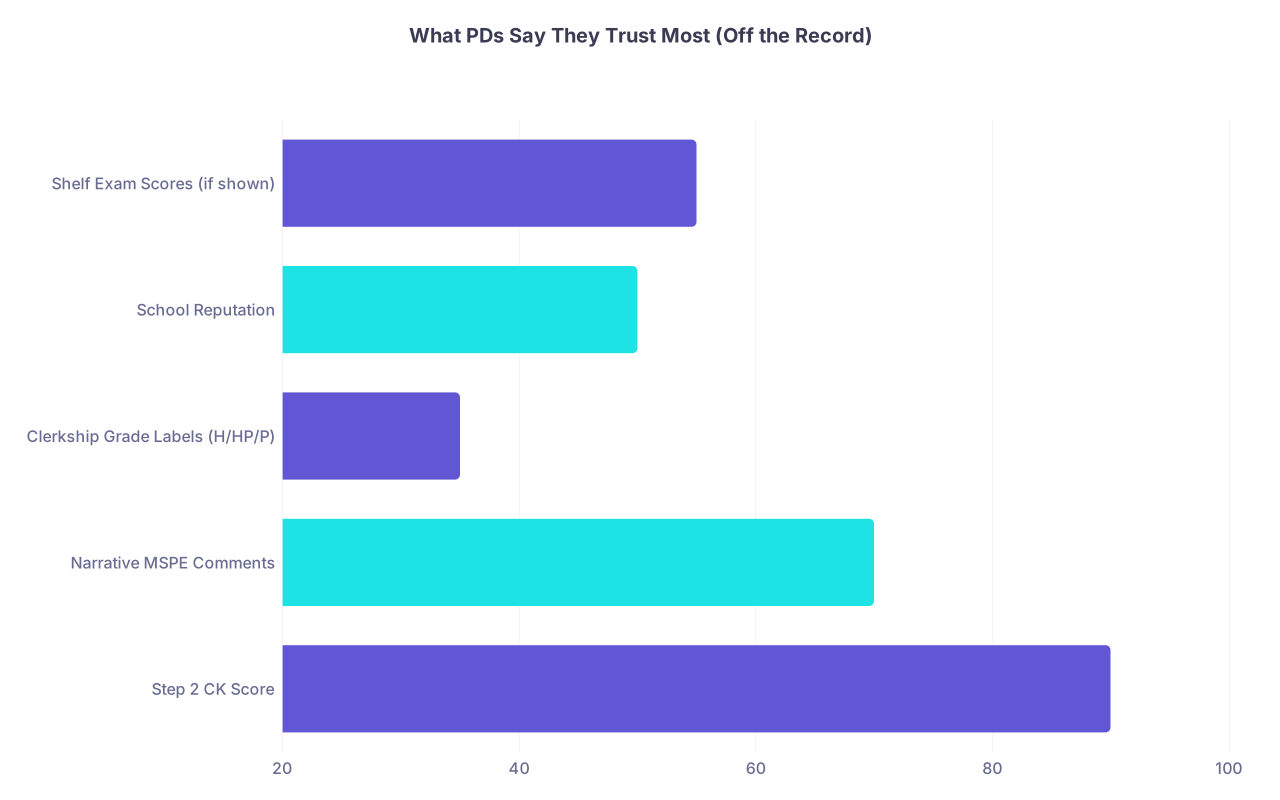
| Category | Value |
|---|---|
| Step 2 CK Score | 90 |
| Narrative MSPE Comments | 70 |
| Clerkship Grade Labels (H/HP/P) | 35 |
| School Reputation | 50 |
| Shelf Exam Scores (if shown) | 55 |
Those numbers aren’t from a publication; they’re a composite of how PDs rank things when you get them off a panel and into a hallway conversation. They’ll criticize Step 2 all day long, but they still lean on it—hard.
Why Step 2 Became the “Least Bad” Truth Signal
Program directors know that Step 2 is imperfect. They’re not naïve. But when they compare it to clerkship grades, they see one major difference: Step 2 doesn’t care who your attending was, what your school’s curve is, or whether your evals got lost for three months.
What PDs like about Step 2 CK
I’ve heard versions of this from IM, EM, surgery, and psych PDs:
It’s standardized across schools.
A 255 from a mid-tier state school and a 255 from a top-10 are the same number. They may not be the same training environment, but for test-taking and knowledge, PDs treat them as equivalent.It correlates (roughly) with board pass rates.
Programs get hammered by the ACGME if their board pass rates drop. PDs are paranoid about this. They see Step 2 as early warning: a string of 215s makes them nervous, no matter how many honors you have.It protects them politically.
When a resident fails boards, the question becomes: “Why did you rank this person so highly?”
Saying “They had great comments on surgery” sounds weak. Saying “They had a 252 Step 2” sounds defensible.It lets them filter volume.
You apply to 40–80 programs. They get 2,000–5,000 applications. They don’t have time to read every MSPE in October. But they can sort a CSV by Step 2 in 5 seconds.
Here’s the part no one prints in brochures:
More and more programs have quietly replaced “Step 1 cutoff” with “Step 2 cutoff” in their back-end filters. They might not advertise it, but the behavior is the same.
Why PDs Distrust Clerkship Grades (Even While They Use Them)
Now let’s talk clerkship grades. You already suspect this, but I’ll say it plainly: most PDs think your raw “Honors/High Pass/Pass” labels are a mess.
They still look at them. They still use them. But they don’t trust them.
Here’s what they complain about when you’re not around.
1. Grade inflation and “Honors for everyone”
At one PD breakout session, the EM PD from a big-name school said, “We get transcripts where 60–70% of the class has Honors in Medicine. I just throw the grade column out. It means nothing.”
Plenty of schools—especially those afraid of impacting residency chances—have inflated:
- “Honors” now going to the top 40–50% of the class.
- “High Pass” being a political consolation prize.
- Grade distributions not being shared at all.
So if you’re from a school that basically hands out Honors like Halloween candy, your grade labels are discounted. PDs will rely more on Step 2 and narratives to separate you from your own classmates.
2. Wild inter-school variability
A PD from a solid Midwest IM program once pulled two transcripts up during a Zoom faculty meeting:
- Student A from School #1: Honors in 3 of 6 core clerkships
- Student B from School #2: Pass in everything
Then he opened their MSPEs. At School #1, Honors = top 30–40%. At School #2, Honors = top 10%, High Pass = next 20%, strict cap. The “Pass” student from School #2 was actually solid mid-class, with strong written comments.
Outcome? The PD said, “This is what I mean. The letters and Step 2 matter more than these grade labels.”
Faculty nod. Then they go right back to glancing at the H/HP/P column out of habit. But the thoughtful ones discount it heavily.
3. Subjectivity, bias, and politics
Every PD has seen this pattern:
- The extroverted, enthusiastic student who loves small talk gets better evals, even if their fund of knowledge is average.
- Quiet, anxious, but very competent students get “pleasant, works hard” comments and a High Pass.
- One malignant attending tanks a grade and writes a single negative line that shadows you for years.
PDs know all that. They’ve been that attending. They’ve watched residents unfairly praise or punish students.
So when they see:
Clerkship: Internal Medicine – Honors
Comments: “Pleasure to work with. Hard working. On time. Read about her patients.”
They roll their eyes. That exact template shows up in 80% of MSPEs. It doesn’t change anything.
But a Step 2 of 262? That moves the needle.
How PDs Actually Combine Step 2 and Clerkship Performance
This is the part you care about: not the philosophy, but the actual decision-making.
Let’s get very concrete.
Imagine three applicants to a categorical IM program:
- Applicant 1: Step 2 = 268, Mostly High Pass, 1 Honors in IM, strong comments
- Applicant 2: Step 2 = 242, Honors in almost everything, at a known grade-inflated school
- Applicant 3: Step 2 = 235, High Pass/Pass mix, strong narratives, tough-grading school
What happens in the real world?
At an academic IM program that wants a strong board pass rate and fellows: Applicant 1 rises fast. Faculty say things like, “That’s the kind of score we need,” and the slightly weaker clerkship grades are forgiven instantly.
Applicant 2 looks shiny until someone remembers, “This school gives Honors to half the class.” They then dive into the MSPE percentiles and comments. If the narratives are generic, the Honors don’t impress.
Applicant 3 depends heavily on the Dean’s Letter. If the MSPE explicitly says, “Our grading is stringent—few honors are awarded; this student is in the top third,” then the lower Step 2 and grades are partially rescued. But they start disadvantaged in most initial filters.
To make this less hypothetical, here’s how different types of programs often weight Step 2 vs clerkship data in practice:
| Program Type | Step 2 Emphasis | Clerkship Grade Emphasis |
|---|---|---|
| Big academic, competitive IM | Very High | Moderate |
| Community IM | High | Low–Moderate |
| Surgical subspecialty (ortho, etc.) | High to Very High | High (for rotation fit) |
| Primary care–focused FM | Moderate | High (for reliability, work ethic) |
| Psych, Neuro, Pathology | High | Moderate |
Not every program follows this exact pattern. But I’ve seen enough rank meetings to tell you this table is closer to reality than any official website language.
What PDs Say When They See Mismatches
PDs pay attention to how your Step 2 and clerks align—or don’t.
Scenario 1: Great Step 2, mediocre clerkships
Common story: the student matures late, struggled with the politics of third year, but is academically strong.
What PDs say:
- “They might have had some rough rotations, but they can clearly learn and test well.”
- “If the comments show growth later in the year, I’m not worried.”
- “I’d rather remediate bedside manner than knowledge gaps.”
This profile is often forgiven. Especially if your letters from later rotations are strong. Step 2 bails you out.
Scenario 2: Stellar clerkships, weak Step 2
This one makes PDs nervous.
The kinder ones say:
- “They’re clearly hard-working, but I’d worry about boards.”
- “We’d need to make sure they do a structured board prep plan.”
The more blunt ones:
- “If you can’t break 230 on Step 2, your glowing ‘Honors in everything’ doesn’t mean much.”
- “This is exactly why I don’t trust clerkship grades anymore.”
These applicants sometimes get ranked, but they lose a lot of spots to people with higher Step 2s and slightly messier third-year records.
Scenario 3: Both strong
This is the golden ticket. PDs love alignment. High Step 2, consistent Honors/High Pass, and strong narratives with specific praise (“leads the team,” “excellent reasoning,” “top 10% of students I’ve worked with”).
In rank meetings, those applicants get fast yes’s. People don’t waste time debating them.
Shelf Exams, Narratives, and the “Context” Layer
Here’s the nuance: while Step 2 is the most trusted broad signal, PDs don’t stop there for serious candidates. Once you clear the numerical screen, they start reading more carefully.
Shelf exams (when visible)
Some schools put shelf scores or percentiles into the MSPE. When they do, PDs quietly love it.
You’ll hear:
- “Strong Step 2 and consistent 80–90th percentile shelves—that’s coherent.”
- “Step 2 is 250 but shelves were 30–40th percentile? Did they just cram once?”
Shelf exams are like mini-Step 2s. Consistency across those plus the final Step 2 reassures PDs this wasn’t a fluke.
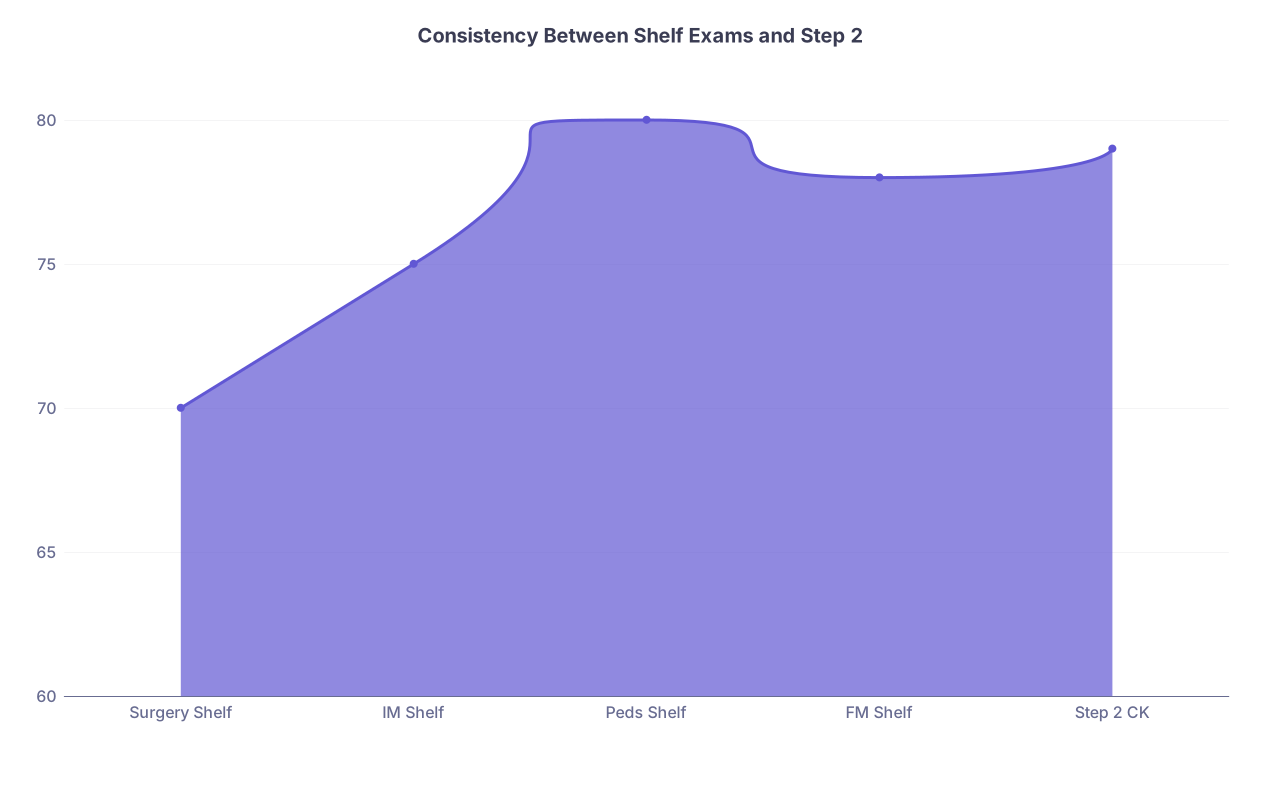
| Category | Value |
|---|---|
| Surgery Shelf | 70 |
| IM Shelf | 75 |
| Peds Shelf | 80 |
| FM Shelf | 78 |
| Step 2 CK | 79 |
When the graph looks like that—no wild outliers—PDs relax. When Step 2 is a massive spike out of nowhere, they get a bit more cautious, but still often accept it.
Narrative MSPE comments
This is where PDs rescue or punish you.
They look for:
- Comparative phrases: “Top 10% of students,” “One of the best I’ve worked with in 5 years.”
- Specific behaviors: “Identified subtle changes in patient status,” “Led family meetings independently,” “Teaches peers effectively.”
- Red or yellow flags: “Needs continued development in efficiency,” “Sometimes requires prompting,” “Struggled with time management.”
When narrative strength matches high Step 2 and decent grades, you’re in the safest zone possible.
When narratives contradict the numbers (“Average fund of knowledge” with a 260, or “Struggles with clinical reasoning” with high honors), that triggers discussion in rank meetings.
How You Should Strategically Play This Era
You do not control whether your school inflates grades. You do not control whether your attending lost half your eval forms. You do control how you respond to the landscape PDs are actually using.
Here’s the unvarnished strategy:
1. Treat Step 2 as your primary “currency”
In the Step 1 pass/fail era, Step 2 is your main lever to override noise.
If your first two clerkships went badly because you had rough teams, you can’t fix those grades now. You can study for Step 2 like your application depends on it—because it does.
A 250+ doesn’t magically erase a couple of Passes. But I’ve watched it move students from “maybe” to “we should interview them anyway” more times than I can count.
2. Protect at least one core clerkship in your target field
While PDs don’t trust clerkship grades globally, they do care about:
- Internal Medicine grade for IM, cards, pulm/crit
- Surgery grade for gen surg, ortho, neurosurg
- Psych grade for psychiatry
- EM SLOEs and rotations for EM (those are their own universe)
You want, at minimum, one clearly strong performance—and ideally a strong letter—in the domain you’re applying to. A 250 Step 2 and a Pass in IM when you’re applying to categorical IM is survivable, but it puts more pressure on your letter-writers and Step 2.
3. Maximize narrative strength, not just labels
If grades are noisy, narratives are the decoder.
On rotations, you should be playing for memorable narrative comments, not just “Honors.” That means:
- Doing specific, noticeable work: taking ownership of a complex patient, spearheading a student teaching session, following up on a subtle diagnostic question.
- Making your chief and senior look good so they want to fight for you when evals are completed.
- Asking directly near the end of a rotation, “Is there anything I can do in this last week to perform at an honors level?” Some attendings will actually tell you exactly what they want to see.
When PDs see “above expectations,” “top student,” “ideal resident material” repeated by different attendings, the noise of grade labels fades a bit.
4. Time Step 2 intelligently relative to clerkships
The timing matters more than students are told.
If your early clerkships were weak and later ones are stronger, many PDs prefer:
- Step 2 taken after you’ve had time to mature clinically and fix knowledge gaps, even if it means applying with a slightly delayed score.
If your clerkship record is already strong and you’re worried about Step 2 dragging you down, you do not want a rushed, mediocre Step 2 before ERAS opens.
The PD calculation is simple: a modest delay is forgivable, a visibly underprepared score is harder to spin.
Specialty Differences: Where Grades Still Bite Hard
Let’s not pretend every field treats this equally. Some specialties lean harder on one or the other.
Surgery and surgical subspecialties
I’ve watched surgery PDs do this live:
- Sort by Step 2.
- From that high-scoring subset, filter by:
- Surgery clerkship grade
- Surgery sub-I performance and letters
If your surgery grade is weak but you have a monster Step 2 and a sub-I letter that says “top 5%,” you still stand a chance. But in these fields, clinical fit and work ethic matter more. Your clerkship and sub-I narrative carry extra weight.
Internal Medicine and the subspecialties
IM, cards, GI, heme/onc: Step 2 is king for initial sort. Clerkships matter most to differentiate people in the same Step 2 band.
A 252 with High Pass in IM and an “excellent” IM letter will usually beat a 240 with Honors in IM and a generic letter. That’s the part students underestimate.
Fields like Psych, Neuro, Path, FM
These have been moving up in competitiveness, but PDs talk more about “fit” and professionalism. They still care a lot about Step 2 (they also have board pass requirements), but they’ll be more willing to believe your strong clerkships and narratives if your Step 2 is merely decent, not stellar.
The Short Version: What PDs Trust Most
If you forced most PDs into a corner and said:
“You have to pick one thing you trust more—clerkship grades or Step 2—what is it?”
They’d pick Step 2.
Not because it’s perfect. Because it’s the least distorted by local politics, grading systems, and personalities.
But when it comes to deciding between two roughly similar Step 2 scores, that’s when they start reading:
- How did this student actually function on the wards?
- What do real humans who worked with them say?
- Did they show up as a resident-level thinker by the end of third year?
Step 2 opens the door. Clerkship performance—as told through narratives and key grades—decides how far inside you get.