
You are here
You are a second‑year sitting in a too‑bright lecture hall. The slide still says “USMLE Step 1,” but everyone knows the game changed. The exam is pass/fail now. The M2 two rows in front of you whispers, “Honestly, you just need to pass. Programs cannot even see the score.”
Part of you wants to believe that. The other part knows better.
Because while people are saying Step 1 is less important, you are seeing:
- PDs posting on Twitter that Step 2 and clinical performance matter more than ever
- Classmates quietly stockpiling research projects
- Upperclassmen telling you their school suddenly “recommends” a high Step 2 for competitive specialties
You are trying to answer one question:
If Step 1 is pass/fail, what is the actual strategy to stand out?
Not vibes. Not platitudes. A concrete, do‑this‑then‑this plan.
That is what I am going to give you.
Step 1 Pass/Fail: What Actually Changed (And What Did Not)
Let me be blunt: Pass/fail did not make things easier. It just changed the scoreboard.
Here is the new reality:
Programs lost an easy numeric filter (Step 1 score).
They replaced it with:
- Step 2 CK score
- School’s internal ranking / clerkship grades
- Research output and letters
- Signals (VSLO/Away rotations, “demonstrated interest”)
You now have two distinct jobs with Step 1:
- Pass on the first attempt
- Do it with minimal damage to your future Step 2 and clerkship performance
Step 1 pass/fail means:
- Failing Step 1 is more toxic than ever. No “but at least I got a 230” narrative. It is just a red flag.
- Passing early and clean frees your brain and schedule for what actually differentiates you.
- Over‑studying Step 1 at the expense of early research or foundations for Step 2 is a strategic mistake.
So your mindset needs to shift from “How high can I score?” to “How can I pass efficiently and set up the rest of my application?”
The Core Framework: Three Phases, One Goal
Think of the pass/fail Step 1 era as three linked phases:
- Pre‑clinical (M1–early M2): Build foundations and credibility
- Dedicated + Step 1: Pass cleanly, protect your ceiling
- Post‑Step 1 (late M2–M4): Aggressively differentiate
Here is the overview.
| Phase | Primary Goal | Secondary Goal |
|---|---|---|
| M1–Early M2 (Preclinical) | Build core knowledge | Start research + networking |
| Dedicated + Step 1 | Pass on first attempt | Preserve Step 2 runway |
| Post-Step 1 (M2–M4) | Excel in clinics + Step 2 | Build a differentiated CV |
Now let’s turn that into a concrete plan.
Phase 1: Preclinical – Set Up Future You
1. Decide your risk profile early
You do not need a final specialty, but you do need a risk band:
- High‑risk specialties (Derm, Ortho, Plastics, ENT, Neurosurg, Rad‑Onc)
- Moderately competitive (EM in some markets, Anesthesia, Radiology, Gas, some IM fellowships)
- Lower‑risk (FM, Peds, Psych, Path, many IM spots)
If you are even considering a high‑risk specialty, assume you will need:
- Strong Step 2 CK (think 250‑ish territory)
- Honors in key clerkships
- Real research output (not just “helped with a chart review once”)
- At least one specialty‑specific mentor who knows you well
You do not have to commit to derm as an M1. But if you might want derm, you must behave like it is on the table.
2. Build a sane but serious preclinical study system
The worst Step 1 pass/fail mistake I see: people use it as an excuse to treat M1/M2 material casually. Then they get crushed by Step 2.
Your move is different:
- Use one primary content source per subject (e.g., Boards & Beyond, Pathoma, Sketchy, Anki deck)
- Align it roughly with your school curriculum
- Do not hoard resources; that is how you end up doing nothing well
Concrete weekly structure (M1 / early M2):
- Lectures/labs: Do what you must to pass your school’s exams.
- Boards resources: 3–5 days per week, 60–90 minutes:
- Watch 1–2 high‑yield videos
- Add/unsuspend related Anki cards
- Keep a running “confusing bucket” list to ask upperclassmen or TAs
You are not gunning for Step 1 mastery here. Your target is conceptual familiarity, not “UWorld‑level” performance yet.
3. Start research early, but not chaotically
You do not need five projects M1. You need one good entry point.
-System to find a project:
- List 2–3 fields you are somewhat curious about
- For each:
- Look up 3–5 faculty with recent publications
- Read titles/abstracts of their last 3 papers
- Email 5–8 people total. Short, direct, specific.
Template that actually works (pared down):
Dear Dr. X,
I am a first‑year medical student interested in [field or topic]. I read your recent paper on [very short citation/point] and I am particularly interested in [concrete aspect].
I have [brief relevant skills OR genuine eagerness to learn], and I am looking for a project where I can contribute meaningfully over the next [time frame, e.g., 6–12 months].
Would you be open to a short meeting to discuss ways I might help with your ongoing work?
Best,
[Name], MS1
When someone bites:
- Show up with 1–2 specific questions about their work
- Be honest about your bandwidth, then deliver reliably
- Push gently for a defined product: abstract, poster, manuscript
You want one serious project started by mid‑M2, not a pile of half‑finished noise.
Phase 2: Dedicated and Step 1 – Pass Cleanly, Protect Your Ceiling
This is where most people overcomplicate things.
The goal is not to crush Step 1. The goal is to:
- Pass on the first attempt
- Avoid burnout so severe that your Step 2 prep is compromised
- Fix glaring knowledge gaps that will wreck your clerkships
1. How long should dedicated be?
For most students, 4–6 weeks of focused dedicated works in the pass/fail era, assuming you:
- Did something board‑relevant during preclinical
- Are not in academic trouble with school exams
Longer is not automatically better. For many, 10 weeks of anxious, low‑efficiency “studying” is worse than 5 intense, structured weeks.
2. Core tools for Step 1 in the pass/fail era
You need three things. Anything extra is optional, not mandatory:
- Question bank: UWorld Step 1 (primary). Amboss if you need a second bank.
- Concise reference: First Aid or similar condensed review; use it as a map, not a novel.
- Your chosen video/path resources: Example: Pathoma + Sketchy micro/pharm.
That is it. If you are stacking 6 resources, you are not focused. You are procrastinating with better branding.
3. A concrete 5‑week dedicated schedule
Assume:
- 5 weeks dedicated
- Goal: comfortable pass margin, no obsession over score
- Baseline NBME: borderline but passing range
Daily structure (5.5 days/week):
Morning – Questions (3–4 hours):
- 40–60 UWorld questions, timed, mixed, random
- Review every question, right and wrong
- For each missed Q: one‑sentence error diagnosis: “Misread the question,” “Never learned this,” “Concept confused with X”
Midday – Targeted content (2–3 hours):
- Based on UWorld misses, do Pathoma/Sketchy/short videos for weak areas
- Use First Aid only to orient yourself and tag topics, not to “read it cover to cover”
Afternoon – Light review (1–2 hours):
- Anki or flashcards for high‑yield facts
- Rapid pass through personal “red list” topics
Evening – Stop.
- Gym, walk, eat, human things
- You are playing a 5‑week game, not a 72‑hour sprint
Assessment points:
- Week 0 (start): NBME baseline
- Week 2: NBME check – should be >10–15 points above pass
- Week 4: NBME / UWSA – aim to be >=15–20 above pass threshold to sit comfortably
If at week 2 you are flirting with the pass line:
- Cut any extra, low‑yield resources
- Shift to:
- More questions per day (60–80)
- Ruthless focus: micro, pharm, path, biochem – the big hitters
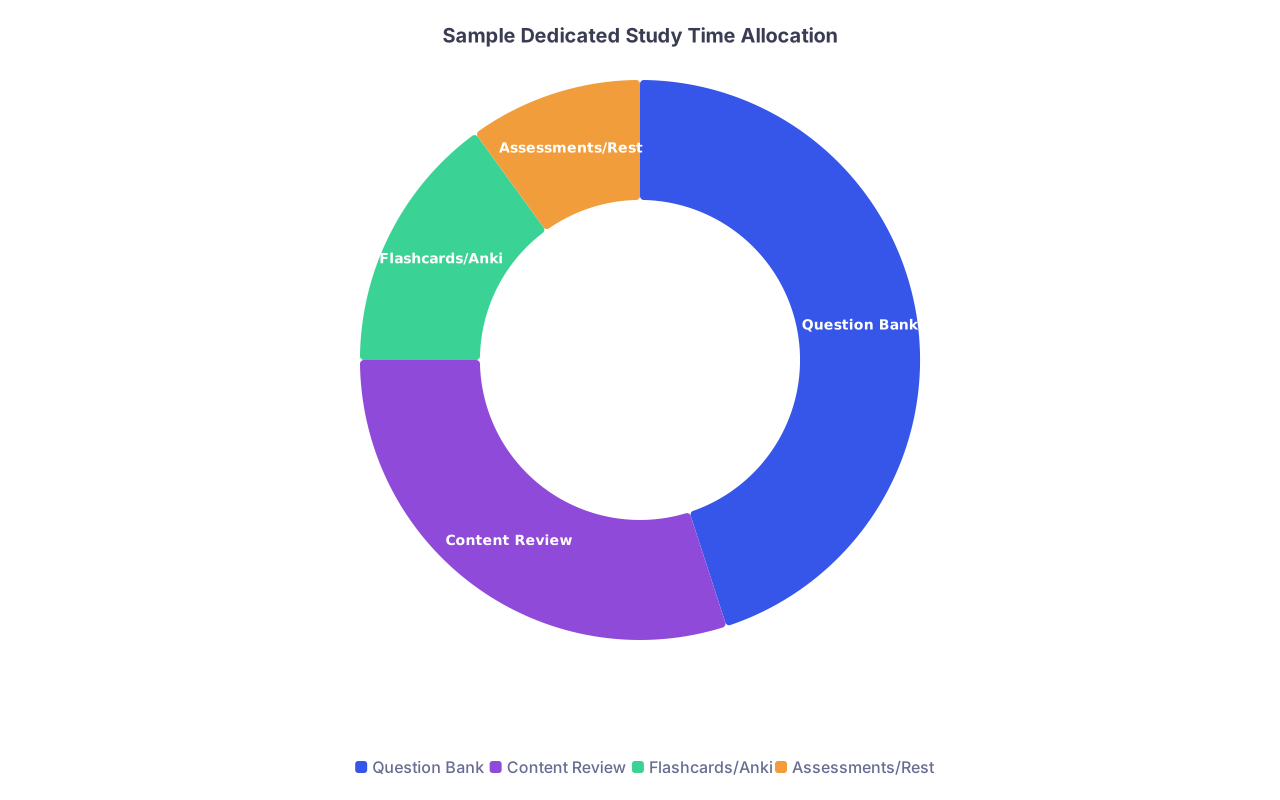
| Category | Value |
|---|---|
| Question Bank | 45 |
| Content Review | 30 |
| Flashcards/Anki | 15 |
| Assessments/Rest | 10 |
4. When to postpone the exam
Postponing is not a moral failure. It is a risk calculation.
You should strongly consider a short delay if:
- Two separate NBMEs (1 week apart) are at or below the pass line
- Your trend is flat or worsening despite full‑time study
- You are so anxious you cannot sit through a block without panic symptoms
But do not postpone endlessly. Max 2–4 weeks extension, with a revised plan, not “more of the same”.
Phase 3: Post‑Step 1 – The Real Differentiation
You passed Step 1. Good. Nobody cares what your underlying score was. Now your application really starts.
Here is where you separate yourself.
1. Step 2 CK: your new hard number
Step 2 CK is now the main standardized exam that programs trust. They know:
- Everyone took it relatively recently
- Scores correlate better with clinical performance than Step 1 did
- It gives them the filter they lost
So your strategy must explicitly set you up for a strong Step 2.
Key principles:
- Do not fully disengage from Step‑style thinking after Step 1
- Use every core clerkship as Step 2 prep
- Start Step 2‑specific work before your official dedicated
Concrete minimal Step 2 plan:
During clerkships:
- Always use a question bank (UWorld Step 2 CK or clerkship‑specific) for each rotation
- 10–20 questions/day, 5 days/week, is enough to maintain board conditioning
- After each block, tag “classic” Step 2 presentations you saw on the wards
Step 2 dedicated (4–6 weeks):
- Full UWorld Step 2 CK pass (or as much as feasible)
- 2–3 practice NBMEs or UWSAs
- Target score depends on specialty, but if you are aiming competitive, be honest: you likely need to be above the national mean by a clear margin
Clinical Years: Build a File Programs Actually Want
Step 1 pass/fail turned the spotlight onto your day‑to‑day performance with patients. That is not romantic. It is just how PDs compensate for losing an early filter.
1. Clerkship grades: how to game the system ethically
Every school has a different rubric, but some things are universal:
- Residents’ narrative comments matter more than you think
- One mediocre eval can be drowned out, but repeated “quiet,” “unprepared,” or “disengaged” is lethal
- Shelf scores can rescue mediocre personality impressions, but not if you are actively disliked
How to reliably show up as an above‑average student:
First week on every rotation, ask two questions:
- “What makes a student stand out positively on this service?”
- “What do students do that annoys the team?”
Then do the first and do not do the second. Shockingly effective.
Own 2–4 patients well rather than 7 badly.
- Know their meds, overnight events, and plan cold
- Anticipate 1–2 small tasks the resident has not asked for yet (filling out forms, prepping discharge summaries, getting outside records)
Study a little daily:
- 30–45 minutes at night with:
- Case Files / Online MedEd / AMBOSS articles
- 10–15 relevant questions
- 30–45 minutes at night with:
You are not auditioning to be the smartest person in the building. You are auditioning to be the intern they want on call.
2. Letters of recommendation: start early, cultivate deliberately
You need 3–4 strong letters:
- 1–2 from your chosen specialty (for competitive fields, more)
- 1 from IM or Surgery (often requested)
- 1 from “someone who knows you well” – research mentor or longitudinal preceptor
How to set this up:
- Identify 3 attendings during M3 you click with
- Tell them midway through the rotation: “I am really enjoying working with you. I am thinking of asking for a letter later on – what should I focus on for the rest of the rotation to make it a strong one?”
- Then follow their roadmap. You basically asked them how to impress them. Use the answer.
When you actually request the letter:
- Give them:
- Updated CV
- Personal statement draft or 1‑page “story” doc
- Bullet list of 3–5 specific cases or projects you did with them
You are making it easy for them to write a detailed, specific letter instead of the deadly generic “Did fine, showed up” template.
Research and “Extras” in the Step 1 Pass/Fail Era
Step 1 going pass/fail pushed programs to use research and scholarly activity even more as a tie‑breaker, especially for top or competitive spots.
1. What kind of research output actually moves the needle?
Here is the blunt hierarchy:
| Output Type | Impact Level | Notes |
|---|---|---|
| First-author paper | Very high | Especially in target specialty |
| Co-author in good journal | High | Shows sustained involvement |
| National conference poster | Moderate | Good for networking |
| Local poster/presentation | Low–moderate | Still better than nothing |
| “Helped with a chart review” (no product) | Low | Barely counts |
Ideal target by mid‑M4, if you are aiming high‑risk:
- 1–2 publications (even middle‑author)
- 2–4 posters/presentations
- A coherent theme (e.g., multiple projects in ortho, not one ortho, one nephrology, one psych at random)
2. If you are behind on research
Let’s say you are late M2, minimal research, and now nervous. Here is the salvage protocol:
Pick one specialty that is realistically in range for you
Find a high‑volume, publication‑heavy mentor (ask upperclassmen who “gets things out the door”)
Tell them explicitly:
- “I am a rising M3. I would like to be very productive between now and [time]. I am prepared to work hard on a project that could realistically lead to a poster or manuscript.”
Prioritize:
- Retrospective chart reviews with existing IRB
- Case series with existing data
- Systematic reviews only if they have a track record of finishing them
You want short‑to‑medium time‑to‑product, not a 3‑year basic science odyssey that might never be published.
Signaling Interest: Aways, Sub‑Is, and Region
Step 1 pass/fail made it harder for programs to know who is serious about them. So they increasingly use:
- Away rotations / Sub‑internships
- Geographic ties
- Program‑specific signals (if/when systems like preference signaling are used)
1. Away rotations (especially for competitive fields)
For fields like Ortho, Derm, ENT, Plastics, EM, your away rotation is effectively a month‑long interview.
You should:
- Time it after you have basic clinical skills (late M3 / early M4)
- Be prepared to function at near‑intern level in work ethic and reliability
- Treat every day as a chance to generate a future LOR quote
On day 1, ask the residents:
- “What do the best students do on this rotation?”
- “What do students do that damages their chances here?”
Then calibrate accordingly.
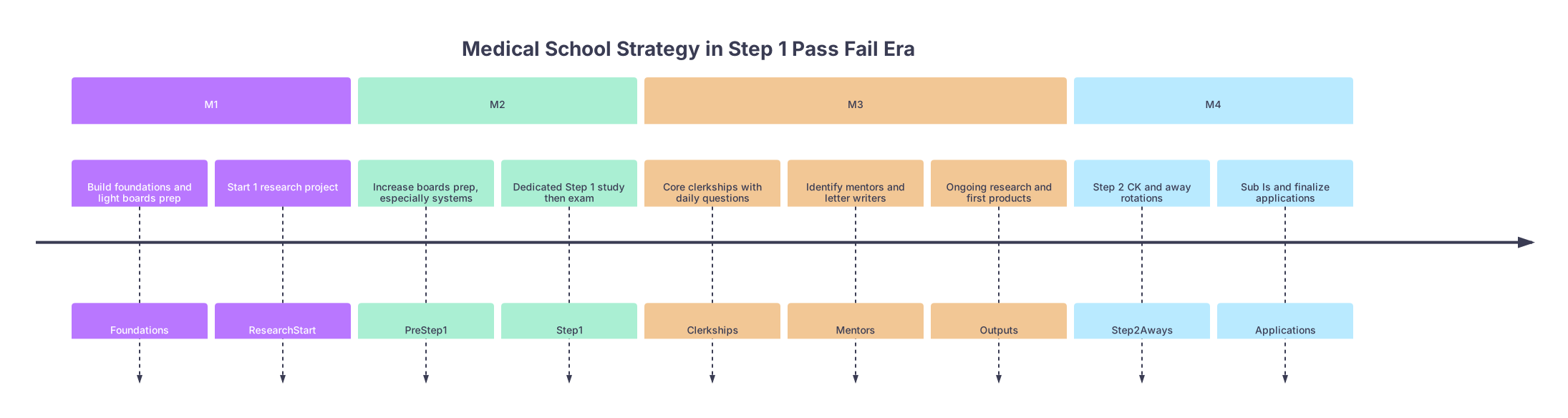
| Period | Event |
|---|---|
| M1 - Build foundations and light boards prep | Foundations |
| M1 - Start 1 research project | ResearchStart |
| M2 - Increase boards prep, especially systems | PreStep1 |
| M2 - Dedicated Step 1 study then exam | Step1 |
| M3 - Core clerkships with daily questions | Clerkships |
| M3 - Identify mentors and letter writers | Mentors |
| M3 - Ongoing research and first products | Outputs |
| M4 - Step 2 CK and away rotations | Step2Aways |
| M4 - Sub Is and finalize applications | Applications |
Application Year: Putting It All Together
By the time ERAS opens, here is what a strong Step 1 pass/fail era file can look like, even without a Step 1 score:
- Step 1: Pass on first attempt
- Step 2 CK: Competitive score for your target field
- Clerkships: Mostly Honors/High Pass in core rotations, especially those relevant to specialty
- Research: At least some tangible output, ideally in your chosen field
- Letters: 3–4 detailed, specific, enthusiastic letters
- Experiences: Longitudinal leadership or service, not 15 one‑day things
Where do you start if you are behind?
Audit your current status honestly:
- Step 1: Pass/Fail – any issues?
- Step 2: Taken or not, what is your score band?
- Clinical grades: Pattern or randomness?
- Research: Anything on paper?
- Mentors: Do you have 2–3 real advocates?
Identify your weakest dimension that programs care about most. Then build a 6–12 month plan around that:
- Weak Step 2 potential → fix your daily study systems on the wards, get a clear Step 2 plan
- No research → lock in one high‑yield mentor and a short time‑to‑product project
- Mediocre evals → ask for direct feedback, adjust how you show up on teams
What Not to Do in the Step 1 Pass/Fail Era
Let me save you from the most common, quietly fatal mistakes:
Treating Step 1 as trivial.
“It’s pass/fail, I will just cram later” is how you end up failing or squeaking by with massive knowledge gaps that haunt you during Step 2.Hoarding resources instead of committing.
You do not need 4 question banks and 8 video series. You need one main path and discipline.Ignoring Step 2 until M4.
Clerkships are Step 2 training. If you are not doing any questions or targeted reading, you are voluntarily handicapping yourself.Doing random, unconnected research.
Three unrelated posters in three different specialties signal one thing: you do not know what you want and could not get sustained mentorship.Being “fine” on the wards.
Students underestimate how much narrative comments shape rank lists. “Fine” does not get you to the yes pile when everyone else is also fine.
If You Are Already Off‑Schedule or Have Red Flags
Maybe you already failed Step 1 once. Or you are mid‑M3 with no research and mediocre evals. This is salvageable, but you cannot pretend it is not a problem.
You need a triage mindset:
If you failed Step 1:
- Crush the retake; no excuses
- Make Step 2 a strength (above average score)
- Address the failure briefly but directly in your application and interviews:
- Take responsibility
- Explain what changed concretely (systems, habits)
- Show the new pattern of success
If your clerkship comments are lukewarm:
- Before the next rotation, ask your last attending or resident privately:
- “What could I have done differently to be in the top group of students you work with?”
- Do not argue with the answer. Implement it.
- Before the next rotation, ask your last attending or resident privately:
If you have almost no research:
- Pick fields where this matters less or compensate with:
- Stellar Step 2
- Very strong clinical performance
- Outstanding letters
- Pick fields where this matters less or compensate with:
The Short Version: How to Stand Out Anyway
You do not win the Step 1 pass/fail era by being relaxed. You win by moving the work earlier and making it more deliberate.
Three core takeaways:
Use Step 1 strategically, not obsessively.
Pass on the first attempt with a disciplined, resource‑light dedicated period, and use preclinical years to build a foundation for Step 2 and clinics.Shift your ambition to Step 2 and clinical performance.
Every core clerkship is now a Step 2 prep block and a month‑long audition for letters. Treat them that way.Build a coherent story: mentor, research, specialty interest.
A few focused projects, strong letters, and a clear, believable trajectory beat scattered, last‑minute padding every time.
You cannot control that Step 1 went pass/fail. You can absolutely control how you respond to it.