
The Step 1 pass/fail era has exposed a brutal truth: most schools never knew how to truly bridge preclinical to clinical in the first place.
Taking away the score did not fix that. It just removed the forcing function that pushed students to integrate.
If you are somewhere between “I crushed my preclinical exams” and “I feel like a fraud on the wards,” this is not because you are not smart enough. It is because the system still teaches in silos and hopes “clinical reasoning” magically appears in third year.
So let’s stop waiting for curriculum committees to save you. Here is how you actually bridge preclinical to clinical in the P/F Step 1 era—deliberately, systematically, and on your own terms.
1. The New Reality: What Changed with P/F Step 1 (and What Did Not)
First, clarity. Step 1 pass/fail did not change what you must know to be a safe, competent clinician. It changed:
- The timing of pressure – less panic in MS1–2, more weight on:
- Shelf exams
- Step 2 CK
- Clinical evals and letters
- How programs filter you – fewer use Step 1 scores as a crude screen and instead lean harder on:
- Step 2 CK score
- Clerkship grades
- Home vs away rotations
- Narrative comments (“excellent clinical reasoning”, “struggled to apply knowledge at the bedside”)
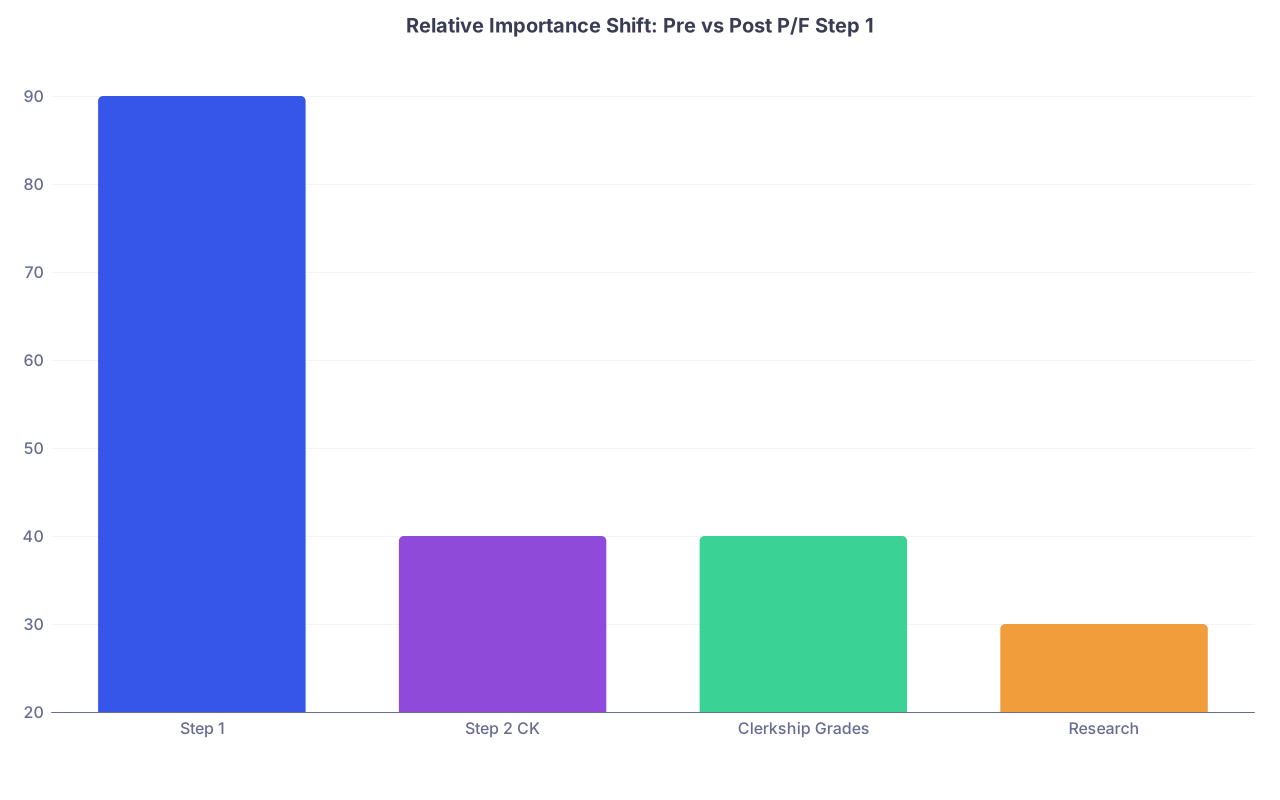
| Category | Value |
|---|---|
| Step 1 | 90 |
| Step 2 CK | 40 |
| Clerkship Grades | 40 |
| Research | 30 |
Pre P/F (approximate emphasis)
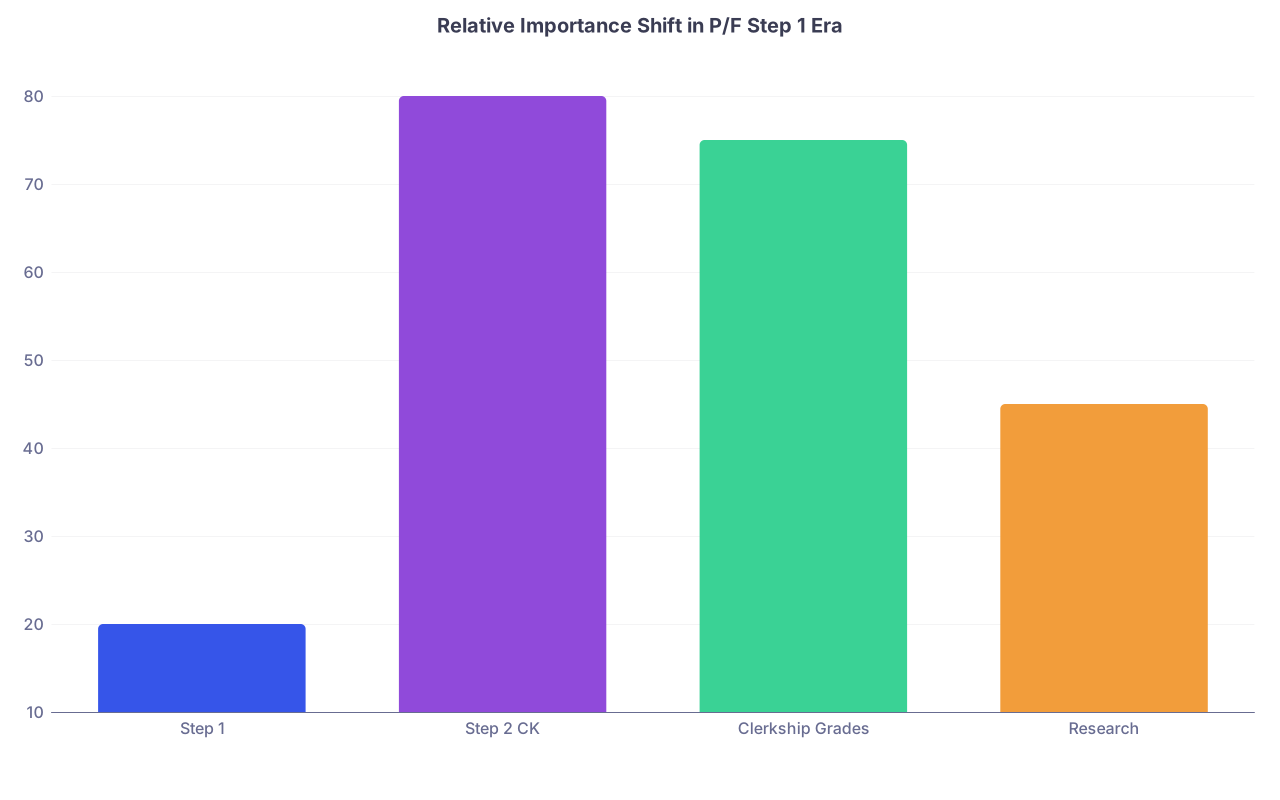
| Category | Value |
|---|---|
| Step 1 | 20 |
| Step 2 CK | 80 |
| Clerkship Grades | 75 |
| Research | 45 |
Post P/F (approximate emphasis)
What did not change:
- You still need strong pathophysiology, pharm, and basic mechanisms to reason through real cases.
- Shelf and Step 2 CK questions still ride heavily on “Step 1-type” knowledge—just in clinical clothing.
So the real game now is:
Use preclinical time to build a clinical-ready brain, not just a test-taking brain.
That means you stop treating “preclinical” and “clinical” as separate phases. You start building clinical reasoning now, even before you have a badge that says “student doctor.”
2. The Core Problem: You Learned Facts, Not Frameworks
Preclinical curricula are very good at stuffing you with:
- Lists (cytokines, bugs, enzymes)
- Pathways (glycolysis, coagulation, RAAS)
- Memorization tricks and mnemonics
They are much worse at teaching you to answer the actual questions you will get paged about:
- “Why is this patient hypotensive?”
- “Is this chest pain stable, urgent, or emergent?”
- “What needs to happen in the next 10 minutes vs next 24 hours?”
So you end up knowing that IL-6 is an inflammatory cytokine but freezing when the intern asks:
“So, what do you think is going on with this patient’s fever and hypotension?”
Here is the shift you must engineer for yourself:
- From: “What is the fact?”
- To: “How do these facts organize into a decision framework?”
You do that in three concrete ways:
- Anchor every preclinical topic to a real clinical vignette.
- Translate mechanisms into “if-then” clinical patterns.
- Practice generating differentials and next steps every single week.
Let me show you how to actually build this.
3. A Weekly Integration Protocol That Actually Works
You do not need your school to redesign the curriculum. You need a weekly integration protocol you follow without fail.
Think of it as “DIY systems-based clinical reasoning training.”
Step 1: Pick 1–2 Core Clinical Problems Each Week
Stop thinking in “lectures” and start thinking in chief complaints.
If your block is cardio, your week might focus on:
- Chest pain
- Dyspnea
If it is neuro:
- Weakness
- Headache
Write them at the top of your notebook or Notion page:
“This week: Chest Pain + Dyspnea”
Step 2: Build a 1-Page Clinical Map for Each Problem
For each chief complaint, create a single page (physical or digital) with:
Top differentials by category
Example – Chest pain:- Cardiac: ACS, stable angina, pericarditis, aortic dissection
- Pulmonary: PE, pneumothorax, pneumonia
- GI: GERD, esophageal spasm, PUD
- MSK: costochondritis, trauma
Key history discriminators (“red flags” and pattern finders)
- Onset: sudden (PE, dissection) vs gradual
- Relation to exertion, breathing, meals
- Radiation (to arm/jaw vs back)
- Associated symptoms (diaphoresis, syncope, hemoptysis)
High-yield exam findings
- Pericarditis: positional, pleuritic, improved by sitting up
- PE: tachycardia, hypoxia, pleuritic pain
- Dissection: pulse deficits, different BPs between arms
First-line workup
- EKG, troponins, CXR
- D-dimer/CTA if PE suspected
- +/- echo in unstable or murmur
You can build these from:
- Boards-style resources (AMBOSS, UWorld explanations)
- Pocket handbooks (Pocket Medicine, Step-Up to Medicine)
- Online outlines (e.g., UpToDate sections your school gives access to)
Refuse to let a week go by without at least two of these pages. That is your bridge.

Step 3: Tie Preclinical Content into That Map
Now, as you go through your basic science lectures:
- Every time you learn a disease, plug it into where it fits on one of your maps.
Example: You have a lecture on stable angina vs NSTEMI vs STEMI.
Do this:
- Put “stable angina” under chronic exertional chest pain, predictable, relieved by rest/NTG.
- Put NSTEMI/STEMI under acute coronary syndrome – unstable plaque.
- Under each, write:
- Pathophys: fixed vs ruptured plaque, partial vs complete occlusion
- Key lab/EKG: troponin normal vs elevated; ST depression vs elevation
- Clinical decisions: outpatient vs urgent vs emergent cath
Now you have linked:
- Pharmacology (beta-blockers, nitrates, antiplatelets)
- Pathology (atherosclerosis, plaque rupture)
- Physiology (myocardial O2 demand/supply)
To a specific decision point: “Is this chest pain unstable ACS that needs the cath lab now?”
That is bridging.
Step 4: Do 5–10 Mixed Clinical Vignettes Every Day
Not just “preclinical-style” questions.
You need clinical vignettes that:
- Start with a complaint
- Give you vitals, labs, and some exam
- Force you to decide:
- What is the most likely diagnosis?
- What is the next best step in management?
- What finding best explains this presentation?
Use:
- UWorld (mix Step 1 and Step 2-style questions for systems you know)
- AMBOSS
- NBME-style practice questions
Do less volume, more depth. After each question:
- Ask: “Which clinical map does this fall under?”
- Add any new discriminating features to your one-page map.
You are building pattern recognition + mechanistic depth simultaneously.
4. How to Use Step 1 P/F to Your Advantage (Instead of Coasting)
A pass/fail exam can make you lazy if you let it. Or it can free up capacity to build a much stronger clinical foundation.
Here is the disciplined way to use the P/F era.
A. Redefine What “Passing” Really Means
If your mental bar is “barely scrape a pass,” you are setting yourself up to be exposed on:
- Shelf exams
- Step 2 CK
- Wards
Define your personal standard like this:
“If I sat for Step 1 tomorrow with numerical scoring restored, I could land at least a 230+.”
Why 230? Not because the number itself matters anymore, but because:
- It reflects solid systems-based knowledge
- It typically parallels a strong Step 2 CK and shelves
- It forces you to study for understanding, not just minimal survival
You never tell a PD your “would-be” score. This is for you as an internal standard.
B. Re-Balance Your Study Time
In the old world, people spent absurd hours memorizing minutiae because half a point could move a percentile.
In the P/F world, your allocation should shift:
| Activity Type | Old World (%) | New World (%) |
|---|---|---|
| Pure memorization (facts) | 40 | 20 |
| Conceptual understanding | 30 | 35 |
| Clinical integration/questions | 20 | 35 |
| Reflection / error analysis | 10 | 10 |
Use the “freed” time from chasing perfection in minutiae to:
- Build clinical maps
- Do mixed vignettes
- Practice oral case presentations (yes, even as MS1–2)
C. Start “Thinking Like Step 2 CK” Early
When you do any question, add one more step:
- After answering:
- Ask: “If this were written as a Step 2-style vignette, what would change?”
- Maybe the same pathology shows up as:
- A post-op complication
- A pregnancy-related issue
- An ED scenario vs outpatient follow-up
You are training your brain that pathophysiology is portable — same mechanisms, different clinical context.
5. Concrete Tools to Build Clinical Thinking Before the Wards
You can dramatically shorten the “lost and useless on day one of clerkships” phase if you start using clinical tools early.
Tool 1: SOAP Notes for Practice Questions
Do not wait for third year to learn how to structure clinical thinking.
Once a day, pick a UWorld/AMBOSS vignette and force yourself to write a mini SOAP note:
- S – One sentence summary of the story
- O – Extract the key vitals and exam/labs
- A –
- Most likely diagnosis
- 2–3 alternative diagnoses and why they are less likely
- P – Immediate next step (test, treatment, or disposition)
You will be terrible at this at the beginning. Good. That is the point.
Over months, you will:
- Speak more clearly on rounds.
- Think in a structured, prioritized way.
- Already “sound clinical” before your first clerkship.
Tool 2: The 3-Level “Why” Drill
For any disease you learn, do this quick exercise:
- Why is this happening? (pathophysiology)
- Why does that produce these symptoms/findings? (mechanism → presentation)
- Why do we use this treatment? (mechanism → therapy)
Example: Systolic heart failure
- Why happening?
- Decreased contractility → reduced EF → neurohormonal activation
- Why these symptoms?
- Low forward output → fatigue, renal hypoperfusion
- High LVEDP → pulmonary congestion → dyspnea, orthopnea
- Why these drugs?
- ACEi/ARB: block RAAS → decrease afterload and remodeling
- Beta-blockers: blunt sympathetic activation, improve survival
- Diuretics: decrease congestion but no mortality benefit
You will notice: questions on shelves and CK repeatedly test those exact linkages.
Tool 3: Ward-Focused Reading While Still Preclinical
Pick one slim but clinically dense book and read it slowly throughout MS1–2:
- “Step-Up to Medicine”
- “Pocket Medicine” (especially the intro sections for each problem)
- “Symptom to Diagnosis” (fantastic for chief-complaint thinking)
Do not read cover to cover. Read around your preclinical block.
For example, during renal block:
- Read the CKD, AKI, and electrolyte disturbance sections in Step-Up.
- Look at how they are organized around clinical decisions, not just pathology slides.
You will start noticing:
- How real medicine is practiced
- How your basic science material feeds into those decisions
6. The Hidden Curriculum: How to Impress on Wards Using Preclinical Knowledge
Here is a blunt truth I have watched play out on rounds:
- Student A: Scored >250 on Step 1 but cannot explain their plan out loud.
- Student B: Step 1 P/F era, strong internal frameworks, explains their reasoning clearly.
Residents and attendings remember Student B. They write the letters for Student B.
Your goal is not just to “know more.” It is to use what you know in a way that makes you look like a budding intern.
Here is how you convert preclinical knowledge into “looks strong on the wards.”
A. Always Tie Your Statements to a Clinical Consequence
Bad student answer:
“The patient has hyperkalemia because of decreased aldosterone.”
Better student answer:
“I think this is type 4 RTA due to hypoaldosteronism, which explains the mild metabolic acidosis and hyperkalemia. That is why we are seeing peaked T waves on the EKG and why correcting the K matters urgently.”
Same knowledge. Different impact.
B. Use the “One-Line Summary + Reason” Format
When you give an answer or suggestion, structure it:
“I think X, because Y and Z.”
Examples:
- “I think this is pre-renal AKI because the BUN:Cr is elevated and the urine Na is low.”
- “I would start a high-intensity statin because this is secondary prevention after MI.”
Your preclinical years should be used to stockpile those “because” chains.
C. Practice Micro-Presentations Now
Once or twice a week, teach a classmate (or an empty room) a 2-minute explanation of a disease you just learned, as if on rounds:
- 1 sentence: definition and context
- 3–4 sentences: key pathophys → classic presentation
- 1–2 sentences: diagnosis and management principles
Examples: “Teach me COPD.” “Teach me DKA.” “Teach me PE.”
You are training the skill that will separate “smart but quiet” from “confident and impressive” on the wards.
7. Protecting Yourself From Common Traps in the P/F Era
The P/F Step 1 era created new failure modes. I see them consistently.
Here are the big ones and how to avoid them.
Trap 1: Coasting Preclinically, Panicking Later
Pattern:
- MS1–2: “It’s pass/fail, I just need to get through.”
- End of MS2: “Oh. Step 2 CK and shelves actually matter. A lot.”
- Result: Frantic catch up, weak foundations, burned-out M3.
Fix:
- Adopt a Step 2-first mindset now.
- Anything you learn in preclinical, ask: “How will this show up on a real patient and on Step 2 CK?”
Trap 2: Over-Indexing on Flashcards, Under-Indexing on Cases
Flashcards are addicting. They feel productive. You watch the “due cards” number go down and think you are winning.
Reality:
- Flashcards = great for facts
- Terrible for clinical reasoning, integration, and prioritization
Fix:
- Cap pure flashcard time at ≤40% of your study block.
- Replace the extra with:
- 5–10 mixed vignettes daily
- Building/refreshing your clinical maps
- Short SOAPs and micro-presentations
Trap 3: Treating Step 1 Material as “Over Once I Pass”
This is brutal: the same renal physiology you hated will come back for:
- Shelf exams
- Step 2 CK
- Intern year when your attending asks, “Why is this patient hyponatremic?”
Fix:
- Use a spaced spiral approach:
- Every 4–6 weeks, do a mini-review of one prior system (20–30 targeted questions + skim your maps).
- Keep a “parking lot” of weak points and deliberately revisit them.
The test score is P/F. The knowledge is not.
8. A Roadmap: What to Do at Each Phase
Let me give you a concrete sequence based on where you are.
If You Are Early MS1
Focus on:
- Building a habit: one clinical map per week minimum
- Learning how to write tiny SOAPs from questions
- Reading 3–4 pages per week from a clinical text (Step-Up, Symptom to Diagnosis) that match your block
Your win condition: By end of MS1, you can say, “For chest pain, dyspnea, fever, and abdominal pain, I have a reasonable mental framework.”
If You Are Late MS1 / MS2 Pre-Dedicated
Focus on:
- Upping clinical question volume (5–15/day) in systems you have covered
- Aggressively linking every pathology you learn to:
- A chief complaint
- A clinical map page
Start:
- Practicing 2-minute micro-presentations weekly
Your win condition: By dedicated, you are not just memorizing content; you are refining frameworks.
If You Are in Dedicated for Step 1 (P/F World)
Do not study like people did for the 260 chase.
Your pillars:
- High-yield Step 1 resources (UWorld, AMBOSS, Anki)
- Plus daily clinical thinking reps:
- 5–10 Step 2-style or shelf-style questions in your main system of the day
- Quick SOAP-style thinking for at least one question
Your win condition: You pass Step 1 comfortably and walk into M3 with momentum, not just relief.
If You Are About to Start Clerkships
Focus on:
- Re-reading your maps for the big complaints: chest pain, dyspnea, abdominal pain, fever, altered mental status, weakness, back pain, trauma
- Doing a tightly focused block of:
- 20–30 IM-style vignettes
- 20–30 surgery/EM-style vignettes
Also:
- Practice 5 oral case presentations (grab a friend or record yourself).
Your win condition: On day one of wards, you do not feel like a total beginner. You have language, structure, and enough pattern recognition to be useful.
9. The Future: Why This Matters More Than You Think
Medicine is moving fast:
- More AI decision support
- More protocols and order sets
- More pressure to be efficient
Ironically, that makes strong human clinical reasoning more—not less—valuable.
Machines can:
- List all possible causes of hyponatremia
- Suggest guideline-directed therapy
They are much worse at:
- Prioritizing when you have incomplete data
- Weighing context, nuance, patient preferences
- Seeing the pattern that “does not fit” and catching disaster early
Bridging preclinical to clinical is not just about exams. It is about:
- Training yourself to see patterns, not isolated facts
- Speaking in a way that earns trust from patients and seniors
- Being the person on the team who actually understands why things are happening
That will survive every exam change and every new guideline.
Open your notes or your tablet right now and do one thing: pick a single chief complaint (chest pain, fever, abdominal pain) and build a one-page clinical map for it. Plug in three diseases you just learned and connect the mechanisms to the presentation and first-line management.
That page is the first real bridge between your preclinical grind and the clinician you are trying to become.