
The pass–fail Step 1 era did not make things easier. It just changed the rules of who wins.
Programs still need ways to sort applicants. Step 1 used to be the lazy filter. Now they are shifting weight to Step 2, school reputation, clinical performance, letters, and your “story.” If you do not adapt to that reality, you get buried in the noise.
You asked for a blueprint. Here it is. Four pillars. MS1 through MS4. Very concrete, very tactical.
The New Game: What Actually Matters Now
Let me be direct: in the pass–fail era, competitive programs quietly reweighted their screen.
Here is roughly how your “scorecard” looks now for most residencies (obviously it varies by specialty, but the pattern is real):
, Clerkship Grades/Evals, [Letters & Reputation](https://residencyadvisor.com/resources/step1-pass-fail-era/crafting-lor-requests-that-compensate-for-missing-step-1-numbers), [Research & Scholarly Work](https://residencyadvisor.com/resources/step1-pass-fail-era/how-research-and-class-rank-quietly-became-the-new-step-1), Personal Factors (story, fit, leadership)](https://cdn.residencyadvisor.com/images/articles_svg/chart-approximate-relative-weighting-in-step-1-p-f-era-3306.svg "Approximate Relative Weighting in Step 1 P/F Era")
| Category | Value |
|---|---|
| [Step 2 CK](https://residencyadvisor.com/resources/step1-pass-fail-era/how-to-pivot-your-study-plan-from-step-1-scores-to-step-2-mastery) | 30 |
| Clerkship Grades/Evals | 25 |
| [Letters & Reputation](https://residencyadvisor.com/resources/step1-pass-fail-era/crafting-lor-requests-that-compensate-for-missing-step-1-numbers) | 20 |
| [Research & Scholarly Work](https://residencyadvisor.com/resources/step1-pass-fail-era/how-research-and-class-rank-quietly-became-the-new-step-1) | 15 |
| Personal Factors (story, fit, leadership) | 10 |
What changed with Step 1 pass–fail:
- Step 2 CK is now the main objective score.
- Clerkship grades and narrative comments carry more weight.
- Letters from people programs know and respect matter even more.
- Research is now less “nice-to-have” and more “expected” in competitive fields.
- How you present your trajectory from MS1–MS4 (coherent story) is under the microscope.
Step 1 is still significant in three ways:
- You must pass on the first attempt. A fail is an anchor on your application.
- Solid Step 1 foundations make Step 2 much easier. The content overlaps massively.
- A strong performance (even if just P) shows in how you perform on shelves and in clinics. Good reasoning, fast recall, calm under pressure.
Your advantage now comes from being the person who plays the whole game well. The four pillars below structure that.
Pillar 1 – Academic Mastery Without Chasing a Step 1 Number (MS1–MS2)
Your goal for basic science years is different now:
- Before: maximize a three-digit score.
- Now: guarantee a clean pass, build deep understanding, and lay a foundation for Step 2 and shelves.
Core Principles MS1–MS2
Curriculum First, Boards as a Layer on Top
Do not be that MS1 living exclusively in Pathoma and Boards & Beyond while ignoring your school’s curriculum. Faculty still write your exam questions. Fail a block and suddenly you are “academic risk” in your dean’s letter.
Practical approach:
- For each block:
- Master school objectives and lecture material first.
- Use board resources (Pathoma, Sketchy, Boards & Beyond, AnKing deck) to reinforce and connect.
- Study flow for a topic (e.g., nephrotic syndrome):
- Skim lecture slides / syllabus.
- Watch the relevant short board video.
- Do 10–15 related questions (AMBOSS, UWorld early if your school allows).
- Add / review Anki for key facts.
- For each block:
Anki, but with Discipline
Anki can either make you or drown you.
Use it like this:
- Start with a curated deck (e.g., AnKing) aligned to your curriculum.
- Cap new cards per day – usually 40–80 for MS1, 80–120 for MS2 depending on comfort and schedule.
- Daily rule: never go to bed with reviews undone. If the number is unmanageable, you are adding too many new cards.
- Suspend low-yield or redundant cards aggressively. You are not paid by the card.
Q-Bank Strategy in the P/F Era
You are not gaming a score anymore; you are building reasoning patterns.
For MS1–early MS2:
- Start with system-based question banks that mirror your curriculum: AMBOSS or Kaplan-type resources.
- Use blocks of 10–20 timed or tutor mode, then review in detail.
- Track why you miss questions:
- Knowledge gap?
- Misread question?
- Overthinking or rushing?
- Make focused notes or limited Anki from your misses. Do not turn every explanation into twenty cards.
For late MS2 (6–9 months before Step 1):
- Gradually transition to UWorld dedicated for Step 1.
- Target: finishing UWorld once before your exam, with 70–80% completed at minimum.
Example Weekly Structure (MS1, Organ System Block)
| Day | Focus |
|---|---|
| Mon–Thu | Lectures, 40–60 Anki, 10–20 Qs/day |
| Fri | Light review, catch-up Anki, 20 Qs |
| Sat | 40–60 Qs mixed, big-picture review |
| Sun | Rest AM, 30–40 Anki PM, plan week |
Dedicated Step 1 Time: How to Use It Now
Most schools still give you 4–8 weeks. Your job is not to chase a 260, it is to convert “I kind of know this” into “I will not fail.”
Non-negotiables:
- NBME Baselines: Take an NBME at the start of dedicated.
- If you are close to the passing cut (e.g., borderline prediction), extend or rethink your plan.
- Finish UWorld at least once, focusing on:
- System-based or mixed blocks of 40 timed.
- Full review of rationales, especially why correct answers are correct.
- Short content passes:
- Pathoma 1–3x for pathology.
- Sketchy micro + pharm review.
- Rapid review style resource (First Aid, Boards & Beyond quick hits).
If your NBME predictions are comfortably above passing, you do not need to grind yourself into dust for a vanity outcome no one will see. Reinvest any extra capacity into setting up for Pillar 2 and Pillar 3 (research and clinical prep).
Pillar 2 – Strategic Differentiation: Research, Projects, and a Coherent Story (MS1–MS4)
In a pass–fail world, your trajectory matters more. You need something beyond “I went to class and passed Step 1.”
You need a story that sounds like:
“From MS1 to MS4, I consistently did X in Y field, with increasing responsibility and output.”
Step 1 P/F Era Reality: Research Expectations
Let us be blunt. For competitive specialties (derm, ortho, plastics, neurosurgery, ENT, rad onc):
- You are competing with applicants with 10–30+ PubMed-indexed items.
- Programs scan ERAS for publications like they used to scan for 260+ scores.
For mid-competitive fields (EM, radiology, anesthesiology, GI through internal medicine, etc.):
- A few meaningful projects, ideally with at least one publication or strong poster at a national meeting, is a solid differentiator.
For less competitive fields:
- Research is helpful but not mandatory.
- Leadership, service, and strong clinical performance can carry more weight.
How to Start in MS1 (Even If You Have No Connections)
Here is the step-by-step playbook I have seen work repeatedly.
Pick 1–2 possible interest areas (not ten).
Example: interested in cardiology and critical care.
Identify active faculty:
- Search your school’s department sites and PubMed.
- Look for:
- Ongoing clinical trials.
- Frequent publications in the last 2–3 years.
- Titles like “Director,” “Chief,” “Fellowship Director.”
Send a concise, targeted email:
Subject:
MS1 interested in [field] research – willing to helpBody (keep it short, something like):
Dear Dr. Smith,
I am a first-year medical student interested in cardiology and clinical outcomes research. I read your recent paper on acute coronary syndromes in older adults and found the focus on ED triage particularly compelling.I have basic experience with Excel and am currently working through an online R course. I am reliable, available [X hours/week], and very willing to help with data collection, chart review, or literature review on ongoing projects.
Would you be open to a brief 15–20 minute meeting to see if there is any way I could contribute to your work?
Sincerely,
[Name], MS1You will get ignored sometimes. That is fine. Send 10–15 of these thoughtfully, not spammy.
Once you get in the door, be the reliable workhorse
- Show up early.
- Turn around tasks before the deadline.
- Ask for clear authorship expectations once you have contributed substantial work.
- Volunteer for the unglamorous stuff: chart review, data entry, literature tables.
Building a Research Timeline by Year
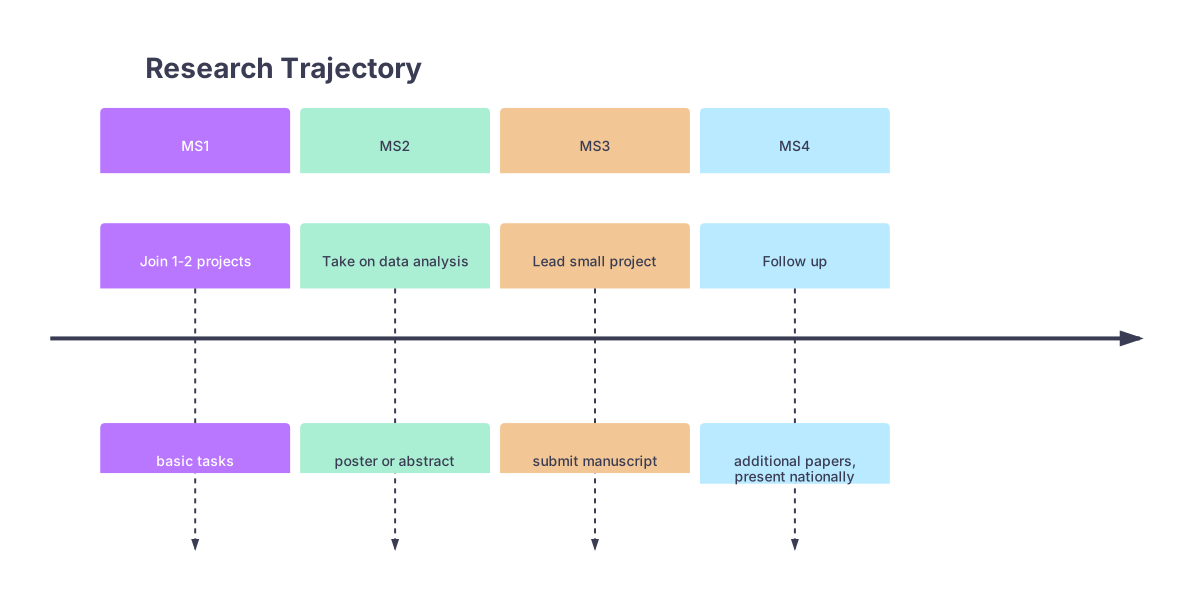
| Period | Event |
|---|---|
| MS1 - Join 1-2 projects | basic tasks |
| MS2 - Take on data analysis | poster or abstract |
| MS3 - Lead small project | submit manuscript |
| MS4 - Follow up | additional papers, present nationally |
That is what a coherent story looks like in your application:
- MS1: Joined Dr. Smith’s outcomes project on ACS.
- MS2: Helped with data analysis; presented at regional conference.
- MS3: Led a sub-study on older adults, first-author abstract.
- MS4: Co-authored manuscript, presented at national cardiology meeting.
Align that with your Step 2 CK timing and clerkship performance, and now P/F Step 1 is an afterthought. Programs see tangible commitment and productivity.
Pillar 3 – Clinical Excellence and Step 2 Dominance (MS3–MS4)
This is where the game is won or lost now.
Step 1 is P/F. Step 2 is not. Your MS3 evaluations are not. Your letters certainly are not.
Step 2 CK: The New Number That Matters
Most competitive programs now think something like this:
- Step 1 P/F: “Fine, did they pass first attempt?”
- Step 2 CK: “This is our standardized filter now.”
Look at typical Step 2 CK means for competitive fields (approximate, varies per year):
| Specialty | “Comfortable” Target Score |
|---|---|
| Dermatology | 250+ |
| Plastic Surgery | 250+ |
| Orthopedics | 245–250+ |
| ENT | 245–250+ |
| Radiology | 240–245+ |
If you are aiming at primary care or less competitive fields, life is less brutal, but a strong Step 2 can still open doors.
Step 2 CK Prep Strategy – Without Burning Out During Clerkships
The key is building “Step 2 habits” during MS3, not cramming in a 4-week panic.
Use every clerkship as Step 2 prep
- For each rotation:
- Use UWorld Step 2 questions for that clerkship (IM, surgery, OB, peds, psych, FM).
- Aim to finish that subject’s UWorld questions by the end of the rotation.
- Do 10–20 questions daily, even on busy days. That muscle memory is gold.
- For each rotation:
NBMEs and Shelf Exams
- Shelf exams are mini-Step 2s.
- Take at least 1–2 NBME-style practice exams for big rotations (IM, surgery).
- Review them like you would Step 2.
Dedicated Step 2 Time
Most schools give 4–8 weeks.
Use it like this, roughly:
- Week 1–2:
- Identify weak areas from shelves / UWorld stats.
- Heavy question volume (60–80 Qs/day) with intense review.
- Week 3–4:
- Mixed blocks only, 40–80 Qs/day.
- 1 practice exam per week (NBME or UWSA).
- Final 1–2 weeks:
- Maintain question volume.
- Light content review of weak topics.
- Simulate test-day conditions at least once.
- Week 1–2:
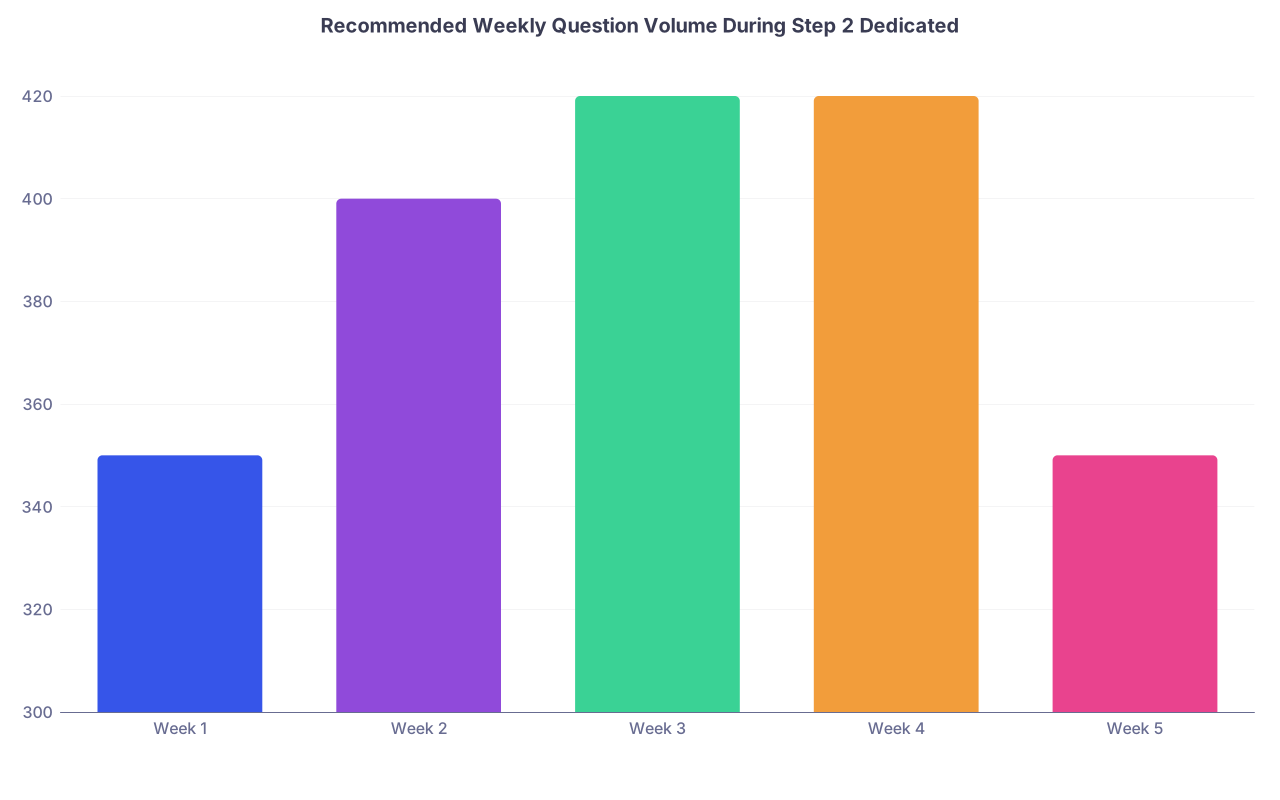
| Category | Value |
|---|---|
| Week 1 | 350 |
| Week 2 | 400 |
| Week 3 | 420 |
| Week 4 | 420 |
| Week 5 | 350 |
You do not have to hit these exact numbers. The point is consistent, high-quality exposure.
Clinical Grades: How to Actually Get “Honors”
In a P/F Step 1 world, “Honors in core rotations” is now a major flex.
No magic here. But there are levers.
Day 1 Script with Each Attending and Resident
I have watched students change their evaluation trajectory in 30 seconds with this.
On day 1, say something like:
“I want to be upfront that I really want to perform at a high level on this rotation. Could you tell me what an ‘excellent’ student looks like for you? And if you see anything I can improve, I would really appreciate blunt feedback early so I can adjust.”
This:
- Signals motivation.
- Gives them permission to correct you.
- Plants “excellent student” in their mind from the start.
Be Visible Without Being Annoying
- Arrive early. Not 3 hours early. Fifteen to thirty minutes.
- Volunteer for tasks that offload others:
- Call consults.
- Follow up labs.
- Update families (when appropriate).
- Pre-chart.
- Ask for 1–2 “teaching points” per day, not 20.
Shelf Strategy Integrated with Clinical Work
- Use patient cases as anchors:
- See a COPD exacerbation? That night, do 10–15 UWorld questions on COPD and respiratory failure.
- Build a small running document:
- “Things that confused me today”
- Spend 30–45 minutes nightly clarifying them.
- Use patient cases as anchors:
Mid-Rotation Feedback Is Mandatory
Halfway through, explicitly ask:
“I really want to perform at the honors level. Based on what you have seen so far, am I on track? And is there one specific behavior I could change this week to improve?”
Then actually fix the thing they name. Quickly. People notice.
Pillar 4 – MS4, ERAS, and Turning Your Trajectory into an Obvious “Yes”
By MS4, your record is mostly written.
- Step 1: P or F (hopefully P, first attempt).
- Step 2: your actual number.
- Clerkship grades: locked.
- Research: mostly matured into abstracts, posters, maybe papers.
Now the work is about packaging and targeting.
Choosing Programs Strategically
Do not apply blindly to 80 programs because a Reddit thread told you to.
Think like this instead:
Honestly assess your competitiveness
Relevant variables:
- Step 2 score relative to national means in your chosen specialty.
- Number and quality of publications / presentations.
- Clerkship grades and class ranking.
- School reputation and geographic region.
Create tiers
For your specialty, divide target programs into:
- Reach (you are below their typical metrics, but have a hook).
- Realistic.
- Safety (you match or exceed their usual profile).
Use data from NRMP, program websites, and your advisors
If ten recent grads from your school matched at Program X, that is a green flag.
If no one has ever matched into derm from your school in ten years, that is a message.
Personal Statement and Application: Telling a Coherent Story
Your application should read like a 4-year narrative, not a scatter plot.
Ask yourself:
Is there a clear interest arc?
(Example: MS1 free clinic → MS2 QI project on transitions of care → MS3 IM honors + sub-I → research in readmission reduction → applying to internal medicine.)Do your letters, activities, and statement all reinforce the same theme?
Step 1 P/F can actually help you here. Programs cannot fixate on a single number. They must look at:
- Your sustained interest.
- Your maturity.
- Your performance over time.
So write your personal statement to highlight that trajectory:
- Where you started.
- Pivotal experiences.
- Increasing responsibility and impact.
- Why this specialty is the logical extension.
Away Rotations (If Relevant to Your Field)
Some specialties (ortho, derm, neurosurgery, EM, ENT, plastics) heavily weight away rotations.
Treat them as month-long interviews:
- Show up earlier than everyone.
- Read on every case the night before.
- Ask for feedback in week 1 and week 3.
- Make it obvious you are committed to that specialty, not “shopping.”
Pulling It All Together: Your 4-Pillar MS1–MS4 Blueprint
Let us visualize the whole plan as a simple flow.

| Step | Description |
|---|---|
| Step 1 | MS1 Start |
| Step 2 | Solidify study system |
| Step 3 | Join 1-2 research projects |
| Step 4 | Strong Step 1 prep - pass first attempt |
| Step 5 | MS3 clerkship excellence |
| Step 6 | Step 2 CK high score |
| Step 7 | MS4 targeted applications |
| Step 8 | Match |
And here is how your time and focus evolve:
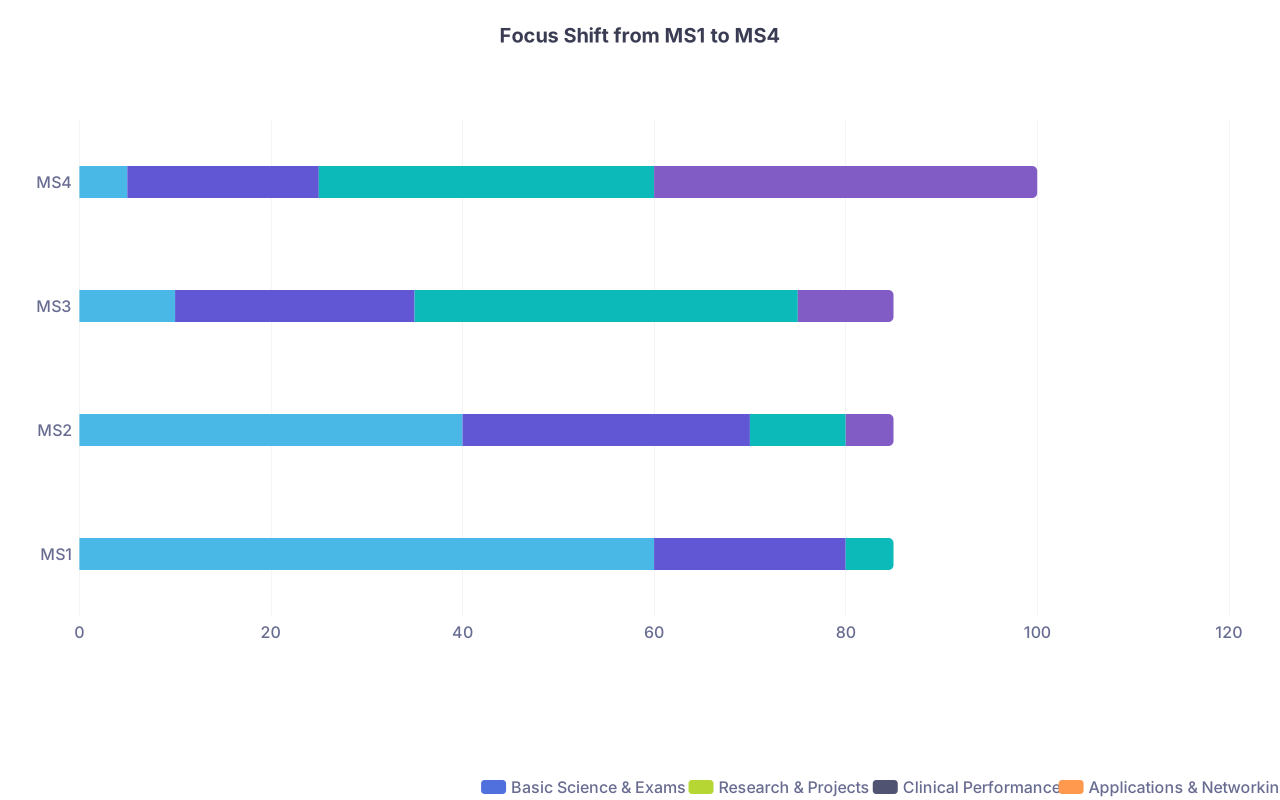
| Category | Basic Science & Exams | Research & Projects | Clinical Performance | Applications & Networking |
|---|---|---|---|---|
| MS1 | 60 | 20 | 5 | 0 |
| MS2 | 40 | 30 | 10 | 5 |
| MS3 | 10 | 25 | 40 | 10 |
| MS4 | 5 | 20 | 35 | 40 |
Two Non-Negotiables You Cannot Ignore
Before we wrap, two things I have seen derail people more than anything else in the pass–fail era:
Mental health and burnout management are no longer “optional.”
You cannot brute-force your way through 4 years, 2 board exams, and 6+ core clerkships without some kind of system:
- Protected time off weekly (actually off).
- Basic sleep hygiene.
- Some form of exercise.
- Willingness to seek help early when you are sliding.
Programs are not impressed by wreckage. They want consistent performance.
Professionalism now matters more because scores matter less.
Late, disorganized, combative, or unreliable?
That shows up in dean’s letters and in whispered phone calls between PDs.The student who is “rock solid, shows up, does the work, pleasant to be around” wins a lot more now that ranking cannot just be outsourced to a score.
Key Takeaways
- Step 1 being pass–fail did not make things easier; it redistributed weight to Step 2, clinical performance, research, and your 4-year trajectory.
- Use MS1–MS2 to build a ruthless study system, pass Step 1 cleanly, and lay foundations for Step 2 while embedding yourself in 1–2 research lanes.
- Treat MS3–MS4 as your proving ground: honor your cores, crush Step 2, deepen your niche, and package your story so that Step 1 P/F becomes irrelevant background noise instead of your defining feature.