
The idea that Step 1 going pass/fail “leveled the playing field” is largely fantasy. It shifted the game. It did not make it fair.
Let me walk you through who actually won, who quietly lost, and how programs are really behaving now that the sacred three‑digit Step 1 score is gone.
What everyone said P/F Step 1 would do
The narrative before the change was almost utopian:
- Less anxiety and burnout
- More focus on learning medicine, not memorizing minutiae
- Less overreliance on a single test score
- Better chances for “late bloomers” and non‑traditional students
- A fairer process for students from less‑known schools or disadvantaged backgrounds
And program directors and deans went on record saying they’d “holistically” review applications and “de‑emphasize metrics.”
Sounds nice. Also, incomplete at best and misleading at worst.
Because once you remove one hard number from a hyper‑competitive funnel, the pressure doesn’t disappear. It moves.
What the data actually shows: the pressure just shifted
The NBME and NRMP did not release some massive RCT, but there’s enough early data, survey results, and on‑the‑ground behavior to see the pattern.
Here’s the short version:
Step 1 P/F redistributed importance to:
- Step 2 CK scores
- School reputation
- Class rank / AOA / clerkship grades
- Research output
- Networking, home programs, and audition rotations
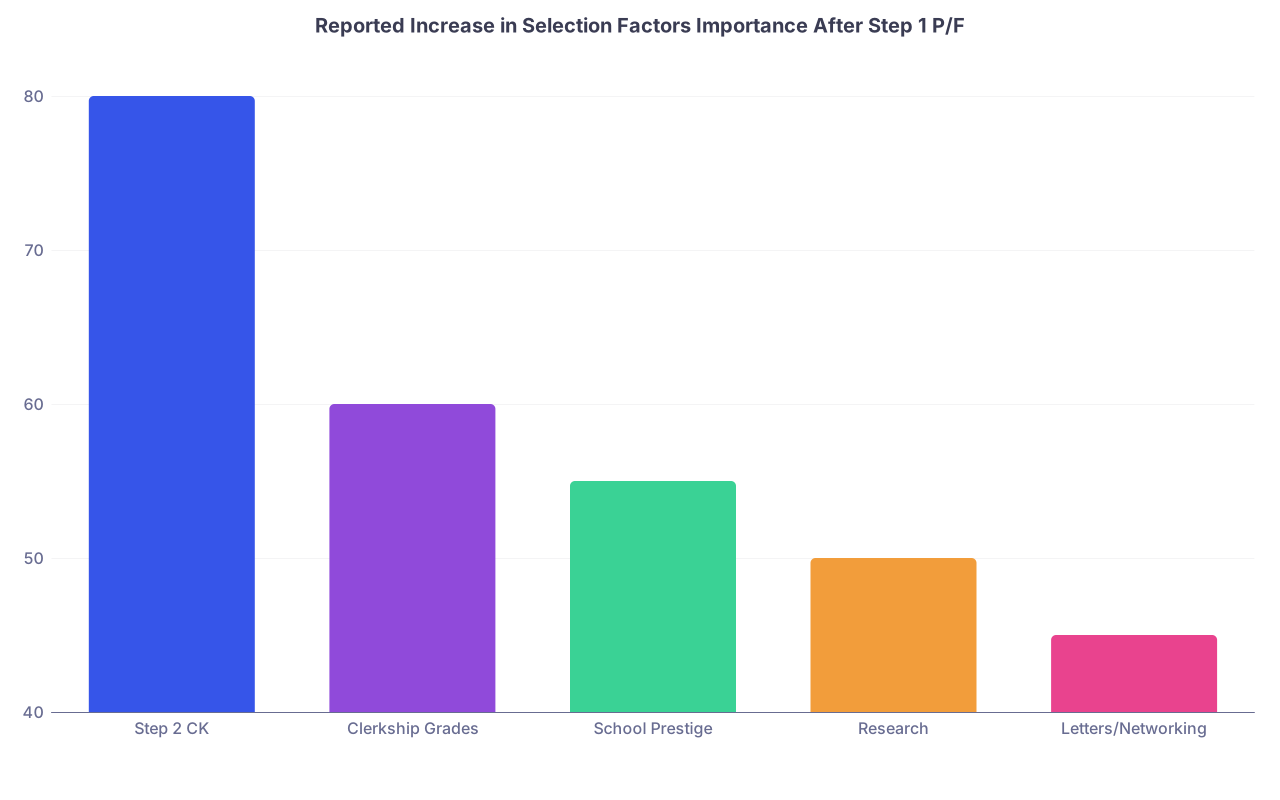
| Category | Value |
|---|---|
| Step 2 CK | 80 |
| Clerkship Grades | 60 |
| School Prestige | 55 |
| Research | 50 |
| Letters/Networking | 45 |
(Values here reflect the general pattern in PD survey reports: majority of programs say Step 2, grades, and prestige now matter more.)
So did anyone “win”? Yes. But it’s not the group everyone keeps talking about.
Winner #1: Students at Top‑Tier Schools
Let’s be blunt. If you’re at Harvard, UCSF, Penn, Hopkins, etc., Step 1 going P/F is a net win for many of you.
Before P/F, a student at a mid‑tier or international school with a 255–260 could stand shoulder‑to‑shoulder on paper with an Ivy student who scored the same. Programs saw that number and had to reckon with it.
Now?
- “School brand” quietly moved up the hierarchy.
- PDs openly admit in NRMP and specialty surveys that they use “school reputation” as a screening tool when objective metrics are weaker or fewer.
- Without a high three‑digit Step 1 to force their attention, they default to what feels safe: known schools, known curricula, known letters.
In other words, the Step 1 exam used to be a rare equalizer: a student from “Unknown State Med” with a 260 forced a second look from a competitive derm or ortho program. That student now has a much harder time standing out on paper.
For top‑tier schools, the absence of that equalizer is convenient.
Winner #2: Average test‑takers in low- to mid‑competitive specialties
If your natural testing ceiling was around 220–230 back in the numeric era, but you’re going into family medicine, psych, peds, PM&R, or internal medicine without chasing the hyper‑elite programs, P/F Step 1 probably helped you.
Why?
- You avoided being prematurely filtered out by arbitrary Step 1 cutoffs.
- Programs in these specialties are more willing to buy the “holistic” story because they have less insane applicant-to-spot ratios.
- Step 2 CK matters, but some of these fields are genuinely more tolerant of modest scores if the rest of the app is solid.
Does this mean there’s no pressure? No. It just means you can survive with a more “human” academic profile if your field is not among the top 5 bloodbaths.
Winner #3: People who are good at playing the whole game
Students who:
- Build relationships with faculty early
- Get onto multi‑author papers or case reports
- Lock in strong clinical evals and honors in key clerkships
- Plan away/audition rotations strategically
Those people quietly improved their odds with P/F Step 1. The application is now more “portfolio‑based,” which favors people who can marshal time, connections, and planning over years. Not just those who can lock themselves in a room for 3 months and crush a test.
That’s not necessarily fair, but it’s real.
The quiet losers: who actually got burned
Now the part no one likes to say out loud.
Loser #1: High‑achieving students at non‑elite or unranked schools
The kid at “Regional State University SOM” who would’ve scored a 255–265 on Step 1? The one who could have used that number to wedge open doors at top radiology, ortho, derm, ENT, or plastics programs?
That person lost a weapon.
Before: Programs might ignore their school until they saw the score and research, then think, “OK, we should at least interview them.”
Now: That same student just looks like “another pass” on Step 1 from a school they barely know, buried under 1,000+ applications from places they do know.
And no, Step 2 CK doesn’t completely fix this, because:
- Step 2 happens later → less time for programs to factor it into initial interview invites, especially in early-specialty timeline pressure.
- Some programs explicitly tell students they “prefer” or “strongly encourage” having Step 2 CK done early, but not all do. There’s inconsistency.
- By the time Step 2 scores land, many interview slots are effectively mentally committed.
So the student whose talent would have popped early on Step 1 is now easier to miss.
| Group | Why They Lost |
|---|---|
| High scorers at mid/low-tier MD/DO | Lost a key equalizer vs brand-name |
| Strong IMGs | Fewer chances to prove equivalence |
| Late bloomers with big Step 1 jump | Early breakout no longer visible |
| Students without strong mentors | Harder to shine without targeted support |
Loser #2: Strong IMGs and FMGs
This one is brutal.
For years, the unofficial triage for international grads was:
- “Do they have a 240+ (or 250+) Step 1?”
- If yes → maybe we look past the unfamiliar school.
- If no → bin.
Was that crude? Yes. But at least there was a path. Outwork everyone, crush the exam, and you had a shot at interviews you’d never get on pedigree alone.
Now:
- “Pass” on Step 1 tells programs almost nothing.
- They lean even harder on school reputation, visa status, and Step 2 cutoffs.
- Highly competitive fields that were already rough for IMGs are in many cases even less accessible.
And no, a 265 Step 2 alone doesn’t fully replace the old “double 250+” halo. Especially when Step 2 is later and often interpreted in the context of an already skeptical filter for IMGs.
Loser #3: Late academic bloomers
Some students find their footing late:
- Rough M1 year adjusting to med school
- Mediocre pre‑clinicals
- Then something clicks. They crush Step 1 and use that number to rebrand themselves.
Those people lost a visible turning point.
If your first big academic breakout now is Step 2, the timing is worse:
- It’s closer to ERAS deadlines.
- You have less time for that new narrative to percolate through letters, research invitations, and away rotations.
- Some programs barely update their mental model of you if they saw weak early performance and only later see the big Step 2 score.
Again, not impossible. Just harder to use a single moment to change your trajectory.
The new king: Step 2 CK (and it’s not subtle)
Let’s kill this myth: P/F did not “de‑testify” the process. It moved the weight.
NRMP Program Director surveys after the change show a consistent theme:
- More programs now require or “strongly prefer” Step 2 CK by the time they review applications.
- Many specialties report Step 2 CK as a top factor in interview decisions.
- Internal notes from faculty I’ve worked with say things like: “We used to use Step 1 cutoff of 230. Now Step 2 CK ~240 is our new first look.”
So you basically traded:
High‑stakes test in M2 → high‑stakes test in M3.
And in some ways Step 2 is worse:
- You’re taking it while also on rotations, doing notes, shelf exams, call, etc.
- There’s less protected time to grind 8–10 hours/day on UWorld.
- Underperforming here is arguably more damaging, because it’s now the only big standardized score left.
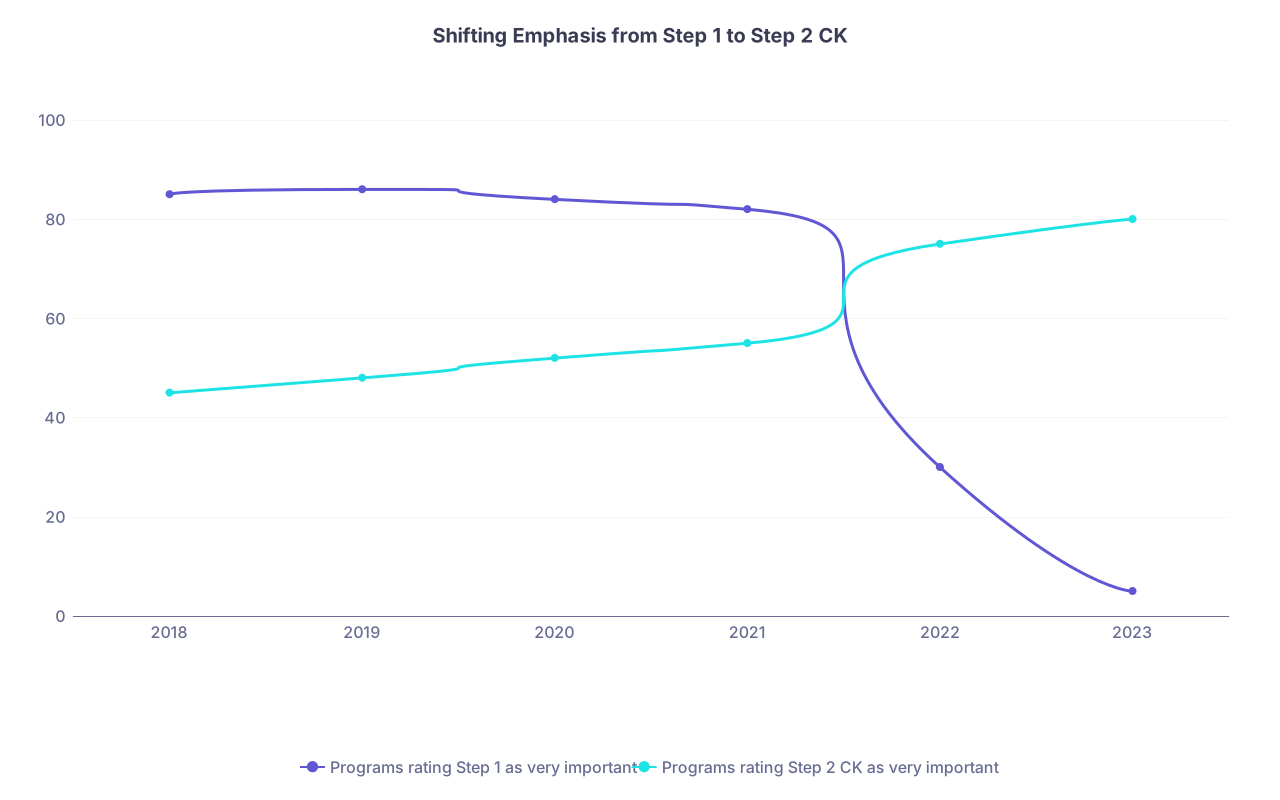
| Category | Programs rating Step 1 as very important | Programs rating Step 2 CK as very important |
|---|---|---|
| 2018 | 85 | 45 |
| 2019 | 86 | 48 |
| 2020 | 84 | 52 |
| 2021 | 82 | 55 |
| 2022 | 30 | 75 |
| 2023 | 5 | 80 |
Ignore the exact percentages; focus on the direction: down for Step 1, sharply up for Step 2.
The stuff that quietly became more cutthroat
Removing one big metric pushes everything else into sharper relief. You see it already:
- Research arms race: 10+ pubs for some specialties is now normal for serious applicants, often via massive student-run or mentor-run retrospective projects.
- AOA / class rank: At schools that still have AOA or quartiles, those labels have more influence when Step 1 is blank.
- Letters and networking: “Our chair knows their chair” matters more than ever. A bland letter from an unknown name is now lighter currency.
- Home programs and away rotations: Being physically present where people can vouch for you became a bigger lever. Especially in ortho, EM, neurosurgery, and surgical subspecialties.

So if you thought P/F would reduce the “arms race,” look around. It just changed weapons.
Did it at least help wellness and burnout?
Some. But less than advertised.
Students do report:
- Less existential dread tied specifically to one three‑digit number in M2
- Slightly more willingness to engage with non‑test content in pre‑clinicals
But they also report:
- More uncertainty and anxiety about what “matters most” now
- Intense Step 2 CK pressure creeping earlier into M3
- Continued obsession with UWorld, Anki, and prep resources—just shifted farther down the timeline
You did not remove the stakes. You just delayed and redistributed them.
So, did Step 1 P/F “level the playing field”?
No. It:
- Helped students at already strong schools more than it helped students who needed a numeric equalizer.
- Hurt strong applicants from weaker brands (including IMGs) who relied on a high Step 1 to break in.
- Shifted pressure to Step 2 CK, clerkship performance, research, and networking.
- Made the process less transparent in some ways: scores are easier to interpret than “school prestige” and informal connections.
If you want genuine leveling, you would need:
- Structured, transparent program criteria
- More standardized letters or competency-based evaluations
- Less fetishizing of school name and more focus on demonstrated skill and professionalism
We did not do that. We just hid one of the more honest metrics and pretended the rest would sort itself out.
How you actually win in the P/F era
You cannot change the rules. You can, however, exploit them.
Focus on three things:
Treat Step 2 CK like the new Step 1
Not emotionally, but strategically. Build in real study time around rotations. Aim for being done early enough that programs see your score when screening.Build a track record, not just a moment
Honors in key clerkships in your target specialty, real relationships with faculty, and steady research output matter more than one perfect exam now.Control what you can about your context
No, you can’t swap schools. But you can:- Do away rotations at places you want to end up
- Seek out mentors who are nationally known in your field
- Get involved in national specialty organizations and conferences

| Step | Description |
|---|---|
| Step 1 | Start M1 |
| Step 2 | Solid preclinical base |
| Step 3 | Early specialty exploration |
| Step 4 | Targeted research in field |
| Step 5 | Strong clerkship performance |
| Step 6 | Dedicated Step 2 CK prep |
| Step 7 | Aways at realistic programs |
| Step 8 | Strong letters and advocacy |
| Step 9 | Rank list with strategy |
This is the game now. Pretending it got simpler or “fairer” just blinds you to how it actually works.
FAQ (4 questions, no fluff)
1. Should I still study hard for Step 1 if it’s pass/fail?
Yes, but with a different goal. The point now is to build a deep foundation so Step 2 CK is less miserable. Passing is not enough if you coast and then get crushed later. The students who did serious Step 1 prep are the same ones who usually find Step 2 less punishing.
2. If I’m from a lower‑tier or DO school, how do I compensate without a numeric Step 1?
You lean hard on three things: a high Step 2 CK, strong away rotations at programs that historically take people from your background, and meaningful research or niche expertise in your specialty. You’re playing on “hard mode,” so your portfolio needs multiple strong signals, not just one.
3. I’m an IMG—do I still have a shot at a competitive specialty?
It’s not impossible, but it’s harder than it was in the numeric Step 1 era. You’ll likely need an outstanding Step 2 CK, serious research (often U.S. based), U.S. clinical experience with strong letters, and strategic targeting of programs that have a track record of taking IMGs. The “just get a 260 and you’re in the conversation everywhere” shortcut is basically gone.
4. Does going P/F mean residency programs are more holistic now?
They say that. Parts of it are true. But in practice, many simply replaced one hard filter with others: Step 2 CK floors, school prestige, AOA/class rank, and research volume. “Holistic” often means “we still screen hard but with more opaque criteria.” Assume the process is competitive and metric-heavy, even if the metrics changed.
Key points:
Step 1 going pass/fail did not level the field; it reweighted it in favor of institutional prestige and Step 2 CK. High performers from less‑known schools and IMGs lost a critical equalizer. If you want to win in this era, stop clinging to the myth of fairness and start playing the game that actually exists.