
Is School Name More Important After Step 1 P/F? Sorting Fact From Fear
If Step 1 is pass/fail now, does that mean your school’s name just became your new Step score?
You would think so from the way people talk. Second-years whisper about “prestige compensating for no score.” Reddit threads read like eulogies for anyone not at a T10. MS0s on tours keep asking, “But how will this school place into derm now that Step 1 is P/F?”
Let’s cut through the noise. The narrative that “Step 1 is pass/fail, so school name is everything now” is clean, scary, and mostly wrong.
The truth is more boring, more data-driven, and a lot less apocalyptic. And it’s not what the loudest voices online are telling you.
What Actually Changed With Step 1 P/F (And What Didn’t)
Step 1 going pass/fail did change things. But not in the “now only Harvard matches” way people love to dramatize.
Here’s what really shifted: programs lost a single, standardized, 3‑digit screening tool that every applicant had to take early in med school. That forces them to redistribute the weight onto other existing data points. It did not conjure “school prestige” out of thin air.
The NRMP asked program directors what they use now. You can read the 2022 and 2023 Program Director Surveys yourself, but here’s the core:
Before P/F, typical top‑screening factors were:
- Step 1 score
- Step 2 CK score
- Clerkship grades
- Class ranking/AOA
- Letters of recommendation
- Personal knowledge/word-of-mouth
After P/F, programs report:
- Step 2 CK score jumped in importance
- Clerkship performance matters more
- Specialty‑specific experiences matter more (research, sub‑I, away rotations)
- School name? Still there. But not suddenly top of the list for most programs.
So yes, with Step 1 gone as a filter, the rest of your application matters more. But “the rest” is not just one big variable called “school prestige.”
To see the pattern clearly, look at what programs actually do about test scores and filters.
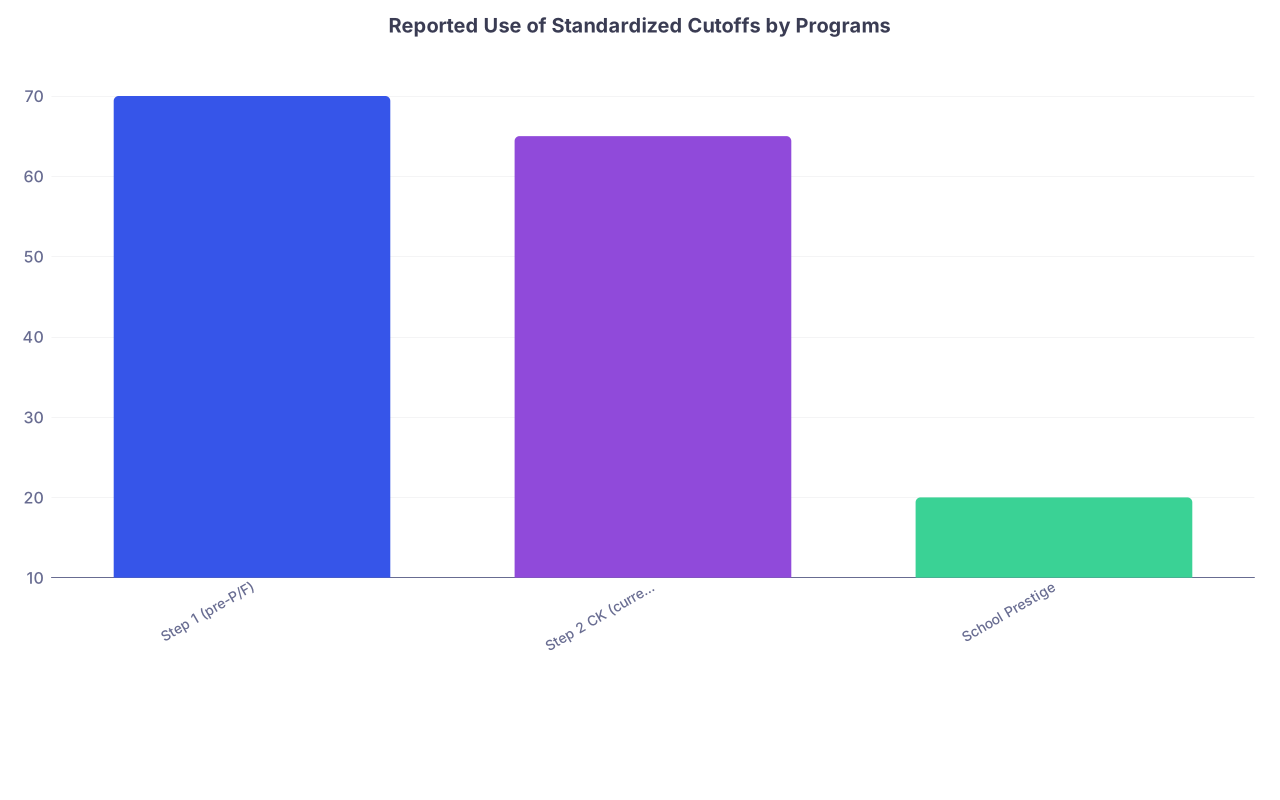
| Category | Value |
|---|---|
| Step 1 (pre-P/F) | 70 |
| Step 2 CK (current) | 65 |
| School Prestige | 20 |
Those numbers are illustrative, but they match the direction of the PD survey data: Step exams and objective metrics are still far more commonly used as filters than school brand.
The Prestige Panic: Where The Myth Comes From
The “school name is everything now” myth exists because people confuse three different ideas and blend them into one lazy conclusion.
Top schools always matched well before P/F.
US News darlings sent lots of grads into derm, plastics, ortho. That didn’t happen by magic. They admit statistically stronger applicants, have more research infrastructure, and often more aggressive advising. If you gather highly competitive people into one building, they’ll match competitively almost regardless of the scoring system.Programs do use school name… in specific contexts.
When a PD in neurosurgery at a major academic center sees “Harvard / Hopkins / UCSF” on an application, they already have a mental model for what that usually means. They’ve trained those grads, know the deans, and trust the letters. That’s signaling, not destiny.People love simple villains.
Losing Step 1 as a numerical safety blanket is psychologically uncomfortable. Blaming “prestige” feels easier than dealing with the messier truth that now your clinical performance and relationships matter more, and those are harder to gamify.
So students turn “some programs pay attention to school reputation” into “now all that matters is being at a top‑20 school.” That jump is not supported by the data.
What The Data Actually Suggests About School Name
No one publishes an “impact of your school on your Match odds” RCT, so we have to triangulate from multiple sources: NRMP data, PD surveys, and what you see year after year in match lists.
Let’s isolate three questions:
- Does school name matter at all?
- Did Step 1 P/F make it dramatically more important?
- Who is actually helped or hurt the most by school name?
1. Does school name matter at all?
Yes. Pretending it doesn’t is just as dishonest as saying it’s everything.
Some patterns are obvious:
- Certain elite programs heavily recruit from the same small cluster of med schools.
- At ultra‑competitive programs in derm, plastics, ENT, neurosurgery, you’ll see disproportionate representation from top‑ranked schools.
- PD surveys show “reputation of school” as a factor, especially at academic programs and in competitive specialties.
But here’s the nuance: most programs still accept from a wide range of schools. If you scroll through the resident pages of mid‑tier IM, EM, FM, peds, anesthesia programs, you’ll see state schools, DO schools, mid‑ranked privates, even Caribbean in some specialties.
School name is a signal, not a gate.
2. Did Step 1 P/F dramatically increase the importance of school name?
Not in the way the fear narrative claims.
Pre‑P/F:
- A high Step 1 score from a mid‑tier school could bulldoze the prestige gap.
- A mediocre Step 1 from a top school absolutely hurt you.
Post‑P/F:
- A strong Step 2 CK score plus strong clinical performance from a mid‑tier school still gets interviews.
- A weak Step 2 from a big‑name school is still a problem.
What changed is which other pieces stepped into the vacuum. And those are things like:
- Step 2 CK
- Shelf/clinical performance
- Audition rotation performance
- Letters from known faculty
- Specialty‑specific research
“Reputation of medical school” did climb in some PD rankings, but it did not suddenly leap to #1 across specialties. The real winner for screening is Step 2 CK.
| Factor | Pre-P/F Typical Rank | Post-P/F Typical Rank |
|---|---|---|
| Step 1 score | Very high | N/A (P/F) |
| Step 2 CK score | High | Very high |
| Clerkship grades | Moderate/High | High |
| School reputation | Low/Moderate | Moderate |
| Research output | Specialty-dependent | Specialty-dependent |
Again, ranks vary by specialty, but school name simply did not become “the new Step 1.”
3. Who is actually helped or hurt the most?
Here’s where the nuance actually matters.
Helped:
- Students at highly resourced, research‑heavy schools who perform decently but not top‑tier on tests. With no visible Step 1 score, the “halo” of their institution and its letters may carry a bit more weight than before.
- Those whose schools have strong connections to certain academic departments. A letter from a big‑name mentor means more now that PDs can’t sort first by a three‑digit Step 1.
Hurt (relative to old system):
- Hyper‑test‑takers at mid‑tier or lower‑tier schools who would’ve put up a 255+ Step 1 and forced programs to look at them. That lever is gone. They now have to show their strength more through Step 2 and clinical context, which is less visible to PDs than a single monster score.
- DO and international grads who used to use Step 1 as a brute‑force door-opener. Step 2 CK still exists, but it’s taken later and sometimes is not in when initial filters are applied.
If you want a blunt summary: Step 1 P/F smoothed out one of the easiest “escape hatches” from a low‑prestige school. It did not suddenly turn school name into a magical key.
Where Programs Are Really Looking Now
If you want to stop living in fear and start playing the game that actually exists, you need to understand how your application is really evaluated post‑P/F.
Think in two phases: the initial screen, and the “who do we actually like?” phase.
Phase 1: Getting past the filter
Most programs still have to triage hundreds or thousands of applications. That means someone – often a coordinator, not the PD – is applying crude filters.
In the pass/fail era, the usual early filters tend to be:
- Step 2 CK (numeric and often with cutoffs)
- US vs international grad
- DO vs MD depending on specialty and program
- Red flags (failures, professionalism issues)
- Sometimes: whether your school is LCME‑accredited and known to reliably produce functional interns
School name occasionally plays a role if a program gets overwhelmed and leans on familiarity. But a lot of community and mid‑tier academic programs just do not care whether your school is ranked #12 or #72. They care whether you’ll show up, cover nights without imploding, and not scare off attendings.
Phase 2: Who do we actually want?
Once you’re through the initial screen, school name fades and other things dominate:
- Narrative coherence: does your CV, personal statement, and letters tell a consistent story?
- Letters from credible people: does someone they trust vouch for you?
- Performance where it actually matters: sub‑I’s, away rotations, research involvement in that field.
- Interview: would they sit next to you at 2 a.m. on a bad call night without wanting to die?
At this stage, being from a big‑name school can act as a soft “trust me, this person has been vetted” signal. But it doesn’t cover for mediocre letters, shaky clinical performance, or a weird vibe on interview day.
You can absolutely lose out to someone from a “lesser” school if they look sharper on paper and in person.
What You Should Actually Do Depending On Your Situation
Hand‑wringing about prestige doesn’t change anything. Strategy does. So let’s get blunt.
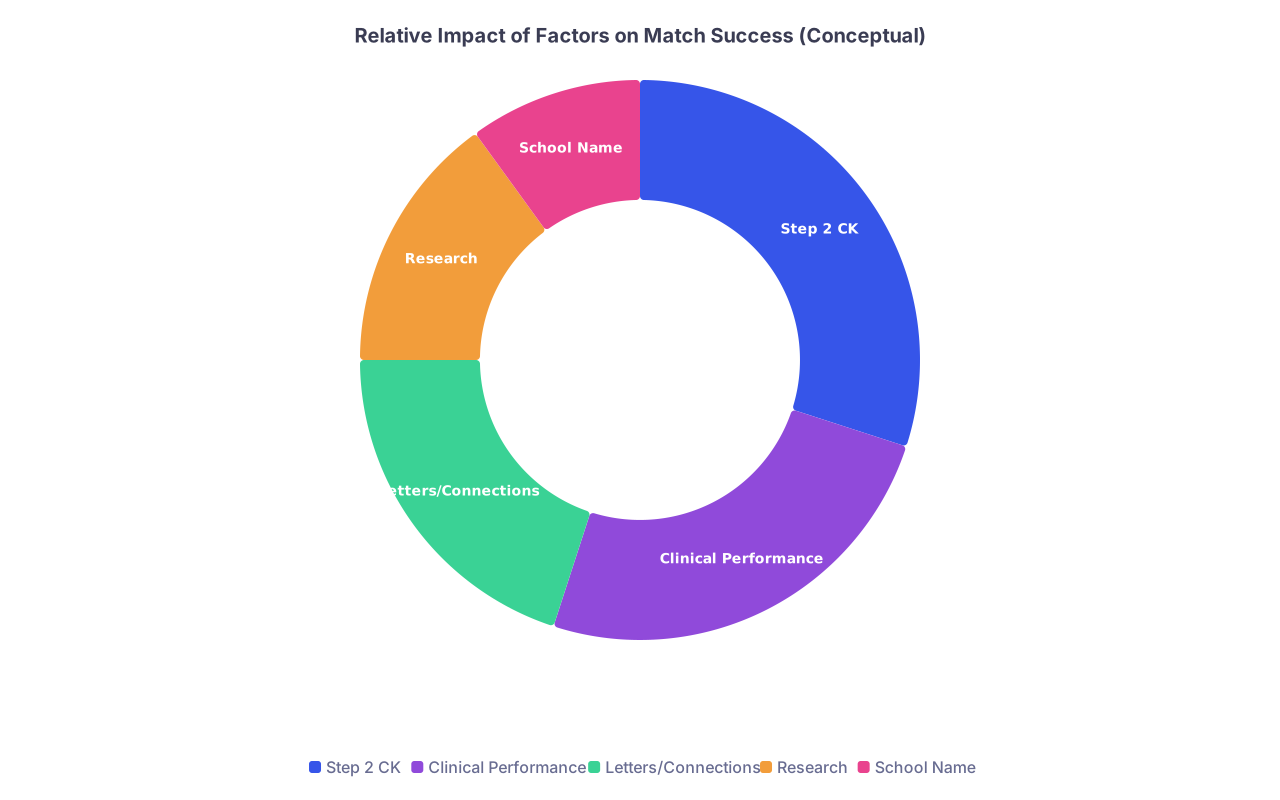
| Category | Value |
|---|---|
| Step 2 CK | 30 |
| Clinical Performance | 25 |
| Letters/Connections | 20 |
| Research | 15 |
| School Name | 10 |
This is conceptual, not literal, but it’s the right shape for most academic specialties.
If you’re at a “non‑prestige” US MD or DO school
You’re not doomed. But you cannot rely on vibes.
You gain leverage by:
- Crushing Step 2 CK relative to your peers
- Being at the top of your class clinically, not just “solid”
- Getting on projects with faculty who will write specific, credible letters
- Doing visiting rotations strategically in your target region/program tier
- Applying smartly – mix of reach and realistic programs, not just chasing brand names
I’ve watched grads from state schools match derm, ortho, ENT post‑P/F. They didn’t do it by doomscrolling; they did it by being undeniable in the areas that still scale.
If you’re at a top‑ranked school
You do have some built‑in advantages. More research labs, more home specialties, advisors who know PDs personally.
But if you think that means you can float with mid‑tier clinical performance and a mediocre Step 2 because “my school places well,” you’re exactly the person who gets filtered out and then blames the system.
Your school gives you opportunities, not guarantees.
The One Thing Almost Everyone Gets Wrong
People talk about “prestige” like it’s a property of the school only. That’s lazy.
Programs don’t just care about the name of your school; they care about the track record of your school’s graduates in their program and specialty.
A supposedly “mid‑tier” school whose graduates have consistently done well in a specific residency will have more pull there than an arbitrarily higher‑ranked school that almost never sends residents.
This is why “we place well locally” is a phrase you hear from advisors who actually read their match lists every year.
Your real questions shouldn’t be:
- “Is my school T20?”
They should be: - “Where do grads in my specialty from this school actually match?”
- “Who are the faculty in my area of interest who pick up the phone for residents and PDs?”
- “How many people two years ahead of me did what I want to do, and what did their applications look like?”
That’s where school matters: as an ecosystem of track record and relationships, not as a US News number.
Bottom Line: Fact vs Fear
Strip it down to the bones.
School name matters somewhat, but Step 1 going pass/fail did not suddenly turn it into the dominant factor. Step 2 CK, clinical performance, and letters still outrank pure “brand” at most programs.
The biggest losers from Step 1 P/F weren’t “non‑prestige” schools in general; they were individual high‑test‑takers who could previously use a monster Step 1 score to overpower institutional bias. That pathway narrowed, but it’s not fully closed with Step 2 still numeric.
You cannot change where you go to school right now, but you can absolutely change how strong you are within your environment. The post‑P/F era rewards people who do the unglamorous work: excel clinically, build real relationships, get strong letters, and choose targets intelligently—not those who just complain about prestige on forums.