
Step 1 going pass/fail did not “liberate” you from the exam. It just made the scoreboard invisible and pushed the consequences into the shadows.
You are no longer playing a game with a visible score. You are playing sudden death overtime where the only two outcomes are: survive, or get cut.
Let’s dismantle the fantasy version first, then talk about how Step 1 actually matters in 2026 and beyond.
The Myth: “Step 1 Is Pass/Fail, So Programs Don’t Care Anymore”
I hear this constantly from M1s and early M2s:
- “Step 1 is just a license test now.”
- “Programs only care about Step 2 and clerkship grades.”
- “You don’t need to grind like before. Everyone just passes.”
That story is convenient. It lets schools pretend they’ve de‑pressurized medical education. It lets students on Reddit feel better about bingeing Anki one week and Netflix the next.
And it is wrong.
Did the use of Step 1 change? Absolutely.
Did the stakes drop to zero? Not even close.
Instead of being a rank-order tool (who’s a 270 vs 250 vs 230), Step 1 morphed into a screen-out tool (who is “safe” vs “possibly risky”). Different job. Same gatekeeping function.
What changed in hard numbers
Step 1 used to separate:
- “Top” applicants (260+)
- “Solid” (240–250)
- “Borderline” (220–230)
- “Uh‑oh”
Now it separates:
- “Passed, took it once” – green light
- “Failed once” – yellow/red flag
- “Failed more than once / still not done” – often auto-screened
For most competitive programs, especially in surgical subspecialties and big-name IM programs, you’ve simply moved from “How high is your Step 1?” to:
- “Did you clear Step 1 cleanly?”
- “How high is your Step 2?”
- “Is there any sign you might struggle on in‑training exams or boards?”
The obsession shifted, not disappeared.
What Programs Actually Do With Step 1 Now
If you sit in resident selection meetings, you notice something: nobody waxes philosophical about pass/fail. They ask three blunt questions:
- Did they pass first attempt?
- How long did it take?
- Does anything about this signal future testing problems?
That’s it.
Step 1 became a binary risk flag. And binary flags are brutal.
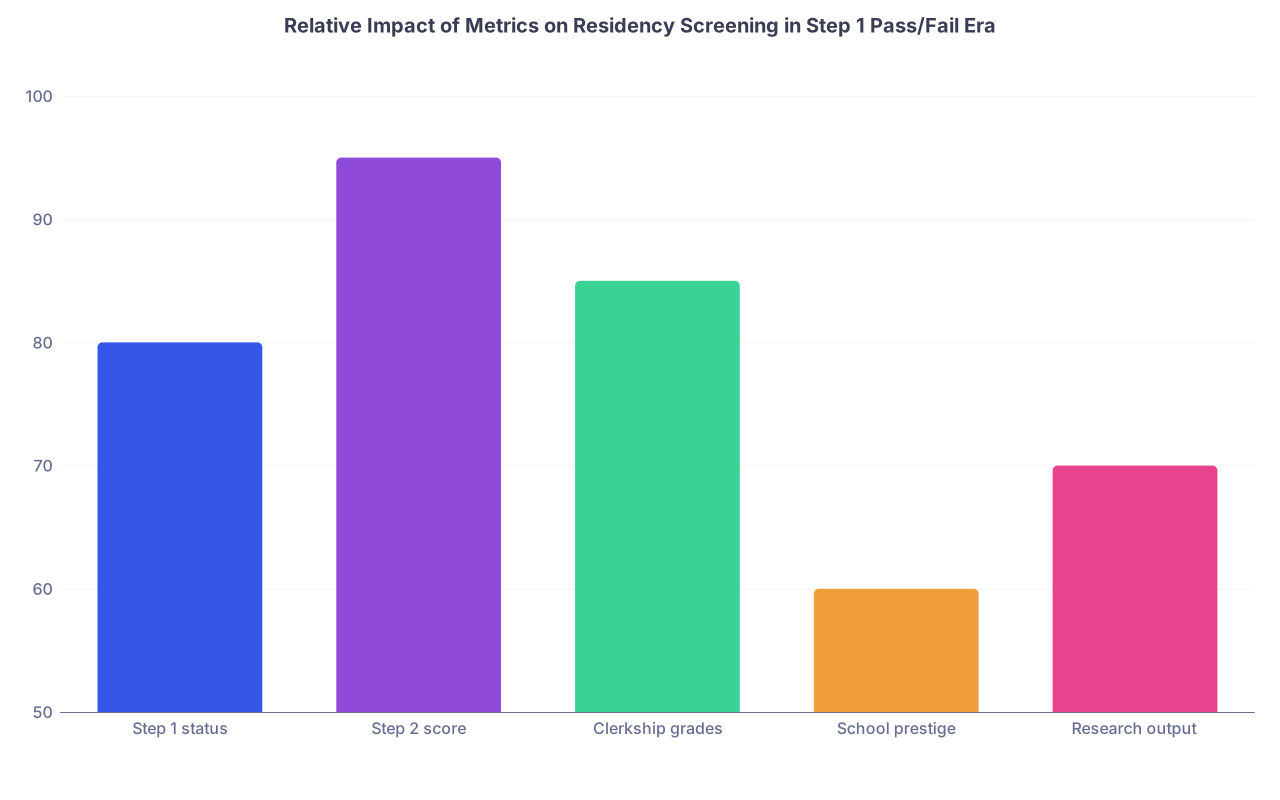
| Category | Value |
|---|---|
| Step 1 status | 80 |
| Step 2 score | 95 |
| Clerkship grades | 85 |
| School prestige | 60 |
| Research output | 70 |
Those numbers aren’t from a single study; they summarize what multiple PD surveys and selection committee behaviors converge on: Step 2 is the new numerical hammer, but Step 1 is still a major gate. You just don’t get style points anymore — only disqualifications.
How programs quietly use “pass”
Here’s what actually happens:
- For many programs, a clean Step 1 pass is treated as “met minimum bar,” and the discussion moves on. That’s the best-case scenario now: no one talks about your Step 1 at all.
- If you failed Step 1, it absolutely gets discussed. Every. Single. Time.
- “What happened?”
- “Is this a pattern?”
- “Did they rebound on Step 2?”
- If you haven’t taken Step 1 yet by a certain point (especially for IMGs or off-cycle students), it can delay or block interview offers.
So yes, Step 1 “matters less” for differentiating, but it still matters a lot for filtering. That distinction is the entire game.
The New Hierarchy: Step 1 vs Step 2 vs Everything Else
In the old world, Step 1 was king. Now it’s more like the bouncer at the door. Step 2 is running the party inside.
Let me spell out how this looks on the ground.
| Scenario | How Most Programs Read It |
|---|---|
| Step 1 pass, strong Step 2 | Safe, test-competent, no concern |
| Step 1 pass, mediocre Step 2 | Safe, but borderline for competitive fields |
| Step 1 fail, strong Step 2 | Red flag explained but not erased; some doors reopen |
| Step 1 fail, weak Step 2 | Major concern about future board passage |
| Step 1 multiple attempts | Serious risk; screened out at many programs |
Nobody’s impressed by Step 1 anymore. They are suspicious of anything that is not a clean pass.
The real shift is this:
- Step 1: You do not get “credit” for doing well, but you do get punished for failing.
- Step 2: You get both credit and punishment. It’s the new Step 1 in all but name.
Why Step 2 didn’t “fix” the pressure problem
There was a naive idea floating around: move pressure from a preclinical exam (Step 1) to a more clinically relevant exam (Step 2), and life gets better.
Reality:
- You are still learning the same preclinical content for Step 1.
- Now you’re also under heavier pressure during clerkships to ace Step 2.
- The stakes just got stacked rather than shifted.
I’ve watched M3s try to juggle 70-hour weeks on surgery, honors-or-bust shelf exams, and Step 2 prep because they coasted too much in M1–M2 under the “pass/fail” illusion.
Spoiler: it doesn’t go well.
Who Is Hurt Most By “Pass/Fail”?
Here’s the part almost nobody talks about:
The step 1 pass/fail change did not impact everyone equally.
It helped some. It quietly hurt others.
Group 1: The “silent winners”
- Students at brand-name med schools (Harvard, UCSF, Penn, etc.)
- MD students with strong home departments in competitive specialties
- People with built-in networks, mentors, and research pipelines
These students used to need a big Step 1 to prove they were truly top-tier, not just riding the prestige wave. Now, as long as they pass Step 1 and do reasonably on Step 2, their school name, letters, and research carry more weight.
In other words: the pass/fail system amplifies structural advantages. Shocking, I know.
Group 2: The hidden losers
- DO students
- IMGs and FMGs
- MD students from lower-ranked or newer schools
- Late bloomers who were planning to “show them all” with a monster Step 1
These people lost a powerful weapon. Before, a DO with a 252 or an IMG with a 260 could force programs to look again. The score itself demanded attention.
Now? You’re back to:
- School type
- Perceived rigor of your training
- Biases about DO vs MD vs IMG
- Connections and letters
A passed Step 1 from a DO school and a passed Step 1 from a top-5 MD school look identical on paper. Guess whose application gets more benefit of the doubt.
The “more holistic” environment paradoxically makes the brand name of your school and your network more important, not less.
The Real Risk: Failing in a Pass/Fail World
Let’s be brutally clear: failing Step 1 now is worse than it was in the score era.
Why?
Because when everyone is “just trying to pass” and the culture minimizes the test, there is:
- Less serious prep early on
- More delayed dedicated time
- More “I’ll be fine, it’s only pass/fail” energy
So when someone fails, the narrative inside committees is harsher:
“If this person struggled just to pass when all their classmates passed and there was no numerical pressure, how will they handle high-stakes exams later?”
Is that a fair take? Not always. But it is real.
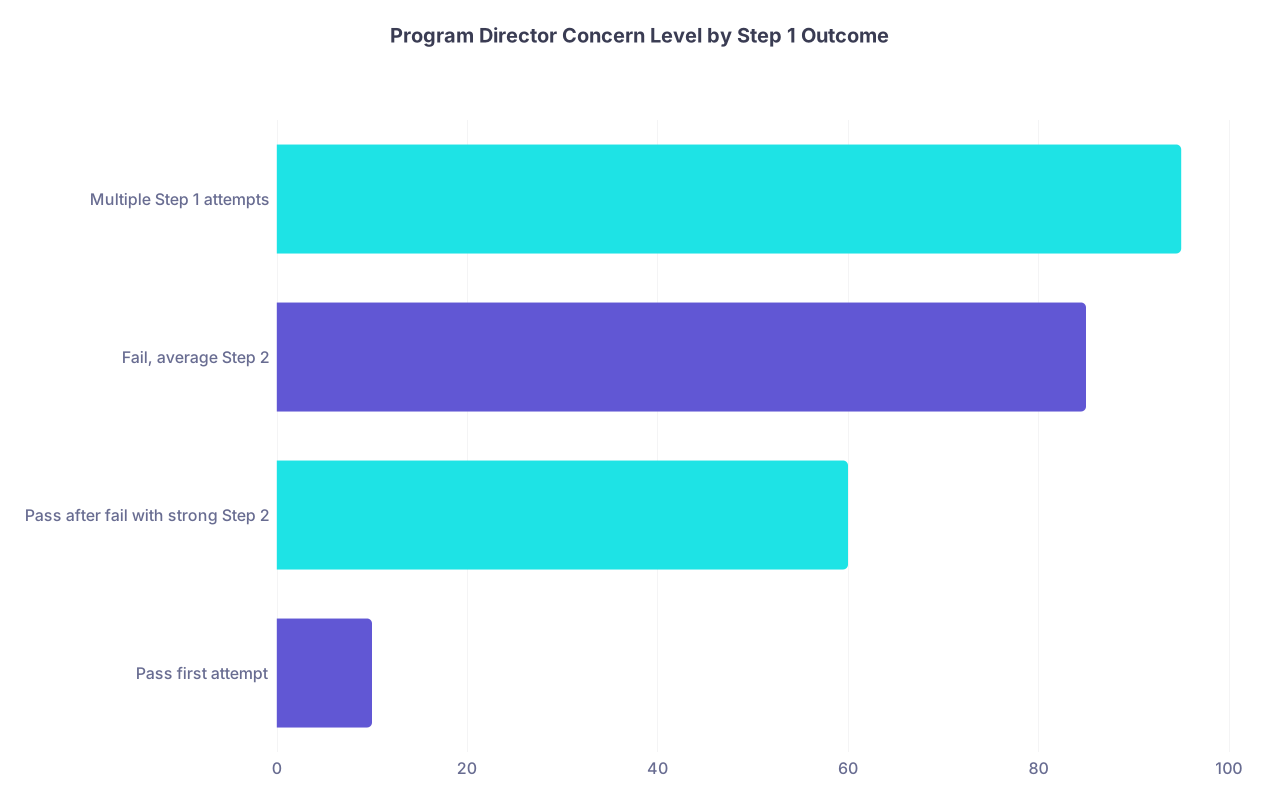
| Category | Value |
|---|---|
| Pass first attempt | 10 |
| Pass after fail with strong Step 2 | 60 |
| Fail, average Step 2 | 85 |
| Multiple Step 1 attempts | 95 |
Concern is asymmetric. Passing doesn’t earn you much. Failing earns you a lot of worry.
And once you’re in residency, in‑training exams and board pass rates matter for program accreditation. PDs aren’t just making a “gut call”; they’re protecting their numbers.
So what does a Step 1 failure say to them?
- Possible pattern of underperformance on standardized exams
- Possible difficulty with knowledge retention or test-taking
- Possible professionalism/discipline issue (started prep too late, etc.)
Yes, you can write a good remediation story. Yes, some PDs will give you a chance, especially if Step 2 is excellent. But you’re now asking busy strangers to bet against their own risk metrics.
That’s a much harder pitch.
How You Should Actually Treat Step 1 Now
Let me simplify your mental model:
- Old era: “I must crush Step 1.”
- New era: “I must make Step 1 invisible.”
Your goal is to make Step 1 so boring that nobody talks about it. That means:
- Pass on the first attempt.
- Do it on a reasonable timeline (no bizarre long delays without an explanation).
- Avoid any drama — leaves of absence, abrupt reschedules, or incomplete attempts — tied to the exam.
From there, all your differentiation shifts to:
- Step 2 CK score
- Clinical grades (especially core clerkships)
- Letters from people PDs actually know
- Research, especially in your target specialty
- Signals of professionalism and reliability
The preparation mistake I see over and over
M1s hear “pass/fail” and react by:
- Treating pre‑clinicals like college courses: cram, forget, move on.
- Relying on “we’ll do dedicated later” as the magical cure.
- Underestimating how much content is assumed for clinicals and Step 2.
Then, midway through M2, they realize:
- There is no cheat code for dense foundational knowledge.
- Their classmates have done 5,000–10,000 more quality questions.
- Dedicated alone is not enough to build a safe margin.
Pass/fail did not change how much you need to know to be safe. It just changed how clearly you see the gap.
The Future: Will Step 1 Ever Truly Not Matter?
Could we reach a world where Step 1 barely matters at all? Possibly. But you’re not there yet.
Several forces are pushing in the opposite direction:
- Residency bottleneck: More grads, relatively flat residency spots. That means more need for filters, not fewer.
- Program risk aversion: Board pass rates are public. PDs are judged on them. They want any signal they can get.
- Data inertia: Institutions have spent decades correlating Step 1 performance with future outcomes. That thinking doesn’t evaporate overnight.
There is also a quiet trend: some specialties and programs are starting to require Step 2 earlier and may begin to expect certain Step 1 timing or performance patterns as well, even without a score.
If anything radical changes next, it’ll be Step 2 going pass/fail. And if that happens, the pressure will just move again—to clerkship grades, school prestige, research volume, and informal networks.
Do not wait for the system to become fair before you start playing the current game well. You’ll graduate long before the policy debates resolve.
So, Does Step 1 Still Matter?
Here’s the honest, unromantic answer:
- Step 1 no longer gets you into the conversation by being “impressive.”
- Step 1 absolutely can knock you out of the conversation by being problematic.
- The people who benefit most from pass/fail are those who were already advantaged.
- The people who lost the most are those who needed a giant score to break through bias.
Your job is not to treat Step 1 like it’s nothing.
Your job is to treat it like air: invisible when it’s there, catastrophic when it’s not.
So study enough that your result is forgettable. Then pour your ambition into Step 2, your clinical performance, and building real relationships in your target specialty.
Years from now, you won’t remember the question about some obscure lysosomal storage disease. You will remember whether Step 1 quietly cleared the runway—or turned into the storm you had to fight for the rest of your career.