
The switch to Pass/Fail Step 1 did not “erase” your numeric score—but it absolutely changed how programs read it.
If you already took Step 1 numerically and now everyone behind you gets a simple “Pass,” you’re in a weird, in‑between cohort. You’re competing in a world that’s shifted under your feet.
Let me be blunt: some people in your position will play this wrong—either by panicking about an average score or coasting because “at least I have a number.” Both are mistakes. You have leverage if you handle this right.
Here’s what to do, scenario by scenario.
1. First, understand how programs now see your numeric Step 1
Step 1 used to be the big filter. Now it’s a context data point—sometimes helpful, sometimes harmful, never the whole story.
Here’s the mental model most program directors use post–P/F transition:
- For older applicants (already graduated, reapplying, or non‑traditional): numeric Step 1 still matters a lot.
- For current med students in this transition cohort: Step 2 CK is the main performance exam; Step 1 numeric is “additional context.”
- For purely P/F cohorts: Step 1 basically only matters as pass vs fail.
You are squarely in the “transition” group. That means:
- A very high Step 1 can still help you.
- A mediocre or low Step 1 is no longer an automatic death sentence—if your Step 2 CK is strong.
- Everyone is now judged more on Step 2, clinical performance, and letters.
So you don’t get to ignore Step 1. But you also don’t have to let it define you.
2. Figure out which bucket you’re in (be brutally honest)
Take 5 minutes and place yourself into a realistic category. Use actual numbers, not vibes.
| Tier | Approx Score | Interpretation Now |
|---|---|---|
| High | ≥ 245 | Clear academic strength |
| Solid | 230–244 | Competent, no concern |
| Middle | 220–229 | Fine, but not flex-worthy |
| Low | < 220 | Needs Step 2 reassurance |
| Fail | Failed once | Must show major recovery |
That’s crude but useful. The exact cutoffs vary by specialty, but the tiers are real.
Now map that to your goals.
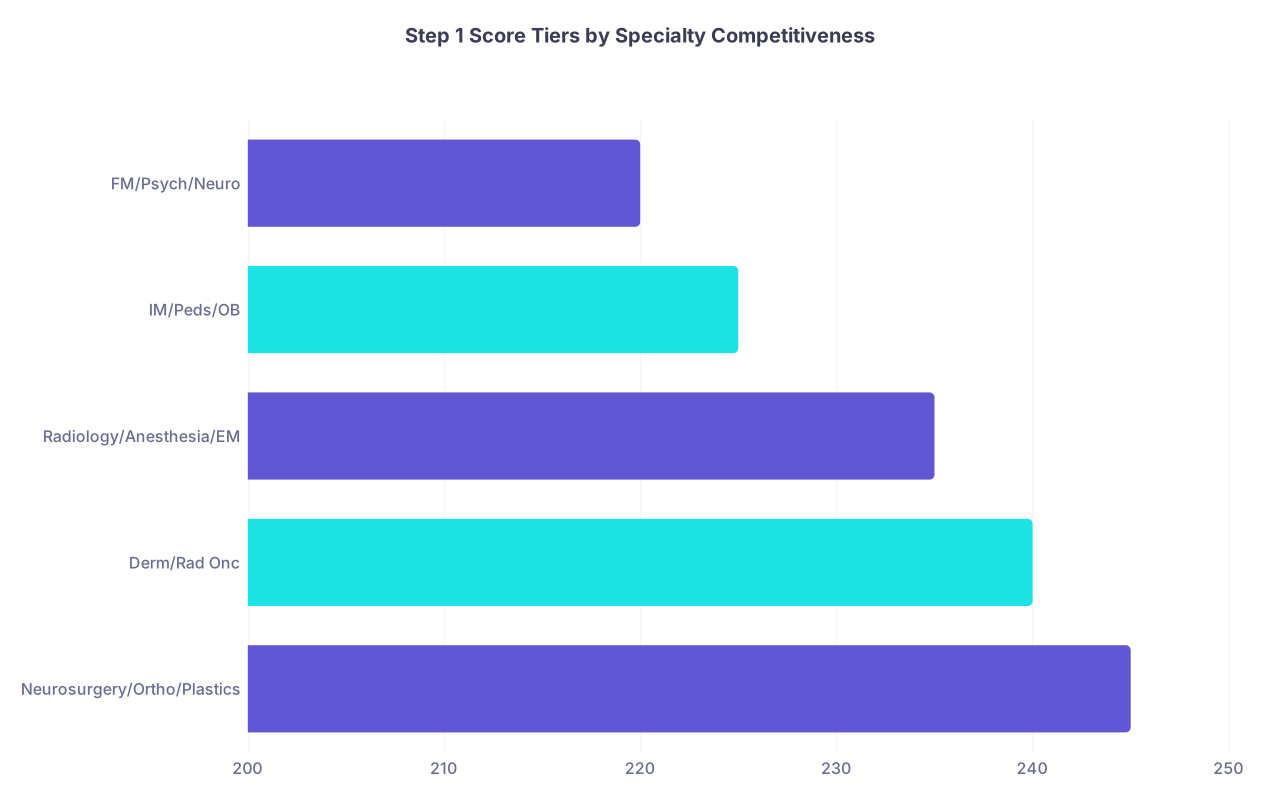
| Category | Value |
|---|---|
| Neurosurgery/Ortho/Plastics | 245 |
| Derm/Rad Onc | 240 |
| Radiology/Anesthesia/EM | 235 |
| IM/Peds/OB | 225 |
| FM/Psych/Neuro | 220 |
These “values” aren’t cutoffs; they’re rough “comfort numbers” programs used to like. But again, Step 2 is now the star of the show.
3. If you scored HIGH (≈245+): how to fully exploit that advantage
If you’re sitting on a 245, 250, 260+ and now everyone else is P/F, you’re in a strong spot. But you can still screw this up by getting lazy with Step 2.
Here’s how to use that high Step 1 wisely:
Treat Step 2 CK as confirmation, not a gamble.
You don’t “need” a 270. You do need to avoid an obvious drop-off. Target: roughly similar range, or at least not 15–20 points lower.Aim high specialties if you want them—but be realistic about the rest of your file.
High Step 1 helps for ortho, derm, neurosurg, plastics, ENT, rad onc, etc., but it does not replace:- Strong clinical evaluations
- Great letters from big names in the field
- Some exposure to the specialty
Use your score strategically in your story.
In your ERAS experiences and personal statement, you don’t need to brag. But you can frame your academic strength:- “Strong performance on Step 1 and Step 2 CK supported my interest in [field]’s cognitive complexity.” Fine. One sentence. Move on.
Don’t let Step 2 lag.
I’ve seen people with 250 Step 1 sleepwalk into a 235 Step 2 because they assumed “I’ve always tested well.” Programs notice. That mismatch raises questions.Schedule Step 2 smartly.
You can afford to take it slightly later than someone with a weak Step 1. But not after rank lists. For competitive specialties, you still want a Step 2 score in by early fall of application season.
If you’re in this bucket, your Step 1 is a net asset. Your main job is not to waste it.
4. If you scored SOLID (≈230–244): how to make this “noise” in your favor
This range is… fine. Good enough that no one’s worried. Not so magical that programs care a ton.
Your plan:
You’re heavily Step 2 dependent.
You want Step 2 CK to be equal or slightly higher. That moves you into “strong exam performance” territory, which matters more now.You can apply anywhere with the right Step 2 + other pieces.
Even for competitive fields, a 235 Step 1 + 245 Step 2 + strong letters is workable at many programs.Don’t obsess over this score.
For many PDs, once they see “nothing concerning,” they move on to:- Clerkship grades
- Class ranking (if available)
- Letters
- Research / fit with their program
Your Step 1 is like a B+ on a prerequisite. Not flex-worthy, not a problem. The rest of the application will decide your fate.
5. If you scored MID (≈220–229): how to neutralize the number
This is where a lot of students panic. In the old world, some specialties saw 220s and quietly filtered you out. In the current P/F era, that’s less rigid.
Your reality:
For less competitive specialties (FM, IM, Peds, Psych, Neuro, OB at many places):
A 220-something Step 1 is plenty acceptable if your Step 2 is strong.For competitive specialties:
It’s not great, but it’s not an auto-reject if:- Step 2 shows real improvement
- You have clear commitment (research, electives, mentors in the field)
- You build an aggressive strategy (backup plans, broad application list)
Your concrete to-do list:
Make Step 2 your redemption arc.
Target: at least 10–15 points higher than Step 1. Think 235–245. That tells programs, “I learned from Step 1, and I can absolutely handle their exam-heavy environment.”Time Step 2 early enough.
Especially if you’re worried programs will side-eye your Step 1. Get Step 2 in before ERAS opens or very early in the season.Be ready only to talk about it when asked.
If a PD brings up Step 1, you need a crisp, non-defensive answer:- “I passed, but I knew I could do better. I changed my study approach—more active practice, earlier clerkship integration—and my Step 2 CK reflects the improvement.” Then stop talking.
Lean on clinical excellence.
Honors in core clerkships will outweigh a 223 Step 1 for many programs. They care more about how you function on the wards.
6. If you scored LOW (<220) or failed once: how to rebuild your application
This is the hardest situation—but not hopeless, especially in the new era where Step 2 is king.
First, don’t gaslight yourself. A 210 Step 1 or a fail attempts means:
- Programs will want assurance you won’t struggle with boards or in-training exams.
- You must give them overwhelming evidence you’ve turned the corner.
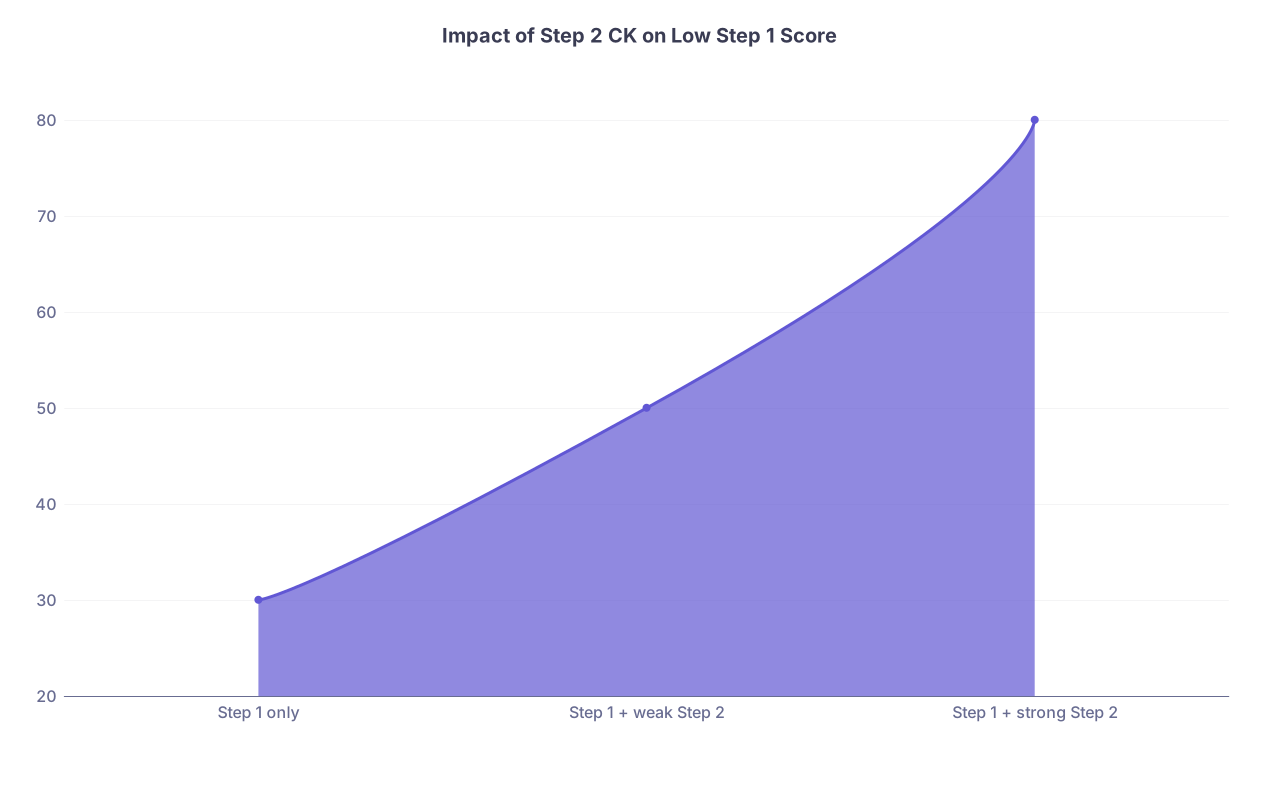
| Category | Value |
|---|---|
| Step 1 only | 30 |
| Step 1 + weak Step 2 | 50 |
| Step 1 + strong Step 2 | 80 |
Think of those “values” as your approximate chance of being taken seriously by many IM/psych/FM programs. Step 2 can triple your credibility.
Your rescue plan:
Crush Step 2 CK. Non-negotiable.
You’re not aiming for “respectable.” You’re aiming for obviously better. A 240+ after a 210 is a massive signal. It says the first score was not your ceiling.Change your study process, not just your effort.
If you studied the same way for Step 2 as for Step 1, expect the same result. You probably need:- Daily UWorld from much earlier
- System-based review instead of random
- Dedicated live or online course if your self-structure is weak
- Honest accountability from a mentor/tutor
Consider specialty reality.
You can match with a low Step 1 or even a fail. But probably not in neurosurgery or derm.
You should have a realistic list that includes:- FM, psych, IM, peds, maybe neuro/OB/home programs
- A broad geographic spread
- Multiple backup specialties if you insist on including competitive ones
Own your narrative without oversharing.
Interview answer template:- Brief acknowledgment: “My Step 1 performance was below my expectation.”
- Concrete change: “I restructured my approach—more questions, spaced repetition, earlier start.”
- Outcome: “That’s reflected in my Step 2 score and my clinical performance since.” That’s it. No sob story, no excuses.
7. How the P/F change shifts emphasis: what actually matters more now
Since Step 1 went P/F for younger cohorts, programs have reweighted their filters. You’re in between—but you’re subject to the new system.
What matters more now:
- Step 2 CK score
- Clinical grades (especially in your desired specialty)
- Letters of recommendation
- Clerkship narrative comments
- Research (for academic and competitive programs)
- Signals of “fit” (geography, ties, rotations)

| Step | Description |
|---|---|
| Step 1 | Applicant |
| Step 2 | Step 2 CK |
| Step 3 | Clerkship Grades |
| Step 4 | Letters |
| Step 5 | Step 1 Score or Pass |
| Step 6 | Research and Fit |
| Step 7 | Program Interest |
Your old assumption that Step 1 was the mountain? That’s dead. You climbed a mountain that’s now more like a hill. Step 2 is the new peak.
8. How to talk about your numeric Step 1 in a P/F world
You will get annoyed by people behind you smugly saying, “Glad I never had to take Step 1 numerically.” Whatever. You did.
Here’s how to handle conversations that actually matter—interviews and PD meetings.
General rules
- Do not volunteer excuses.
- Do not over-explain a decent score.
- Do not pretend the number is irrelevant; programs have it.
- Do not lie about how much it stressed you out—but keep that for safe spaces, not interviews.
If asked, adapt one of these based on your situation:
High score:
“I was happy with my performance. I tried to treat Step 1 as a foundation and built on that for Step 2 and clinical work.”Solid/mid score:
“I passed comfortably, but I felt I could show more on Step 2, so I focused on applying those lessons forward.”Low/fail:
“I was disappointed in that result. I changed my approach significantly—more active practice, seeking early feedback—and you can see that reflected in my Step 2 score and clerkship performance.”
Short, neutral, forward-looking. The more you dwell, the more you signal insecurity.
9. Tactical timing: when to take Step 2 if you already have a numeric Step 1
Your Step 1 situation should influence your Step 2 plan a bit.
| Step 1 Tier | Step 2 Timing | Reason |
|---|---|---|
| High | Late summer | You have buffer; focus on strong prep |
| Solid | Early-mid summer | Show continued strength early |
| Mid | Early summer | Reassure programs before they screen |
| Low/Fail | As soon as safely ready | You need Step 2 to repair your file |
Don’t take Step 2 too early just to “have it in.” A bad Step 2 hurts more than a delayed good one. But yes, if your Step 1 isn’t great, earlier is better—assuming readiness.
10. Adjusting specialty choice with your numeric Step 1 reality
You don’t have to give up your dream because your Step 1 wasn’t perfect. But you can’t ignore data either.
Here’s a blunt framework:
If Step 1 and Step 2 are BOTH strong (e.g., 245+):
You can chase any specialty. What matters more is research, mentorship, and networking.If Step 1 is mid but Step 2 is strong (big upward trend):
You can still go for moderately competitive fields (EM, anesthesia, radiology, some surgical subs) if the rest of your app is aligned. But you should add a safety specialty.If Step 1 is low or failed, even with a strong Step 2:
You should seriously consider less competitive fields as primary targets. You can still attempt a small number of applications to a dream specialty, but don’t bet your whole career on it.
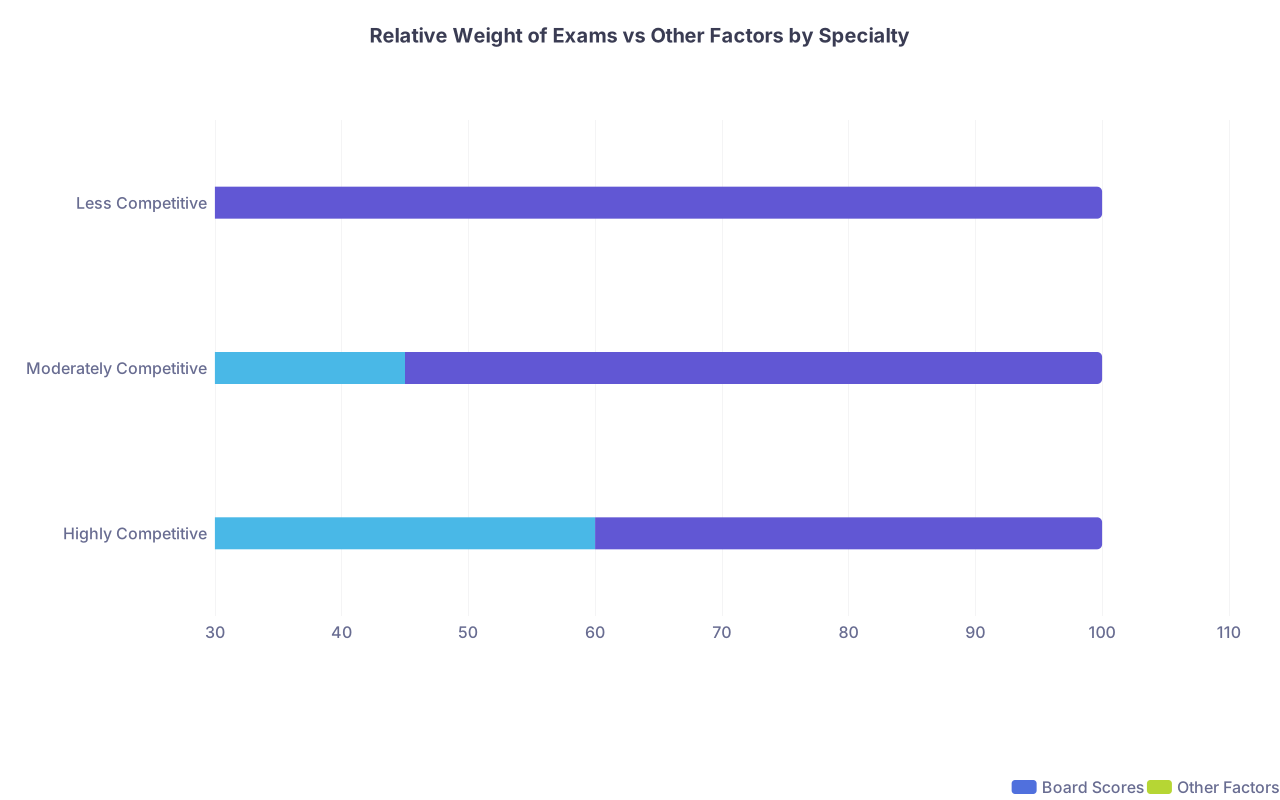
| Category | Board Scores | Other Factors |
|---|---|---|
| Highly Competitive | 60 | 40 |
| Moderately Competitive | 45 | 55 |
| Less Competitive | 30 | 70 |
Yes, those percentages are approximate. The point stands: in derm, scores are still huge; in family medicine, a strong Step 2 plus good clinical work goes a very long way.
11. The quiet mental toll of being the “numeric” cohort
This part nobody warns you about.
You took a 7+ hour exam that everyone behind you will never face in the same way. That can feel unfair, especially if your score isn’t what you wanted.
Two things:
You’re not crazy for feeling resentful. That’s human. You sacrificed time, sleep, relationships, your mental health—to have your score downgraded from “the main metric” to “just another data point.”
Feel it. Then move on. Because the game you’re in is the only one that matters.Do not let this turn into paralysis or bitterness. I’ve watched students with perfectly matchable profiles self-sabotage because they got stuck on “If only Step 1 was still P/F for us.”
Programs don’t care about that narrative. They care what you’ve done with the hand you were dealt.
If you need to process it, talk to classmates in the same cohort or a counselor who actually understands this stuff. Then put your head down and execute the plan that gets you matched.
FAQ (exactly 5 questions)
1. My Step 1 is 218 and Step 2 is 244. Will programs fixate on the Step 1?
Most will not. They’ll notice the upward trend and feel reassured. In the pass/fail era, a strong Step 2 CK is far more predictive of residency success and is weighted heavier. Some super competitive programs might still hesitate for their most sought-after spots, but for IM, peds, psych, FM and many OB/neuro programs, your Step 2 essentially “overwrites” much of the concern about Step 1.
2. I have a 252 Step 1 but only a 239 Step 2 CK. Did I hurt myself?
A small drop like that is not catastrophic. It’s not ideal, but a 239 Step 2 is still very respectable. Programs might think you plateaued rather than improved, but they’re not going to reject you for that alone. The rest of your application—clerkship performance, letters, and specialty alignment—will have more impact than that 10–15 point difference.
3. Should I mention Step 1 in my personal statement if my score is low?
Generally, no. Unless there is a very unusual, clearly resolved circumstance and a mentor has explicitly advised you to address it, you gain nothing by calling attention to a weak score in your own narrative. Let your improved Step 2, strong clinical comments, and letters tell the “growth” story. If people want clarification, they’ll ask in interviews.
4. I failed Step 1 once but passed on the second attempt and got a strong Step 2. Can I still match?
Yes. I’ve seen it happen repeatedly in the current era. You’ll likely have to focus on less competitive specialties, cast a wide net, and lean hard on a strong Step 2, solid clinical evaluations, and supportive letters that explicitly vouch for your reliability and work ethic. A failure is a red flag; a major turnaround with clear performance afterward can turn it into a yellow one.
5. Programs now say they “don’t care” about Step 1. Are they lying?
They’re exaggerating. Most programs still look at any numeric Step 1 they have, but they no longer treat it as the primary gatekeeper. For your cohort, the typical mental ranking is: Step 2 CK > clinical performance/letters > Step 1. So yes, they care somewhat—but nowhere near as much as they used to. That shift is real, and you can and should use it to your advantage.
Key takeaways:
- Your numeric Step 1 is now context, not destiny; Step 2 CK and clinical performance drive the bus.
- Whatever your Step 1 number is, there’s a specific, rational strategy to either leverage it or neutralize it. Use it.