The problem is not that you are weak. The problem is that Step 1 prep was designed for a world that no longer exists—and your brain paid the price.
You burned yourself out for an exam that is now pass/fail, and clinical year is looming. You’re supposed to be “excited for the wards,” but instead you feel empty, resentful, and vaguely panicked that you have nothing left to give.
Let me be direct: this is fixable. But if you walk into clerkships pretending you’re fine, you risk blowing the year that actually matters.
Here’s what to do instead.
1. First, name what actually happened to you
You did not “just study a lot.” You went through a grind that checks every box for burnout:
- Chronic overwork (10–12 hour “study days”)
- High stakes (Step 1 = “life or death for your career,” even though that’s now outdated)
- Low control (school schedules, NBME exams, everyone else’s Anki streaks)
- Constant comparison (Discord, Reddit, group chats)
For a lot of people in this pass/fail era, Step 1 studying became this absurd hybrid:
- You knew it was pass/fail…
- …but your school, upperclassmen, and your own anxiety treated it like it was still scored.
So you went all in anyway. Maximal effort for minimal visible reward.
And now:
- You passed, but it feels hollow.
- Or you passed, but your Step 2 mountain is already looming.
- Or you barely passed, and you’re terrified that you “used up” all your discipline and will never be able to do that again.
Burnout symptoms I see all the time post–Step 1:
- Emotional flatness: nothing sounds interesting, even specialties you used to like
- Cognitive drag: slower recall, zoning out during simple tasks, rereading the same thing 3 times
- Cynicism: “None of this matters, it’s all a game”
- Physical stuff: headaches, insomnia, GI issues, random pain
If you’re nodding along, good. That means you’re not imagining it. You’re not being dramatic. You’re accurately reading what your nervous system is screaming at you.
2. Reality check: what clinical year actually demands from you
You’re not walking into another Step 1. You’re walking into something very different.
Clerkships require three things above all:
- A functioning brain
- A tolerable personality at 5:30 a.m.
- Enough gas in the tank to show up again tomorrow
Notice what’s not on that list:
- Perfect recall of every glycogen storage disease
- Doing 1,000 UWorld questions a week
- Living in fear of a three-digit score
Yes, Shelf exams exist. Yes, Step 2 matters. But the biggest immediate risk if you start clinical year burned out is not failing tests. It’s:
- Getting labeled early as “checked out,” “low energy,” or “disengaged”
- Missing chances to impress people who actually write your letters
- Hating medicine so much you start fantasizing about quitting
You cannot fix burnout by “powering through” the same way you did for Step 1. If push-through worked, you wouldn’t be reading this.
Clinical year is a marathon done while sleep-deprived, occasionally humiliated, and constantly evaluated. You need range and resilience more than raw study hours.
So your job for the next few weeks (or the next month if you have it) is not “do more.” Your job is “stabilize the system.”
3. Triage: what to do in the 2–6 weeks before clerkships
Different schools give different gaps between Step 1 and starting rotations. I’ll break it down by realistic time windows.
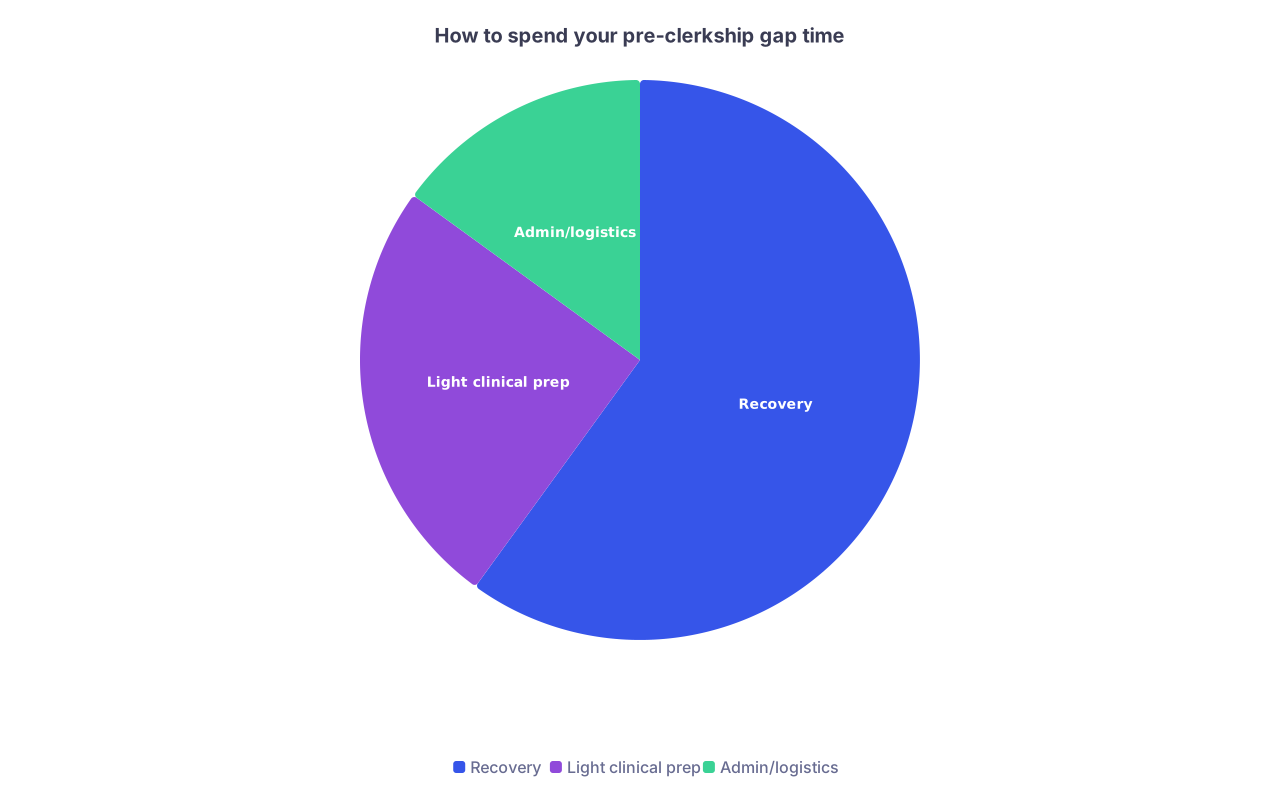
| Category | Value |
|---|---|
| Recovery | 60 |
| Light clinical prep | 25 |
| Admin/logistics | 15 |
If you have 4–6 weeks
You have enough time for a proper reset.
Week 1–2: Full-on decompression
No, not “decompression but also some UWorld.” Actual decompression.
- Sleep until you wake up without an alarm for several days in a row.
- Move your body daily: walks, gym, yoga, whatever doesn’t feel like punishment.
- Get off Step-related social media. Mute the gunner group chat if you need to.
- Do 1–2 things that remind you you’re a person: visit family, travel modestly, do a hobby you totally dropped.
Non-negotiable: no Qbank, no Anki, no “just a quick refresher” the first week. Your brain needs to believe the emergency is over.
Week 3–4: Gentle return to structure
Now you shift from “off” to “low gear.”
- Set a fixed, modest daily schedule:
- 1–2 hours max of light academic stuff:
- Watch a few basic clinical skills videos (physical exam, presenting a patient)
- Revisit super-high-yield, low-stress material (normal labs, EKG basics)
- 30–60 minutes of movement
- 1–2 blocks of “non-medical but productive” tasks (cleaning, finances, life admin)
- 1–2 hours max of light academic stuff:
This is about rhythm, not rigor. You’re practicing showing up, not grinding.
If you want something structured but not soul-crushing, early in this window is a good time to:
- Skim through your school’s clinical skills manual
- Watch a rapid review of common inpatient meds (heparin, insulin, beta-blockers)
- Practice speaking out loud: “This is a 54-year-old male with a history of…”
Week 5–6 (if you have them): Targeted clinical warm-up
Only after your energy is clearly better do you add slightly more serious prep:
- Pick the first two clerkships you’ll have (e.g., IM then surgery).
- For each, choose one main resource (ex: OnlineMedEd, Case Files).
- Do light exposure: a couple videos/cases per day, not full cram mode.
The metric here is: could I walk onto the floor and at least sound like I belong in a hospital? Not “could I ace the Shelf tomorrow.”
If you only have 2–3 weeks
You compress, but you don’t skip the recovery.
- First 4–5 days: Hard reset. Same as above—no studying.
- Middle block: Add light structure and some clinical skills exposure. Watch a few videos on:
- How to preround
- How to write an H&P
- How to present a patient in under 2 minutes
- Final 5–7 days: Preview your first clerkship only. Not all of them. Don’t try to read an entire textbook. Just:
- Learn common diagnoses
- Learn a basic exam
- Skim common inpatient meds and lab trends
If you have basically no gap (≤1 week)
You’re in “micro-reset” mode.
- Take 3 days completely off if you possibly can.
- Sleep, move, eat real food, see a human you like.
- Then spend 2–3 days on:
- Logistics: shoes, white coat ready, pens, notebook, EMR login, parking, etc.
- Watching 3–5 short videos on “day in the life of a [your first clerkship] student”
- Learning how to introduce yourself to patients and present succinctly
You don’t have time to “rebuild” fully. Fine. You focus on damage control and realistic expectations.
4. How to walk onto the wards when you feel half-empty
You might not feel “ready” when day 1 hits. That’s OK. The goal is not feeling full of boundless energy. The goal is functioning and not digging the hole deeper.
Here’s the starter kit.
Script your first week behaviors
First impressions stick. You want to look engaged even if inside you feel like toast.
Day 1–3:
- Show up 10–15 minutes early. Not 30. Not late.
- Write down everyone’s name and role: attending, seniors, interns, nurses.
- Say this to your senior on day 1:
“I’m really excited to learn. I’d love any feedback on how I can be most useful to the team.”
That single sentence buys you grace and frames you as teachable.
Energy-saving hacks:
- Always have a small task you can do without thinking (checking last vitals, updating the to-do list, printing lists).
- Park yourself somewhere visible but not in the way. If they see you, they’re less likely to forget you exist—which is demoralizing and exhausting.
- Keep a minimalist pocket notebook: 1 page per patient, short problem list, one “learning point” each day.
Protect your post-call and post-clinic time—ruthlessly
Old Step 1 brain says: “Use every free minute for UWorld.”
New clinical brain says: “If I’m a zombie, my evaluations and learning tank.”
Set a hard rule: on heavy days (call, long OR, brutal admissions):
- No question banks after 7 p.m.
- Prioritize:
- Food
- Shower
- 15–20 minutes of decompressing (not doomscrolling—actual unwinding)
- 15 minutes max reviewing 1–2 patients or a single topic that came up
That’s it. You are no longer a test-taking machine. You’re a human in a clinical ecosystem.
5. Dealing with guilt and comparison in the pass/fail era
You will have classmates who:
- Finished Step 1 early and “pre-studied” for every clerkship
- Are already halfway through UWorld Step 2
- Talk loudly about how “clinical year is the time to crush research and leadership”
Some of that is real, and some of that is performance. Either way, you don’t have the luxury to live in their heads. You’re working on not flaming out.
Here’s the mindset shift you need:
You are no longer trying to win Step 1. You are trying to be sustainably good at medicine for the next decade.
That means:
- You do not chase their pace. You protect your own capacity.
- You double down on showing up as the student people actually like working with.
- You remember that letters and narrative comments now carry massive weight.
I’ve seen mid-pack testers who:
- Showed up mildly underprepared but
- Asked good questions,
- Owned their mistakes,
- Stayed kind at 6 p.m. when everyone else was snapping
…end up with killer letters and strong matches.
And I’ve watched hyper-prepared, emotionally wrecked students get tagged as “brittle” or “difficult to work with,” which is poison in a pass/fail Step 1 world.
If you burned out on Step 1, your ace card now is self-awareness plus correction. Programs care more about that than your old three-digit fantasy score.
6. Concrete weekly template for a burned-out new clerk
Let’s make this stupidly practical. Here’s a realistic week once rotations start, if you’re still in recovery mode.
| Time | Focus |
|---|---|
| 5–6 a.m. | Wake, quick breakfast, commute |
| 6–5 p.m. | Clinical duties (pre-round, rounds, notes, tasks) |
| 5–6 p.m. | Commute, decompress |
| 6–7 p.m. | Dinner, short walk/stretch |
| 7–7:30 p.m. | Light review (patient topics) |
| 7:30–9:30 p.m. | Free time + wind-down |
| 9:30–10 p.m. | Bed |
Academic work on weekdays:
- Focus on:
- Reading about your own patients
- Writing better notes
- Practicing presentations
- Shelf prep: small, consistent doses
- 10–20 questions or 1 short chapter/video, 4–5 days per week
- Skip on post-call, catch up a bit on a lighter day
Weekend:
- One heavier “study half-day”:
- 2–3 hours of questions + targeted review
- One mostly off day:
- Chores, real rest, maybe light reading
If you feel the urge to “catch up” like Step 1 mode? Remember: doubling your weekly questions while burned out just means halving your retention and tripling your misery.
7. When burnout is more than just “tired”
There’s a line where normal Step 1 exhaustion crosses into something that needs actual professional help. Do not ignore it.
Red flags:
- You wake up dreading every single day, not just hard ones.
- You feel numb or detached around patients and don’t care that you don’t care.
- You think, “If I got hit by a car and couldn’t finish med school, that might be a relief.”
- You’re using alcohol, weed, or other substances every day just to turn your brain off.
- You can’t sleep even when you’re exhausted, or you sleep 12 hours and still feel wrecked.
If that’s you, I’m going to be blunt: white-knuckling through clinical year is a terrible plan.
What to do:
- Contact student health or counseling. Say the words “burnout from Step 1, clinical year starting, I’m worried I won’t make it through.” They’ve heard it.
- Loop in someone at your school you trust: an advisor, dean of students, or a faculty mentor.
- Ask directly about:
- Adjusted schedules
- Delaying the start of clerkships if you’re at that level
- Formal accommodation if needed
You’re not the first person to need this. Schools handle this every year. The students who do best long-term are the ones who admit it early and get help, not the ones who “tough it out” until something breaks.
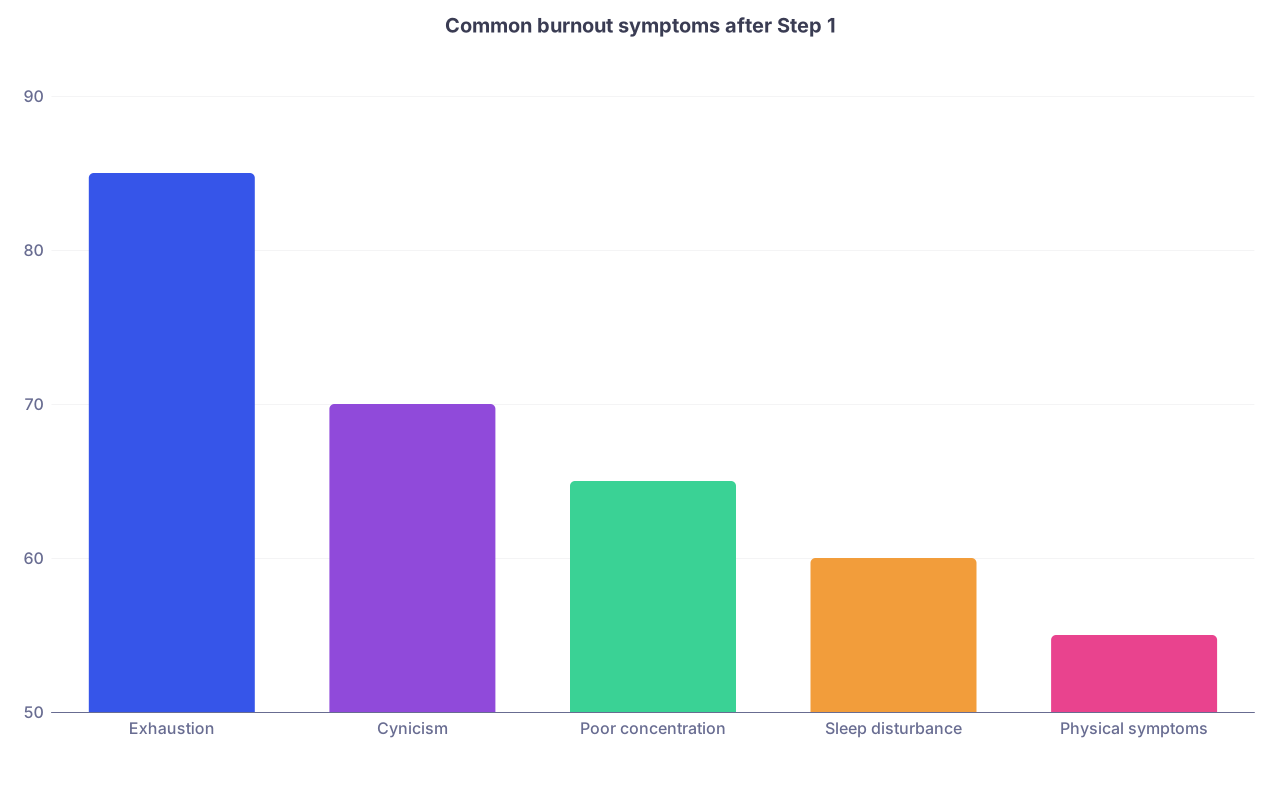
| Category | Value |
|---|---|
| Exhaustion | 85 |
| Cynicism | 70 |
| Poor concentration | 65 |
| Sleep disturbance | 60 |
| Physical symptoms | 55 |
8. The future: how Step 1 pass/fail changes the game—and your strategy
Old world:
- Step 1 = sorting hat
- Everyone killed themselves for a number
- Clinical year mattered, but less than that score
New world:
- Step 1 = gatekeeper
- Step 2 + clinical evaluations + letters = sorting hat
- People who didn’t burn out have a huge advantage
If your Step 1 prep already burned you out, you have two choices:
Pretend it didn’t, and then repeat that pattern with Step 2 and shelves, likely with worse consequences.
Accept that your nervous system has given you data and change your operating system now.
Here’s what that new OS looks like, in plain English:
- You never again treat an exam as more important than your long-term ability to function.
- You treat sleep as a required rotation, not an optional elective.
- You prioritize relationships with attendings and residents as much as question banks.
- You allow “good enough” preparation sometimes, so you do not slide back into that Step 1 hole.
One last mindset shift: you didn’t waste your Step 1 effort. You overpaid, but you got something out of it:
- You proved you can tolerate discomfort for a goal.
- You learned exactly where your limits are.
- You now have a very clear signal: this way of working is not sustainable.
Use that data. Adjust now, not in residency when the stakes are higher and the hours are worse.

| Step | Description |
|---|---|
| Step 1 | Step 1 Burnout |
| Step 2 | Deep Recovery + Light Prep |
| Step 3 | Micro Recovery + Targeted Prep |
| Step 4 | Micro Reset + Logistics Focus |
| Step 5 | Structured Clinical Year Plan |
| Step 6 | Monitor Burnout Signs |
| Step 7 | Adjust Study Load |
| Step 8 | Seek Professional Help |
| Step 9 | Build Sustainable Habits |
| Step 10 | Gap Before Clerkships |
FAQ (exactly 3 questions)
1. Should I delay starting clinical year if I feel completely wrecked after Step 1?
If you’re at the point where basic functioning is hard—struggling to get out of bed, persistent hopelessness, or serious physical symptoms—yes, you should seriously consider a delay. Talk to student health and your dean before rotations start. A 3–6 month pause with structured recovery and therapy can save your career. Taking that time looks much better to programs than limping through clerkships with mediocre evaluations and possibly failing a rotation.
2. How much should I study for Step 2 during MS3 if I’m already burned out from Step 1?
Early in MS3, almost nothing that’s not Shelf-related. Focus on doing well on each rotation and using its Shelf prep as Step 2 groundwork. A reasonable target later in the year is:
- During each clerkship: 10–20 high-quality questions per day tied to that specialty
- Dedicated Step 2 time: 4–8 weeks after MS3, depending on your goals and energy
If you’re still feeling fragile by mid-year, shorter daily sessions with more rest will beat aggressive schedules you won’t sustain.
3. I feel guilty that I “wasted” so much time on Step 1 when it’s pass/fail now. How do I get over that?
You didn’t have perfect information, and you were operating under intense cultural pressure. That’s not a moral failing; that’s being a med student in a messy transition era. The only useful move now is converting that regret into strategy: you already know what overwork does to you. So you draw a line: no more sacrificing your mental health for marginal exam gains. Your future evaluations, letters, and Step 2 performance will come from a stable, sustainable you—not the hollowed-out version Step 1 left behind.
Key takeaways:
- Treat your Step 1 burnout as real data, not weakness—recovery before clerkships is not optional.
- Start clinical year with sustainable habits: modest studying, solid sleep, and being the student people actually like working with.
- In the pass/fail Step 1 era, long-term resilience and strong clinical performance matter more than trying to recreate an unsustainable Step 1 grind.