
What if you’re about to blow an entire year of your life on “research” just because Step 1 went pass/fail—and it ends up not helping you at all?
Let’s talk about that.
You’re in this weird new era: Step 1 is pass/fail, everyone is anxious about “standing out,” and suddenly every other MS2/MS3 on Reddit is “strongly considering” a research year because “programs care more about research now.”
Some of them need it. A lot of them don’t. And nobody’s telling you the difference clearly.
I will.
Step 1 P/F: What Actually Changed vs What People Are Just Panicking About
First, you need a clean picture of reality. Not the hearsay.
Before P/F:
- Step 1 was the screening nuke.
- 260+ opened a lot of doors. 210 closed many.
- Research helped, but often as a tiebreaker.
Now:
- Step 1 is a checkbox: Pass or did you blow it.
- Step 2 CK, clinical grades, and letters matter more.
- Research matters more in some fields, but it didn’t suddenly become a magic ticket.
Programs didn’t suddenly become research institutes.
They still care about:
- Step 2 CK (a lot)
- Clerkship performance
- How strong your letters are
- Fit and professionalism
- Actual evidence you’re serious about their specialty
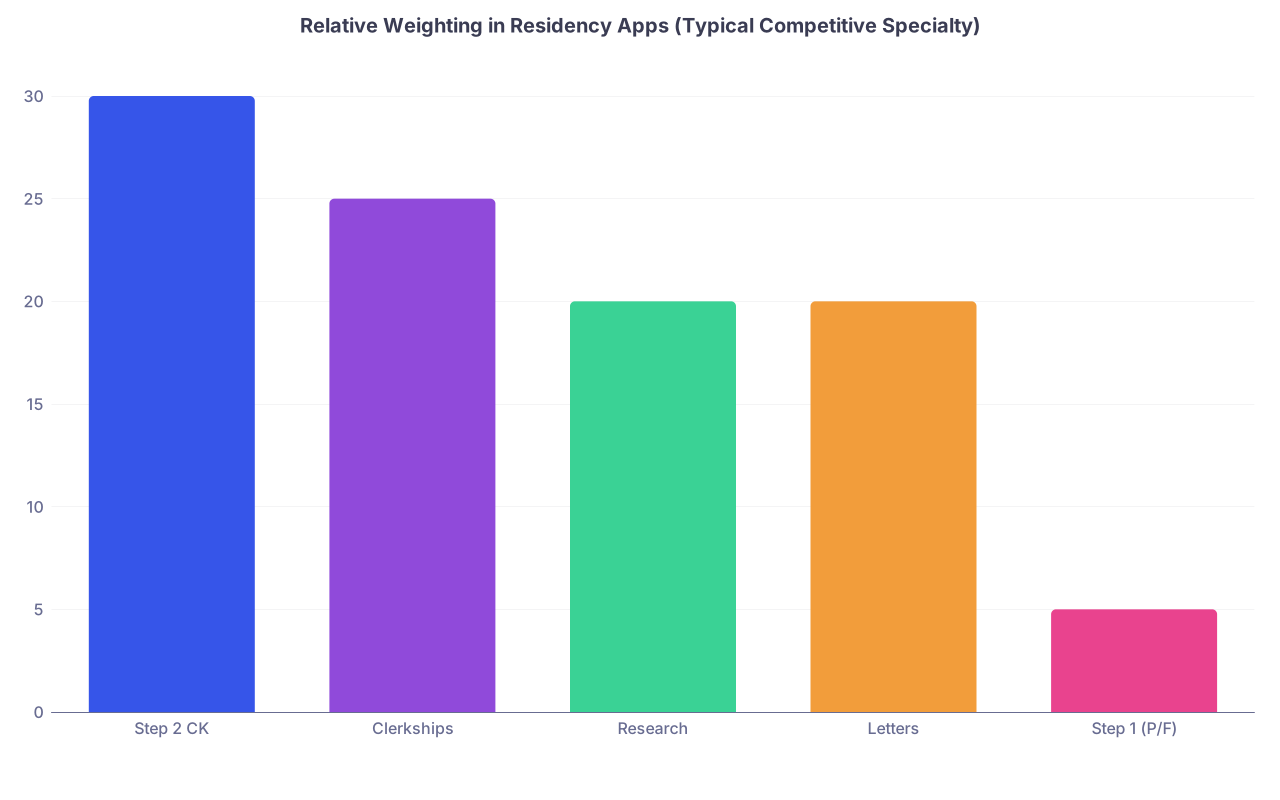
| Category | Value |
|---|---|
| Step 2 CK | 30 |
| Clerkships | 25 |
| Research | 20 |
| Letters | 20 |
| Step 1 (P/F) | 5 |
Are there programs that filter hard by research output? Yes. Derm, rad onc, some neurosurg, some academic IM or ENT programs.
But the big question for you isn’t “does research help?”
It’s: Does a full research year make sense for you, given your goals and current profile?
When a Research Year Actually Makes Sense (And When You’re Just Hiding)
Let me be blunt: a research year is expensive. In time, in lost salary as a resident, in burnout risk. It can be absolutely worth it—but only in specific situations.
Situation 1: You’re Gunning for a Hyper-Competitive Specialty with Little to Show
Example: You’re MS2/MS3, want derm, ortho, plastics, ENT, neurosurg, IR, rad onc.
Your current situation:
- No meaningful research (maybe a poster from undergrad that no one cares about).
- Mediocre Step 2 practice scores so far.
- No strong specialty connections.
Here, a research year can:
- Get you 3–10+ pubs/abstracts in the right journals.
- Embed you with a well-known attending who can write a killer letter.
- Give you time to study and crush Step 2 CK.
- Help you get on the radar of a specific department.
That’s a rational reason.
Situation 2: Your Application Is Already Damaged, and You Need a Rebuild
Think:
- You failed Step 1 once (but passed eventually).
- You have a failed clerkship or serious professionalism flag.
- Your school is lower tier with weak home department in your target specialty.
Here, a research year can:
- Show a coherent story: “I regrouped, focused, and produced.”
- Provide a high-quality letter from someone outside your home institution.
- Give programs a reason to believe your best work is ahead of you.
Still not guaranteed to “fix” anything. But at least it changes the trajectory.
Situation 3: You’re Serious About an Academic Career Long-Term
You’re not just chasing dermatology because the lifestyle is nice. You actually like:
- Thinking about study design
- Data, stats, writing
- The idea of being faculty
Then a dedicated research year can:
- Clarify if you truly like research or just like the idea of liking research.
- Give you protected time to get skills you’ll reuse: R, Python, REDCap, basics of manuscript writing.
- Position you for resident research tracks, K awards later.
Now, when is a research year a bad idea?
Red Flag Situations: When a Research Year Is Mostly Avoidance
“Everyone on SDN is doing it.”
That’s not a reason. That’s herd panic.You don’t even know your specialty yet.
Taking a year off “to build my app” with no target? You’re just delaying decisions.You’re trying to avoid clinical rotations.
If you’re burned out, depressed, or scared of clerkships, a research year can become a very expensive avoidance strategy.Your Step 2 potential is low and you’re not addressing it.
If you can’t break ~220–230 on practice exams and you’re not fixing that, research isn’t your bottleneck. Step 2 is.
Step 1 P/F Alone Is Not a Reason for a Research Year
This is the core point: the existence of pass/fail Step 1 does not, by itself, justify a research year.
Compare two hypothetical students aiming for ENT:
| Factor | Student A (No Research Year) | Student B (Research Year) |
|---|---|---|
| Step 1 | Pass | Pass |
| Step 2 CK | 255 | 245 |
| Research Output | 1 small abstract | 8 papers/abstracts |
| Clinical Grades | Mostly honors | Mostly high pass |
| Specialty Exposure | Strong sub-I + letters | Good but less clinic time |
Who looks better to many programs? Student A.
A monster Step 2 and strong clinicals beat “8 papers” with a weaker exam and weaker clerkships at a lot of places.
Programs know how easy it is to slap your name on 6 retrospective chart reviews in a year. They weigh that accordingly.
If your Step 2 could be a 255+ and your clinical performance solid, sacrificing that momentum for “one more line on my CV” is backwards.
How to Decide: A Brutally Honest Self-Interrogation
This is the part you probably haven’t done properly yet.
Take a notebook. Answer these directly. No fluff.
What specialty would I apply to if ERAS opened tomorrow?
If you can’t answer, you’re not ready to commit a year to “improving your app.”For that specialty, how does my current profile stack up?
Look at:- Step 1: Pass, any fails?
- Practice Step 2 CK scores.
- Core clerkship grades (especially IM, surgery, neuro, psych depending on specialty).
- Any home program? Any mentors?
Pull actual program data.
Go beyond vibes. Look at NRMP Charting Outcomes, program websites, recent match lists from your school. You’re trying to answer:- Do most matched students have a dedicated research year? Or just “some research”?
- Are you below average, average, or already competitive?
Ask two relevant people for specific feedback.
Not your roommate. Not the r/medicalschool hive mind.- One: An attending or senior resident in your target specialty.
- Two: Your dean/advising office.
Ask them this exact question:
“If I continue as-is, without a research year, do you think I have a realistic shot at matching in X? Be honest.”
If BOTH say “yes, with a strong Step 2 and letters,” you probably do not need to disappear into a research black hole for a year.
If You Do a Research Year, Do Not Waste It
If you’ve thought it through and still decide on a research year, then it needs to be structured, not “vibe-based academic drifting.”
Here’s what that looks like in practice.
1. Pick the Right Environment, Not Just the Shiniest Name
A fancy institution is useless if you’re:
- One of 20 students orbiting a PI who doesn’t remember your name.
- Doing data entry all year with no ownership.
Better:
- A mid-tier academic center with 1–2 hungry mentors who actually publish and give you first-author work.
- Departments with active clinical research pipelines: ortho trauma, cardiology, ED, derm, neurosurg, etc.
Ask before committing:
- “How many papers did your last research-year student get, and in what roles (first, middle, last)?”
- “What will my first 4 weeks look like specifically?”
- “How often do you meet with your students?”
If they can’t answer concretely, that’s a red flag.
2. Have a Project Portfolio, Not Just One Massive Study
The risk: you hitch your entire year to a large RCT or big database project that:
- Stalls in IRB
- Never gets enough data
- Dies when the fellow leaves
You want a mix:
- 1–2 big projects that could become strong first-/second-author pubs.
- 3–6 small/medium projects: case series, retrospective reviews, conference abstracts.
That way, your output doesn’t depend on a single fragile timeline.

| Step | Description |
|---|---|
| Step 1 | Start Research Year |
| Step 2 | Meet with Mentor |
| Step 3 | Plan 1-2 Major Projects |
| Step 4 | Plan 3-6 Smaller Projects |
| Step 5 | IRB and Data Collection |
| Step 6 | Quick Turnaround Abstracts |
| Step 7 | Manuscript Draft |
| Step 8 | Presentations and Publications |
| Step 9 | Letters and Program Visibility |
3. Tie Everything to Your Specialty Narrative
If you say you want ortho, but all your research is in psychiatry and nephrology, programs will raise an eyebrow.
You want at least:
- Majority of your output in or adjacent to your intended field.
- A clear story: “I took a year to dive deeper into X aspect of Y specialty.”
Then your personal statement, letters, and CV all tell the same story.
4. Guard Your Step 2 CK Like It’s Your Actual Job (Because It Is)
A research year is the perfect time to crush Step 2—if you don’t get lazy.
You should:
- Schedule Step 2 within the year, not after you return to full-time rotations.
- Block 2–3 dedicated months near the end of the year if possible.
- Treat clinical question banks (UWorld, NBME forms) as non-negotiable.
If you finish a research year and walk away with:
- 6 abstracts and
- A mediocre Step 2 score (or delayed exam),
you’ve used the year badly.
Signs You’re Using “Research Year” As a Cover Story
I’ve watched students talk themselves into a research year when what they really needed was something else entirely.
Here are the patterns:
You haven’t actually asked anyone in your target specialty about your competitiveness.
Because you’re afraid of the answer.You can’t articulate what you’d do during the year, beyond “research and maybe some shadowing.”
That’s not a plan. That’s academic loitering.Your main emotion about a research year is relief, not excitement.
Relief from rotations, exams, pressure. That usually signals burnout, not academic ambition.
If that’s you, the real question isn’t “Should I take a research year?”
It’s: “Am I burned out/struggling enough that I should be talking to student health, a therapist, or my dean about accommodations or a leave?”
Different problem. Different solution.
What To Do Instead of a Research Year (If You Don’t Actually Need One)
You still want to strengthen your application. Fair. There are other moves that often give more ROI than an entire gap year.
Option 1: Targeted Research Without a Full Year Off
Ask to:
- Join a project with a resident/fellow.
- Take on a defined chunk (data extraction on 200 patients, literature review, etc.).
- Aim for 1–3 solid abstracts/papers over 6–12 months.
Many students quietly build good research portfolios this way during M3/M4 without stepping out for a year.
Option 2: Fix the Bigger Lever—Step 2 CK
For most specialties, Step 2 CK is now one of the highest-yield things you can improve.
If you’re scoring:
- 230s and want IM, psych, peds: you’re fine at many programs.
- Lower than that or aiming for more competitive fields: your energy is better spent getting that into the 250+ range than chasing one more PubMed line.
Option 3: Crush Clinical Rotations and Sub-Is
Strong performance on core clerkships and sub-internships:
- Leads to better letters.
- Shows programs you can actually function on the floor.
- Often outweighs a weak-ish research record in non-ultra-competitive specialties.
Many program directors would rather have a workhorse with great bedside skills and reliability than a pseudo-PhD student with 10 middle-author papers who can’t manage a patient list.
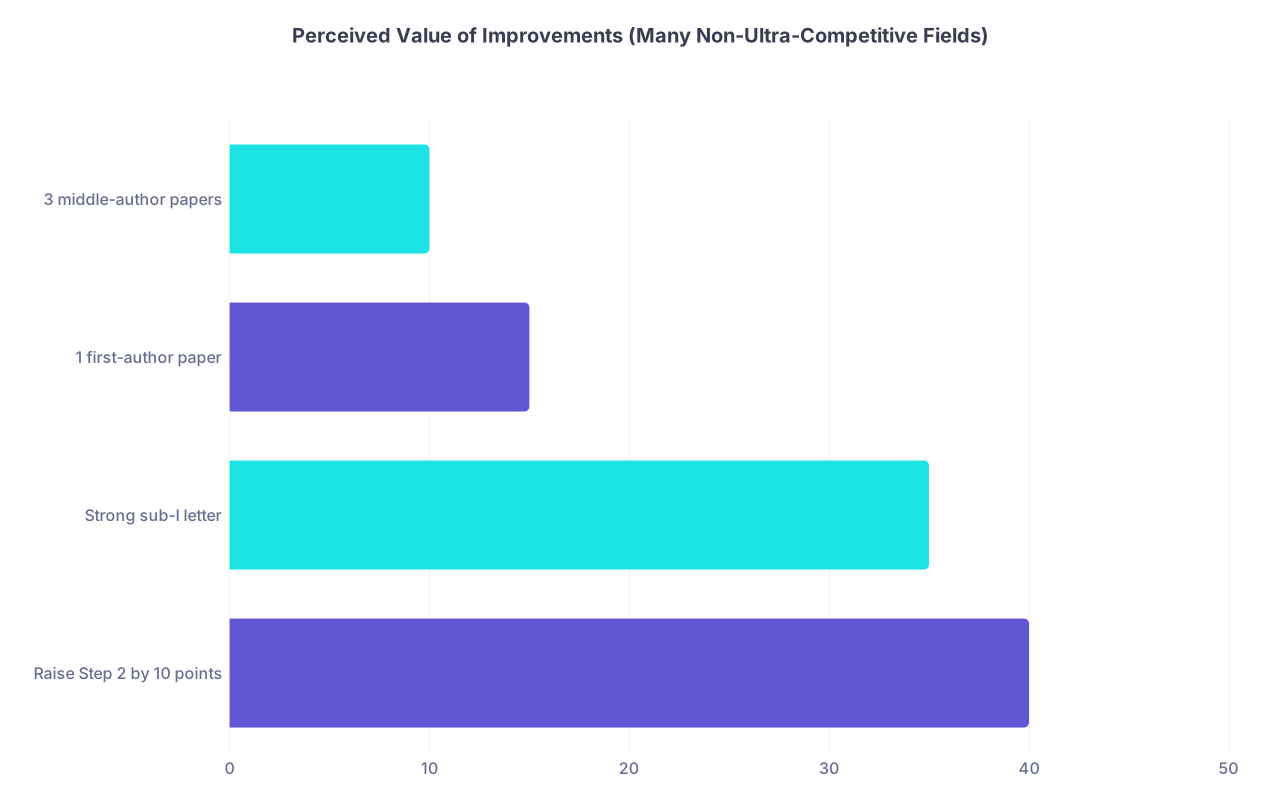
| Category | Value |
|---|---|
| Raise Step 2 by 10 points | 40 |
| Strong sub-I letter | 35 |
| 1 first-author paper | 15 |
| 3 middle-author papers | 10 |
How To Make the Decision This Month
You don’t need a 3-month existential spiral. You need a structured week.
Day 1–2:
- Decide on your likely specialty (or top 2).
- Gather your current numbers: grades, exams, any research.
Day 3–4:
- Look up actual match data and program descriptions.
- Draft an email to 2–3 faculty in that field asking for a brief advising meeting.
Day 5–7:
- Have those meetings.
- Ask them: “Would you recommend I take a research year, given my current stats and goals?”
If two experienced people in your field say “you do not need a year off; focus on Step 2 and rotations,” believe them over Reddit.
If they both independently say, “for what you’re aiming at, a research year would help you significantly,” then you’re not being paranoid. You’re listening to data.
FAQs
1. I passed Step 1 on the second attempt. Do I need a research year now?
Not automatically. A Step 1 fail is a real blemish, but specialty and context matter.
If you’re going for derm/plastics/neurosurg, yes, you probably need every possible plus—research year, stellar Step 2, strong letters.
If you’re going for IM, FM, psych, peds, or even many anesthesiology programs, a strong Step 2 (think: significantly above mean), clean clinical record, and some solid research or leadership might be enough.
Talk to faculty in your chosen field with your full profile in front of them before deciding.
2. Does doing a research year at a famous institution (Harvard, Mayo, etc.) matter more than output?
Name helps, but not as much as people fantasize. A well-known institution plus strong letters and multiple first-author projects is great.
But a big-name place where you’re buried on 8 middle-author papers and nobody knows you personally is worse than a smaller program where an attending can say, “This student basically ran three projects for me and is outstanding.”
If forced to choose, I’d pick strong mentorship + real output over big name + weak involvement.
3. How many publications “justify” a research year for a competitive specialty?
There’s no magic number, but if you do a full, dedicated year and end up with:
- 2–3 first- or second-author manuscripts submitted/accepted, and
- 3–6 posters/abstracts at relevant conferences,
that’s a solid return.
If you come out with only 1 poster and nothing submitted, programs will quietly wonder what you did for 12 months. Plan your year so that doesn’t happen.
4. What if I start a research year and realize 3 months in that I hate research?
Then you adjust. Talk to your mentor and your dean. Options:
- Narrow your project load and focus on 1–2 things you can actually finish.
- Shift to more clinically oriented work (QI projects, outcomes studies).
- If truly miserable and it’s harming you, discuss shortening the gap and returning to school early.
Do not ghost the lab or just “coast.” That burns bridges and can backfire in letters. Own your decision and exit cleanly.
Open your notes app right now and answer this in one sentence: “If I don’t take a research year, here’s my plan to become a strong applicant in my chosen specialty.” If you can’t write that sentence clearly, fix the plan before you sacrifice a year.