
The pass/fail Step 1 era has not made things easier. It has made the biggest mistakes easier to hide.
The comforting lie that will wreck your application
“Step 1 is pass/fail now, so it doesn’t really matter.”
I’ve heard that exact sentence from students at:
- A top-10 MD school
- A Caribbean school
- A DO program fighting for competitive specialties
Every time, the ending is similar:
- Average Step 2 score
- Bland application
- Shock on Match Day when the list doesn’t match back
You’re not competing in the same game as the people who matched your dream specialty five years ago. The rules changed. You just haven’t updated your playbook.
Let me walk you through the new landmines that quietly kill competitive dreams in the Step 1 pass/fail era—and how to avoid stepping on them.
1. Treating “pass” on Step 1 as a finish line instead of a warning label
The most dangerous mindset now: “As long as I pass Step 1, I’m fine.”
No. Passing Step 1 is now the starting filter, not the deciding factor.
Here’s the trap:
- Students study to barely pass.
- They do few or no timed blocks.
- They never build real test stamina.
- They move on feeling “done with boards.”
What actually happened? They skipped the only free rehearsal they were ever going to get for Step 2 CK.
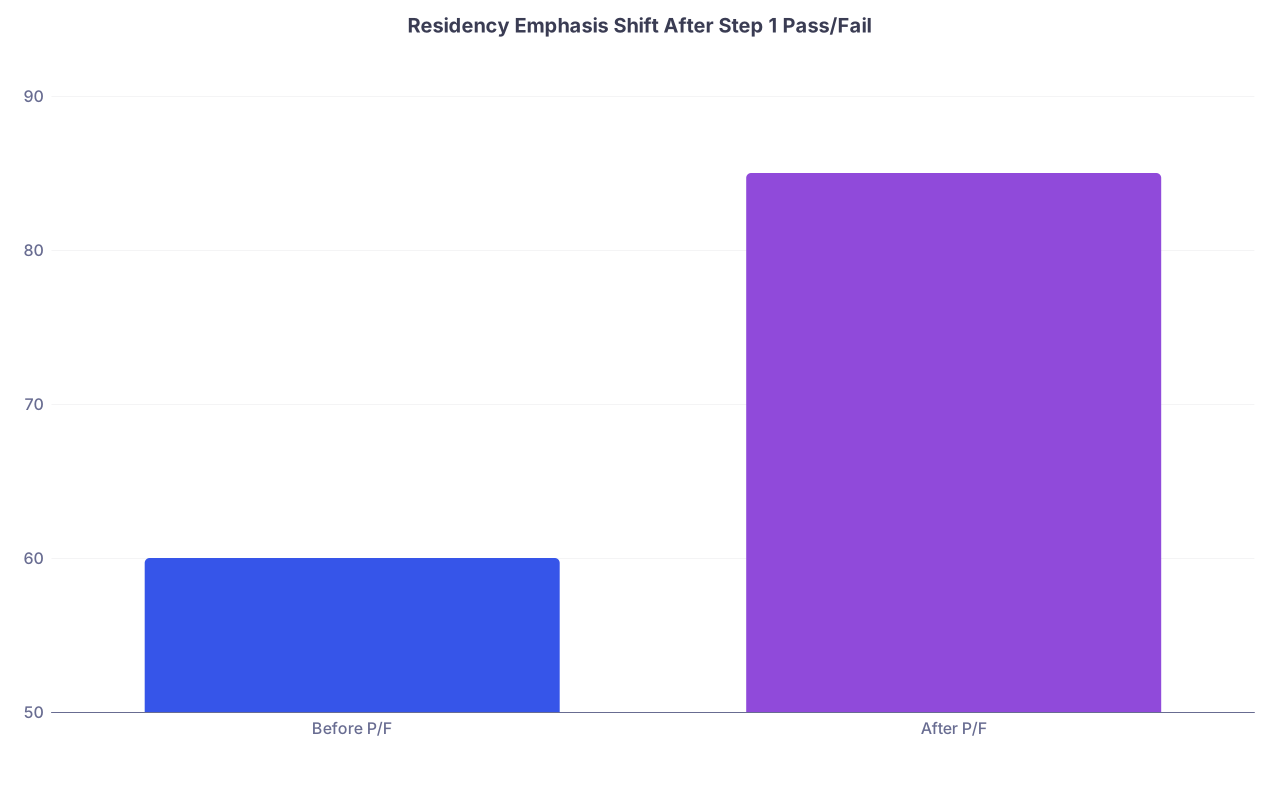
| Category | Value |
|---|---|
| Before P/F | 60 |
| After P/F | 85 |
That bar isn’t scientific data, but it reflects reality: program emphasis on Step 2 CK has exploded.
The hidden consequences of “just get a pass”:
- You never learn to grind through 8-hour testing days.
- You don’t build a question-bank habit early.
- You don’t learn your pattern of mistakes under pressure.
- You carry weak foundations straight into clerkships and Step 2.
And then? You suddenly “discover” that Step 2 CK actually matters when you’re 6 months out, on busy rotations, with no real prep system.
Avoid this mistake: Treat Step 1 as:
- A diagnostic for Step 2 CK readiness
- A dress rehearsal for test endurance
- A way to build your systems: Anki, question banks, review habits
Do not study to “pass.” Study to “destroy the material.” The score isn’t reported—but your knowledge is.
2. Letting preclinical grades and school name quietly kill you
Here’s an ugly truth programs won’t put in brochures: when Step 1 went pass/fail, programs started staring harder at everything else.
If you’re making these mistakes, you’re handing them reasons to screen you out:
- Coasting through preclinical because “pass is enough”
- Taking every “low-stakes” quiz like it’s optional
- Bragging “I don’t really care about preclinical grades; I care about being a good doctor”
That might sound noble. It reads as “lack of drive” on the program side.
- Class rank / honors
- Internal exam performance
- School reputation
- Narrative comments (“below expectations,” “requires close supervision”)
| Factor | Attention Before P/F | Attention After P/F |
|---|---|---|
| Step 1 Score | Very High | None (no number) |
| Step 2 CK Score | High | Extremely High |
| Preclinical Grades | Low–Moderate | High |
| School Reputation | Moderate | Higher |
| Narrative Comments | Moderate | Higher |
The silent killers:
- Being bottom half of your class at a mid-tier school
- Faculty comments like “needs redirection,” “slow to pick up tasks”
- Failing a course and repeating it (with no explanation in your app)
None of these automatically destroy a career. But together? They quietly move you from “competitive” to “backup candidate.”
Avoid this mistake: You don’t need straight honors. But you absolutely cannot:
- Stack multiple remediations
- Be known to faculty as the student who doesn’t show up prepared
- Treat “just passing” as your standard
Aim for:
- Solid middle or better in class rank
- Clean transcript with minimal remediations
- Positive relationships with at least a few preclinical faculty
You’re building a record of reliability. That matters more now than ever.
3. Ignoring the Step 2 CK monster until it’s too late
The most common self-sabotage in the pass/fail era: waking up to Step 2 CK after you’ve already screwed your timeline.
I’ve watched this pattern too many times:
- M1–M2: “Step 1 is pass/fail, so I’m focusing on wellness.”
- M3 start: “I’ll just learn on the wards, that’ll help Step 2.”
- Mid-M3: Shelf scores are mediocre, you’re exhausted, and there’s no system.
- 4–6 months before Step 2: panic, then unrealistic study plans.
- Score comes back: good enough to pass, not good enough to compete.
Step 2 CK is now the single most important number on many applications. People pretend otherwise, but program rank lists say different.
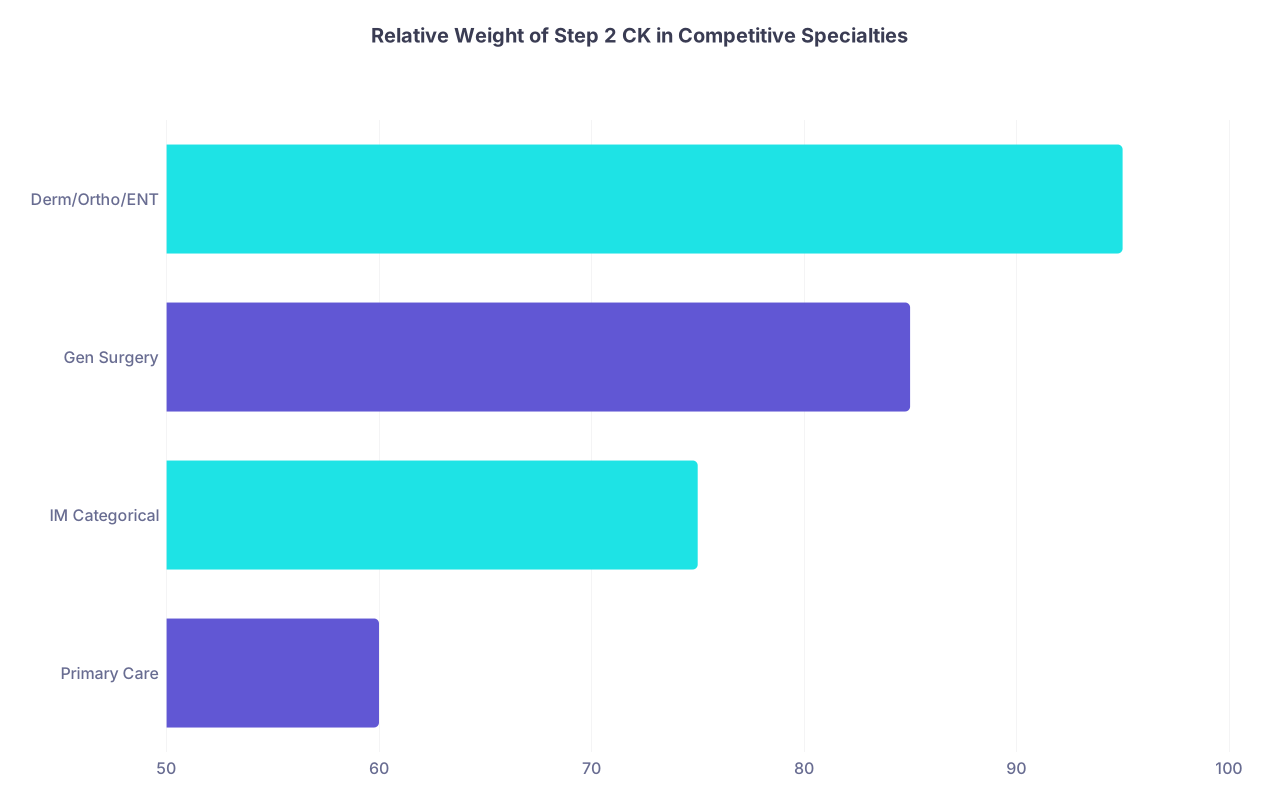
| Category | Value |
|---|---|
| Primary Care | 60 |
| IM Categorical | 75 |
| Gen Surgery | 85 |
| Derm/Ortho/ENT | 95 |
Again, illustrative, not exact percentages—but directionally correct.
Major Step 2 timing mistakes:
- Scheduling Step 2 after ERAS opens “because I’m not ready yet”
- Taking it late summer/early fall of M4 for competitive specialties
- Not using shelf exams as real prep data
- Ignoring that some programs now have soft Step 2 cutoffs
Programs cannot use a Step 1 number to separate you anymore. So they lean hard on:
- Step 2 CK
- Clerkship grades
- Class rank
- School reputation
If Step 2 lands in the “meh” range:
- IM competitive: < 240–245 often stings
- Surgery/Anes/EM: low 240s can hurt depending on the rest of your file
- Derm/Ortho/ENT/Plastics: you know the score expectations; “average” isn’t helping
Avoid this mistake: By M2, you should have:
- A consistent question bank habit (not days before the exam)
- A Step 2 target window on the calendar, ideally:
- Before ERAS opens if you’re aiming high
- With enough buffer for a retake only if absolutely catastrophic
Use every shelf exam as:
- A barometer of where you’d land on Step 2 today
- A signal for where you’re weak (OB? Neuro? Psych?)
Do not wait for some imaginary, magical “dedicated” that will fix everything. It never does.
4. Underestimating how much professionalism now matters
Step 1 used to hide a lot of sins. If you had a 260, some programs would look past your weird comments, your occasional lateness, your mediocre evals.
That cover is gone.
Now that programs can’t obsess over Step 1 numbers, they look closer at:
- Dean’s letter comments
- Clerkship narratives
- Red flags (formal professionalism issues, leave of absence without clarity)
- How attendings describe working with you
I’ve literally read comments like:
- “Frequently late, required frequent reminders”
- “Struggled with insight into performance”
- “Had difficulty integrating feedback”
You think those get ignored because your Step 1 says “Pass”? Absolutely not.
Quiet professionalism-killer behaviors:
- Rolling into pre-rounds five minutes late because “it’s just med school”
- Checking your phone in front of patients
- Acting disengaged on “unimportant” rotations
- Subtle eye rolls, sighs, or body language when asked to do scut
- Venting about attendings in ways that get back to them (it happens more than you think)
Let me be blunt: in a pass/fail Step 1 world, your reputation is now a bigger part of your application.
Avoid this mistake:
- Decide now: no lateness pattern. Period.
- Treat every rotation like its attending might be writing your future letter. Because one of them will.
- When you mess up (and you will), own it early: “I’m sorry I was late. No excuse. It won’t happen again.”
- Be the student people describe as “easy to work with,” “reliable,” “takes feedback well”
Programs are terrified of toxic residents. They’d rather choose a slightly lower Step 2 with excellent professionalism than a brilliant jerk.
5. Building a cardboard application with no real story
Here’s a subtle casualty of the pass/fail era: more students feel like they don’t need a compelling narrative.
They think:
- “I’ll pass Step 1 and get a decent Step 2 score. That’s enough.”
- “Research doesn’t matter unless you’re going for derm or ortho.”
- “Everyone has leadership and volunteer stuff, I’ll just check the boxes.”
So their applications look like:
- 2–3 scattered research “experiences” with no output
- Generic free clinic volunteering they can barely describe
- A “leadership role” that was basically a line on a CV
- No through-line between their interests and their specialty choice
In an era where the main standardized score is gone, your story matters more. Because it’s what separates you from the dozens of other “Pass / 242 / AOA-eligible / 3 research items” applicants in the pile.
Common narrative-killing mistakes:
- Jumping on random projects with no continuity
- Chasing “what looks good” instead of what you’ll actually commit to
- Dropping activities once they get hard or boring
- Not taking ownership of anything long term

Avoid this mistake: Build a spine for your application:
- 1–2 long-term commitments (e.g., same clinic, same research group, same advocacy project)
- Real responsibility: coordinating volunteers, leading a project, running a quality-improvement initiative
- A plausible, honest connection between:
- What you study
- What you do
- The specialty you claim you care about
You’re not manufacturing a story. You’re actually living one—intentionally.
6. Misreading how competitive your dream specialty really is now
Another nasty side effect of Step 1 going pass/fail: a lot of students think specialties “softened.”
They did not. Some got harder because:
- Everyone who would’ve been scared off by a 250+ Step 1 bar is now emboldened to apply
- Programs have fewer objective tools to screen, so they lean harder on:
- School brand
- Research depth
- Step 2 CK cutoffs
- Connections and away rotations
I’ve seen students make these mistakes:
- Believing “Step 1 P/F helps lower-tier schools” while ignoring that Step 2 now does the separating
- Assuming “good letters” can fully compensate for a weak Step 2 in derm/ortho/ENT
- Refusing to build a realistic parallel plan because “I’ll just work harder”
Here’s what quietly happens behind the scenes for ultra-competitive fields:
- Programs pre-screen on Step 2 CK and school reputation
- They lean heavily into faculty advocacy: “This student is a must-interview”
- They use away rotations as month-long auditions
If you’re at a less-known school, you particularly can’t afford:
- Late or mediocre Step 2 CK
- No research in the field
- Zero away rotations
- Bland letters
Avoid this mistake:
- By mid-M3, have a brutally honest conversation with:
- A mentor in the specialty
- Your dean’s office or career advisor
- Ask straight: “With my record so far, what’s my realistic shot if I apply here as #1 only?”
- If they get quiet, that’s your sign you need either:
- A much stronger M4 (away rotations + Step 2)
- Or a thoughtful dual-application or backup plan
Hope is not a strategy. Not in this market.
7. Believing wellness means avoiding all discomfort
The pass/fail Step 1 era arrived in parallel with a bigger and very real conversation about wellness. That’s good. Burnout is real and ugly.
But there’s a twisted version of “wellness” I see quietly killing careers:
- Using “self-care” as a shield from any sustained grind
- Avoiding practice tests because “they stress me out”
- Refusing feedback because “it makes me feel bad”
- Bailing on commitments the second they get uncomfortable
That’s not wellness. That’s avoidance dressed up as mental health language.
I’m not talking about people with legitimate mental health crises or disability accommodations. I’m talking about garden-variety discomfort that medical training will absolutely require you to face.
In a pass/fail Step 1 era, where:
- Your habits matter more
- Your longitudinal performance matters more
- Your professionalism matters more
…systematic avoidance becomes painfully visible.
Avoid this mistake: Redefine wellness as:
- Sustainable, consistent work over frantic cramming
- Facing reality early (NBME scores, shelf performance)
- Getting help before it’s a five-alarm fire
- Saying “no” selectively, not reflexively
If you need therapy, medication, time off—get it. That’s strength, not weakness.
But don’t hide a fear of difficulty behind wellness vocabulary. Programs can’t see your feelings, but they absolutely can see your outcomes.
8. Assuming technology and AI will “cover the gaps”
Let me be blunt: using AI and flashy tools as a substitute for understanding is another quiet dream-killer.
Common patterns:
- Letting AI summarize lecture content you never fully learned
- Using question-explanation bots instead of wrestling with why you missed something
- Copying AI-generated content into notes or even research drafts without real comprehension
- Thinking “I’ll just ask ChatGPT on the wards if I don’t know something”
This looks efficient. Until:
- You’re on a shelf exam, and there’s no autocomplete for your brain
- You’re in front of an attending who expects a logical differential, not buzzwords
- You’re in residency, and your patient needs you to synthesize information in real time
AI is a powerful tool. It will not save a hollow foundation.
Avoid this mistake:
- Use tech to accelerate, not replace, your own understanding.
- Summaries → starting point, not end point
- Explanations → prompts for your own re-phrasing and note-making
- If you can’t explain a concept from memory, slowly and clearly, you don’t own it.
- Protect deep work: at least some hours where it’s you, the text, and questions—no shortcuts.
In the pass/fail Step 1 world, your weaknesses show up later. On the wards. On Step 2. In residency. That’s worse.
FAQ: Step 1 Pass/Fail Era
1. If Step 1 is pass/fail, is there any point in aiming for “high performance” on it?
Yes. You’re not chasing a number; you’re chasing mastery. The disciplines and knowledge you build for Step 1:
- Make clerkships dramatically easier
- Give you a running start for Step 2 CK (the exam that actually has a score)
- Reduce the cognitive load when you’re trying to learn on the wards
Students who “just pass” tend to struggle with shelves, then scramble late to patch holes. That scramble usually shows in their Step 2 CK score. So yes, aim high—for your future self’s sanity.
2. How bad is it to take Step 2 CK after ERAS opens?
For truly competitive specialties (derm, ortho, ENT, plastics, some surgical subs), it can quietly hurt you. Programs often:
- Screen applicants before your score arrives
- Fill most interview spots early
- Use early Step 2 scores to prioritize invites
For less competitive fields, a later Step 2 might be fine, if your application is otherwise strong. But building your entire strategy around “I’ll just take it late” is exactly how people end up with fewer interview offers than they expected.
3. I’m at a lower-ranked school. Has Step 1 pass/fail helped or hurt me overall?
Net effect: it shifted the battlefield; it didn’t remove it. You lose one of the easiest ways to “signal up” (a sky-high Step 1). Now you must hit harder on:
- Step 2 CK
- Research in your desired specialty
- Strong letters from known faculty
- Stellar away rotations
You aren’t doomed, but you also can’t be average and expect top-tier outcomes. The margin for error is thinner. That means you need to be more intentional, not less.
Open your calendar today and block one hour to do this: write down your target specialty (or top two), your current Step 2 CK target date, and what you’re actually doing this week that will make your application harder to ignore in a pass/fail Step 1 world. If that page looks empty or vague, fix that now—not in M4 when it’s already too late.