
The fantasy that “Step 1 pass/fail means programs are more holistic now” is mostly wrong.
They did not become kinder. They just changed the filters.
I sit in rooms where faculty scroll through ERAS like they’re triaging a disaster. Three hundred applications for 10 spots. Nobody is reading 300 personal statements with a cup of tea and an open heart. They are filtering. Hard. And in the post–Step 1 P/F era, the filters have shifted in ways most students do not understand.
Let me walk you through what actually happens now.
The Void Step 1 Left – And What Filled It
Before pass/fail, there was one god: the Step 1 three‑digit score.
You know the old algorithm. Program director opens ERAS, applies a Step 1 cutoff (220, 230, 240, 250 depending on specialty), chops the pool in half without blinking. Then they look at everything else.
That number is gone. The behavior is not.
Here’s what changed behind the curtain: they simply substituted other metrics into that first‑pass filter. Nobody announced it. There is no official PDF. But every program director, usually with the chief residents and a couple of faculty, sat down and said:
“Okay, what’s our new first screen?”
Some did this explicitly in a meeting. Some quietly changed the sort order in ERAS and never told anyone outside the office.
Here’s the uncomfortable truth: you’re still being filtered by numbers and checkboxes. Just different ones.
The New Primary Cutoffs: What Really Gets You Screened In or Out
I’ll lay out what I’ve seen and heard directly from program directors and selection committee members over the last two cycles. This is especially true in competitive and mid‑tier academic programs; community programs sometimes soften this, but the pattern holds.
1. Step 2 CK: The New Step 1 (Even if They Pretend Otherwise)
Nobody wants to admit this publicly, but Step 2 CK is now the de facto numeric spine of your application.
Here’s how the logic usually sounds in the room:
- “Step 1 is P/F now, we can’t use that. Sort by Step 2 descending.”
- “We’ll look more holistically… but let’s start with people above X so we aren’t drowning.”
That “X” is the new unspoken cutoff. Programs do not publish it. But if you listen to conversations and watch who gets interviews, you can back‑calculate it.
For most moderately competitive university programs:
- Internal Medicine academic: soft screen around 240–245
- General Surgery academic: 245–250
- EM academic: ~240
- OB/GYN: 240–245
- Peds: 230–235
- Psych (at good programs): ~235
At top‑tier or name‑brand places, bump those by 5–10 points.
No one writes “240 cutoff” in a policy manual. What actually happens is:
- They sort by Step 2 CK.
- They start “selecting for review” from the top.
- They stop when they’ve flagged roughly 2–3x the number of applicants they can realistically interview.
- Everyone below the point where they got tired of clicking “select” might as well not exist unless they have some special flag (home student, known to faculty, huge research, URiM, etc.).
And if you don’t have a Step 2 score available early? Many places now auto‑discard or defer those applications unless they’re from their own school.
A blunt comment I heard from one surgical PD: “If you don’t have Step 2 in by September, you’re signaling you either failed, scored low, or don’t understand the game. None of those help you.”
2. Step 1 Pass/Fail Still Matters – Just Not How You Think
You thought pass/fail would de‑stress Step 1. In reality, a late or barely pass is the new scarlet letter.
Here’s how Step 1 P/F gets used now:
Timing of pass
Programs can see when you passed. Failing Step 1 and then passing 6–9 months later is a data point. Not always fatal, but it absolutely colors interpretation of a borderline Step 2 CK score.Patterns with preclinical performance
If you barely passed preclinicals, had to remediate, then passed Step 1 late, and Step 2 CK is 225… that file becomes “high risk” in many rooms.International vs US grad
Some US programs are quietly using Step 1 “pass” for US MD/DO and “high Step 2 + first‑attempt Step 1 pass” as a minimum for IMGs. They won’t say that out loud, but I’ve watched the filters.
The new hidden cutoffs here are about flags:
- Multiple exam failures? Many programs will auto‑screen out unless you have insane compensatory strengths.
- Delayed Step 1 + lowish Step 2? That combo is a major uphill battle.
Nobody cares that you got “just pass” vs “high pass” on Step 1. They can’t see the score. But they care a lot about failure patterns and timing.
3. Class Rank + Clinical Grades: The Quiet Academic Filter
With Step 1 gone, more programs are rediscovering something they used to claim mattered but barely looked at: transcript and rank.
Here’s the behind‑the‑doors reality:
- When there’s no Step 1 number, PDs look for any marker of “can this person handle our clinical workload and exams?”
- That often becomes: core clerkship grades, AOA, GHHS, quartile/tertile.
Many schools sanitized this by going pass/fail for preclinicals and even shelves. But clerkship narratives and “overall standing” are still there.
What committees actually scan for:
- Honors or high pass in Medicine and Surgery
- Pattern: Did you tank early and improve, or did you slide downward?
- Any comments like “requires significant supervision,” “below level,” “professionalism concern.”
Some programs tell their residents: “If they’re bottom quartile with no strong story or improvement, I don’t want to risk a weak intern.”
Top 25–30% of the class with strong clinical comments is the new unofficial “safe” zone for competitive specialties. Not a hard cutoff, but an unspoken comfort line.
4. School Prestige and Type: The Filter Nobody Likes to Admit
Everyone loves to say “we don’t care where you went to school, we look at the whole person.”
Then you sit in the actual selection meeting.
Some PDs literally click “sort by Medical School” and scan for familiar names first, or they apply softer Step 2 CK expectations to certain med schools.
Here’s how it really plays out:
US MD vs DO vs IMG
Most academic programs still apply tiers. Step 2 expectations are quietly higher for IMGs. Some surgey and derm programs simply do not look at DO/IMG files unless there’s a connection.Highly ranked schools
If you’re from a big‑name school, committees often tolerate slightly lower Step 2 or weaker research because they “trust the brand” and know the clinical environment.Lesser‑known or new schools
Now that Step 1 is P/F, some PDs lean harder on school reputation as a surrogate for academic rigor. They won’t say it out loud, but when they see an unknown offshore school and a 232 Step 2, they get nervous.
Unspoken cutoffs here are fuzzy, but very real:
- For some surgical subspecialties, US MD is effectively the baseline requirement, then they move to Step 2 screens.
- For IMGs, I’ve heard this exact line: “If you’re IMG, below 245–250 Step 2, we’re not looking unless someone here knows you or you have a Nature paper.”
5. Research as a De Facto Filter in Academic Programs
Step 1 P/F didn’t just elevate Step 2. It elevated PubMed.
Not everywhere. But at academic and university‑based programs, research is now being used as a quiet pre‑screen more often.
The mentality:
- “We can’t tell who’s ‘smart’ from Step 1 anymore. Who’s got real scholarly work? Who survived a lab year? Who has an RCT, not just a poster at a regional conference?”
So they sort by:
- Number of PubMed‑indexed publications
- First‑author or not
- Alignment with their department’s interests (onc, cardiology, basic science, etc.)
For certain specialties (rad onc, derm, neurosurg), research is now almost a proxy for “serious candidate.” For medicine subspecialty‑feeder programs, a couple of decent publications can be the difference between “maybe” and “hard pass” at the screening stage.
Is there a hard cutoff? Not numeric. But the pattern is:
- Zero research in a research‑heavy field = low probability of serious review
- One case report vs someone with 5–6 papers and a research year? The committee doesn’t waste time pretending those are equivalent.
How Programs Actually Screen Now: The Unspoken Algorithm
Let me make this concrete. This is very close to what happens in practice at a mid‑to‑high tier university internal medicine program.

| Step | Description |
|---|---|
| Step 1 | All Applications |
| Step 2 | Home/known only |
| Step 3 | Auto screen out unless special flag |
| Step 4 | Higher bar for Step 2 and research |
| Step 5 | Review transcript and letters |
| Step 6 | Possible reject unless champion |
| Step 7 | Invite or alternate list |
| Step 8 | Step 2 CK present by Sept? |
| Step 9 | Step 2 above soft cutoff? |
| Step 10 | US MD or strong known DO/IMG? |
| Step 11 | Any red flags or failures? |
Behind those nodes are unspoken thresholds:
- Step 2 “soft cutoff” might be 240 that year. Next year, with a different applicant pool, maybe 242.
- “Strong known DO/IMG” = someone from a school they’ve matched from before, or with a trusted letter writer.
And yes, there are always exceptions. But they’re rare and usually require a faculty champion who walks into the meeting and says: “This one is mine. Interview them.”
The Data Reality: What’s Quietly Driving Decisions
The NRMP Program Director Survey hints at this, but the real story is sharper. Since Step 1 went P/F, Step 2 CK importance has jumped, but so has the “importance” of the other academic and professionalism signals.
Here’s a simplified comparison of how things effectively shifted, based on what PDs say vs what they actually do.
| Factor | Before Step 1 P/F | After Step 1 P/F |
|---|---|---|
| Step 1 Score | Primary hard cutoff | Must pass, timing matters |
| Step 2 CK Score | Secondary filter | Primary numeric filter |
| Med School Reputation | Moderate | Higher (esp. no Step 1) |
| Class Rank / Grades | Tertiary | Secondary filter |
| Research | Specialty‑dependent | Elevated in academics |
And yes, different specialties weight these differently. Surgery cares more about Step 2 and clinical excellence. Derm cares more about research and letters from names. Psych may be more forgiving numerically but less tolerant of professionalism issues.
But the pattern is the same: when you remove one pillar, the others have to carry more weight.
The New Red Flags You Don’t Hear About Publicly
Some of this hasn’t changed, but the sensitivity to it has. With Step 1 no longer differentiating, committees are extra jumpy about:
Multiple exam failures
Step 1 fail + Step 2 fail? Very difficult road without an insider or massive rehabilitation.Late Step 2 with weak explanation
If your Step 2 score hits ERAS in November and it’s 228, people start telling themselves stories: “Were they hiding this?” “Were they remediating?” Even if it’s not fair.Unexplained leave / gap years
Gap for research is fine, often valued. Gap with vague “personal reasons” and no documentation or narrative in your MSPE? People get suspicious.Professionalism comments in clerkships
In the old world, a 255 Step 1 could wash a lot of sins. Not anymore. A line like “occasionally late,” “had difficulty accepting feedback,” or “concerns about reliability” can kill an application even with a strong Step 2.
This is the hidden grim part of the P/F transition: programs lost a convenient, defensible numeric shield. So they lean harder on subjective impressions, institutional bias, and red flags.
Strategy: How You Actually Adapt to This New Landscape
Let me be direct. If you’re in med school now, here’s how you play in a Step 1 P/F world that still loves cutoffs.
1. Treat Step 2 CK as the New Center of Gravity
You cannot coast.
You don’t have Step 1 to buffer a mediocre Step 2 anymore. That window is gone.
So:
- Schedule Step 2 so your score is in ERAS by early–mid September.
- Prepare like it’s the most important exam of your training thus far, because for residency selection, it is.
- If your school pressure‑cooks you into an early Step 2 date you’re not ready for, push back. Quietly, professionally, but firmly. A rushed 229 is worse than a slightly later 242.
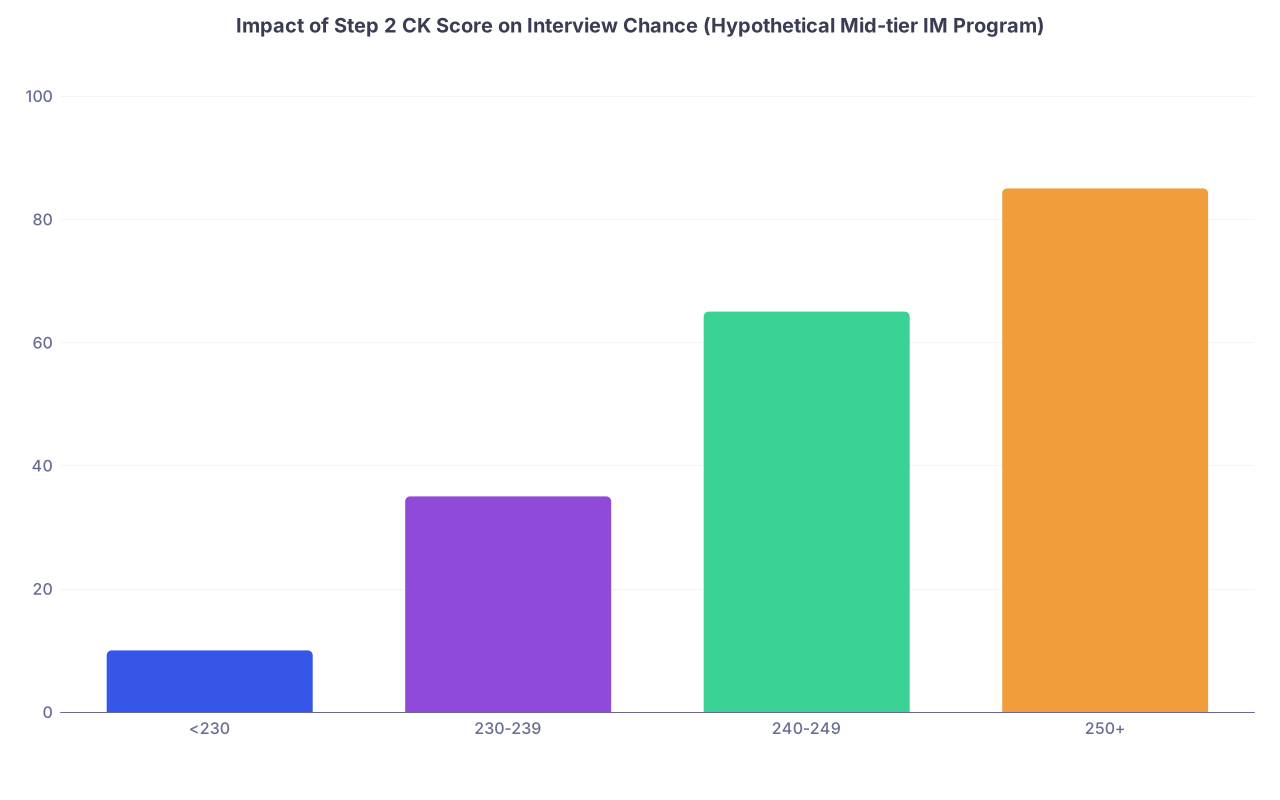
| Category | Value |
|---|---|
| <230 | 10 |
| 230-239 | 35 |
| 240-249 | 65 |
| 250+ | 85 |
These aren’t official numbers from any one program, but this shape is exactly how it looks across many.
2. Stop Ignoring Your Clinical Evaluations
In the old era, some students mentally wrote off third‑year comments: “Whatever, I’ll crush Step 1/2 and it’ll be fine.”
That logic will hurt you now.
Those narratives about your work ethic, how you handle feedback, whether attendings trust you with patients — they’re getting more attention, not less.
If you’re already in clerkships:
- Fight for clean, strong comments. That means showing up early, closing the loop, doing the boring scut well, being reliable.
- Ask attendings directly: “Is there anything I can improve before the end of the rotation? I’d really like to earn a strong evaluation.” Subtle, but it nudges them to think in those terms.
If your school gives you class rank or quartiles, understand: being in the bottom quartile will now trigger extra scrutiny in a way that used to be overwritten by a good Step 1.
3. Be Honest About Where You Fit
Harsh reality: some of you are still choosing target specialties as if Step 1 270 was sitting in your pocket.
In this environment, your combination of:
- Step 2 CK
- School type
- Clinical performance
- Research
…should drive your specialty and program list.
If you’re a US MD with a 245 Step 2, solid Medicine and Surgery honors, and light research, you’re in a strong position for university IM, EM, OB/GYN, decent surgery.
If you’re an IMG with 234 Step 2, no US letters, and minimal research, and you’re applying ortho to 40 top programs because “anything is possible,” you’re not being bold. You’re being naive.
Programs are still using cutoffs. They’re just not publishing them.
4. Use Relationships to Break the Algorithm
There’s one thing that still punches through all of this:
- A trusted attending walking into the selection room and saying: “This one is a must‑interview.”
Or:
- Being a known, liked rotator at that institution with strong onsite performance.
That’s the oldest trick in the book, and it’s still the most powerful.
In a Step 1 P/F world, network and advocacy matter more than ever, because you can no longer stand out with one giant number. If you know you’re borderline numerically, you cannot be passive. You need:
- Away rotations at realistic programs
- Strong, personal letters from people who are actually known in the field
- PDs or chairs willing to send an email or make a call
I’ve watched applicants with mediocre Step 2 but stellar in‑person performance jump ahead of 20 higher‑scoring strangers on an interview list. It’s not fair. It’s not equal. It is how this world works.
5. Understand That “Holistic” Is Real, But Not Soft
People misread “holistic review” as “they’ll overlook numbers if you’re nice and involved.”
No. Holistic review means:
- Numbers + trajectory + context + character + fit.
In practice, that means:
- A 232 Step 2 from a student who failed Step 1 and had professionalism issues = probably done.
- A 232 Step 2 from a student who worked full‑time before med school, supported family, had upward academic trend, great letters, no red flags = still absolutely interviewable, especially in less cutthroat fields.
Holistic doesn’t erase cutoffs. It just makes them more flexible for the right story.
FAQs
1. If Step 1 is pass/fail, should I still study hard for it?
Yes, but not to the level of personal destruction. You study hard enough to pass comfortably on the first attempt and to build a conceptual foundation for Step 2. A clean, on‑time pass with solid knowledge is all you get from Step 1 now — but that’s still crucial.
2. How bad is it to take Step 2 after ERAS submission?
For many academic programs, it quietly hurts you. They won’t say “auto‑reject” if Step 2 isn’t in, but they’re hesitant to offer an interview without seeing it. A late, mediocre score can be worse than a slightly delayed submission with a strong score ready by early October.
3. Can strong research really offset a mediocre Step 2 CK?
Sometimes, but only in specific contexts. For research‑heavy fields and big academic centers, a serious research portfolio (real publications with real mentors) plus strong letters can get you looked at despite a softer Step 2. It rarely rescues very low scores, but it can move you from “no” to “maybe.”
4. I’m an IMG/DO with a solid Step 2. What else matters most?
US clinical experience with strong letters from people your target programs actually recognize. A clean record on exams (no failures), and evidence you can function smoothly in US hospital systems. For IMGs especially, the combination of Step 2 score + first‑time Step 1 pass + trusted letters is the main triage trio.
5. Are community programs less strict about these new cutoffs?
Generally, yes — but not uniformly. Many community programs are more flexible with Step 2 ranges and school types, and more willing to consider the whole story. But even they need a way to manage volume, so Step 2 and red flags still matter. The difference is they’re more open to interviewing a wider numerical band if you look reliable and motivated.
Key takeaways: Step 1 going pass/fail did not end cutoffs; it redistributed them to Step 2 CK, school reputation, clinical performance, and research. Programs still screen brutally because they have to. Your job is to understand the unspoken thresholds, position yourself intelligently, and use relationships and performance to break through when your numbers alone are not enough.