
The pass/fail Step 1 era did not “simplify” residency applications. It just moved the pressure and the deadlines.
If you treat this season like the old Step 1–centric timeline, you’re already behind.
What follows is a month‑by‑month, then week‑by‑week guide to residency application season specifically in the new testing order: Step 1 pass/fail, Step 2 CK as the numerical anchor, and program directors ruthlessly updating their filters.
I’ll walk you straight through it: what should be done when, what’s safe to delay, and what will quietly destroy your application if you miss by a week.
Big Picture: How the New Testing Order Changed the Timeline
At this point you should understand the new rules of the game:
- Step 1 is now a binary gate. Pass = proceed. Fail = delayed or derailed.
- Step 2 CK is the primary score. Programs are now waiting on it to rank you.
- Many specialties want Step 2 CK in hand before interview offers.
- Clinical grades, letters, and timing suddenly matter much more than they used to.
In practical terms, that means three huge timeline shifts:
- You can’t push Step 2 to late fall anymore if you’re even vaguely competitive.
- Your “application season” now truly starts 9–12 months earlier, during core clerkships.
- Deadlines are more spread out but less forgiving—miss a window and a program quietly removes you from consideration.
Let’s map it.
Phase 1: Late MS2 – Early MS3 (Setting Up the Testing Order)
Think of this as “pre‑season.” You’re not in ERAS yet, but you’re already deciding whether you’ll be ready when it opens.
January–March (MS2): Step 1 Strategy in the Pass/Fail World
At this point you should:
- Pick a Step 1 test window that preserves MS3 flexibility.
- Avoid the common mistake: pushing Step 1 so late that it collides with clerkships and Step 2 CK prep.
A realistic, safe anchor for most students:
- Take Step 1 between April–June of MS2.
This does a few things:
- Leaves time to recover from a fail (harsh but true).
- Keeps your core clerkship start reasonably intact.
- Gives you room to aim Step 2 CK for June–July before ERAS submission.
If you’re aiming for highly competitive fields (Derm, Ortho, ENT, Plastics, NSGY), you should:
- Treat Step 1 as something you want to pass comfortably on the first try, so you’re not running damage control during MS3.
Red flag I’ve seen too often:
- Student takes Step 1 in late August.
- Starts cores in September visibly burnt out.
- Has zero bandwidth to prep for Step 2 CK early.
- Ends up taking Step 2 in November of application year.
Programs never see the score in time. Invitations don’t come.
Phase 2: Core Clerkships and Step 2 Positioning (MS3)
This is where the new testing order really bites.
April–June (Early MS3): Lining Up Your Test Dates
At this point you should:
- Book a Step 2 CK window. Yes, this early.
- Target: late May–mid July of the following year, depending on your school calendar.
Why so aggressive?
Because programs are increasingly doing this:
| Specialty | Wants Step 2 CK Before | Effect if Late Score |
|---|---|---|
| Internal Med (academic) | Interview invites | Lower invite chance |
| General Surgery | Rank list | Rank lower or not at all |
| EM | Interview invites | Often screened out |
| OB/GYN | Interview invites | Reduced consideration |
| Competitive surgical (Ortho/ENT/Plastics) | Application review | Treated as risk |
At the same time, you must:
- Start collecting feedback on attendings who write good letters.
- Track your strong rotations (you’ll come back for sub‑Is and letters).
No, you don’t wait until ERAS season to think about this. That’s amateur hour.
Phase 3: The Real Application Year – Month‑by‑Month
Assume a “standard” schedule where you’ll apply in September of MS4 (or equivalent). We’ll start the clock in January of the calendar year you apply.
January (Application Year – 9 months to ERAS submission)
At this point you should:
- Confirm your Step 2 CK test month (ideally May–July).
- Look at your rotation schedule from now through September:
- You want at least 1–2 sub‑Is or audition rotations in your target specialty before August.
- You want enough cushion so you’re not taking Step 2 CK during brutal inpatient months if you can help it.
Concrete tasks:
- Meet with your advisor or dean:
- Reality‑check specialty choice.
- Identify if your Step 2 CK needs to be earlier based on competitiveness.
- If you failed Step 1 (or barely passed and are worried):
- Put Step 2 CK earlier (April–May) to prove you’re fine.
February–March (7–8 months to ERAS submission)
At this point you should:
Lock in:
- Sub‑I / acting internship dates (ideally April–July).
- Away rotations (if your specialty uses VSLO and aways are common).
Identify letter writers:
- One from your home specialty department.
- One strong clinical IM or Surgery attending (depending on field).
- Possibly a research mentor if you’ve done substantial work.
Deadlines that sneak up here:
- Some schools and VSLO‑heavy specialties have March/April due dates for away rotation requests. Miss those and your audition plan collapses.
April (5 months to ERAS submission)
At this point you should:
Finalize Step 2 CK date.
- If you’re targeting early score reporting before ERAS opens:
- Aim to test by late June.
- If you’re comfortable with score arriving slightly after ERAS opens but before most invites:
- Aim for early–mid July.
- If you’re targeting early score reporting before ERAS opens:
Start CV and experiences list:
- Everything you might put into ERAS.
- Awards, leadership, research, community work.
- Get out of the “I’ll remember it later” fantasy.
You also:
- Begin gathering personal statement notes:
- Specific patient encounters.
- Why this specialty, beyond clichés.
- Moments from cores/sub‑Is that made things click.
Critical Testing Window: Step 2 CK vs ERAS
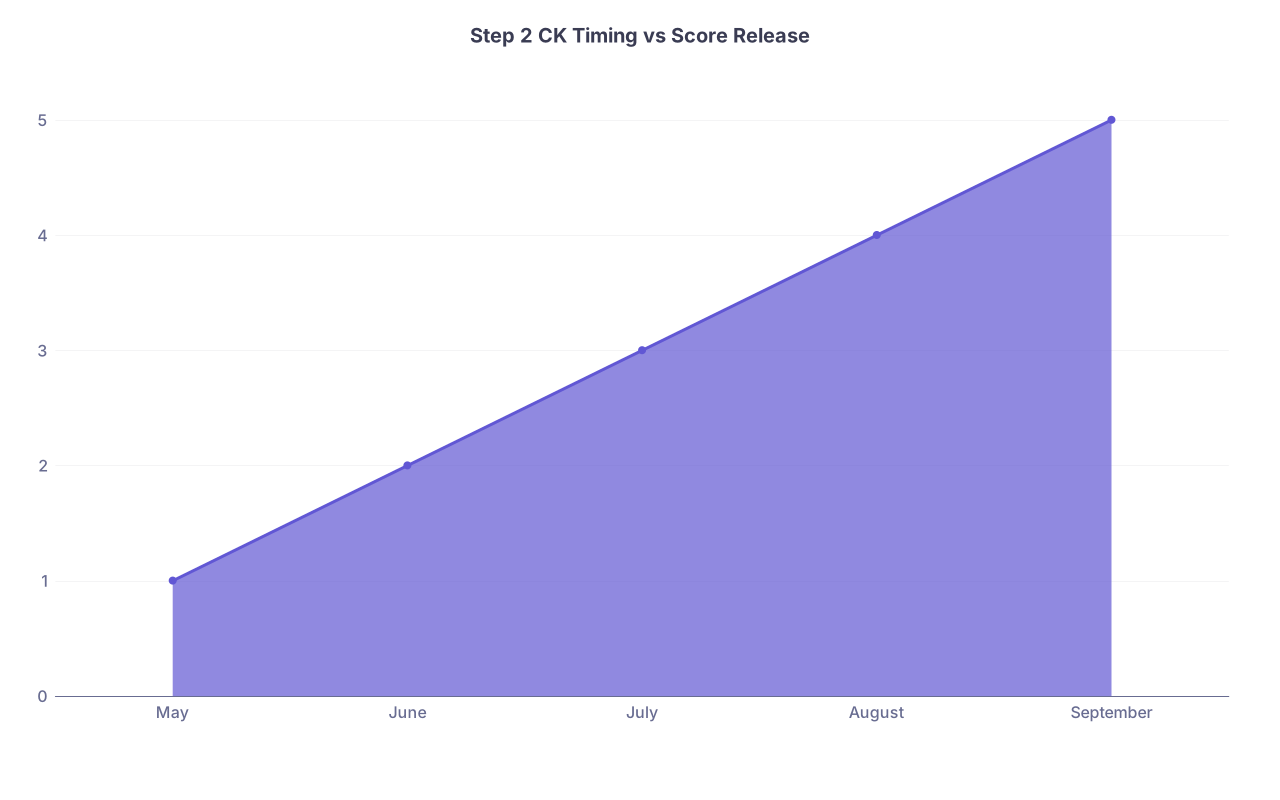
Before we go deeper into ERAS timing, visualize the key tension: when you test vs when programs can see your score.
| Category | Value |
|---|---|
| May | 1 |
| June | 2 |
| July | 3 |
| August | 4 |
| September | 5 |
Translate that nonsense line into what matters:
- Test in May → Score back by late May/early June → Safely in your file when ERAS opens.
- Test in June → Score back late June/early July → In your file well before programs start reviewing.
- Test in early July → Score back late July/early August → Usually fine, but tight for early reviewers.
- Test late July / August → Score may not be back for early interview offers.
- Test September or later → Many programs will either:
- Screen you out if “Score Not Available”
- Or quietly drop you lower in the sort pile.
For most people in the Step 1 pass/fail era, the sweet spot is:
Take Step 2 CK between May 15 and July 15.
Later than that is playing with fire unless:
- You’re at a less competitive school but applying to a less competitive specialty with a strong application.
- Or you already have a practice test track record that suggests a very strong Step 2 and you are willing to risk late invites.
Phase 4: ERAS and Application Build (May–September)
Now we tighten the screws.
May (4 months to ERAS submission)
At this point you should:
Open last year’s ERAS (or any sample) and familiarize yourself:
- Experiences entries.
- Publications format.
- Program list structure.
Draft:
- Personal statement v1.
- Experiences bullet points for your top 10 most meaningful entries.
Confirm:
- Letter writers are on board and know your specialty target.
- They understand when they’ll need to upload (August–early September for most).
If you’re taking Step 2 CK in May:
- The month is ugly. You balance:
- Final push to test.
- Light ERAS prep: just enough so June doesn’t drown you.
June (3 months to ERAS submission; ERAS token / opening month)
ERAS typically opens for applicants to start entering information in June (exact dates vary year to year).
At this point you should:
Log into ERAS the week it opens.
Input:
- Demographics.
- Education history.
- USMLE/COMLEX exams taken so far.
- Draft versions of experiences.
If you tested Step 2 CK in May:
- Watch for your score release. Confirm it’s:
- Uploaded to NBME.
- Linked correctly in ERAS.
- Watch for your score release. Confirm it’s:
You also:
- Refine your program list (target numbers):
- Less competitive primary care: 25–40.
- Mid to high competitiveness: 40–60.
- Highly competitive surgical/neuro: 60–80+ (with some sanity).
July (2 months to ERAS submission)
At this point you should:
Be in heavy ERAS build mode:
- Experiences mostly written.
- Personal statement on draft 2–3.
- Program list 80% finalized.
Check on letters of recommendation:
- Send letter writers your CV + draft PS.
- Give them a clear deadline: “Could you please upload by August 25?”
If you’re testing Step 2 CK in July:
- Make sure your test date is no later than mid‑July if you want a decent chance your score appears in time for:
- Early screening.
- Early interview offers.
You should also:
- Decide on secondary specialty (if you’re hedging):
- Example: Ortho + prelim surgery or TY.
- EM + IM.
- Derm + internal medicine.
- This decision affects program list building now.
Phase 5: August–September – The Hard Deadlines
This is where people quietly fail at timing.
Early August (5–7 weeks to ERAS submission)
At this point you should:
- Have:
- Final personal statement or nearly there.
- Experiences fully entered.
- List of “most meaningful” experiences flagged.
- Confirm:
- Which letters go to which specialty (if multiple).
You also:
- Chase letter writers who are slow. Yes, you email them.
- Polite reminder.
- Re‑include ERAS Letter ID.
- Re‑state your target date.
Mid–Late August (3–4 weeks to ERAS submission)
ERAS doesn’t transmit to programs yet, but you’re on a countdown.
At this point you should:
Do a full dry run of your application:
- Download/print a PDF if ERAS allows it that year.
- Check for:
- Typos.
- Inconsistent dates.
- Awkward phrasing.
Finalize your program list count.
If your Step 2 CK was in late July:
- You’re watching for score release now.
- You want that score to hit before programs start building filters.
Programs are preparing too:
- Many start screening in early–mid September.
- They batch review applicants once Step 2 CK scores populate.
Early–Mid September: Application Submission
ERAS typically:
- Opens for submission in early September.
- Transmits applications to programs a bit later (mid–late September).
At this point you should:
- Submit on or near the first submission day.
- Being 1–4 days late is okay.
- Being 2–3 weeks late is not. That’s how you quietly lose half your possible interviews.
Non‑negotiables before submission:
- USMLE/COMLEX exam entries correct.
- Specialty‑specific personal statements attached to correct programs.
- Letters properly assigned by specialty.
If your Step 2 CK score is not yet available:
- You still submit.
- But understand:
- Programs that rely heavily on Step 2 CK may auto‑hold your file.
- You’re now dependent on their willingness to re‑review later.
Phase 6: Interview Season Timeline in the New Era
Step order and score timing now heavily influence when you’re invited.
Late September–October: Early Invites
At this point you should:
- Be checking email and portal daily.
- Respond to interview offers same day if possible.
- Early slots go to the fastest applicants.
Programs in competitive fields often:
- Use a Step 2 CK cutoff.
- Fill most of their interview spots in October.
If your Step 2 CK score dropped after initial review:
- Some programs will automatically update your file and move you above their cutoff.
- Others will not. This is where your dean’s office or advisor can sometimes advocate.
November–December: Main Interview Block
At this point you should:
- Have the majority of your interview invites scheduled.
- If you have fewer than ~8–10 interviews for moderately competitive fields, or fewer than 12–15 for competitive fields:
- Talk to your dean/advisor.
- Consider:
- Expanding your program list if it’s not too late.
- Sending targeted, respectful interest emails to realistic programs (not mass spam).
The testing order effect here:
- A solid Step 2 CK score that arrived before or early in this period keeps invites coming.
- A late Step 2 CK may mean:
- Clustered later‑cycle invites.
- More uncertainty into December/January.
January–February: Late Interviews and Rank Lists
At this point you should:
- Attend any late interviews (especially for community or less competitive programs).
- Finalize your rank list.
The testing timeline still matters:
- Program rank committees often look again at:
- Full exam sequence: Step 1 (pass/fail), Step 2 CK, Step 3 (for some prelims).
- Any late updates (new Step 2 CK score if you had to retake, updated transcript).
Micro‑Level: Week‑By‑Week Around the Major Testing and ERAS Deadlines
Let’s zoom in on two critical windows: Step 2 CK month and ERAS submission month.
Step 2 CK Month – Week‑By‑Week
Assume you’re testing June 20.
4 weeks out (late May)
At this point you should:- Be on:
- NBME/UWSA practice test every 7–10 days.
- 40–80 UWorld questions/day, reviewed hard.
- Have every clinical core (IM/Surg/Peds/OB/Neuro/Psych) at least lightly reviewed.
- Be on:
2 weeks out (early June)
You:- Take your last major practice exam.
- Decide:
- Stay with the June 20 date if you’re near target.
- Or very selectively push 1–2 weeks if scores are dangerously low.
- Do not knee‑jerk postpone into August. That’s how you nuke your ERAS season.
1 week out (mid June)
You:- Taper slightly (fewer questions, more focused review).
- Fix weaknesses from final practice test.
- Protect sleep. You’re not 19 anymore.
Score release week (late June / early July)
You:- Verify score appears.
- Screenshot for your own records.
- Immediately:
- Share with advisor.
- Adjust specialty/program strategy if the score is way above/below expectations.
ERAS Submission Month – Week‑By‑Week
Assume ERAS submission opens September 5 and you plan to submit that day.
4 weeks out (early August)
At this point you should:- Have:
- Draft PS finished.
- Most experiences entered.
- Start:
- Fine‑tuning wording.
- Confirming letters are in progress.
- Have:
2 weeks out (late August)
You:- Lock:
- Personal statement content.
- Program list (maybe with a few to add).
- Check:
- Letters status. Nudge anyone missing.
- Lock:
1 week out (start of September)
You:- Do line‑by‑line review of:
- Experiences.
- Honors/Awards.
- USMLE entries.
- Finalize:
- Which PS goes to which specialty.
- If letters are missing, you still submit and let letters arrive later.
- Do line‑by‑line review of:
Submission day
You:- Submit early in the day.
- Confirm:
- Payment processed.
- Application status shows as submitted for all selected programs.
The Future Direction: Where Deadlines Are Likely Heading
Let me be blunt: the Step 1 pass/fail era is not finished evolving.
At this point you should assume:
Step 2 CK will become even more central.
- More programs will formalize Step 2 CK cutoffs.
- More specialties will require Step 2 CK at time of application, unofficially if not officially.
Earlier Step 2 CK will become the norm.
- Testing in May or June of application year will be standard advice.
- Late summer tests will be coded as “risky” by advisors.
Holistic review is real but not blind to timing.
- Pass/fail Step 1 widened the aperture for some schools.
- But if you delay key components (Step 2 CK, letters, sub‑Is), you’re still signaling disorganization or risk.
So you build your personal timeline assuming:
- Programs want clean, on‑time data.
- You give it to them. Not in a rushed panic, but as a planned sequence.
If You’re Already “Behind”
Maybe you’re reading this with:
- Step 2 CK scheduled in August or September.
- No real ERAS work started.
- Minimal letters lined up.
At this point you should:
- Sit down with someone who isn’t going to sugarcoat:
- Honest advisor.
- Program director who knows you.
- Dean’s office.
You’ll likely need to choose between:
- Keeping the current cycle and accepting:
- Fewer interviews.
- Possible SOAP/second cycle.
- Or delaying your application year:
- Take Step 2 CK strong and early next season.
- Stack meaningful experiences.
- Apply as a more mature, complete candidate.
The worst option is denial. Drifting into September with missing scores and half‑built ERAS ruins cycles.
Two Final Anchors
Cut through the noise and remember:
Step 2 CK timing is now a central residency deadline.
In the pass/fail Step 1 era, a June–July Step 2 CK is not “aggressive,” it’s standard. Later is a calculated risk.ERAS is not one date; it’s a season of linked deadlines.
Sub‑Is, letters, test dates, and submission timing all interlock. Get one wrong and you limit what the rest can do for you.
Build your calendar now. Then follow it like it actually matters—because in this new testing order, it does.