
The idea that you can “figure it out later” now that Step 1 is pass/fail is fantasy. Programs have simply shifted the signal, not lowered the bar.
You are in MS3. The old Step 1 three-digit flex is gone. At this point, every clerkship month either builds a believable replacement signal—or quietly buries your application. I am going to walk you through month-by-month, then zoom into weeks and days where it matters.
This is a longitudinal plan for an average U.S. MD/DO student aiming for a reasonably competitive match (IM, EM, OB, anesthesia, neuro, etc.). If you are gunning for derm, plastics, or ortho, treat this as the floor, not the ceiling.
Big Picture: What Replaces the Old Step 1 Signal?
Here is what programs are actually using now to answer the old Step 1 question: “Can this person handle the cognitive load?”
| Signal Type | Primary Tool Now |
|---|---|
| Knowledge / test skill | Step 2 CK score |
| Clinical performance | Core clerkship grades |
| Work ethic / judgment | MSPE narrative |
| Distinction / ambition | Research & sub-I evals |
| Professionalism | Dean's letter comments |
You do not control all of these equally, but you can systematically stack them over MS3.
To keep this organized, I will assume:
- MS3 runs July–June
- You will take Step 2 CK in late June or July after MS3
- You get 4-week core rotations in the usual suspects: IM, surgery, peds, OB/GYN, psych, family, neuro
Adjust the exact months to your calendar, but keep the sequence of moves.
Pre–MS3: Last 4–6 Weeks Before Clerkships Start
At this point you should stop pretending pre-clinical is “over.” You are about to be clinically evaluated on that same content, plus you are now living in a world where Step 2 CK is your new Step 1.
4–6 Weeks Before MS3
Your priorities:
- Build your Step 2 CK spine
- Decide your “likely” specialty tier
- Set non-negotiable habits
Concrete tasks:
Choose your Step 2 CK ecosystem and stop window-shopping:
- UWorld Step 2 CK (non-negotiable)
- One main text / video:
- OnlineMedEd or Boards and Beyond (not both)
- Question target: ~2000–2500 questions by the time you sit for Step 2
Do a baseline diagnostic:
- 1 UWorld mixed-tutor block of 40 questions
- Do not obsess over the percent. Categorize misses into:
- “I never knew this”
- “I forgot this”
- “I misread / rushed”
Sketch your MS3 year map:
- When are IM, surgery, and OB happening? These are Step 2-heavy.
- When do you get a lighter block (psych, FM) that can be leveraged as a Step 2 study month?
Install two hard habits:
- 20–40 UWorld Step 2 CK questions twice weekly
- 10 minutes post-shift reflection (one clinical pearl, one professionalism moment, one feedback item)
At this stage you are not “studying for Step 2.” You are building a floor and routines.
Months 1–3 of MS3: Lay Down Clinical and Test-Taking Foundation
You cannot replace the Step 1 signal without showing two things early: you perform on the wards, and you can handle exam-style thinking under stress.
Month 1: First Core Rotation (Often Internal Medicine or Surgery)
At this point you should:
- Learn how to be useful on a team
- Prove you can still think like a test-taker
Weekly structure:
Daily on rotation:
- Show up 10–15 minutes early. Every day. No drama.
- See 1–2 patients more than your peers on day 3 onward.
- Write your assessment and plan before you see what the resident wrote.
3 evenings per week (45–60 min):
- 10–15 UWorld Step 2 CK questions tied to your rotation (IM or surgery blocks)
- Review explanations briefly; annotate only what you truly did not know
One longer session per week (2–3 hours on a day off):
- 2 blocks of 20–40 questions
- Quick review; flag weak systems (renal, heme/onc, OB, etc.)
End of Month 1 checklist:
- You know the expectations on rounds (presentations, notes, how attendings like data framed).
- You have 200–300 UWorld questions completed.
- You have identified 1–2 faculty who might become strong letter writers.
Month 2: Second Core Rotation
Here is the trap in Month 2: you either double down on the habits from Month 1, or you slide into survival mode and stop building the Step 2 signal.
At this point you should:
- Start thinking about honors on at least one core
- Begin capturing mini-narratives for your future MSPE and personal statement
Weekly:
- Keep the 3-evening + 1-long-session UWorld structure.
- Start a running log (simple doc or notebook):
- “Cases I managed well”
- “Moments of growth / feedback”
- “Procedures / skills I did”
This log will later translate into:
- MSPE comments that sound real
- Interview stories that do not feel generic
By the end of Month 2:
- Target 400–500 cumulative UWorld questions.
- One core clerkship grade is in or pending, and you know roughly if an honors is realistic for you.
Month 3: Third Core Rotation + First Look at Step 2 Timelines
At this point you should:
- Decide the rough window for your Step 2 CK (late June vs July vs August)
- Analyze your test performance trajectory
Tasks:
Pull your UWorld performance stats:
- Overall percent
- System-level performance
Set a Step 2 CK test month:
- If you want broader specialty options, Step 2 in late June or early July after MS3 is ideal.
- If you are weaker academically, late July can work, but do not drift into September.
Talk to one mentor:
- Show them your rotation schedule and tentative Step 2 date.
- Ask plainly: “Given my current strength, is this date aggressive, safe, or too late?”
By the end of Month 3:
- You know when you will protect 3–4 weeks for Step 2 CK.
- You have 600–700 UWorld questions done, mostly rotation-aligned.
Months 4–6: Convergence of Signals – Shelf Exams, Evaluations, and Early Specialty Direction
This is where most MS3s either start building a truly competitive story—or drift.
Month 4: Mid–MS3 Reality Check
At this point you should:
Do a formal practice exam:
- NBME or UWSA for Step 2 CK (yes, even if you are months away)
- Goal is not the score itself but the pattern of misses
Classify your gaps:
- Core knowledge gaps (e.g., never solid on acid-base, valvular disease, psych pharm)
- Sloppy errors (reading too fast, mis-clicks)
- Strategy problems (time, panic, second-guessing)
Your weekly structure may need a bump:
- 4 evenings per week with 15–20 UWorld questions
- 1–2 blocks (40–80 questions) on the weekend
On the clinical side:
- Aim for at least one core honors by now, or be very close.
- Request mid-rotation feedback explicitly:
- “What would it take for me to be in the top group of students on this rotation?”
- Then adjust in real time.
Month 5: First “Lighter” Rotation = Step 2 Boost Month
Psych, FM, or neuro often feel lighter than surgery/IM. This is where smart students quietly separate themselves.
At this point you should:
- Use this rotation as a Step 2 acceleration block.
Weekly target:
- Question volume: 200–250 UWorld questions per week
- 5 days of 40–50 questions, plus 1 review day
Study structure:
- Week 1–2: Focus on weak systems identified from your NBME/UWSA.
- Week 3–4: Start doing more mixed blocks to mimic real exam conditions.
Clinical minimums still apply:
- Show up prepared.
- Do not tank your evals because you are “focusing on Step 2.” That will backfire in your MSPE.
By the end of Month 5:
- You should be >1200–1400 UWorld questions deep.
- Your test-taking endurance is clearly better than 2–3 months prior.
Month 6: Confirm Specialty Direction and Timeline
At this point you should:
- Narrow to 1–2 primary specialty interests.
- Check realistic competitiveness using a sober lens:
- Step 1: Pass
- Clinical grades so far
- Any research or meaningful projects
- Anticipated Step 2 strength based on current trajectory
This is when you map how strong a Step 2 signal you must send:
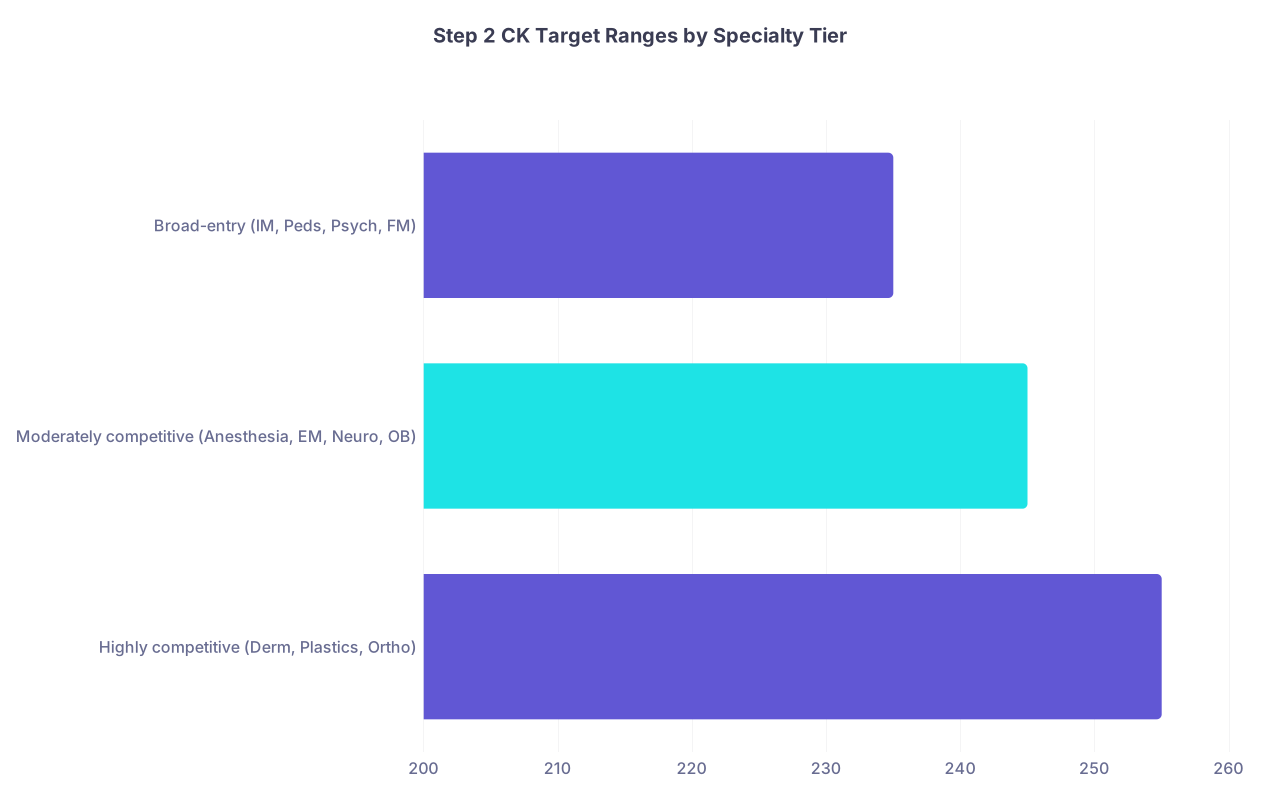
| Category | Value |
|---|---|
| Highly competitive (Derm, Plastics, Ortho) | 255 |
| Moderately competitive (Anesthesia, EM, Neuro, OB) | 245 |
| Broad-entry (IM, Peds, Psych, FM) | 235 |
(These are general targets, not absolutes. But if you want derm with a 230 Step 2, you are living in denial.)
End of Month 6 checklist:
- You have a working target score for Step 2 CK.
- You know whether you must crush IM/surgery/OB shelves to compensate for mediocre pre-clinicals.
Months 7–9: Build the Hard Academic Signal – Step 2 CK and Key Core Grades
These months either replace your old Step 1 number effectively—or leave a hole that programs will fill with assumptions.
Month 7: Ramp-Up + Schedule Final Step 2 Date
At this point you should:
- Lock your Step 2 CK date in the Prometric calendar.
- Reverse-engineer the prior 6 weeks from that date.
If you are 6 weeks out:
- Week 6–4 out:
- 60–80 UWorld questions per day, 5–6 days per week
- 1 NBME or UWSA every 2 weeks
- Week 4–2 out:
- Mixed blocks only
- Tighten timing (55–60 minutes per 40 questions)
- Advanced review: why each distractor was wrong
- Week 2–0:
- 2 full-length practice exams (spaced)
- Lighter days in between (20–40 questions, focused review)
On rotations:
- You must actively communicate about your exam:
- Give chiefs/attendings early notice of your protected study days.
- Do not spring it on them last minute.
Month 8: Dedicated or Semi-Dedicated Step 2 Period
This is your main opportunity to shout to programs: “I can handle the cognitive load.”
At this point—during the 3–4 weeks before your exam—you should live on a simple loop:
Daily schedule (example for full dedicated):
- Morning:
- 2 blocks of 40 UWorld questions in timed, random mode
- Immediate break between blocks (15–20 min)
- Early afternoon:
- Review both blocks (high-yield misses first)
- Late afternoon:
- 20–40 more questions targeted to weak systems
- Evening:
- 30–45 minutes of light content (videos or a concise review resource)
Key rules:
- No new resources.
- No spiral into doom scrolling test forums.
- Sleep is non-negotiable. Garbage cognition = garbage signal.
If you are semi-dedicated (still on a lighter rotation):
- 1–2 blocks per day on weekdays
- 2–3 blocks per day on weekends
- Protect at least one full day off per week for recovery.
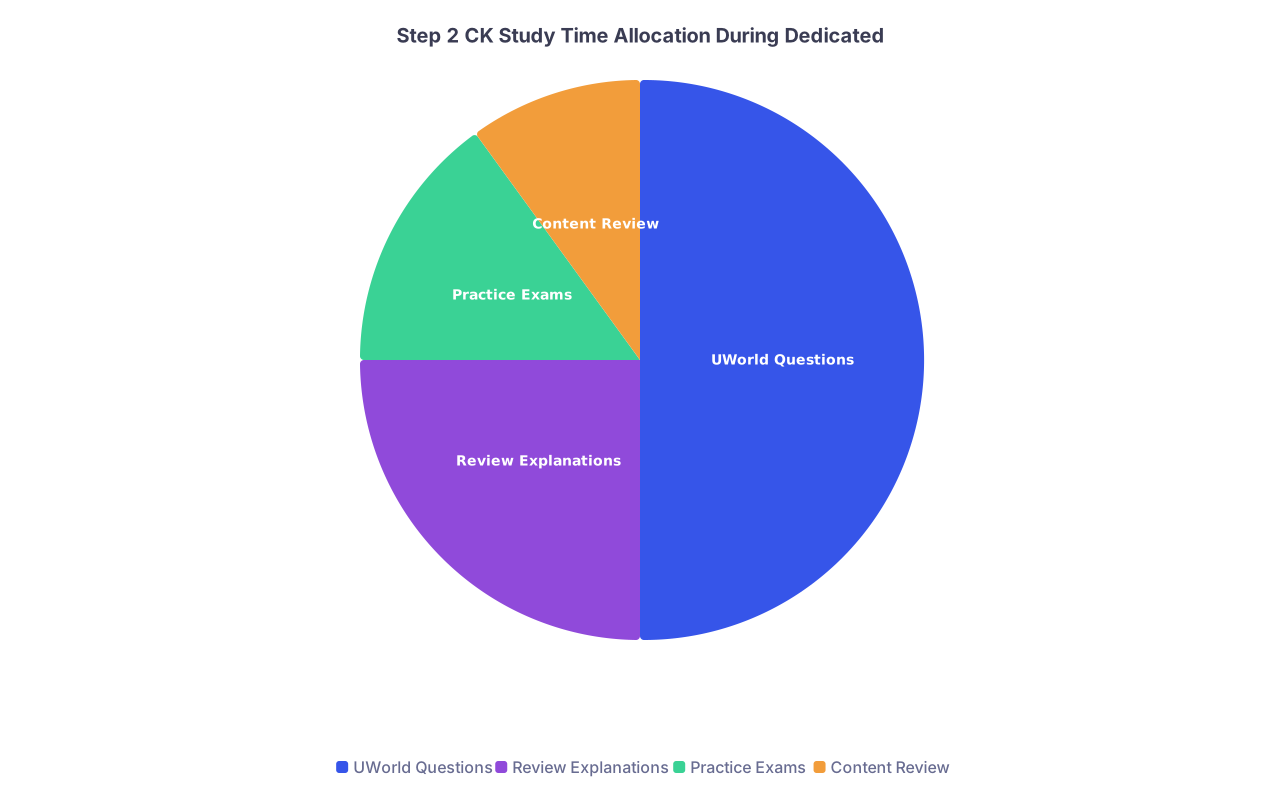
| Category | Value |
|---|---|
| UWorld Questions | 50 |
| Review Explanations | 25 |
| Practice Exams | 15 |
| Content Review | 10 |
Day-by-day, last 7 days before Step 2:
- Day -7: Full-length practice exam, review lightly.
- Day -6 to -4: 40–80 questions per day, targeted; minimal new topics.
- Day -3: Light mixed blocks, high-yield concept review.
- Day -2: 40 questions max, finish by early afternoon, then off.
- Day -1: No questions. Very light skim only. Movement, good food, early bed.
- Day 0: Exam. You are done. No post-mortem.
Month 9: Post–Step 2 Re-entry + Clerkship Focus
At this point you should:
- Step back on the wards with a very simple plan:
- Rebuild your clinical presence
- Avoid letting “test hangover” drag down performance
Once your Step 2 score releases:
- Compare to your target tier:
- At/above target for your specialty tier → Step 2 is now your primary replacement signal for Step 1.
- Below target → you must overperform on the remaining cores and possibly adjust specialty ambition or strengthen other signals (research, home program relationships, away rotations).
Either way:
- You keep doing 20–40 questions 1–2x/week to prevent decay.
- You shift emphasis back to shelf excellence and faculty impressions.
Months 10–12: Lock In Clinical Performance and Narrative
The last quarter of MS3 is where your MSPE narrative, letters, and clerkship transcript really solidify.
Month 10: Strategic Rotations for Letters
At this point you should:
- Intentionally line up rotations with potential letter writers in your chosen specialty.
On each of these rotations, week-by-week:
- Week 1:
- Learn expectations, workflow, and culture.
- Volunteer for unglamorous tasks (discharges, paperwork, follow-up calls).
- Week 2:
- Start carrying more patient load than average.
- Ask for mid-point feedback.
- Week 3:
- Incorporate feedback visibly.
- Offer to do a short teaching moment for the team (5-minute topic).
- Week 4:
- Ask for a letter in person if the relationship is strong:
- “Would you feel comfortable writing me a strong letter for X specialty?”
- Ask for a letter in person if the relationship is strong:
One or two strong letters from MS3 that reference:
- Work ethic
- Clinical reasoning
- Team contribution
…are powerful Step 1-replacement signals.
Month 11: Clean Up Weak Spots
Look at your record:
- Any core with a borderline pass or low shelf?
- Any narrative suggesting professionalism concerns or weak initiative?
At this point you should:
- Use elective or sub-I time to counterbalance:
- If surgery was weak but you want anesthesia → crush your anesthesia sub-I.
- If IM was mediocre but you want cards → honor an IM sub-I with documented growth.
You are rewriting the “story” programs will read in your MSPE:
- “Started average, ended strong.”
- This matters more now that Step 1 is invisible as a precise number.
Month 12: Transition to Application Prep
By end of MS3 you should have your replacement signals in place:
- Step 2 CK: Completed, ideally with a score that strengthens or at least does not hurt your application.
- Clerkship grades: At least 2–3 honors in core or relevant rotations.
- Narratives/letters: 2–3 faculty willing to advocate for you strongly.
Now your weekly tasks shift:
- Organize:
- CV updated with concrete details (patient volumes, leadership roles, research outputs).
- Case log and experience stories pulled from your reflection notes.
- Draft:
- Personal statement anchored in specific MS3 experiences, not clichés.
- Clarify:
- Program tiers where your new “signal stack” will be competitive.
Visual Overview: The MS3 Signal-Building Timeline
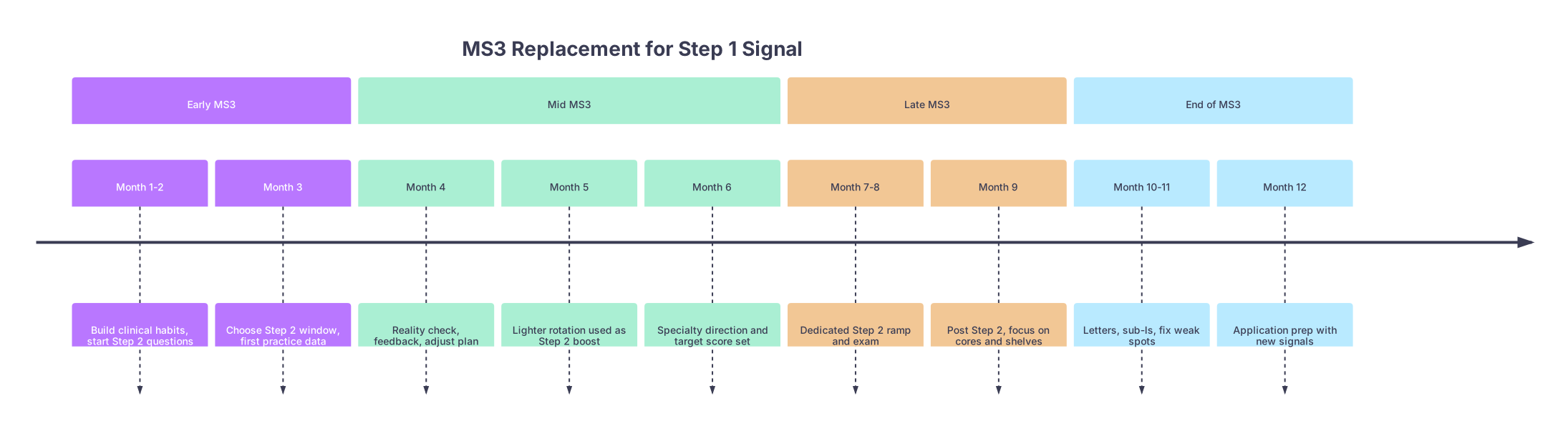
| Period | Event |
|---|---|
| Early MS3 - Month 1-2 | Build clinical habits, start Step 2 questions |
| Early MS3 - Month 3 | Choose Step 2 window, first practice data |
| Mid MS3 - Month 4 | Reality check, feedback, adjust plan |
| Mid MS3 - Month 5 | Lighter rotation used as Step 2 boost |
| Mid MS3 - Month 6 | Specialty direction and target score set |
| Late MS3 - Month 7-8 | Dedicated Step 2 ramp and exam |
| Late MS3 - Month 9 | Post Step 2, focus on cores and shelves |
| End of MS3 - Month 10-11 | Letters, sub-Is, fix weak spots |
| End of MS3 - Month 12 | Application prep with new signals |
Daily and Weekly Minimums: Non-Negotiables
To keep this practical, here is the bare minimum cadence that tends to separate solid applicants from “hopeful” ones.

On Any Rotation Month (non-dedicated)
Weekly:
- UWorld Step 2 CK: 100–150 questions
- 1 focused review block of shelf-relevant topics (1–2 hours)
- 1 feedback touchpoint with resident or attending (5–10 minutes)
- 2–3 brief reflection entries
Daily on wards:
- Arrive early.
- Pre-read about 1–2 patients or common conditions you will see.
- Do something that makes someone’s day easier (yes, that also gets noticed).
During Dedicated or Semi-Dedicated Step 2 Period
Daily:
- 80–120 questions (full dedicated) or 40–80 (semi)
- Active review with understanding why wrong distractors are wrong
- Short content/topical review tied to your weak areas
How This Replaces the Old Step 1 “Signal”
You are not just chasing grades and scores. You are constructing a portfolio of signals that answers the old Step 1 question in a better, more nuanced way:
- Step 2 CK: Replaces the raw cognitive horsepower metric.
- Core clerkship honors and shelves: Show applied knowledge and consistency.
- Narratives and letters: Prove you are not a robot—professionalism, judgment, teachability.
If you follow this month-by-month structure, by the end of MS3 you are not praying programs “see past” the missing Step 1 score. You have given them something clearer to see instead.
Key points:
- Start treating Step 2 CK as your primary academic signal from Month 1 of MS3, not three months before the exam.
- Use lighter rotations and the mid-year window to accelerate question volume and lock in a strong Step 2 result.
- Intentionally engineer clerkship performance and letters so your clinical story matches your test story—capable, reliable, and getting stronger over time.