
The Step 1 pass/fail era did not “save” everyone. It created a gray zone. And if you delayed Step 1 into the P/F era, you’re sitting right in the middle of it.
You’re not doomed. But you also do not get to coast.
What you do get is a different game with different leverage points. Let’s walk through exactly what to do if you’re in this situation, specialty by specialty, decision by decision.
1. Understand the Game You’re Actually Playing
First, stop thinking “Step 1 is pass/fail so it doesn’t matter.” That line is lazy and wrong.
Here’s what your situation really looks like if you delayed Step 1 into the pass/fail era:
- You no longer have a Step 1 score to prove you can crush standardized exams.
- Programs still have more applicants than spots.
- PDs still need a way to sort applicants in 10 seconds.
So what changed?
| Factor | Before P/F Step 1 | After P/F Step 1 |
|---|---|---|
| Step 1 Score | Primary screen | Pass only, basic filter |
| Step 2 CK Score | Secondary, but big | Primary numeric screen |
| School Name | Moderate | Slightly more important |
| Clinical Grades | Important | Very important |
| Research (esp. pubs) | Variable by specialty | More important across many |
| Letters of Rec | Always important | Now even more differentiating |
Step 1 going P/F shifted the spotlight. It did not remove it.
You’re now being judged harder on:
- Step 2 CK
- Clinical performance
- Research and meaningful experiences
- Letters and narrative signals (MSPE, dean’s letter, personal statement)
So the real question is: how do you use the P/F Step 1 era instead of getting crushed by it?
2. Know Which Bucket You’re In
Not all “delayed Step 1 into P/F” stories are equal. You fall into one of these buckets:
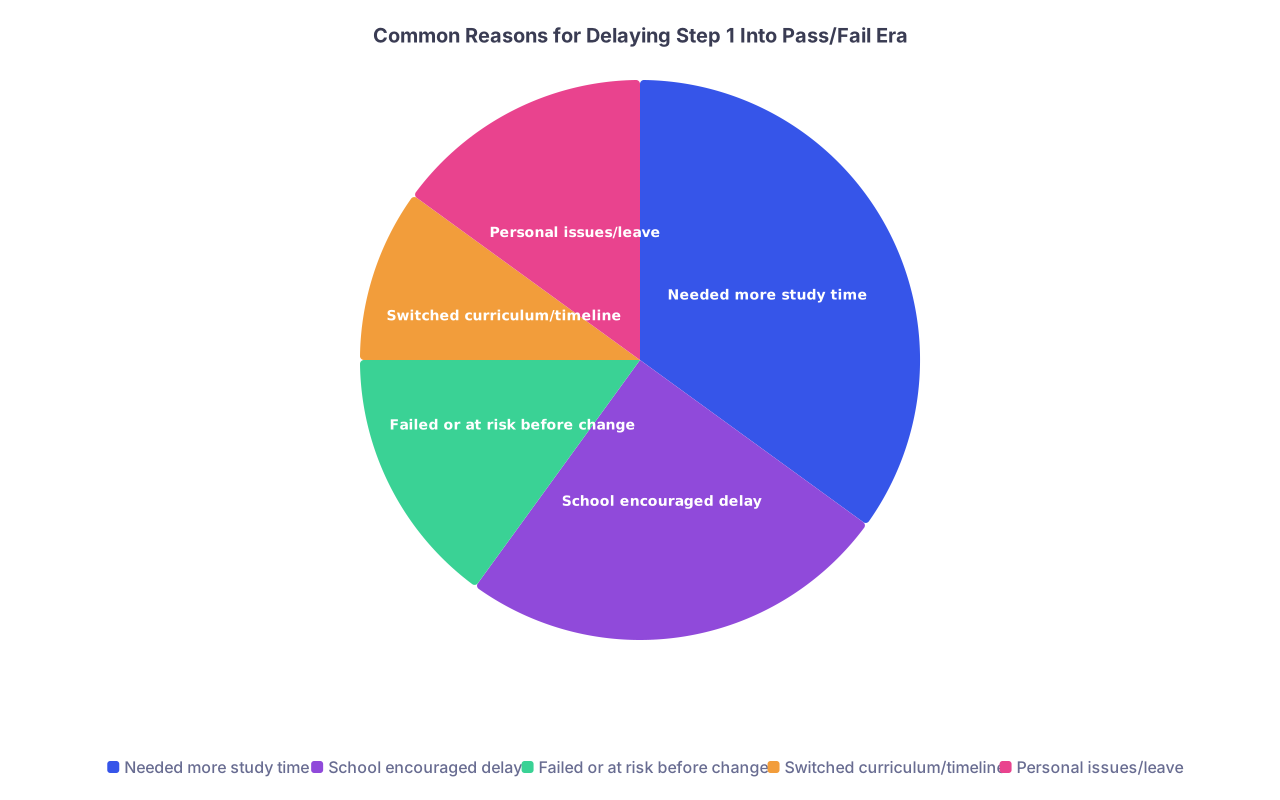
| Category | Value |
|---|---|
| Needed more study time | 35 |
| School encouraged delay | 25 |
| Failed or at risk before change | 15 |
| Switched curriculum/timeline | 10 |
| Personal issues/leave | 15 |
Bucket A: You delayed purely to land in P/F
You timed it so you’d avoid a number. Maybe administration quietly suggested it. Maybe classmates were doing it and it felt smart.
Implications:
- Programs may assume you feared a low score.
- You need to show evidence you’re not weak on test-taking: strong Step 2 CK, shelf scores, maybe NBME/COMSAE if mentioned.
What to do:
- Treat Step 2 CK like your Step 1 score—because functionally, it is.
- Aim for at least your target specialty’s median or above.
- Be ready to answer, “Why did you take Step 1 when you did?” with something better than “it went P/F.”
Bucket B: You delayed because you were struggling
You weren’t passing NBMEs. You needed remediation. Maybe you almost failed Step 1 before the change, or you failed an early attempt and then retook in the P/F window.
Implications:
- Program directors will sniff out academic instability quickly (course failures, LOA, delays).
- They will look for redemption: later strong performance that clearly reverses the earlier pattern.
What to do:
- Your story must be “early struggle, later surge.” Not “ongoing chaos.”
- You absolutely must protect your Step 2 CK. No half-prep. No “I’ll wing it.”
- You’ll lean heavily on clinical excellence, narrative, and progress.
Bucket C: You delayed because of curriculum or life
New curriculum. Dual degree. Family crisis. Health issue. LOA for something legitimate.
Implications:
- This is often neutral or even positive if:
- You did something productive (research, MPH, MBA, service).
- There’s a clean explanation, and your performance after returning is strong.
What to do:
- Clarify this in your dean’s letter and, if needed, your personal statement.
- Make your “time off” look like intention, not drifting.
3. Step 2 CK: This Is Your New Scorecard
Let me be blunt: in the P/F Step 1 era, Step 2 CK is your audition tape. You cannot treat it like an afterthought.
For specialties, this is the reality:
| Specialty Type | Step 2 CK Target (MD) |
|---|---|
| Ultra-competitive (Derm, PRS, Ortho, ENT, NSG) | 250+ |
| Competitive (EM, Anes, Rads, Gas, Urology) | 245+ |
| Mid-competitive (IM academic, OB, Neuro) | 240+ |
| Less competitive (FM, Peds, Psych, Path) | 230+ |
These are targets, not hard cutoffs. But you need a number to aim at, not vibes.
How to prep if you haven’t taken Step 1 yet (or just passed recently)
If you delayed Step 1 and still haven’t taken Step 2 CK, your plan needs to be integrated, not “two separate mountains.”
Step sequence if you’re in the overlap:
- Build foundation with Step 1 resources (UWorld, Sketchy, Pathoma/Boards & Beyond).
- As you enter clerkships, shift quickly into Step 2 mode:
- UWorld Step 2 timed, random, early.
- NBME practice spaced throughout MS3.
- Use shelves as mini-Step 2s:
- If your shelf scores are weak (<50–60th percentile), you cannot coast into Step 2. You need—no exaggeration—a 4–6 week intensive dedicated period.
If you already passed Step 1 P/F and are heading toward Step 2
Treat every rotation as Step 2 prep. Stop separating “clerkship test” and “Step 2 content” in your brain. Same universe, slightly different emphasis.
If you’re weaker:
- You need a more structured trajectory:
- 1 UWorld pass across MS3 (or 70–75% of it).
- 2–3 NBMEs before a 3–5 week dedicated.
- Honest score thresholds: don’t sit for Step 2 if your last NBME is 20+ points below your target. Fix that first.
4. Clinical Grades: Your New First Impression
Without a Step 1 score, many programs look at your transcript and the MSPE paragraph breakdown before anything else:
- Did this person honor core rotations?
- Is there a consistent pattern of “excellent,” or a mix of “marginal/pass” and “excellent”?
- Any professionalism flags?
Here’s what I’ve seen: students who delayed Step 1 often also had bumpy preclinical years. You cannot afford to be “average” in both preclinical and clinical.
So if you’re early MS3 or just starting rotations, your priorities shift:
Pick 1–2 “flagship” rotations to crush.
- If you want IM or derm → Medicine needs to be top-tier.
- If you want surgery or ortho → Surgery must be strong.
Optimize the basics aggressively:
- Be in early and stay reasonably late, but don’t just loiter.
- Present clearly and concisely. Practice with residents.
- Know your patients cold. PDs and attendings remember the student who knew every lab, line, and med without flipping through Epic.
Repair a weak start:
- If you tanked your first rotation, don’t spiral. You still have several more for an upward trend.
- Do not let two marginal rotations stack. Ask attendings early: “Can you give me honest feedback about how to move from ‘solid’ to ‘excellent’ on this service?”
5. Research and “Seriousness Signals” Matter More Now
In the old Step 1 era, a 260 could sometimes compensate for thin research. That crutch is gone.
If you delayed Step 1 into P/F, PDs are going to ask: “Is this applicant serious about my field or just drifting?” Research and experiences are how you answer that.
How hard you need to go, by specialty
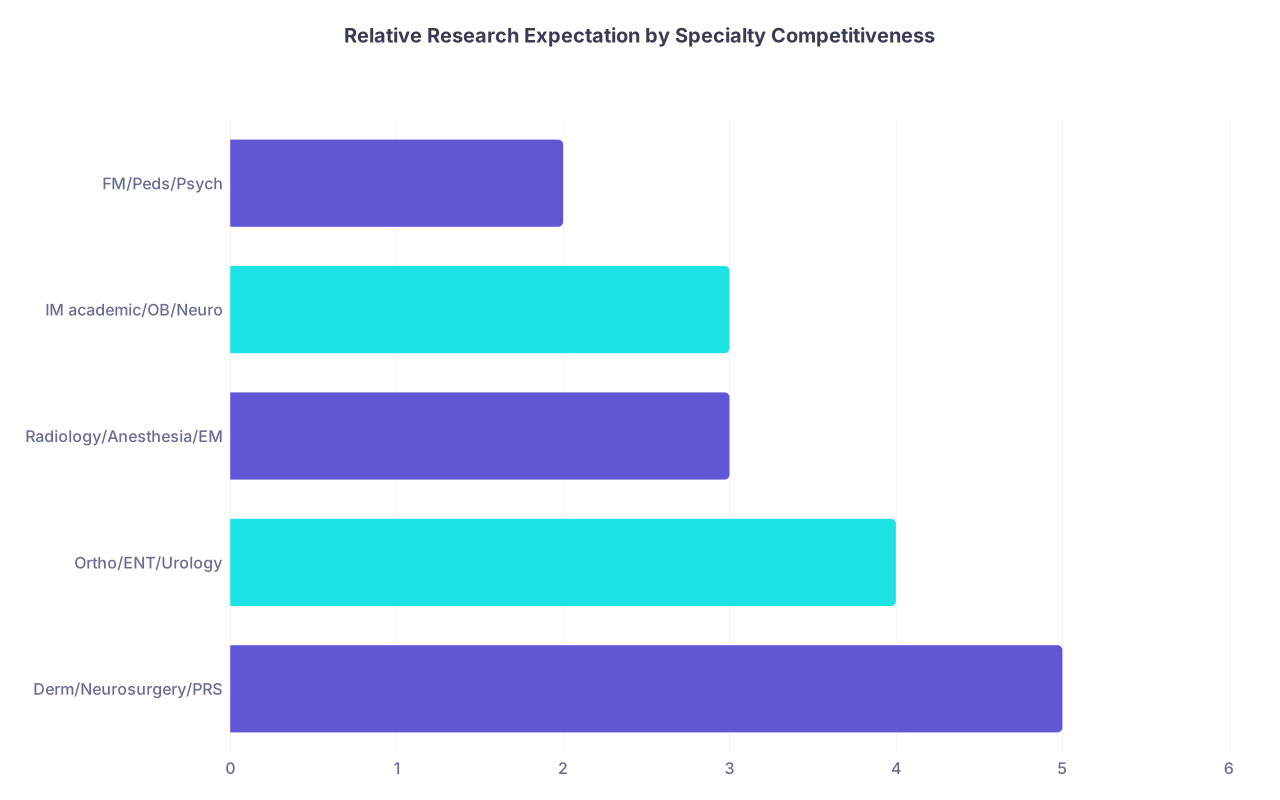
| Category | Value |
|---|---|
| Derm/Neurosurgery/PRS | 5 |
| Ortho/ENT/Urology | 4 |
| Radiology/Anesthesia/EM | 3 |
| IM academic/OB/Neuro | 3 |
| FM/Peds/Psych | 2 |
(5 = “multiple pubs, maybe a year off”, 1 = “a few projects or none is fine”)
If you delayed Step 1 and want something competitive, you need to lean in:
- Get on projects early MS2 or MS3.
- Prefer projects that will mature before ERAS:
- Case reports with quick turnaround.
- Chart reviews where your PI already has data.
- QI projects with a defined endpoint.
And then this part that many students screw up: be able to talk about your research like an adult.
Not, “We looked at this thing and maybe it was significant.”
More like:
- “Our primary outcome was X.”
- “We controlled for Y.”
- “The main limitation was Z, but it still suggests…”
That tells PDs: this isn’t checkbox research. This person thinks.
6. How to Explain Your Delay Without Sounding Weak
You’ll get some version of: “Tell me about your Step 1 timing,” especially from older PDs and faculty still anchored in the score era.
What you do not say:
- “I wanted it to be pass/fail.”
- “I thought it’d be easier.”
- “My class all did it.”
You need a framing that:
- Acknowledges reality without sounding evasive.
- Shows intention.
- Ends with a pivot to your strengths.
Example if you were a borderline student early:
“Early in med school I struggled with the transition to independent learning and timed board-style exams. My school and I agreed it made sense to take a bit more time to solidify foundations before sitting for Step 1, which I ultimately passed on the first try. I then used that base to really focus on clinical application, which you can see in my shelf scores and Step 2 CK.”
Example if it was partly strategic:
“Our curriculum was in the middle of transitioning and Step 1 was shifting to pass/fail. The administration encouraged us to align our timing with that change. I followed that guidance, passed Step 1, and put my main focus on excelling in clerkships and Step 2 CK, where you see my strongest performance.”
Example if there was life/health stuff:
“I had a significant family/health situation arise just before my planned exam date. Working with my dean, I took additional time to handle that properly and then returned and passed Step 1. The experience forced me to get much more structured, which paid off later in my clerkship performance and Step 2 CK.”
Key rule:
You answer the question once, clearly, without getting defensive. Then you redirect to where you shine.
7. Specialty-Specific Realities in the P/F Era
Let’s not pretend all residencies read your file the same way.
If you’re eyeing ultra-competitive fields (Derm, PRS, Ortho, ENT, NSG)
If you delayed Step 1 into P/F and want one of these, your margin for sloppiness is zero.
You need:
- Step 2 CK: ideally 250+.
- Research: several projects, preferably in-field, and at least 1–2 real publications/abstracts.
- Mentorship: a home program advocate who will pick up the phone for you.
- Audition rotations or aways that go well.
If any of those are missing, you need to be realistic and create a Plan B early (e.g., prelim year, related specialty, dual-apply smartly).
If you’re aiming for moderately competitive (EM, Anes, Rads, Urology, OB, academic IM)
Here the delay is less toxic, but only if:
- You nail Step 2 CK.
- Your clinical narrative (MSPE, letters) is uninterrupted and strong.
These programs are used to complexity: EM and OB people understand chaos; academic IM people understand growth arcs. They will give you a fair shot if your recent performance backs it up.
If you’re aiming for less competitive (FM, Peds, Psych, Path)
You have more room. But “more room” is not “no expectations.”
Your risk:
- Becoming complacent and presenting as “average with a weird delay and mediocre Step 2.”
Better angle:
- Lean heavily into fit: continuity, underserved, mental health, kids, etc.
- Show that even with weird timing, you built a coherent story:
- Strong Step 2 within target for field.
- Clear track record (electives, volunteer work) aligning with specialty.
8. Timeline & Decision Flow: What To Do Right Now
Most students in this gray zone don’t have a content problem. They have a decision-making problem. They keep punting hard decisions until it’s too late.
Here’s a simple reality-check flow:

| Step | Description |
|---|---|
| Step 1 | Delayed Step 1 into P/F era |
| Step 2 | Schedule Step 1 with 6-8 weeks serious prep |
| Step 3 | Use Step 2 score to set specialty range |
| Step 4 | Target 3-5 week dedicated Step 2 CK |
| Step 5 | Extend prep, fix weak foundations |
| Step 6 | Pass Step 1 then shift focus to shelves |
| Step 7 | Delay Step 2 CK until last NBME in safe range |
| Step 8 | Already passed Step 1? |
| Step 9 | Step 2 CK taken? |
| Step 10 | Shelf scores strong? |
Practical moves by phase:
Pre-Step 1 (but already in P/F era):
- Get at least 2–3 NBME assessments before scheduling.
- Do not schedule to “just get it over with” if you’re failing practice tests.
Post-Step 1, pre-Step 2:
- Start UWorld Step 2 early; don’t wait until dedicated.
- Decide specialty before the final months of MS3 so you can target aways/electives, research, and Step 2 target.
Heading into ERAS:
- Fit your specialty to your stats and story, not your ego.
- If you’re out-of-range for your dream field, think:
- Research year
- Dual applying
- Reframing towards a related, more realistic field
9. How to Mentally Handle the Gray Zone
Last thing. This situation messes with people’s heads.
Common thoughts I’ve heard:
- “Everyone else has it figured out.”
- “I messed up my whole career by delaying.”
- “PDs are going to think I’m lazy/stupid/weak.”
Here’s the reality: PDs care less about your exact Step 1 timing and more about your trajectory.
They’re scanning for:
- Does this person learn from struggle or collapse under it?
- Do they trend up or stay flat?
- Would I trust them on my team at 2 a.m.?
You can absolutely be the “late bloomer who crushed clerkships and Step 2.” That’s a real archetype, and many PDs like it more than the “260 and socially useless” type.
But it does not happen by accident.
You will need:
- A few months of very disciplined, boring consistency (for Step 2 and clinicals).
- A willingness to ask for help early—from mentors, academic support, upperclassmen.
- The maturity to adjust your specialty path based on real data, not wishful thinking.
Bottom line
If you delayed Step 1 into the pass/fail era:
- You just shifted the pressure to Step 2 CK, clinical grades, research, and letters. Treat those like your lifeline.
- PDs are watching your trajectory more than your timing. Build a clear “early bumps, strong finish” story and back it up with performance.
- Be intentional. No drifting, no denial. Make a plan for scores, rotations, research, and specialty choice—and commit to it.