
The Step 1 pass/fail era did not make switching specialties easier. It just changed what you have to weaponize.
You used to pivot with a big Step 1 number. Now you have to pivot with everything else: story, timing, relationships, research, clerkship performance, Step 2, and some cold, uncomfortable decisions. Let’s walk through what this actually looks like if you’re sitting there thinking: “I’m on track for X, but I want Y… and I only have a Step 1 ‘Pass’ to my name.”
This is going to be blunt. Because if you’re switching late, you do not have time for vague optimism.
Step 1 P/F: What Actually Changed for Switching Specialties
Step 1 going pass/fail did not remove competition. It just forced programs to sort you differently.
Here’s what shifted in most programs I’ve seen or worked with:
- Step 1 is now a minimum competence filter. If you passed, you’re through that gate. No style points.
- Step 2 CK became the new number. Especially for competitive specialties.
- Programs lean harder on:
- School reputation
- Clinical grades and narrative comments
- Research and letters
- Signals of genuine interest in their field (electives, sub-I’s, away rotations)
What that means for you: if you’re switching specialties, you cannot “wow” anyone with Step 1. Your Pass simply means “fine.” You have to build your case almost entirely on what you did after Step 1.
So the central question is not “Can I switch?”
It’s: “Given where I am in the timeline, what levers do I still have to pull?”
Diagnose Your Situation First: Where Are You in Training?
The exact move set depends completely on your phase. Do not copy advice meant for a different stage.
| Stage | Main Levers You Still Have |
|---|---|
| Pre-clinical (M1–M2 post-P/F) | Research, mentors, Step 2, electives |
| Core clerkships (M3) | Honors, narrative evals, letters |
| Early M4 (pre-ERAS) | Sub-I’s, aways, targeted research |
| Late M4 (post-ERAS) | Re-strategize rank list, reapply |
| Resident (PGY-1+) | PD support, new Step 2/3, research |
If you’re pre-clinical (M1–M2)
You’re not “switching” yet. You’re just changing your trajectory while it’s still soft clay. Good news: this is the easiest zone to reposition in.
Your playbook:
- Step 1: Pass. Early. Cleanly. Move on.
- Push your energy into:
- Building relationships in the target department
- Getting on any research project they throw at you (retrospective chart review? fine)
- Shadowing to confirm you actually like the work
- Laying groundwork for strong M3 clinical performance in that field’s feeder rotations (e.g., medicine for cards, surgery for ortho/ENT, peds for peds subspecialties)
If you’re in core clerkships (M3)
This is where most students panic-switch. Someone does surgery and suddenly wants ortho. Or they thought they were IM but now they want derm.
You can absolutely reposition here. But every move has to be intentional.
Your real “stats” now:
- Core clerkship grades and comments
- Early relationships with attendings and residents
- Your Step 2 CK potential
- How soon you discovered your new interest
We’ll get tactical on each of those in a minute.
If you’re M4 in the ERAS season
You’re not just switching specialties. You’re fighting the clock. Here you’re deciding between:
- Switching immediately and delaying grad/year off
- Applying to both (“dual applying”) in a structured way
- Leaning into a transitional year/prelim year as a bridge
Again: possible, but now it’s chess, not checkers.
If you’re already a resident
Whole different animal, but yes, still possible:
- IM to radiology
- Gen surg to anesthesia
- FM to psych I’ve seen all of those happen. But nothing happens without serious planning and PD involvement.
Step 2 CK: Your New “Score Card”
In the Step 1 pass/fail era, Step 2 CK is where you prove raw test-taking power. For a specialty switch, this can make or break your story.
Think of Step 2 like this:
- For competitive specialties, a strong Step 2 can partially compensate for:
- A non-elite med school
- Average preclinical performance
- The lack of a Step 1 flex
- For less competitive fields, a solid Step 2 (not stellar, just solid) frees you to focus on narrative, letters, and fit.
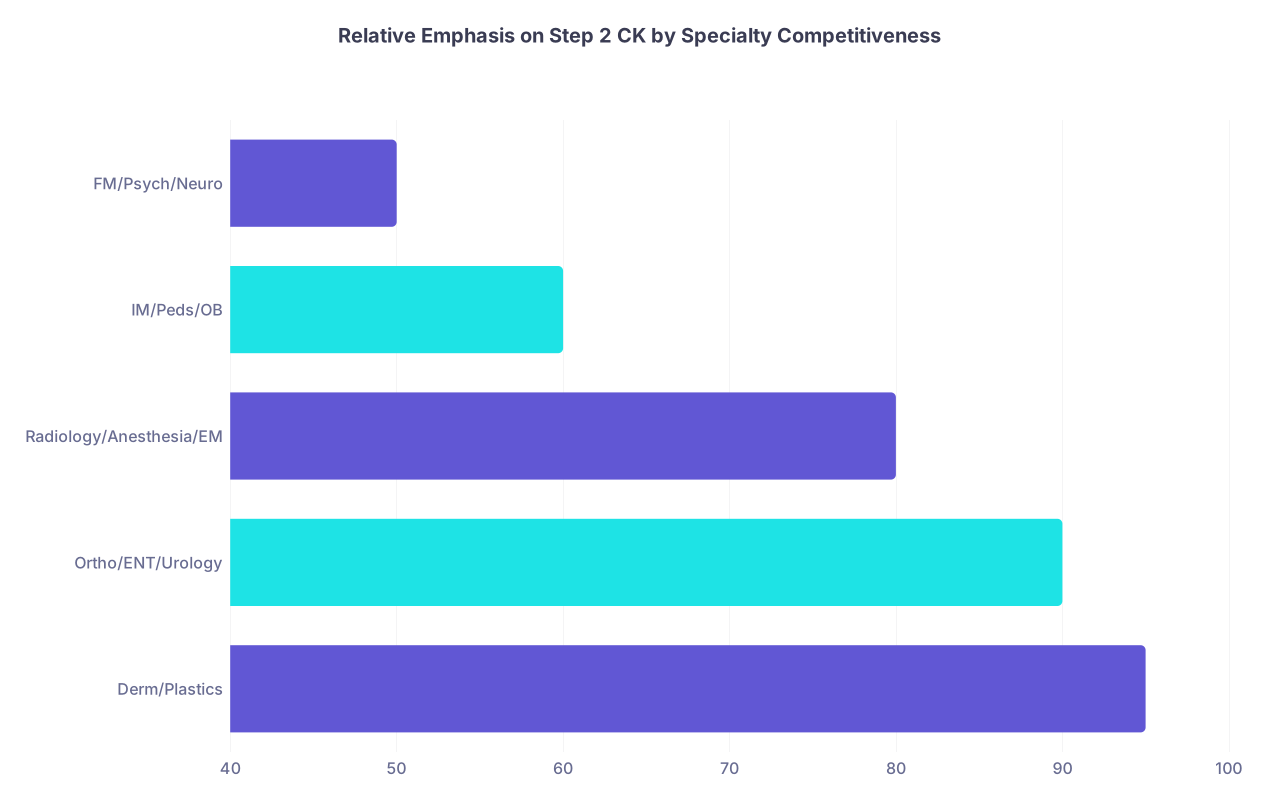
| Category | Value |
|---|---|
| Derm/Plastics | 95 |
| Ortho/ENT/Urology | 90 |
| Radiology/Anesthesia/EM | 80 |
| IM/Peds/OB | 60 |
| FM/Psych/Neuro | 50 |
If you’re thinking of switching into anything competitive, your immediate question should be:
“Can I realistically score at or above this specialty’s typical interview threshold on Step 2?”
Not “do I want to,” but “can I.”
If your NBME practice exams are:
245+ range: you have legitimate upside for competitive fields.
- 230–245: can still pivot into mid-to-high competitiveness if everything else is sharp.
- < 230: can you still match? Absolutely. But I would not bet your only plan on derm or ortho unless something else in your app is a true outlier (published research with leaders, prior PhD, etc.).
If Step 2 is still ahead of you and you want to reposition:
- Delay any formal “switch” announcements until you have a good practice test trajectory.
Do not walk into derm clinic announcing your love for derm with 210-level practice scores. - Build your clerkship habits around Step 2 skills:
- UWorld all year
- Shelf exams not as “pass the shelf,” but as Step 2 prep
- Treat every core rotation like you’re building your medicine knowledge spine for Step 2
The Core Problem: Your Story No Longer Matches Your Target
When students say they want to switch specialties post–Step 1 P/F, here’s what they usually mean:
“I’ve been living like a future [old specialty], but now I want [new specialty], and all my visible choices point in the wrong direction.”
Example:
- You’ve done 2 years of IM research, you joined the IM interest group, shadowed cardiology, wrote your “interests: IM” in some random bio, and now, mid-surgery clerkship, you want ortho.
What programs see:
- A confused applicant with a last-minute crush on their field.
Your job is to:
- Explain the origin of the switch in a way that feels real, not contrived.
- Show sustained action in the new direction, even if compressed in time.
- Preserve optionality in case the new specialty does not pan out.
Let’s get very concrete.
Tactical Move Set by Phase: What To Do Right Now
If you’re in M3, mid-core rotations
Situation: You discovered your new specialty interest this year. You aren’t locked in yet.
What to do in the next 2–4 weeks:
Identify the right department people
- One approachable attending or fellow in the new specialty
- Ideally someone who:
- Teaches med students
- Is semi-involved in residency selection
- Your ask: a 20–30 minute conversation about career interests, not a letter.
Have the “I’m exploring” conversation, not the “I’ve converted” speech Script, roughly:
“I came into third year leaning toward [old field] because of my preclinical experiences, but after doing [rotation/event], I realized I’m genuinely interested in [new field] for [specific reasons]. I’m still figuring out if this is the right long-term fit. Could I get your perspective on what you look for in students who come to this specialty a bit later?”
They will usually:
- Tell you what’s realistic
- Suggest specific electives, research, or people
- Reveal whether your school’s department is supportive of late converts
Lock down the right electives and sub-I’s Do not just randomly add an elective. Sequence matters.
Priority order:
- Core sub-I or acting internship in the new specialty (if available at your school)
- Away rotation(s) if the specialty uses them heavily (ortho, ENT, derm, some surg subs)
- Feeder electives that make sense (e.g., radiology electives for rads; ICU/surg electives for anesthesia)
Reframe your past experience You’re not erasing old work. You’re reinterpreting it.
Example: IM research → now switching to anesthesia:
- Old story: “I love inpatient medicine and longitudinal care.”
- New story: “Working on complex inpatient cases actually made me realize I’m drawn to acute physiology, procedures, and OR environments, which I saw more clearly when I [specific OR experience].”
Start building letter capital immediately The moment you set foot in a new specialty’s clinic/OR, behave like every attending is a future letter writer:
- Be early, be prepared, ask for readings.
- Verbally signal interest without being pushy:
“I’m strongly considering [specialty] and I’m trying to see what the day-to-day is really like.”
- After a good week, ask how you’re doing and what to improve. That’s the prelude to a letter ask months later.
If you’re early M4 and ERAS is approaching
This is where switching specialties post–Step 1 P/F becomes serious strategy, not just curiosity.
You need to answer three questions:
- Am I going all-in on the new specialty this cycle?
- Do I need a dual-application plan?
- Would waiting a year materially change my odds?
Let me be explicit:
If you’re going from a moderately competitive field to a hyper-competitive one (IM → derm, FM → ortho) late in M4, with:
- no research in the new field,
- no strong letters in the new field, and
- no stellar Step 2 CK,
then going “all-in” this year is not bold. It’s reckless. You’ll probably burn a cycle.
In that situation, smarter moves look like:
- Dual applying (e.g., derm + IM with a derm-friendly IM focus)
- Or planning a research/fellowship year to build a real derm-level CV before applying
On the other hand, if you’re moving:
- OB → IM
- Gen surg → anesthesia
- IM → psych
You often can pull this off in one cycle if you:
- Get 2–3 strong letters from the new specialty fast
- Have a reasonable Step 2 (ideally > 230, higher for some areas)
- Use your personal statement and experiences section to weave a coherent story
Resident-Level Switches: When You’re Already in a Program
Whole different pressure. You’ve matched, you’re in a system, and now you want out or sideways.
From what I’ve seen, successful resident switches usually share three features:
- Program director involvement, early
- A realistic target specialty
- A very respectful tone toward your current field
The playbook:
Clarify your why. For yourself first.
- “I hate this” is not enough.
- You need a clear, specific explanation:
- Not “surgery is mean,” but “the day-to-day has much less [thing] and much more [thing] than aligns with my strengths, and I’ve consistently found myself drawn to [aspects of new specialty].”
Quietly explore with the new specialty Before you blow anything up with your current PD, have 1–2 discreet conversations with:
- A faculty member or PD in the target specialty at your institution
- Ask: “Do people ever successfully transition into your program from other specialties here? Under what conditions?”
Talk to your current PD before rumors do Do not let them hear about your intentions from someone else. That’s how bridges get torched.
The frame:
- Gratitude for training and mentors
- Clear explanation of misalignment
- Emphasis that you want to leave well and professionally, not abandon ship mid-call
- Ask directly:
“If, over the next [X] months, we can arrange a transition that works for both programs, would you be willing to support that?”
Timeline discipline Resident switches are often governed by:
- Off-cycle openings
- NRMP rules
- Funding slots (FTE positions)
Expect a 6–18 month path, not 6 weeks.
Letters, Research, and Reputation: Your New Currency
With Step 1 neutralized to “Pass,” these are now your levers:
Letters of recommendation
For a late switch, letters are everything.
You want:
- 2+ letters from the new specialty
- 1 letter that speaks to your general clinical excellence (often IM or surgery)
How to get them faster:
- Volunteer for cases/clinics where attendings work closely with you, not rotating 10 students.
- Ask for feedback frequently so they remember specific examples.
- When asking for a letter, be direct:
“I’m planning to apply in [specialty] and you’ve seen me work in [settings]. Would you feel comfortable writing a strong letter for my residency application?”
Watch that word: strong. If they hesitate, thank them and move on.
Research
You do not necessarily need years of research to switch. But you do need a signal of academic engagement in the new field, especially for competitive specialties.
Realistic late-game moves:
- Retrospective chart review with a resident or fellow
- Case report from an interesting patient you saw together
- Getting involved in a QI project that the program can slap onto a poster
This is not about building an H-index. It’s about being able to say on your application:
- “Yes, I came to this field later, but I cared enough to do real work in it.”
How to Rebuild Your Story Without Sounding Fake
Programs can smell a switch that was made at 2 a.m. after one cool surgery.
Your narrative has to:
- Acknowledge your initial trajectory honestly
- Pinpoint specific clinical experiences that changed your course
- Show that you tested the new interest with real exposure
Bad version:
“I always thought I wanted internal medicine, but on my surgery rotation I realized I loved working with my hands, so I decided to pursue orthopedics.”
Better version:
“I entered clerkships expecting to pursue internal medicine. I enjoyed complex inpatient care and worked on [specific project]. But during my surgery rotation, two things shifted my trajectory: first, I found myself most engaged in the OR, focusing on anatomy and the immediate mechanical solutions to patient problems; second, I realized I consistently left clinic frustrated, but left operative days energized. I spent the next six months testing that insight with additional time in orthopedics clinics, a sports medicine elective, and starting a project on outcomes after [specific procedure]. That arc is why I’m applying in orthopedics now.”
See the difference? It sounds like an evolution, not a whim.
Reality Check: When Switching Is a Bad Idea This Cycle
There are moments when the bravest, smartest move is not to switch this year.
Red flags that you’re about to walk into a brick wall:
- You discovered your new specialty interest after most away rotation slots are full, and that specialty lives on aways.
- You have no letters, no mentors, and no research in the new field and ERAS is in 8 weeks.
- Your Step 2 is already taken and sits well below the range that specialty generally interviews, and you have no counter-balancing strengths.
In that situation, real options look like:
- Commit to your original specialty this cycle and build a strong, happy career there.
- Take a structured extra year (research, chief year, prelim year) to reposition properly.
- Consider a related specialty that better fits your current record and your emerging interests (e.g., you wanted ortho, but anesthesia or PM&R might be a more realistic pivot that still keeps you near the OR and musculoskeletal issues).
This isn’t failure. It’s choosing a hill you can actually take.
Put It All Together: A Simple Flow for Your Next Month
Let’s make this painfully practical. Here’s the actual decision flow most students in your shoes need to walk through:

| Step | Description |
|---|---|
| Step 1 | Thinking about switching |
| Step 2 | Focus on Step 2 and early exposure |
| Step 3 | Talk to new specialty faculty |
| Step 4 | Decide single vs dual apply |
| Step 5 | Meet with current PD |
| Step 6 | Schedule electives and sub I |
| Step 7 | Plan extra year or adjust target |
| Step 8 | Build strong single or dual app |
| Step 9 | Delay switch or research year |
| Step 10 | Training stage |
| Step 11 | New specialty realistic this cycle |
| Step 12 | Have letters and some research? |
What You Should Do Today
Do not “think about switching” in circles for three more months. Do this instead:
Identify your current stage (M1–M2, M3, early M4, resident). Then take one concrete step in the next 24 hours that moves you from vague desire to real planning:
If you’re pre-clinical:
Email one faculty member in the specialty you’re considering and ask for a 20-minute meeting about their field and what they look for in applicants.If you’re M3:
Open your rotation schedule and pick the earliest possible elective/sub-I block you can convert into your target specialty. Then email the coordinator today to ask about availability.If you’re early M4:
Open your ERAS draft and rewrite your “intended specialty” and personal statement outline as if you were fully committed to the new field. See where the story feels thin. That’s where you need to act.If you’re a resident:
Write bullet points of why you want to switch that you’d be willing to say to your PD’s face. If you can’t say it out loud yet, you’re not ready to pull that trigger.
Pick one. Do it now. Then the fantasy of “maybe I’ll switch someday” turns into an actual specialty change strategy you can execute—Step 1 pass/fail or not.