
The idea that Step 1 going pass/fail suddenly makes international electives “strategic gold” is wrong. They can help you—or quietly hurt you—depending entirely on how and why you do them.
You’re not choosing a vacation. You’re choosing how PDs will read a big blank space where your Step 1 score used to be.
Let’s walk through what to do if you’re in this exact spot: Step 1 is pass/fail, you’re tempted by an away in another country, and you’re trying to figure out if this still matters for residency.
1. How PDs Actually See International Electives Now
Step 1 going P/F did not suddenly make “I went to Peru” a competitive edge. Program directors still care about the same core questions:
- Can you handle the work here?
- Do you understand U.S. systems, documentation, and standards?
- Can I trust you with my patients and my team?
International electives plug into that story—sometimes positively, sometimes as background noise.
Here’s the real hierarchy in most PDs’ heads, roughly:
, Clerkship Grades, Letters, Home/Away Rotations, Research, International Electives](https://cdn.residencyadvisor.com/images/articles_svg/chart-relative-importance-of-residency-selection-factors-5248.svg "Relative Importance of Residency Selection Factors")
| Category | Value |
|---|---|
| [Step 2 CK](https://residencyadvisor.com/resources/step1-pass-fail-era/clerkship-grades-vs-step-2-what-pds-privately-say-they-trust-most) | 95 |
| Clerkship Grades | 90 |
| Letters | 88 |
| Home/Away Rotations | 85 |
| Research | 75 |
| International Electives | 40 |
General rule: international electives are “nice-to-have signal,” not “core criterion.” They can tip the scale if everything else is solid. They will not rescue weak Step 2 CK, poor clinical grades, or generic letters.
Where they do raise PD eyebrows in a good way:
- Global health, ID, IM, EM, FM, pediatrics, OB/GYN with underserved focus
- Programs with established global health tracks or fellowships
- PDs who have done global work themselves (and they remember exactly what it’s like)
Where they can be nearly irrelevant:
- Hyper-competitive, procedure-heavy surgical subspecialties
- Programs obsessed with high board scores and high-octane research
- Places that barely have time to read your PS, let alone parse your South Africa pediatrics month
So no, they’re not dead. But they are niche. You should only invest if that niche matches you.
2. When an International Elective Does Help You (Step 1 P/F Context)
With Step 1 P/F, PDs use more “soft” signals to differentiate you. International work is one of those—but only if it’s structured and you can talk about it like a professional, not like a tourist.
It helps in three main scenarios.
Scenario A: You’re Aiming at Global Health-Oriented Programs
If you want:
- IM with global health track
- EM with global health/expedition medicine
- Peds with global health or immigrant health focus
- FM with underserved/international migrants
Then a strong, clinically relevant international elective is a plus.
In this situation, you should:
Choose a site that looks serious, not casual
Think: long-standing university partnership (Makerere–Johns Hopkins, Partners In Health sites, long-term NGO hospitals) rather than “random private company that places students abroad.”Aim for continuity with your specialty interest
If you’re leaning IM: adult medicine, HIV/TB, NCDs.
If peds: inpatient peds, NICU, community vaccines.
Match the elective to what you’ll apply into.Make sure you’ll actually be supervised
A PD reading “independent practice” in a low-resource setting with no supervision thinks: liability, corners cut, no feedback. You want clear attending oversight and real teaching.
Scenario B: You Have Strong Academics, Need Distinctiveness
You passed Step 1, not a superstar, but not weak. Step 2 CK is solid or trending that way. Clerkship evals: good but not glowing. You’re trying to stand out among 50 other “good but not glowing” applicants.
Here an international elective can be:
- A strong interview talking point
- A way to show maturity, adaptability, team skills, and resilience
- A platform for a specific project (QI, education, small study) that lands on your CV
The key is follow-through. PDs are tired of “I saw poverty; it changed me.” If you can show:
- A small but concrete project (protocol, checklist, teaching module)
- Sustained engagement (stayed in touch, helped remotely, co-authored a short paper/poster)
- Specific changes in how you practice now (“I learned to examine without tech, which made my physical exam sharper on my medicine rotation”)
—then it reads as substance, not tourism.
Scenario C: You Already Do Global Work and Are Making It Coherent
If you’ve been doing global health since undergrad—NGOs, language skills, long-term involvement—then an international elective is not optional. It’s consistency.
Skipping it can actually make your narrative look thin: “You talk big global health game but didn’t use your 4th-year freedom to go back out?”
If this is you, use the elective to:
- Deepen prior connections rather than start totally new ones
- Get a letter from someone who has observed you longitudinally
- Anchor any global-health-themed personal statement or ERAS experiences
3. When an International Elective Is a Bad Idea (or Timing Is Wrong)
There are situations where you absolutely should not prioritize an international elective. These matter more in the Step 1 P/F world because you have fewer objective anchors.
Here’s the blunt list:
Your Step 2 CK is coming up and you’re underprepared
If your practice NBMEs are marginal, taking four weeks halfway around the world instead of locking in Step 2 is a mistake. PDs do not care that you were rounding in rural Guatemala if your Step 2 CK is 214 and you want IM at a decent academic center.Your core clerkship grades are mediocre and you’re skipping sub‑Is to go abroad
If you have a string of HPs and a few Ps, you need strong sub‑internship performance more than you need one more “life-changing” experience. Sub‑Is > passport stamps.The elective is purely observational with zero responsibility or feedback
A month “shadowing” in a language you don’t speak, in a system you don’t understand, with no real role—that’s basically a long vacation. And PDs can smell it.You’re not physically or mentally stable enough for the stress
Long flights, jet lag, unfamiliar food, infectious diseases, limited mental health resources. If you’re barely holding it together on home rotations, layering an unstable environment on top is a bad call.You’re using it as an escape from your actual problems
Burned out? Hating your current city? Angry at your school? You may be tempted to run away “to find meaning.” Classic trap. You come home to the same exams, same eval system, same application pressures.
If any of those describe you, fix the core issues first. Then revisit the idea.
4. Program Types: Who Actually Cares?
Not all programs read your international elective the same way.
| Program Type | How They Usually View International Electives |
|---|---|
| Academic with global health track | Positive if structured and relevant |
| Community program, high volume | Mildly positive, mostly neutral |
| Hyper-competitive surgical subspec | Largely irrelevant |
| IM/Peds with strong ID/TB/HIV focus | Strong plus if aligned |
| Lifestyle-focused community FM | Nice but not necessary |
If you’re dead set on ortho, derm, rad onc, neurosurg—an international elective is more about your own personal growth than strategy. That’s fine, but don’t pretend it’s a major competitive asset.
If you want IM with an ID fellowship at a place like UCSF, UW, MGH, Hopkins? A serious global health month on your CV, plus relevant research or projects, can absolutely fit and help.
5. Designing an Elective That Actually Matters
If you decide to go for it, do not just sign up for the first shiny location you see.
Here’s how to build an elective that holds up under PD scrutiny and gives you something real to talk about in the Step 1 P/F era.
A. Choose the Right Site and Supervisor
Look for:
- Institutional partnerships (med school to teaching hospital, long-standing NGO)
- Clear learning objectives and scope of practice
- A named supervising physician who’s used to teaching U.S. students
- Potential for a meaningful letter of recommendation
Red flag language from brochures or websites:
- “Students work independently with minimal supervision”
- “See and treat large volumes of patients on your own”
- “Experience medicine beyond regulations”
That might sound adventurous. It’s also how you lose credibility with U.S. programs.

B. Define Your Role Up Front
Before you go, clarify in writing:
- What you’re allowed to do (history, exam, procedures, notes)
- How orders are entered and by whom
- How feedback will be given and who will do your evaluation/letter
You want to be able to say on interviews:
“I functioned similarly to a sub‑I: pre-rounded, presented on rounds, proposed plans, and documented under supervision.”
Not:
“I observed many fascinating surgeries and diseases.”
C. Anchor It to a Project
You don’t need a massive RCT. But you do need something more concrete than “I cared a lot.”
Good options:
- A simple QI project (triage flow, hand hygiene, documentation templates)
- A teaching module you develop and deliver to local students or nurses
- A small retrospective chart review that turns into a poster
Then you can say:
“During my month at Hospital X, I helped design a simple chest pain triage checklist. Six months later, they emailed me that they’d implemented it in their ED workflow.”
That’s sticky. That’s memorable.
D. Timing Around Step 2 CK and Applications
You have to fit this into a timeline that, in the Step 1 P/F era, now revolves heavily around Step 2 CK.
Here’s a reasonable structure for a typical M3–M4 path:
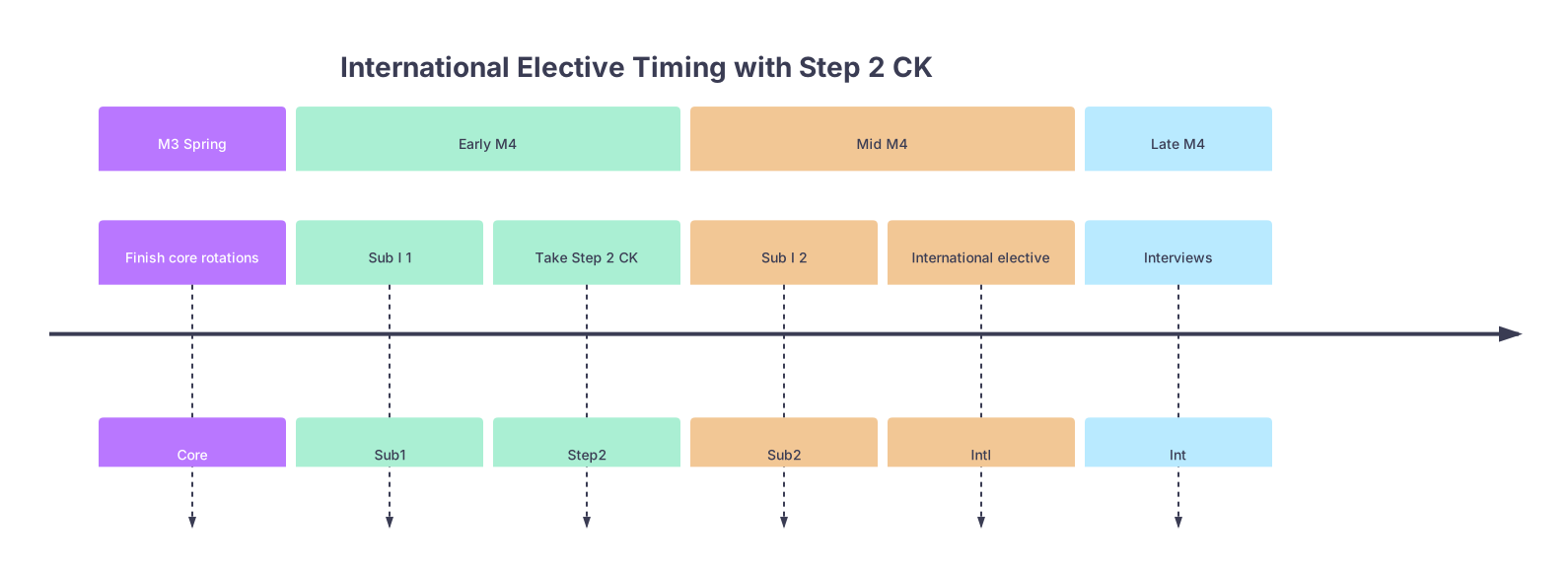
| Period | Event |
|---|---|
| M3 Spring - Finish core rotations | Core |
| Early M4 - Sub I 1 | Sub1 |
| Early M4 - Take Step 2 CK | Step2 |
| Mid M4 - Sub I 2 | Sub2 |
| Mid M4 - International elective | Intl |
| Late M4 - Interviews | Int |
Key rules:
- Do not schedule an international elective right before Step 2 CK if you’re borderline ready
- Try to have at least one strong U.S.-based sub‑I done before going abroad
- Make sure the elective ends with enough time to get the evaluation and letter into ERAS
6. How to Talk About It on ERAS and in Interviews
The Step 1 P/F era means your interviews carry more narrative weight. You cannot afford to bungle how you present your international month.
On ERAS
List it as:
- A formal elective under “Education” or “Experience”
- With specific responsibilities, not fluff
Bad description:
Participated in a one-month rotation in Kenya, seeing many tropical diseases and learning to work in low-resource settings.
Better:
One-month supervised internal medicine elective at [Hospital Name], a teaching hospital affiliated with [Local University]. Managed daily patient loads of 6–8 under attending supervision, presented on rounds, participated in HIV/TB and NCD clinics, and co-developed a simple heart failure patient education sheet now used on the ward.
In Interviews
Expect some version of: “Tell me about your international elective—what did you actually do there?”
Structure your answer:
- Setting and role in one sentence
- One or two concrete clinical responsibilities
- One specific challenge and how you handled it
- One specific way it changed your everyday practice now
Example:
“I spent a month at a teaching hospital in Malawi on their adult medicine ward. Day to day I pre‑rounded on 6–8 patients, presented on rounds, and proposed plans that were then co-signed by the attending. The biggest challenge was working without imaging—no CT, limited ultrasound—so our team leaned heavily on physical exam and history. Since then, I’ve been much more systematic in my exam on my home IM rotation, and my faculty actually commented that my assessments seemed more localized and less shotgun.”
That sounds like growth, not tourism.
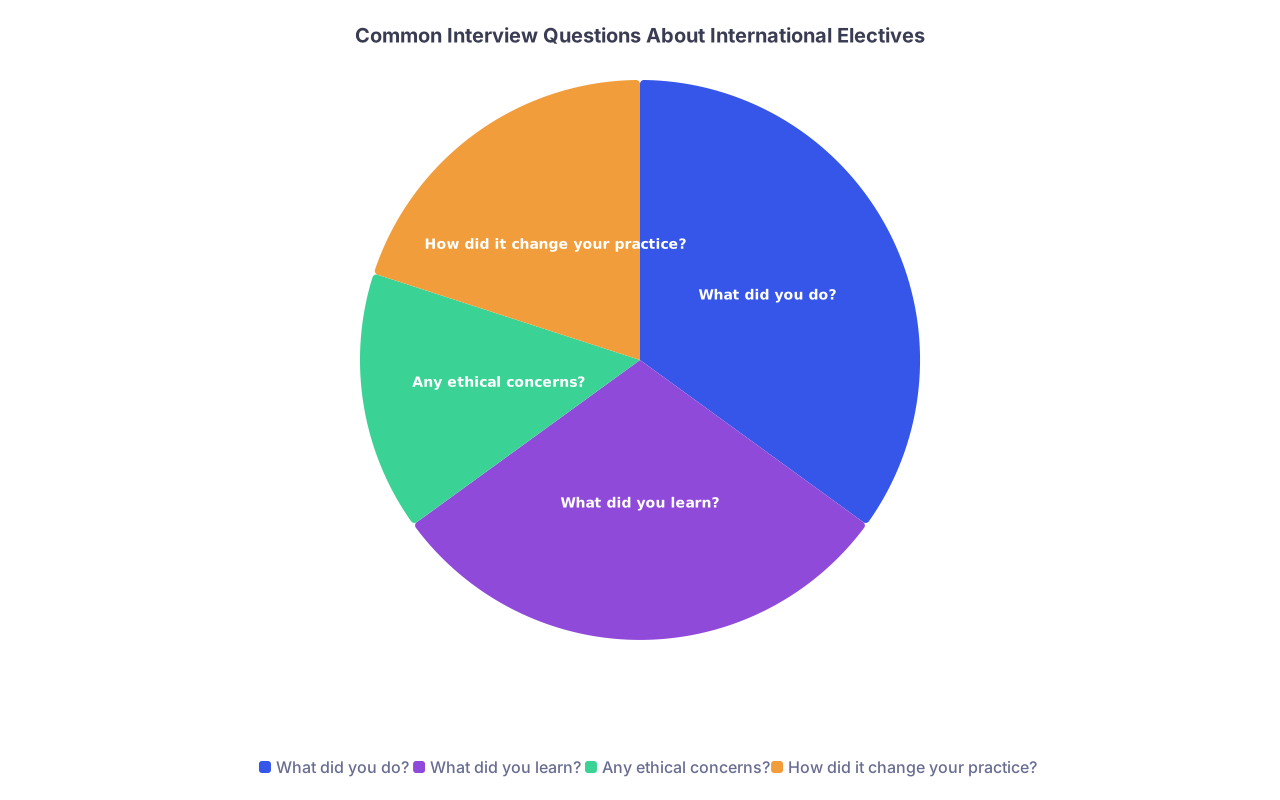
| Category | Value |
|---|---|
| What did you do? | 35 |
| What did you learn? | 30 |
| Any ethical concerns? | 15 |
| How did it change your practice? | 20 |
7. Money, Risk, and Reality Checks
Let’s be adults about this. International electives cost money and come with risk. You are not obligated to do one to be a strong applicant in the Step 1 P/F era.
Common hidden costs:
- Program fee (if through a placement company)
- Flights, visas, insurance, vaccinations, travel meds
- Housing and food
- Missed income if you planned to work a side job during that time
If you’re already stretching to cover Step exams and interview travel, dropping $4–6k on a month abroad may be a bad financial decision. PDs are not secretly ranking “did an elective in Tanzania” above “paid my bills and stayed sane.”
There’s also risk:
- Safety (political instability, crime, transport accidents)
- Infectious diseases (malaria, dengue, TB)
- Limited access to healthcare if you get sick or injured
If you’re going, do it like a professional:
- Get pre‑travel consult and proper vaccines
- Understand local laws and cultural norms
- Clarify emergency plans with the home and host institutions
You’re not a backpacker. You’re still a physician in training, even if nobody at home is watching.

8. So, Do They Still Matter in the Step 1 P/F Era?
Yes—with asterisks.
Here’s the honest bottom line:
International electives still matter if:
- You choose them strategically (aligned with your specialty and goals)
- You maintain or improve your core metrics (Step 2 CK, clerkship grades, sub‑Is)
- You actually do meaningful, supervised, clinically relevant work
- You can talk about them concretely, not sentimentally
They don’t matter—or can actively backfire—if:
- You use them to escape academic problems instead of fix them
- You sacrifice Step 2 CK prep or critical sub‑Is to go
- You pick poorly supervised or ethically sketchy placements and brag about “doing procedures” you weren’t trained for
Do not chase the fantasy that one month abroad will transform your application. It won’t. But if you build a solid foundation first and then add a thoughtful international elective, it can sharpen your story, deepen your skills, and give PDs one more reason to trust that you’ll show up prepared—wherever you are.

FAQs
1. If I had to remediate a course or just barely passed Step 1, should I still do an international elective?
Prioritize damage control first. If your record already has red flags—failed course, barely passing Step 1, weak early clinical evaluations—you should focus on strong sub‑Is and Step 2 CK performance before considering an international elective. Once your core profile is stable (solid Step 2 CK, good IM/FM/peds rotations), then an international experience can be considered without looking like avoidance.
2. Does an international elective help more than a U.S. away rotation in my chosen specialty?
No. If your specialty uses away rotations heavily (ortho, EM, neurosurg, derm, some IM programs), a U.S. away in a target program is almost always higher yield for match purposes. International electives are additive, not a substitute for domestic aways. If you have to pick only one for scheduling or financial reasons, choose the U.S. away in your desired specialty/location.
3. Can an international preceptor’s letter of recommendation carry the same weight as a U.S. attending’s letter?
Usually not. PDs trust letters from people they understand—U.S.-trained faculty who know the expectations, grading culture, and what “above average” really means locally. An international letter can be a useful supplement, especially for global-health-oriented programs, but it should not replace strong domestic letters from your core rotations and sub‑Is.
4. How many weeks of international electives is “enough” to matter?
For residency applications, 4 weeks of a well-structured, clinically meaningful elective is sufficient. More than 8 weeks starts to raise questions if it replaces time that could have been used for sub‑Is, Step 2 CK prep, or research. One solid month that you can describe in detail and maybe connect to a small project is better than three months of loosely structured “exposure” that you can’t clearly explain.