
The dirty secret of the pass/fail Step 1 era is simple: they didn’t remove the filter. They just changed it. Research and class rank are the new Step 1, and programs are using them more aggressively than most students realize.
Let me walk you through what program directors are actually saying behind closed doors. Not the polished stuff from webinars. The stuff that decides who gets an interview and who gets silently screened out.
How We Got Here: The Vacuum Step 1 Left Behind
Step 1 going pass/fail didn’t “reduce stress” the way the official messaging claimed. It just shifted the stress somewhere else.
Before, the sorting algorithm was crude but clear:
– High Step 1 = doors open
– Mediocre Step 1 = doors maybe open
– Low Step 1 = doors quietly close
When Step 1 flipped to pass/fail, programs lost their single most convenient numerical filter. And there’s something you need to understand about residency selection: convenience almost always beats fairness. Faculty are drowning in work. No one is heroically reading all 3,000 applications one by one.
So programs started asking:
“Ok, if I can’t sort by Step 1, what can I sort by that roughly tracks the same thing – but still lets me cut 80–90% of applicants with a click?”
The answer that rose to the top, unofficially but consistently, was:
– Quantifiable research output
– Class rank / quartile / AOA / internal grading flags
– Step 2 CK (obviously)
Step 2 CK is the obvious replacement. But here’s the part students miss: for the top and mid-tier programs, research and class rank have become pre-filters before Step 2 CK even matters.
If your file screams “average student, average research,” you get buried no matter how “pass” your Step 1 looks.
What Program Directors Actually Look At First Now
You need to see the order in which your application is actually consumed.
Most students imagine some holistic, thoughtful reading process. That’s not reality in the first pass.
In the initial sort, a lot of programs do something like this:

| Step | Description |
|---|---|
| Step 1 | ERAS Applications |
| Step 2 | Auto Screened Out |
| Step 3 | Advance to Interview Review |
| Step 4 | Sort by Research + Rank |
| Step 5 | Check Step 2 Score |
| Step 6 | Maybe List |
| Step 7 | Meets Hard Filters |
| Step 8 | Home/Rotator? |
| Step 9 | High Research or High Rank |
Let me translate that into real conversation from selection meetings:
- “What’s their school? Top 30? International? DO?”
- “Ok, research?”
- “Any first-author stuff? PubMed? Big names?”
- “What’s their rank? Top quartile? AOA? Honors?”
- “What’s Step 2?”
Notice what’s missing: Step 1. No one cares. It’s a binary “did they pass.” That’s it.
What replaced it is a two-headed monster: research as an external metric, class rank as an internal one.
So now, the early “quick sort” looks more like:
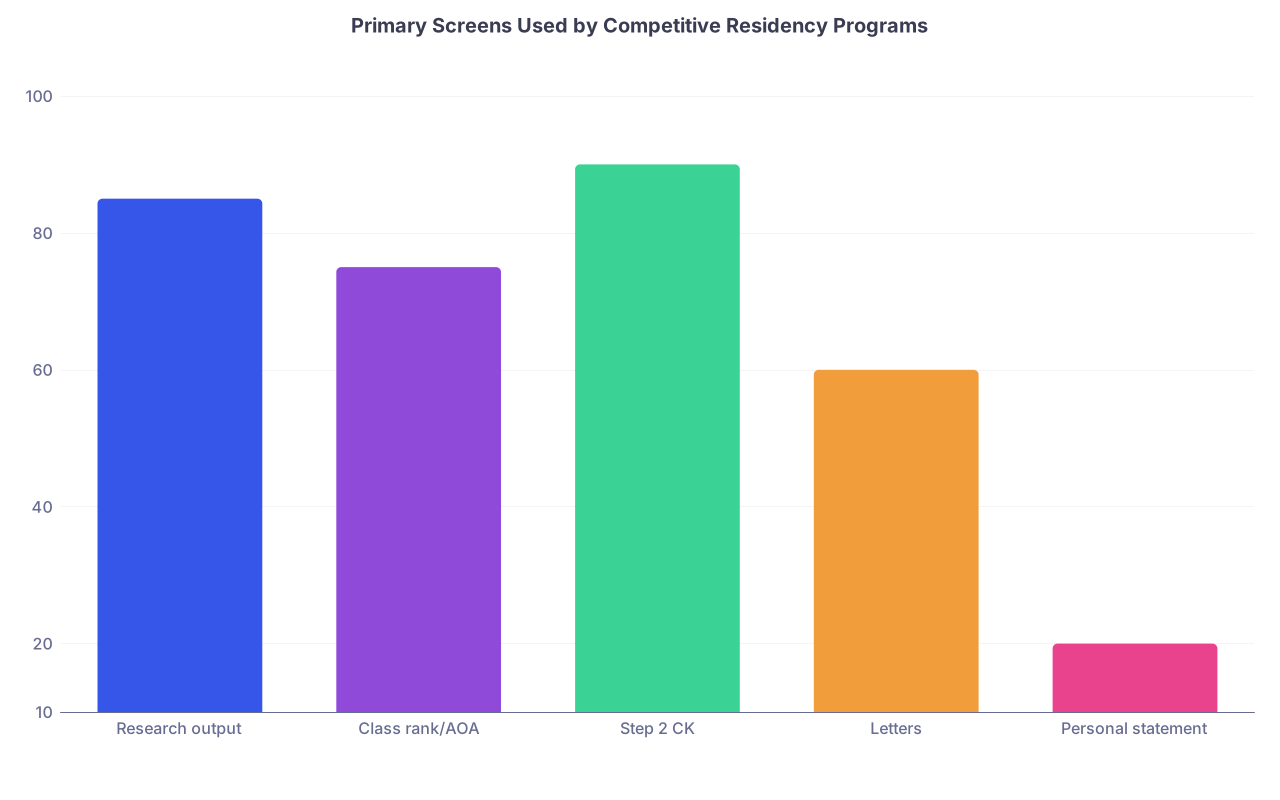
| Category | Value |
|---|---|
| Research output | 85 |
| Class rank/AOA | 75 |
| Step 2 CK | 90 |
| Letters | 60 |
| Personal statement | 20 |
Those percentages reflect how often I’ve heard directors in competitive fields say, “We use this up front” in the Step 1 pass/fail era. Step 2 CK is still king. But research and rank are now right up there as gatekeepers.
Research: The New “Score” You Didn’t Realize You Were Being Graded On
Here’s what changed: before, research was a bonus. Now, for many specialties, it’s a de facto filter.
Talk to PDs in ortho, derm, neurosurgery, ENT, rad onc, IR, plastics. Off the record, they’ll say variations of the same thing:
“We can’t see Step 1 anymore, so we lean heavily on research to tell us who’s serious.”
They won’t say that on a podcast. But in a conference side room after the session, you hear:
“Honestly, if they’re coming from a mid-tier school and don’t have serious research, we’re not moving them forward.”
Serious research doesn’t mean a poster in MS1 you barely remember. It means:
- PubMed-indexed work, preferably multiple items
- First-author or second-author on at least one project
- Projects in the specialty you’re applying into
- Ideally with a recognizable PI or institution
Let’s make this concrete.
You’ve got two applicants, both from a mid-tier US MD school, both with “Pass” Step 1, both with a 253 Step 2 CK:
- Applicant A: 1 poster at a school research day, no publications
- Applicant B: 3 PubMed papers (1 first-author), 2 national conference presentations, all in the target specialty
Applicant B isn’t just “favored.” Applicant A often doesn’t even get discussed. They die in the pre-screen.
Programs are doing informal “research score” mental math:
- 0–1 low-yield projects → Red flag for competitive specialties
- 2–4 decent projects, maybe 1 publication → Average
- 5+ items with at least 1–2 real papers → Serious candidate
| Research Profile | How Committees Quietly View You |
|---|---|
| No research | Major liability in competitive fields |
| 1–2 posters, no publications | Token effort, barely helps |
| 1 publication, few posters | Acceptable, not impressive |
| 2–3 publications (any author position) | Solid, competitive |
| 4+ publications, 1+ first-author | High-value applicant |
No one writes this rubric down officially. But I’ve watched committees talk exactly like this.
And here’s the part students really underestimate: research is now being used as an early cutoff. Not just as “nice icing on the cake.”
“Sort the spreadsheet by number of PubMed hits” is the new “sort by Step 1 score.”
You think I’m exaggerating? I’ve seen spreadsheets literally sorted by “# of publications” next to “Step 2 CK” and “rank quartile” columns, with hard lines drawn:
“If <2 pubs, no interview unless home or connection.”
Class Rank, AOA, and Internal Codes: Your Hidden Transcript
Now let’s talk about the other half of this: class rank and its cousins.
The pass/fail Step 1 era gave internal metrics a lot more power. Deans’ offices know this. They’re suddenly under pressure to produce some way for programs to distinguish “top students” from “solid passes.”
So what do they do?
- They maintain internal quartiles, deciles, or rank lists
- They boost the visibility of things like AOA, Gold Humanism, or “Honors” tallies
- They write deans’ letters full of coded language that selection committees have learned to decode
I’ve sat in rank meetings where someone literally says:
“Her Step 2 is fine, but she’s bottom half of the class, no AOA, mostly ‘Pass’ in clerkships. That’s a concern.”
In the old days, a monster Step 1 could buffer a weaker class rank. Now, with Step 1 gone, class rank and clinical performance have moved up the power hierarchy.
Here’s roughly how schools signal rank, even when they pretend not to:
- Explicit: “Top quartile” or “Upper third” printed somewhere
- Semi-explicit: “Consistently outstanding performance across clerkships” versus “performed at the expected level”
- Implicit: Count how many “Honors” versus “High Pass” appear on the transcript
Programs know your school’s grading culture. They share this informally:
“School X hands out Honors like candy – don’t overvalue it.”
“School Y barely gives any Honors – if they have multiple, that’s meaningful.”
They keep mental adjustment factors for different schools.
So Step 1 used to be your global external objective metric. Now, it’s splintered into:
- External work (research)
- Internal ranking (class quartile, AOA, clerkship grades)
- And Step 2 CK sitting on top
But the key point: rank and research have become structural filters, not just decorations.
The Combined Effect: How Programs Now “Score” You
Let me show you how this looks in practice, because that’s where students really get blindsided.
Imagine a competitive program with 3,000 applicants for 10–15 spots. They’ll maybe interview 80–120 people.
They might do something like this internally, whether they call it a scorecard or not:
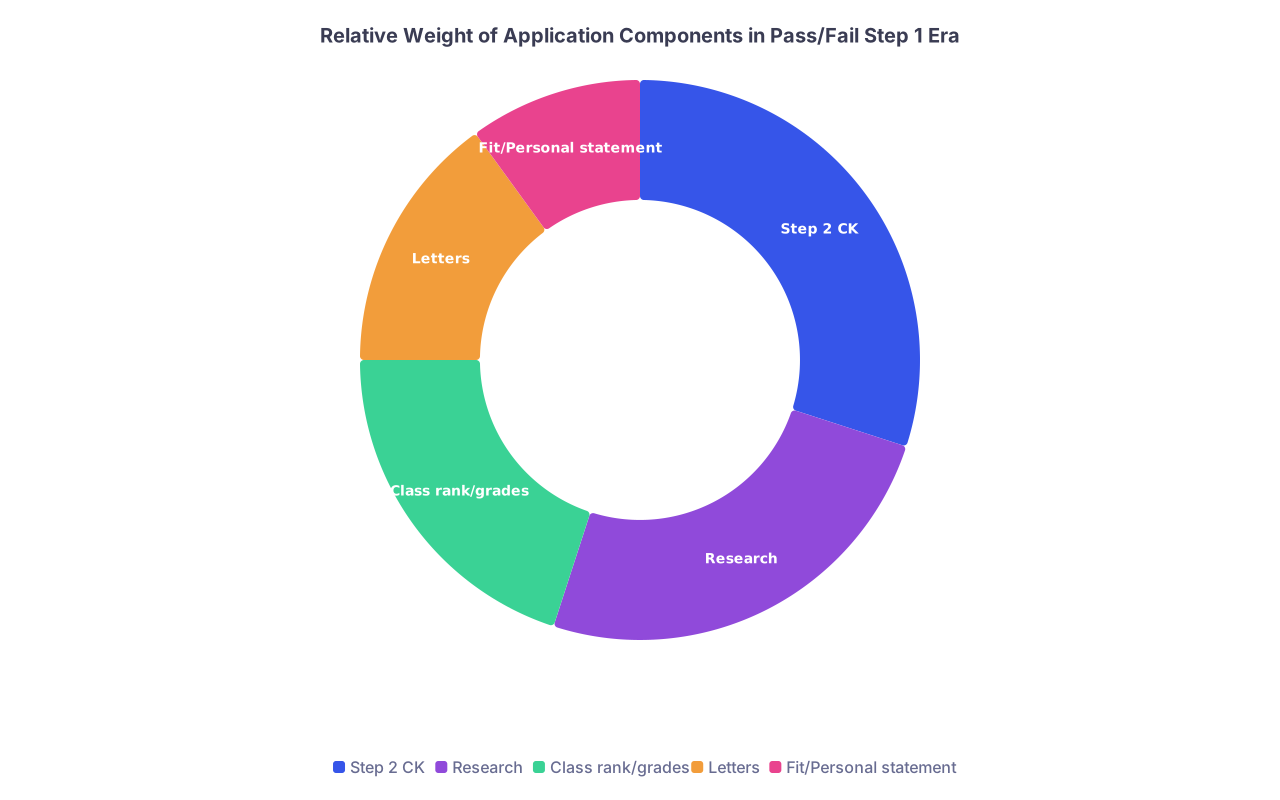
| Category | Value |
|---|---|
| Step 2 CK | 30 |
| Research | 25 |
| Class rank/grades | 20 |
| Letters | 15 |
| Fit/Personal statement | 10 |
This is for competitive fields. For primary care–oriented programs, research might drop and “fit” or letters climb. But in places like ortho, derm, neurosurgery, ENT, IR, rads, anesthesia at top centers – research and rank hold massive weight.
So your “file” now reads like this when a PD glances at it for 10–20 seconds:
- Step 2 CK: strong, average, weak
- Research: serious, acceptable, token, none
- Class rank / clerkships: top, middle, bottom
- School: strong, mid, unknown, international
- Letters: powerful advocate vs. generic
If you’re weak on research and weak on rank, it’s the new “Step 1 score below cutline.” You’re done before anyone cares that you “passed Step 1.”
Who’s Getting Hurt the Most by This Shift
The Step 1 pass/fail change was sold as equity-friendly. There’s a dark side to that.
Groups that are getting quietly hammered now:
Late bloomers
The student who wakes up in MS3, crushes Step 2, but has mediocre preclinical grades and no early research? Used to be able to redeem themselves with a 250+ Step 1. Now they’ve got a nice Step 2 and… not much else to offset a bland CV.Students at schools with weak or inaccessible research
Community-heavy MD schools, many DO schools, and international schools without strong research infrastructure. Before: strong Step 1 could punch you a ticket. Now: you’re competing against people with 6–10 PubMed hits and a PI who knows half the faculty on the selection committee.Non-gunners who only decided on competitive specialties late
The “maybe I’ll do FM” student who falls in love with ortho on rotation. Pre-Step 1 change, they could do a Year Off + monster Step 1 + away rotations and still be in the game. Now, they’re sprinting uphill without a score 3 standard deviations above the mean to rescue them.People with uneven preclinical performance but strong test-taking
The classic “average preclinically but lethal on standardized exams” student used to be able to rewrite their story with Step 1. That weapon is gone. Now their class rank tattoos their file in a way Step 2 alone can’t fully erase.
How to Play the New Game (Instead of Pretending the Old One Still Exists)
You cannot change the system. You can absolutely exploit it.
Here’s what I’d do if I were an MS1 or MS2 right now, eyes open about the pass/fail Step 1 reality.
First, accept this: research is now a timeline problem, not just an “I’ll do a project when I have time” problem.
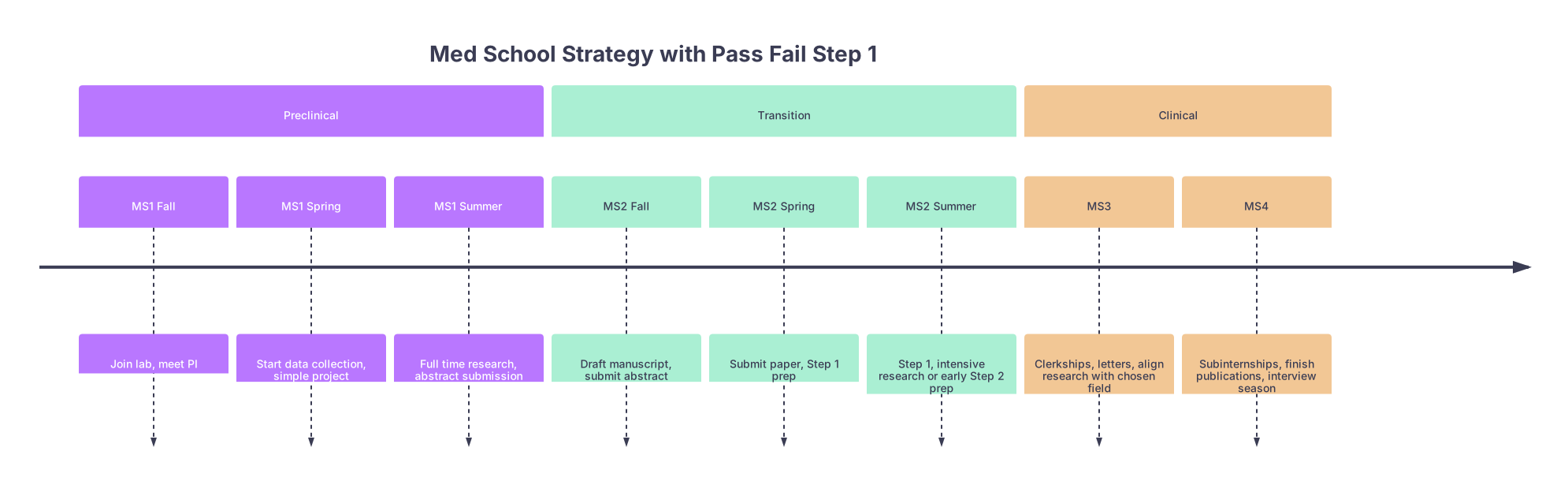
| Period | Event |
|---|---|
| Preclinical - MS1 Fall | Join lab, meet PI |
| Preclinical - MS1 Spring | Start data collection, simple project |
| Preclinical - MS1 Summer | Full time research, abstract submission |
| Transition - MS2 Fall | Draft manuscript, submit abstract |
| Transition - MS2 Spring | Submit paper, Step 1 prep |
| Transition - MS2 Summer | Step 1, intensive research or early Step 2 prep |
| Clinical - MS3 | Clerkships, letters, align research with chosen field |
| Clinical - MS4 | Subinternships, finish publications, interview season |
You want at least one decent research product before your clinical year explodes. If you wait until after you pass Step 1 to think about research, you are already behind the people you’ll be compared against.
Second, you protect your class rank like people used to protect their Step 1 prep time. This is where many students mess up in the pass/fail era. They relax too much in preclinical because “it’s pass/fail” or “our school says they don’t rank.”
Your school ranks you more than they admit. At least internally. And that leaks into:
- Honors/Pass distributions in key courses
- Eligibility for AOA or special distinctions
- Deans’ letters and MSPE ranking language
Third, you treat Step 2 CK as your public exam “anchor,” but you don’t fool yourself into thinking it can fully compensate for zero research and mediocre rank in a competitive field. It can’t. Not reliably.
This is the mistake I see over and over:
“I’ll just crush Step 2 CK.”
Great. So will thousands of others.
You have to build parallel lanes: performance, research, and relationships.
What Program Directors Won’t Say Out Loud (But Operate By)
Let me give you a few unfiltered statements I’ve heard in actual rooms, edited only to protect individuals:
From a derm PD at a major coastal academic center:
“If they don’t have at least a couple real publications, they’re not in the serious pile unless someone here knows them.”
From an ortho faculty member on a selection committee:
“Step 1 being pass/fail just pushed us to look harder at research and where they rank in their class. We still need a way to say no to 90% of people.”
From an IM subspecialty PD (very well-known institution):
“We care more about Step 2 now, but class rank is probably what we use earliest, followed by research. Step 1 is just: did you pass.”
From a surgery APD:
“I feel bad for the late-deciders. Before, a big Step 1 could save them. Now if they don’t have research and they’re middle of the class, they’re done for us.”
No one puts that in official policy. But it’s the operating reality.
So What Do You Actually Do With This?
For different stages:
If you’re preclinical (MS1/MS2):
You should be more anxious about research and internal performance than about Step 1. Not less serious about Step 1 – but you can’t treat it like the only mountain anymore. Join a lab. Attach yourself to a productive PI. Aim for at least one submission (not just a draft that dies on someone’s desktop) before MS3.
If you’re MS3 and light on research:
You have to decide how badly you want a competitive specialty. If you’re late to the game, you may need a dedicated research year. In the old model, maybe you could squeak by with a 260+ Step 1 and strong rotations. That escape hatch is closed.
If you’re already a weaker student on class rank:
Then research becomes not optional; it becomes your only realistic way to shift how committees perceive you. I’ve seen mid-class students with killer research portfolios get bumped up over higher-ranked classmates. Publication count and PI reputation can partially override internal rank, especially in academic programs.
If you’re at a school with terrible research access:
You might have to go outside your institution. Remote collaborations. Multi-institutional groups. National student research networks. It’s harder, yes. But pretending research doesn’t matter because your school doesn’t emphasize it? That’s how you end up shocked on Match Day.
FAQ (Exactly 4 Questions)
1. Does research really matter for non-competitive specialties like FM, IM, peds?
Less, but still more than before. For pure community FM, research won’t make or break you. For academic IM or peds at big-name hospitals (think MGH, CHOP, UCSF), research absolutely matters now. Those places are drowning in applicants. Research is an easy way to identify “academic track” candidates. If you’re aiming for university-based residency or future fellowship, research is no longer optional if you want maximum flexibility.
2. Can a very strong Step 2 CK compensate for weak research and class rank?
Sometimes, but not consistently, and almost never in truly competitive fields. A 260+ Step 2 may save you at some mid-tier or lower-tier programs, especially if your letters are strong. But at top programs in ortho, derm, neurosurgery, ENT, IR, etc., you’ll still be behind applicants with slightly lower Step 2 but far stronger research and rank. Step 2 is necessary. It’s not sufficient.
3. If my school is pass/fail with no AOA, am I at a disadvantage for class rank?
Only if you act like that means rank doesn’t exist. Programs track the grading culture of each school. If your school is true pass/fail preclinically and has shelf/clerkship grades only, they’ll look at clinical performance patterns, deans’ letter language, and Step 2 more heavily. But within your school, the administration almost always maintains some internal ranking that bleeds into MSPE language. You still need to aim to be in that top-performing band, even if no one prints “top quartile” on paper.
4. If I’m already late (MS3/early MS4) with minimal research, what’s my best move?
You have three realistic options:
- Pivot to a less competitive specialty where research is less critical and focus on strong letters and Step 2;
- Take a dedicated research year with a productive, well-connected mentor in your chosen field and stack publications;
- Apply more broadly to a mix of academic and community programs, accepting that the top-tier academic spots may not be realistic this cycle. The worst option is denial – applying to ultra-competitive programs with no research, average rank, and hoping the pass/fail Step 1 era magically makes things “more holistic.” It hasn’t.
Two things to remember:
- Step 1 going pass/fail did not level the field. It shifted the battleground to research, class rank, and Step 2 CK.
- If you want control in this new era, you have to plan for research and internal performance early – the way people used to build their entire lives around Step 1.
Play the game that actually exists, not the one people pretend exists on official webinars. That’s how you win.