The belief that “Step 1 is pass/fail now, so class rank doesn’t matter” is not just wrong—it’s dangerous.
The New Lie Students Are Telling Themselves
You’re being sold a comforting story:
Step 1 is pass/fail. Programs have less objective data. So your life just got easier.
No. Your life got more exposed.
When Step 1 went pass/fail, many students relaxed in exactly the wrong places. They treated pre‑clinical grades as optional, skipped honors-level effort on clerkships, and stopped caring about where they landed in their class. I’ve watched MS2s literally say, “Dude, no one cares about rank anymore. It’s vibes and research now.”
That attitude is a fantastic way to destroy options you do not even realize you’re losing.
Let me be blunt: class rank, grading tiers (honors/high pass/pass), and your transcript matter more in the Step 1 P/F era for a lot of applicants. Program directors did not suddenly decide to stop sorting people. They just shifted what they sort by.
If you ignore class rank now, you will feel it later—when interview invites don’t show up, doors to competitive specialties are closed, and you’re trying to fix a 3-year pattern of mediocrity with 3 months of panic.
Why Class Rank Got More Important, Not Less
, Class Rank/Grades, AOA, Research, Letters](https://cdn.residencyadvisor.com/images/articles_svg/chart-key-objective-factors-after-step-1-went-pass-fail-8394.svg "Key Objective Factors After Step 1 Went Pass/Fail")
| Category | Value |
|---|---|
| [Step 2 CK](https://residencyadvisor.com/resources/step1-pass-fail-era/step-1-pf-study-habits-that-sabotage-step-2-ck-performance-later) | 90 |
| Class Rank/Grades | 75 |
| AOA | 60 |
| Research | 70 |
| Letters | 80 |
Here’s the key mistake: people assume when one major metric disappears (numeric Step 1), everything becomes fluffier and more holistic.
Reality is more cynical.
Programs still have:
- Hundreds to thousands of applications
- Limited time
- Enormous pressure to choose residents who won’t fail boards or the service
So they lean harder on what’s left:
- Step 2 CK
- Class rank and grade distributions
- AOA and other honors designations
- School reputation and transcript rigor
Class rank is the quiet backbone behind a lot of those decisions. They may not get a neat “you are #57/152” line for every school, but they absolutely see:
- How many honors vs passes you got
- Whether you’re in the top, middle, or bottom performance tiers
- Narrative comments that directly correlate with your relative standing
Schools report this in different ways: quartiles, terciles, “top 25%,” “outstanding,” “exceeds expectations,” etc. But the message is the same: where you stand compared to your peers.
The big shift in the Step 1 P/F era isn’t the end of ranking. It’s the disguising of ranking through every other data point.
The Common Rationalizations (And Why They’re Wrong)
You’ve probably heard or thought at least one of these. Let’s take them apart.
“Programs can’t see exact rank, so who cares?”
False comfort. Just because they do not see “73rd percentile” doesn’t mean they’re blind.
What they do see:
- Your grade distribution in pre‑clinicals and clerkships
- Percentages of your class getting honors in each rotation
- Whether you qualify for AOA or similar distinctions
- MSPE phrases like “one of the top students I have worked with this year” vs “performed at the expected level”
Programs are good at reading between the lines. They’ve been doing it for years for schools that never reported explicit rank.
“Step 2 CK will fix everything”
This is the laziest fantasy.
Step 2 CK is crucial, yes. But trying to use it to patch a history of weak performance is like slapping a new coat of paint on a building with structural damage. It helps. It doesn’t erase.
If your transcript shows years of:
- Mostly “Pass” in pre‑clinicals
- Few or no honors in core clerkships
- Mediocre narrative comments
…then a 255+ Step 2 CK is good, but it’s not magic. Some programs will still hesitate. Especially in competitive fields.
“I only care about [insert less competitive specialty] so I’m fine”
Students say this in M1/M2. Then they hit rotations. They fall in love with derm, ortho, ENT, radiology, anesthesia, EM, or a competitive academic IM program.
Too late.
I’ve seen people realize in M3 they actually love a competitive field—and then spend the next year realizing their early “just pass” mentality boxed them out. The worst part? They could have been competitive if they had not mailed in the first two years.
Do not assume your future self will want the same ceiling your current self is settling for.
“My school is pass/fail pre‑clinical, it won’t matter”
Another trap. Many schools that are P/F pre‑clinical:
- Still track internal performance
- Use that data for AOA, letters, and MSPE language
- Rank you quietly even if they don’t show you the number
And once you hit clerkships, you’re back to graded land: honors/high pass/pass. That is literally relative ranking baked into your transcript.
Pass/fail does not mean “nobody’s keeping score.” It just means you don’t see the scoreboard clearly.
Where Ignoring Class Rank Costs You—Specifically

Let’s walk through exactly where this bites you.
1. Competitive Specialties
Dermatology. Plastic surgery. Ortho. ENT. Neurosurgery. Integrated vascular. Even some internal medicine programs at big-name academic centers.
These fields are drowning in high-achieving applicants. Post Step 1 P/F, what differentiates them?
- Step 2 CK score
- Class performance (rank/grades)
- Research
- Letters
- AOA / Gold Humanism / institutional awards
If your record shows you consistently hover in the middle or bottom, you’re betting everything on a single CK score, a couple of letters, and maybe some research. Meanwhile, your competition is stacking:
- Top quartile performance
- Multiple honors in core rotations
- Strong comments about “among the very best students”
Ignoring rank doesn’t just weaken you; it makes you easy to cut early in the screening pile.
2. Strong Academic IM and Competitive Fellowships
Students underestimate this one badly.
You might think: “I’ll just do IM; it’s not that hard to match.”
True—somewhere. But what about:
- Top academic IM programs (MGH, UCSF, Hopkins, Mayo, etc.)
- Cards, GI, heme/onc, ICU-critical care, advanced pulm
Those programs look at your entire trajectory. If you want elite fellowships later, your residency program pedigree and your proven performance from day one matter a lot.
Your M1–M4 performance is the first signal that you can excel in high-expectation environments. A pattern of “good enough to pass” does not scream “future academic cardiologist.”
3. AOA and Institutional Awards
AOA is not a perfect system, but it exists, and programs notice it.
Criteria commonly include:
- Pre‑clinical performance (even at P/F schools, via internal metrics)
- Clerkship grades and narrative comments
- Professionalism and leadership
- Sometimes research and service
If you coast early, you’re essentially deciding that AOA and major institutional honors are “not for you.” That closes doors later, whether you realize it now or not.
4. Letters of Recommendation Quality
This part is simple and brutal.
Faculty write different letters for:
- The student who consistently performs at the top of the service, asks good questions, reads ahead, and takes ownership
- The student who shows up, does what’s asked, and is “fine”
Both might get “good” letters. Only one gets “outstanding, top 5%,” with detailed stories that back it up.
Your effort affects how people perceive you relative to your peers. That’s just another form of rank.
5. MSPE (Dean’s Letter) Language
The MSPE is full of coded ranking language. Program directors can read it like a second language.
Phrases that suggest top tier:
- “Consistently among the strongest students in her cohort”
- “Stands out as a leader among peers”
- “One of the best students I have worked with in recent years”
Phrases that signal middle of the pack:
- “Performed at the expected level”
- “Met the requirements of the rotation”
- “A solid member of the team”
You earn those adjectives and comparisons by caring where you stand against your peers. If you ignore rank, you also ignore how your performance will be described in writing to every program director you apply to.
The Silent Ways Your School Is Ranking You
| Signal Type | How It Reflects Rank |
|---|---|
| Clerkship Tiers | Honors vs HP vs Pass |
| AOA Eligibility | Usually top % of class |
| Awards/Prizes | Given to top performers |
| Narrative Language | “Top” vs “solid” vs “meets” |
| MSPE Grouping | Quartile/tercile categorizing |
You can pretend your school doesn’t rank. Your school cannot pretend.
Even at the “most holistic, most wellness-focused, most P/F” schools, somebody on an academic committee knows who the top, middle, and bottom performers are.
They know because they must:
- Decide who gets AOA
- Decide who gets institutional scholarships and awards
- Write MSPE summaries
- Flag struggling students who might need support
So while you tell yourself rank “doesn’t exist,” your engagement in class, your test scores, your clerkship evaluations, and your professionalism are quietly feeding into an internal picture of where you stand.
Ignoring class rank is like ignoring your cholesterol numbers because the lab report used a different font. The data didn’t change just because the format did.
How Not To Lose Your Mind and Still Care About Rank
I’m not telling you to become an anxious scoreboard addict. Watching every micro‑fluctuation in class percentile is a great way to burn out and be miserable.
But pretending rank is irrelevant is just as harmful—because it tricks you into underperforming your own potential.
You want a middle ground: rank-aware, not rank-obsessed.

| Step | Description |
|---|---|
| Step 1 | Set Target Ceiling |
| Step 2 | Understand Specialty Competitiveness |
| Step 3 | Aim for Strong Performance |
| Step 4 | Adjust Workload and Seek Support |
| Step 5 | Maintain Habits |
| Step 6 | Burnout? |
Here’s how you avoid the big mistakes without wrecking your sanity.
1. Decide on a Ceiling, Not a Specialty
You do not need to pick derm vs EM vs peds in M1. That’s premature and fake precision.
You do need to decide: Do I want to keep doors open to competitive fields or not?
If yes, then your behavior has to match that:
- Take pre‑clinical seriously, even if P/F
- Aim for high performance on shelf exams and core rotations
- Protect your Step 2 CK runway (don’t schedule it on 3 weeks of tiredness and chaos)
If no, that’s fine—but do not lie to yourself later when you fall in love with something competitive.
2. Treat Pre‑Clinical as “Foundation + Signal”
Pre‑clinical years do two things:
- Build the knowledge you’ll use for clerkships and Step 2
- Send early signals about your work ethic and academic ceiling
The mistake is thinking: “It’s pass/fail so I just need to pass.”
The smarter view: “It’s pass/fail, so I can learn deeply without perfectionism, but I should still push myself.”
You’re not chasing a numeric rank; you’re chasing being in the habit of operating closer to your real potential, not the minimum.
3. Take Every Core Clerkship Seriously
This is where rank becomes very real. And very visible.
On rotations:
- Ask how students are evaluated
- Know what it takes to get honors beyond just the shelf score
- Show up prepared (reading, basic understanding of common conditions)
- Make life easier for your team; they remember that
Students who coast on “aiming for passes” are effectively telling future PDs: “When it got closer to real medicine, I did the minimum.”
That’s not the signal you want to send.
4. Protect Your Step 2 CK—but Don’t Worship It
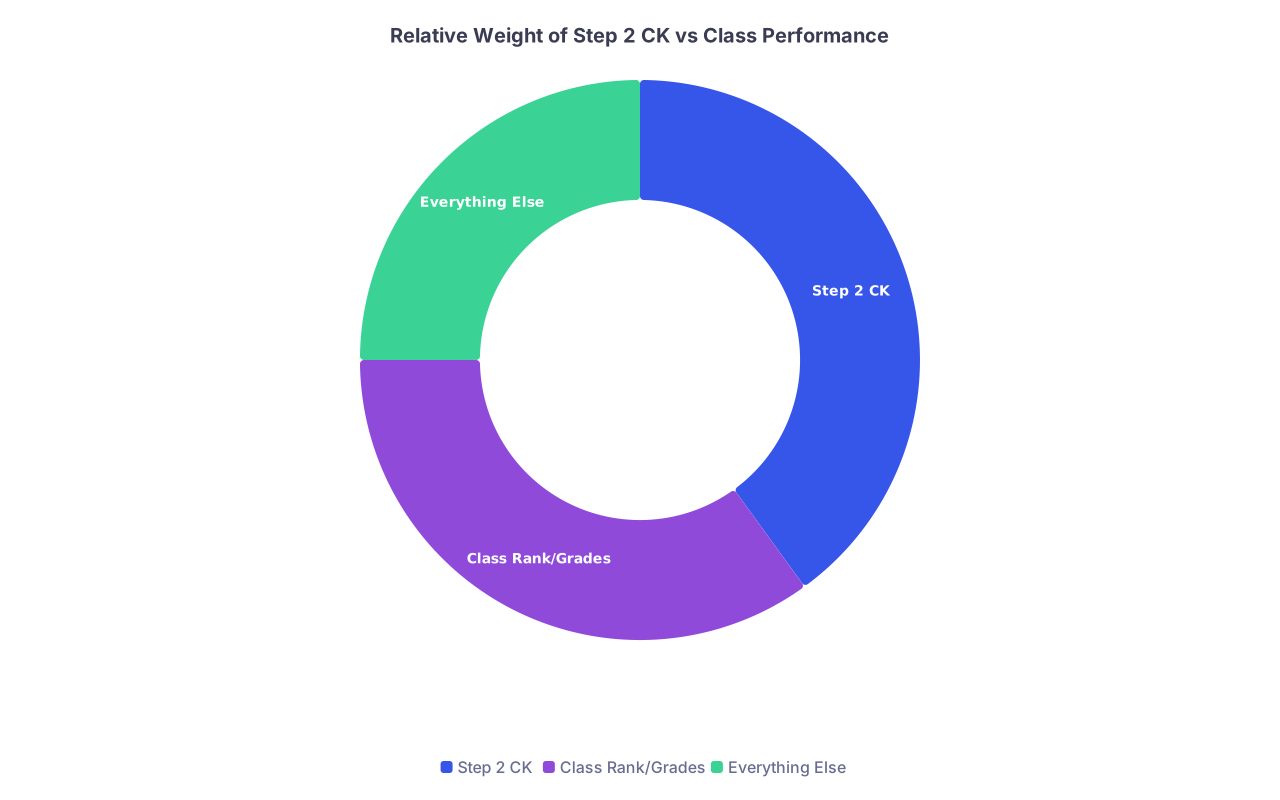
| Category | Value |
|---|---|
| Step 2 CK | 40 |
| Class Rank/Grades | 35 |
| Everything Else | 25 |
Yes, Step 2 CK is the new big number. No, it’s not your only lifeline.
The students who do this badly:
- Ignore everything for two years
- Cram Step 2 after exhausting rotations
- Hope a big number erases a weak trajectory
The students who do this well:
- Learn solidly in pre‑clinicals and clerkships (making CK prep easier)
- Schedule CK with enough dedicated time
- Use their existing strength to push from “good” to “strong,” not from “weak” to “desperate”
Again: CK enhances a strong record; it rarely redeems a chronically weak one.
5. Track Performance Trends, Not Every Point
You don’t need to know whether you’re exactly top 23%. You do need to know:
- Am I generally toward the top, middle, or bottom?
- Are my shelf scores rising, flat, or dropping?
- Are attendings and residents describing me as “strong,” “average,” or “barely there”?
If you’re consistently in the middle and you want competitive options, that’s your warning signal. Not for panic—for deliberate adjustment.
The Hidden Cost: Future You Has Less Leverage

Here’s the part no one tells you when they peddle “Step 1 is P/F, relax” advice:
You are either building leverage for your future self or denying it.
- Strong class performance = leverage to choose your specialty and program
- Weak/mediocre performance = dependence on luck, connections, and geography
Future you might:
- Have a partner whose job is location-limited
- Develop a passion for a specific subspecialty
- Need a program with strong research support or visa flexibility
- Want to leave the door open for academics or leadership
If you dismiss class rank now, you silently choose fewer choices later. That trade usually doesn’t feel real until it’s too late to fix it.
What You Should Do Differently Starting Now

| Step | Description |
|---|---|
| Step 1 | Assess Current Standing |
| Step 2 | Clarify Desired Ceiling |
| Step 3 | Identify Weak Areas |
| Step 4 | Plan for Next 2 Blocks or Rotations |
| Step 5 | Seek Feedback from Faculty |
| Step 6 | Adjust and Repeat |
You don’t need a personality transplant. You need directional correction.
Do this:
- Ask honestly: Where am I likely sitting—top, middle, or bottom of my class?
- Ask yourself: Do I want future access to competitive fields or top programs?
- If yes, identify one or two things you can raise from “fine” to “strong”:
- Shelf exam prep strategy
- Daily reading habits on rotations
- Willingness to ask for feedback mid-rotation and course-correct
- Meet with a dean or advisor and say directly:
“I want to keep doors open to competitive specialties. What does that require from my performance from now through M3?”
You don’t fix trajectory by wishing. You fix it by making specific, sustained, slightly uncomfortable improvements.
And no, you do not need straight honors to have a great career. But pretending that relative performance is irrelevant in a world that’s still ranking you in a dozen indirect ways? That’s how smart students kneecap themselves.
FAQ (Exactly 5 Questions)
1. My school doesn’t publish class rank. Does it still matter for residency?
Yes. Programs rarely see an exact number, but they see your performance relative to peers through clerkship grades, AOA selection, awards, and MSPE language. Your school may not hand you “you’re 45th,” but they still communicate tiers and relative strength to programs.
2. If I messed up M1/M2, is it hopeless to aim for a competitive specialty now?
Not hopeless—but harder. You’ll need a strong Step 2 CK, excellent clerkship performance (especially in core rotations), and standout letters. You can compensate somewhat, but you can’t fully erase a long pattern of underperformance. You’re playing from behind, so you must be deliberate and realistic.
3. Does AOA really matter in the Step 1 P/F era?
It matters more than students want it to. Not having AOA won’t ruin you, but having it is a clear, widely recognized signal of top performance. In tie-breaker situations or for hyper-competitive fields and programs, it can absolutely help. The process that earns you AOA (strong performance over time) is the real asset.
4. Should I sacrifice research or extracurriculars to chase a higher class rank?
If you’re aiming at highly competitive specialties, you need both decent performance and some scholarly or extracurricular depth. The mistake is going all-in on research while treating your grades as an afterthought. Start by securing solid-to-strong class and clerkship performance, then layer research on top—not the other way around.
5. I really struggle with anxiety around grades. How can I care about rank without burning out?
Shift your focus from “I must be top X%” to “I want a strong trajectory and habits.” Set process goals you control: consistent study blocks, active participation on rotations, early feedback. Check in on your performance every few months instead of obsessing over every quiz. Rank-awareness means using performance as feedback, not as your identity.
Open your transcript and your last few evaluations right now. Ask yourself, bluntly: “Is this record giving my future self more options—or quietly taking them away?”