
The idea that “preclinical does not matter anymore because everything is pass/fail” is dangerously wrong.
That mindset is exactly how strong applicants quietly become average. Or worse: explainers on SOAP day.
You are in the Step 1 pass/fail era now. The visible scoreboard changed. The behind‑the‑scenes scorekeeping did not. It just moved to places you are not watching carefully enough.
This is what I want to protect you from: treating preclinical as “low stakes” and stepping straight into a set of silent GPA traps that will follow you into ERAS, dean’s letters, and rank lists.
Let’s walk through the mistakes students keep making now that Step 1 is pass/fail—and how to avoid ending up as the cautionary tale people whisper about two classes below you.
The Big Lie: “Preclinical Is Low Stakes Now”
Here is the false narrative I hear constantly from M1s and even M2s:
“Step 1 is pass/fail.” “My school made preclinical pass/fail or pass/H.” “Residencies just care if I passed. So I can chill now and turn it on for Step 2, right?”
No. That is how you build a transcript that quietly screams “average and risky” to program directors.
The traps are subtle:
- Your transcript still shows patterns.
- Your dean’s letter (MSPE) still ranks you.
- Your school still tracks internal GPA or quartiles.
- Your study habits calcify early—good or bad.
I have watched students coast through organ systems because “it’s just P/F now” and then get blindsided when:
- They are told in M3 orientation: “You are in the bottom quartile academically.”
- They realize they are locked out of AΩA because of early preclinical performance.
- They try to flip a switch for Step 2 and it does not work, because their foundation is full of gaps they never had to close.
You are not just trying to pass preclinical. You are building evidence. Evidence that you can handle high‑level medical content, learn consistently, and not fall apart when stakes shift. Programs read that evidence very carefully now that Step 1 no longer sorts you by three extra digits.
Silent Trap #1: “It’s Pass/Fail, So Grades Don’t Exist”
This is the most common, most expensive misconception: thinking that because your transcript shows “Pass,” no one can tell who barely scraped by and who dominated.
They can. In multiple ways.
Here is how the game actually works at most schools, even in P/F or P/H systems:
- Internal numeric scores still exist. You may never see them on your transcript, but they feed into class rank, quartiles, AΩA, and MSPE language.
- “Preclinical performance” becomes a summarized metric. Your school may literally send programs something like “Preclinical performance: upper third / middle third / lower third.”
- Comments carry coded language. MSPE phrases like “met expectations” vs “consistently exceeded expectations” are not accidental. They map to internal performance tiers.
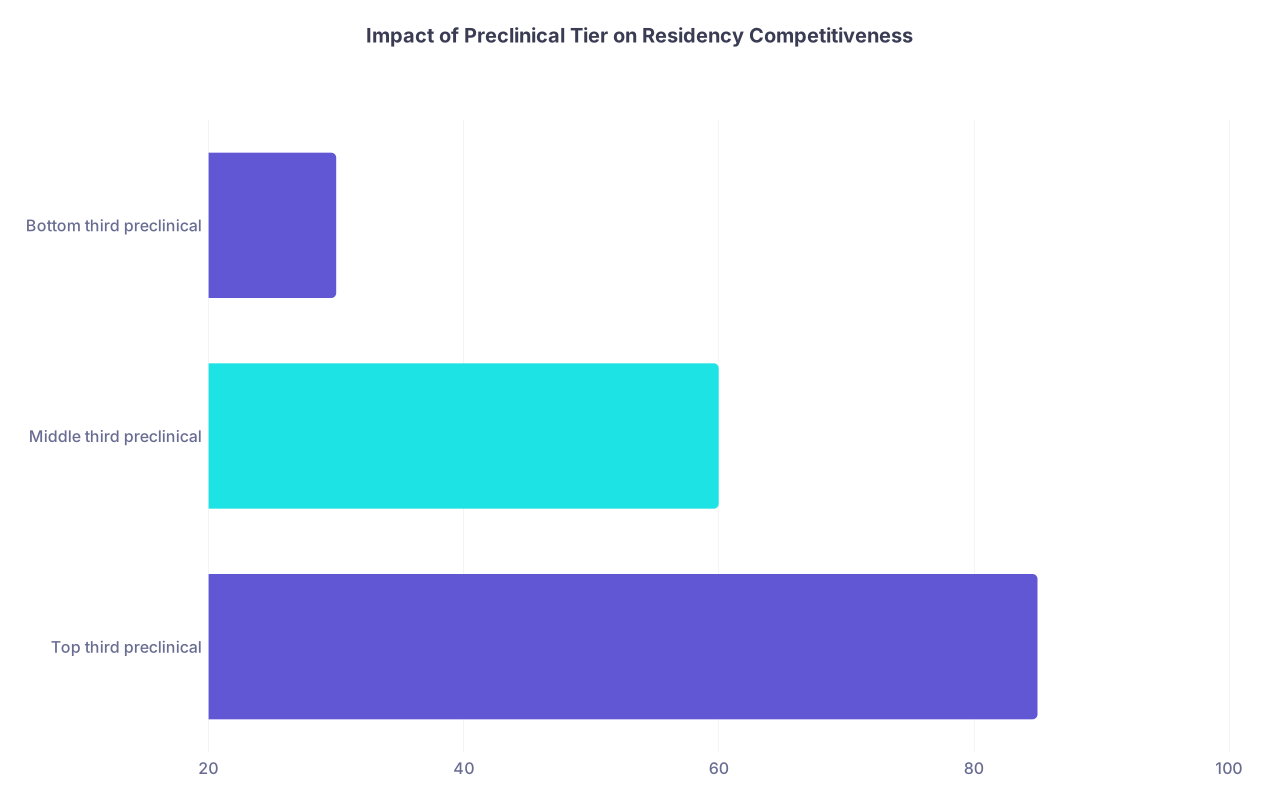
| Category | Value |
|---|---|
| Top third preclinical | 85 |
| Middle third preclinical | 60 |
| Bottom third preclinical | 30 |
So what happens when you treat early preclinical as “low stakes”?
You accumulate:
- Borderline passes on systems exams
- Multiple remediation flags or retakes
- A pattern of barely clearing the bar
Individual passes may not show. The pattern eventually does.
By M3, you discover you are classified in the “lower third” academically. That label appears in your MSPE. And then you are asking why your research, leadership, and glowing letters did not beat that single line of text.
Do not make that mistake. You should still treat each course as if there is a rank list behind it—because there is.
Silent Trap #2: Confusing “Pass” With “Prepared”
Another brutal misunderstanding: assuming that passing preclinical equals being ready for Step 1 or clinical rotations.
Passing is a floor, not a sign you are safe. The P/F era tempted people into this lazy equation:
“Exam passed → I know enough → I can move on.”
I have seen this play out over and over:
- M1 student treats anatomy, micro, and pharm as “whatever gets me above 70%.”
- They skip spaced repetition because “I will see it again for Step 1.”
- They cram before each block, dump the content the next week, and chase the next pass.
By late M2, they finally open a Qbank in a serious way. Then they are horrified:
- 40–50% on early blocks of UWorld
- Forgetting core physiology from six months ago
- Realizing that “pass level” understanding is nowhere near “Step‑ready” or “ward‑ready” understanding
The disaster scenario is not failing Step 1 anymore. It is squeaking by on Step 1, then getting crushed by:
- Shelf exams
- Step 2 CK
- Clinical expectations
Because your foundation is sand.
P/F preclinical tempts you to aim just high enough to pass this exam. The smart move is very different: aim to truly master the high‑yield core on first pass, so your Step 2 and clerkships are a refinement, not a rescue mission.
Silent Trap #3: Underestimating the New Weight of Step 2 CK
Here is the shift no one likes to talk about: when Step 1 went pass/fail, Step 2 CK quietly got sharper teeth.
Programs still need a hard metric to compare applicants. Many of them simply slid their “screen by Step 1” filters straight over to Step 2 CK.
Result: your Step 2 CK now carries far more weight, and your preclinical habits directly determine how high you can realistically score.
Look at how performance tiers often end up distributed:
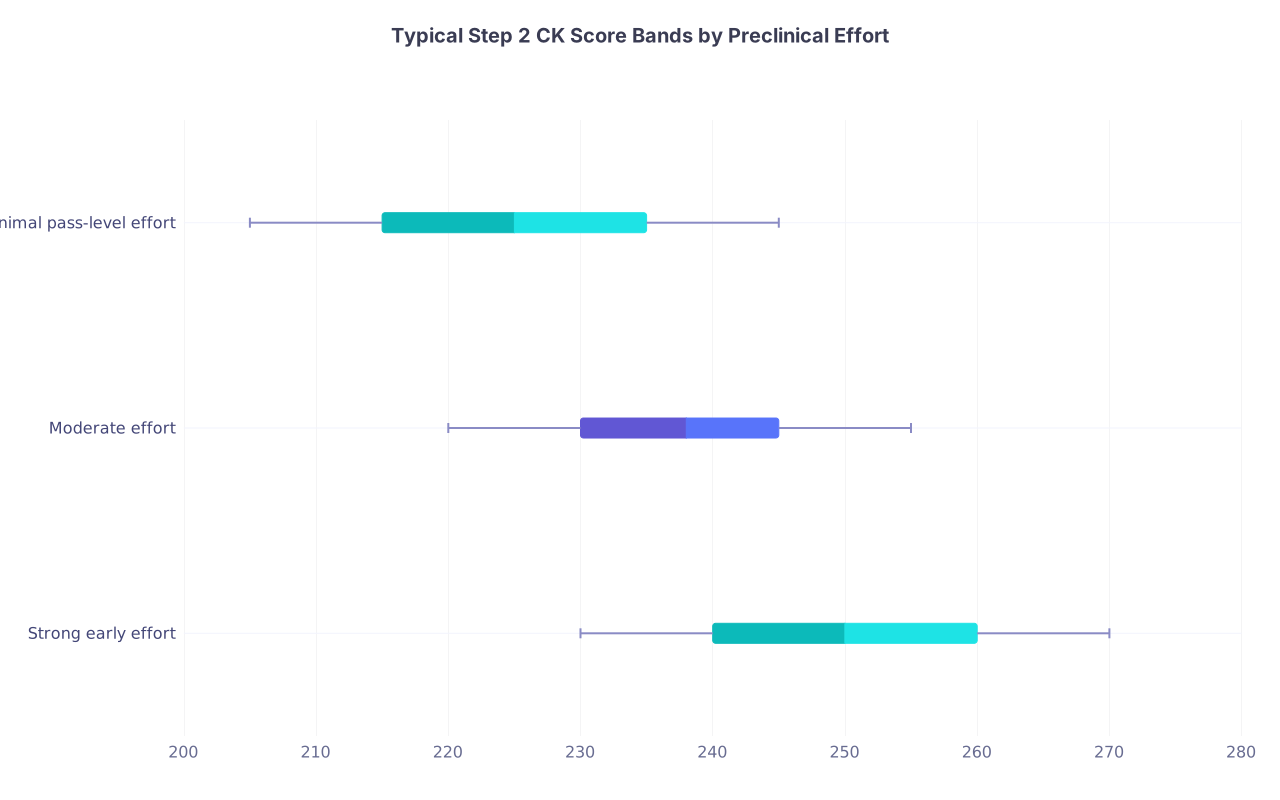
| Category | Min | Q1 | Median | Q3 | Max |
|---|---|---|---|---|---|
| Strong early effort | 230 | 240 | 250 | 260 | 270 |
| Moderate effort | 220 | 230 | 238 | 245 | 255 |
| Minimal pass-level effort | 205 | 215 | 225 | 235 | 245 |
Is that perfect science? No. But I have watched versions of this pattern too many times to ignore it.
Common mistake sequence:
- Treat M1 and early M2 as P/F, aim to “just pass.”
- Build weak, fragmented understanding of pathophys, pharm, and micro.
- Hit clinical year and realize Step 2 CK is now do‑or‑die for competitive specialties.
- Try to “turn it on” with poor fundamentals and limited bandwidth during clerkships.
- End up with a decent but not standout Step 2 score—just when you needed a star.
Programs in competitive fields (derm, ortho, neurosurg, plastics, ENT) have not suddenly abandoned objective academic metrics. They just moved the goalposts. Your preclinical “low‑stakes” mindset comes back in the form of a Step 2 ceiling you cannot break through.
Silent Trap #4: Destroying Your Study Habits Before They Form
Here is the less obvious trap: this is not only about knowledge and numbers. It is about your behavior.
Preclinical is where you build:
- Daily habits
- Systems for reviewing content
- Tolerance for delay of gratification
- Resilience when material gets overwhelming
When you tell yourself, “It is just P/F; I will do the minimum,” what you are really training is:
- Inconsistent effort
- No long‑term review strategy
- Reliance on cramming
- Rationalizing shortcuts
Then you hit clerkships and suddenly the stakes feel very real:
- Real patients
- Attending evaluations
- Shelf exams every 6–8 weeks
- Step 2 CK looming over everything
You try to flip into “serious mode,” but your only practiced mode is “cram, survive, forget.”
That is not a switch. It is a skill set. And you never built it.
This is why I get worried when an M1 says proudly, “I only studied the last three days before each exam and still passed.” That is not flexing. That is documenting your habit of under‑preparing and over‑relying on short‑term memory.
Fixing that in M3 is like remodeling the airplane while it is already in the air.
Silent Trap #5: Ignoring How MSPE and Class Rank Actually Work
You cannot afford to be naive about the MSPE (dean’s letter). It is not just a fluffy recommendation. It is a structured, standardized report. And in the Step 1 P/F era, many schools beefed up internal metrics to compensate.
Two things you should not ignore:
Quartiles / deciles
Many schools formally classify you in a performance band that includes both preclinical and clerkships. Your M1–M2 “I just need to pass” era absolutely can drag you down, even if you wake up later.Narrative language
Deans and committee members use specific, repeated phrases to signal performance level. This starts early. If your preclinical years are marked by remediations, professionalism flags, or chronic “borderline pass” behavior, it seeps in.
Here is how this plays out in residency selection:
| Signal Type | How Programs Interpret It |
|---|---|
| Top third preclinical | Strong foundation, reliable learner |
| Middle third preclinical | Solid but not standout |
| Bottom third preclinical | Risk of needing remediation |
| Multiple remediations M1 | Concerns about consistency |
| Honors in later clerkships | Improvement, but not a full reset |
Can you overcome a weak preclinical record? Sometimes, yes—especially with:
- Stellar Step 2 CK
- Strong letters
- Outstanding clinical evals
But you will always be playing uphill. And you did that to yourself because you believed the myth that “preclinical is low stakes now.”
Silent Trap #6: Wellness as an Excuse, Not a Strategy
I am going to step on some toes here.
There is real burnout in medical school. Real depression. Real anxiety. You cannot grind endlessly without consequences. But there is a growing, dangerous misuse of “wellness” to rationalize chronic under‑effort.
Here is the pattern:
- Student decides from day one: “I am prioritizing wellness, so I will not over‑study.”
- Translates that into:
- No consistent review
- Minimal lecture engagement
- “I will watch videos at 2x the weekend before”
- Justifies every low‑effort choice as “boundaries” and “self‑care”
You know what is not good for your mental health?
- Repeating courses
- Failing shelves
- Scrambling in SOAP
- Realizing in M4 that half the specialties you like are effectively closed
Genuine wellness is not the enemy of high performance. Poor planning is.
The fix is not “study 14 hours daily.” It is:
- Stable, reasonable daily study blocks
- Aggressive protection of sleep
- Smart use of Anki / Qbanks from day one
- Saying no to time‑wasting activities, not to effective studying
If you use pass/fail as an excuse to check out, you trade short‑term comfort for long‑term stress. That is a bad bargain.
Silent Trap #7: Misreading Your Peers and the Culture Shift
Step 1 pass/fail changed the vibe in many schools. That relaxed atmosphere is deceptive.
You will hear:
- “No one studies that hard anymore; it’s just P/F.”
- “I am only doing AnKing right before exams.”
- “I do not touch Qbanks until late M2; chill.”
Some of those people:
- Already have strong science backgrounds
- Are quietly doing more than they admit
- Will panic and ramp up later (too late to help you if you copied them)
Here is what has actually changed in the Step 1 P/F era:
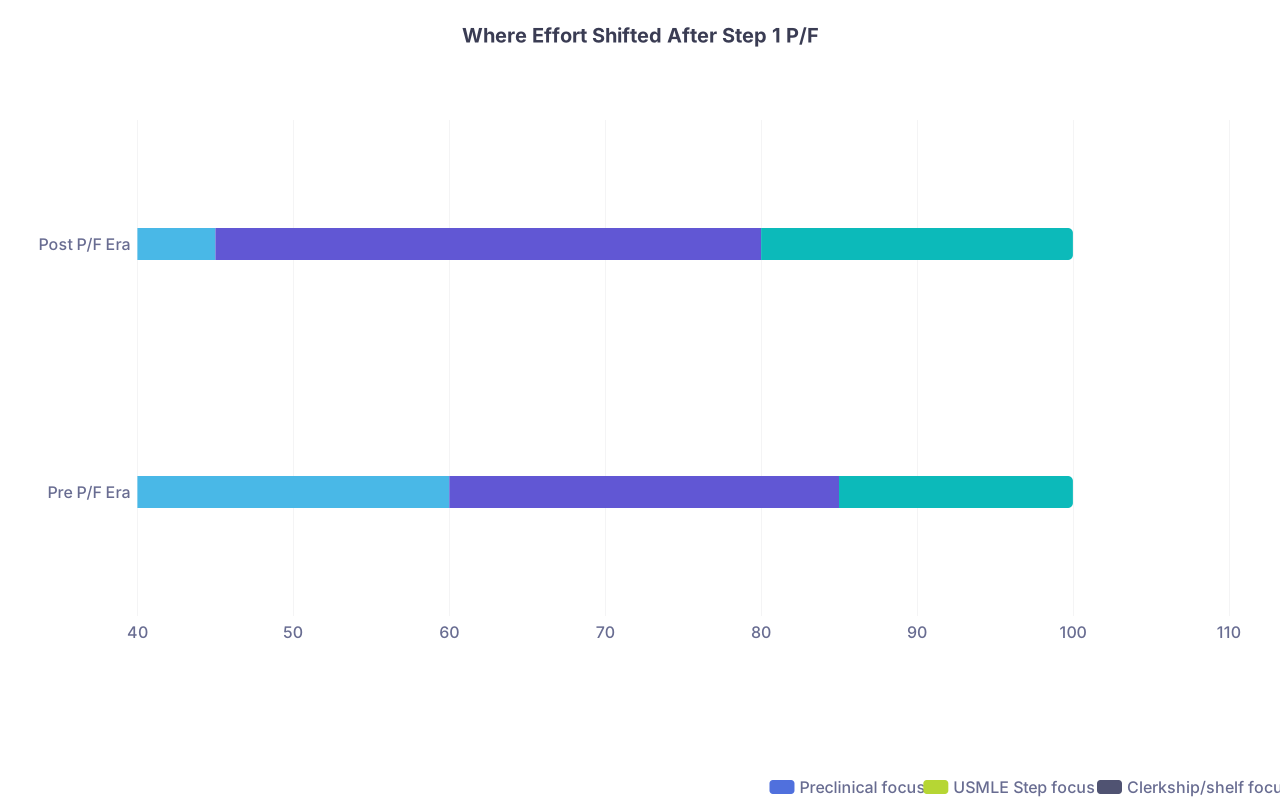
| Category | Preclinical focus | USMLE Step focus | Clerkship/shelf focus |
|---|---|---|---|
| Pre P/F Era | 60 | 25 | 15 |
| Post P/F Era | 45 | 35 | 20 |
What you cannot afford to do is lower your baseline because the group mood seems more relaxed. Residency programs did not relax with them.
They:
- Shifted emphasis to Step 2 CK
- Scrutinize MSPE and class performance more
- Look for evidence of consistent effort and growth
So while everyone is celebrating that “the Step 1 era is over,” some of you are quietly drifting into underperformance that will only become obvious three years from now.
What To Do Instead: Treat P/F As Cover, Not As “Free Time”
You do not need to live like a Step 1‑scored prisoner again. But you do need to stop pretending preclinical is low impact.
Use pass/fail as protection while you build smart habits—not as permission to disengage.
Concretely, avoid these specific mistakes:
Do not aim to barely pass
Always target a true working understanding of:- Pathophysiology
- Pharmacology
- Microbiology
- Biostatistics / EBM
Those are Step 2 and clerkship core.
Do not delay Qbanks until late M2
Start light, early exposure to board‑style questions once you have some systems under your belt. Not to chase scores yet, but to train thinking patterns.Do not abandon spaced repetition
Anki (or any spaced system) is not about being a “gunner.” It is about not relearning the same mechanism 6 times at increasing levels of panic.Do not ignore feedback
If your block exam scores are consistently low passes, that is early warning. Do not shrug it off because the transcript still says “Pass.”Do not treat wellness as avoidance
Real wellness is built on competence + boundaries, not denial.
And just as importantly: protect your future optionality. You might think today you are “100% going into family medicine” and that none of this matters. Then you do a rotation in EM, derm, rads, ortho, anesthesia—whatever—and suddenly you care a lot about being competitive.
Preclinical “low stakes” choices are how people close doors on specialties they have not even met yet.
A Visual Reality Check: Your Timeline
Look at how everything stacks over four years. There is no dead zone. Just compounding.
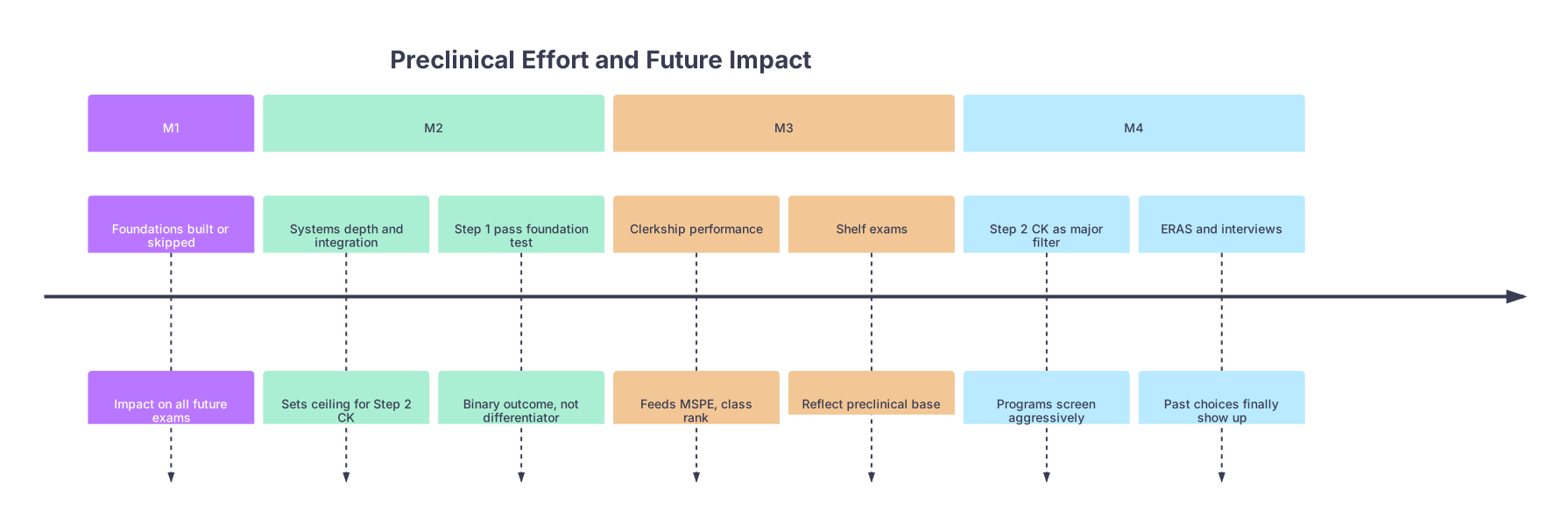
| Period | Event |
|---|---|
| M1 - Foundations built or skipped | Impact on all future exams |
| M2 - Systems depth and integration | Sets ceiling for Step 2 CK |
| M2 - Step 1 pass foundation test | Binary outcome, not differentiator |
| M3 - Clerkship performance | Feeds MSPE, class rank |
| M3 - Shelf exams | Reflect preclinical base |
| M4 - Step 2 CK as major filter | Programs screen aggressively |
| M4 - ERAS and interviews | Past choices finally show up |
Every time you tell yourself “this block does not matter,” you are ignoring this timeline. There is a lag between your choices and the consequences, which makes it easy to pretend there are none.
They just arrive later. With interest.
FAQ (3 Questions)
1. If my school is truly pass/fail with no internal ranking, can I relax more in preclinical?
Be very suspicious of the word “truly.” Most schools that say “no class rank” still provide some form of performance description in the MSPE, use preclinical as a threshold for AΩA eligibility, or have internal academic concern committees that track patterns. Even if yours is one of the rare schools that hides all preclinical stratification from programs, your Step 2 CK and clerkship performance will still heavily depend on your M1–M2 foundation. You can relax on perfectionism. You cannot relax on mastery of core material.
2. I started M1 with a “just pass” mindset. Is it too late to fix this in M2?
No, but you cannot keep the same approach and expect a different outcome. You will have to deliberately rebuild your system: commit to daily review, identify weak core subjects from M1 (like pharm or phys), and actually remediate them, not just move on. Start consistent Qbank work earlier, and treat each block as Step 2 prep, not just a hurdle. You might not completely erase early performance in your internal ranking, but you can absolutely change the narrative from “chronically borderline” to “clear upward trajectory,” which program directors do respect.
3. How do I balance not burning out with not underperforming in a P/F preclinical system?
The balance is structure, not volume. You do not need 12‑hour study days. You do need predictable, protected 4–6 hour blocks of focused work on most days, real rest built into your week, and a clear system: lectures or resources chosen intentionally (not everything), daily Anki or spaced review, plus gradual Qbank integration. Burnout usually comes from panic cycles and lack of control, not from steady, reasonable effort. Underperformance comes from treating every week like it is optional. Your goal is to run a sustainable, boringly consistent routine—not heroic sprints right before exams.
Open your last block’s study schedule right now and circle every day where you essentially “took preclinical off” because it was “just pass/fail.” Then design the next two weeks so that never happens again.