
It’s March of M2. Your school just announced another Step 1 info session “to reassure everyone about pass/fail.” Half your class sighed in relief. You heard someone in the hallway say, “Bro, as long as I pass, Step 1 doesn’t even matter anymore. I’ll just turn it on for Step 2.”
If that sentence sounds familiar, this article is for you.
Because here’s the trap: Step 1 going pass/fail did not suddenly make the foundational work optional. It just delayed the bill. And Step 2 CK is where the debt comes due. With interest.
Let me walk you through the specific Step 1-era habits that quietly wreck Step 2 CK performance 12–18 months later, and how to avoid them before you dig a hole you cannot climb out of during clerkship year.
Mistake #1: Treating “Pass” as the Ceiling Instead of the Floor
The worst mindset shift I’ve seen with pass/fail Step 1 is simple and deadly:
“Passing is good enough.”
No. Passing is the minimum amount of competence to not be dangerous. Step 2 CK is a ranked exam again. Residencies will sort you by that number. Programs that used to screen by Step 1 now screen by Step 2. You can pretend that’s unfair. It is. But it’s also real.
During the Step 1 era, this shows up as:
- Stopping content review as soon as your NBME crosses the passing line
- Saying “I’m only aiming for a pass, so I don’t need to memorize pathways/details”
- Declaring whole subjects “low-yield for just passing” (biochem, immuno, neuroanatomy usually get sacrificed first)
Fine. You might pass Step 1 doing that.
But Step 2 CK is built on the assumption that you already know this stuff, and it layers management decisions on top. If you never actually built the base, you’re trying to do differential + workup + treatment while still shaky on mechanism and pathophys.
Here’s what that looks like a year later:
- You miss endocrine questions on CK because you never truly understood thyroid physiology, you just memorized which lab pattern = Graves long enough to scrape by
- You’re slow on renal questions because you skipped acid–base in M2 (“too detailed for P/F”) and now every metabolic alkalosis/respiratory acidosis question eats 3 minutes
- You can’t connect symptoms to underlying disease because you never internalized pathophys, you just memorized buzzwords
Do not make the mistake of using “pass/fail” as a signal that depth no longer matters.
Protective habit:
Set your personal Step 1 standard higher than “barely pass.” I am not saying you must chase a 260-level mastery. I am saying:
- Build robust conceptual understanding, not just “enough to pass”
- Hold yourself to “I want to be fast and accurate with foundations” instead of “I want to be barely competent”
If your practice blocks are hovering just above the pass line and you’re calling that “good enough,” you’re setting up future you for a brutal Step 2 year.
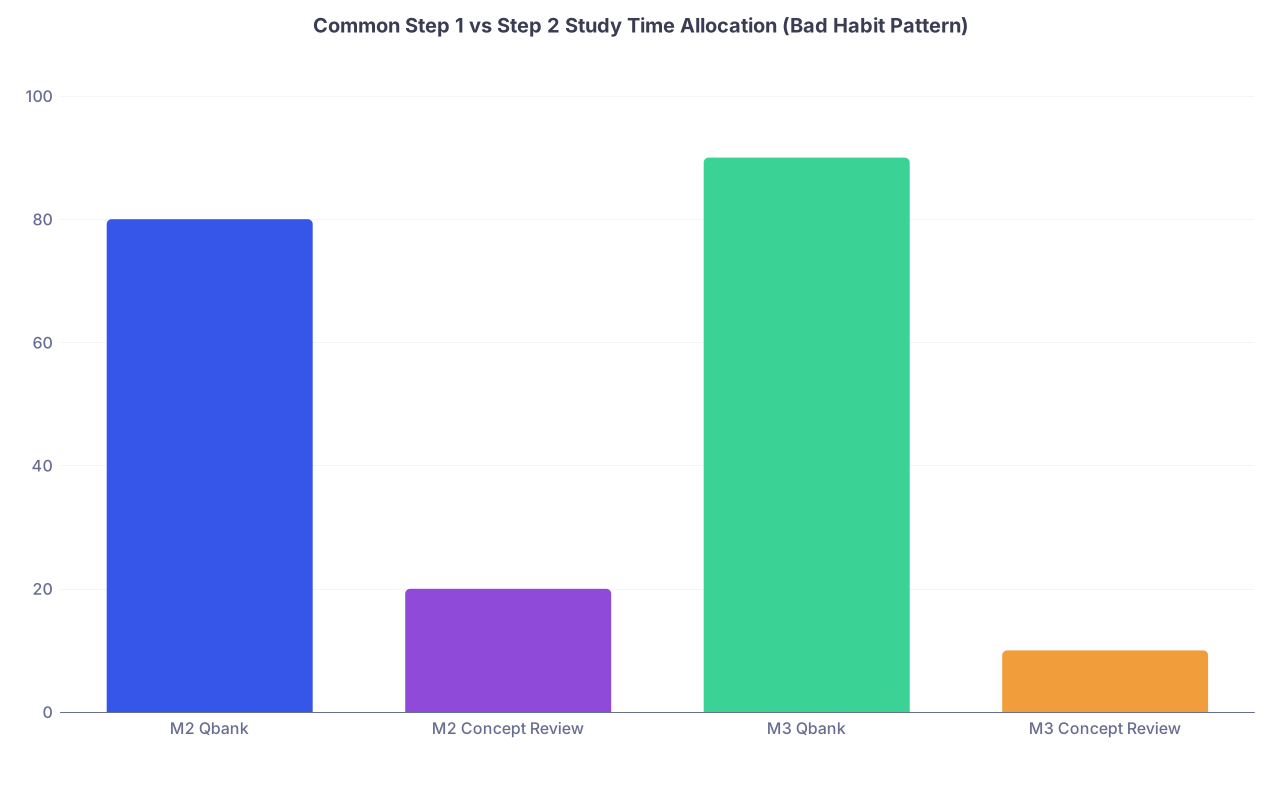
Mistake #2: QBanking Like a Grinder, Not a Learner
| Category | Value |
|---|---|
| M2 Qbank | 80 |
| M2 Concept Review | 20 |
| M3 Qbank | 90 |
| M3 Concept Review | 10 |
Here’s the classic Step 1 P/F disaster pattern:
You buy UWorld Day 1 of M2. You grind through 3,000+ questions. You “redo” half of them. You brag that you finished the whole QBank twice.
But your review process is trash.
- You check the correct answer
- Maybe skim the explanation
- Screenshot a few “hard” facts
- Then rush to the next block
That’s Step 1 gaming. Quantity over quality. It used to work better when the goal was a one-time score. Now it’s a long-term boomerang.
The problem is this: Step 2 CK expects you to reason, prioritize, and manage patients based on deeply integrated knowledge. Mindlessly hammering QBank items trains you to recognize patterns in a controlled environment, not to understand why the right answer is right and the wrong ones are wrong.
A year later:
- You’re slow on Step 2 CK because you never truly learned how to use questions as teaching tools; all you learned was “pattern match or guess”
- Your retention is awful, because you never paused long enough to build mental frameworks; everything lived in Anki or a screenshot folder you never opened again
- You struggle to adapt to UWorld Step 2 CK’s more complex stems and multi-step reasoning because your Step 1 approach was shallow
Protective habit:
Use Step 1 prep to master how to review questions, not just how to do them.
For each missed or lucky-correct question:
- Write out: What concept was tested?
- Why was the correct answer correct?
- Why was each wrong answer wrong, in one sentence each?
- What’s the “one-liner” rule you can carry forward?
That style of review is overkill if your only goal is “pass.” But it’s exactly what Step 2 CK demands. If you train lazy review on Step 1, you will almost certainly carry that laziness into M3, when you have even less time and more fatigue.
Mistake #3: Ignoring Systems You “Don’t See” on the Wards
Here’s a nasty one people don’t realize until too late.
During Step 1, some students mentally categorize systems as “important for future” and “meh, I won’t do that specialty anyway.” They subconsciously underinvest in:
- Neuroanatomy and neurophysiology
- Renal physiology and acid–base
- Biostatistics and EBM
- Immunology and rheumatology
- Biochem/metabolism
“I’m not going into neurology.”
“I’ll just treat with fluids and move on.”
“Stats is just a couple of questions.”
Fast-forward to Step 2 CK:
- Every shelf has neuro, renal, stats, immunology baked into questions across specialties
- CK loves EBM, sensitivity/specificity, NNT, non-inferiority trials, etc. These are not optional fringe topics
- Neuro deficits, localizing lesions, EM bleeds, stroke workup, immunosuppression complications — these are all high-stakes, heavily tested
What you blew off in the P/F Step 1 world becomes your anchor in Step 2 CK.
The brutal part? You’ll have far less protected study time as an M3 or early M4. Trying to rebuild neuro and renal from scratch during busy rotations is miserable. You won’t do it efficiently. You’ll patch holes with half-understanding, then watch your practice scores hover stubbornly below your target.
Protective habit:
During Step 1:
- Treat “weak, low-yield” systems as future landmines, not optional
- For every subject you hate, aim for “solid and functional” understanding, not genius level, but enough to not panic when you see it
- Keep a short running list of “concepts I refuse to be weak at for CK” and make sure neuro, renal, stats, and endocrine are on it
You’re not just studying for an exam. You’re preventing future emergencies in your own performance.
Mistake #4: Relying on Pure Memorization and Screenshot Hoarding

I’ve watched students “study” for Step 1 by:
- Taking thousands of screenshots of explanations, tables, mnemonics
- Dumping them into a “Study” folder on their phone or Google Drive
- Telling themselves they’d “review them later”
They never do. Or if they do, it’s a frantic, shallow scroll.
This creates two big problems for Step 2 CK:
- You train your brain to think “I don’t have to fully understand this now, I’ve captured it.” That’s the opposite of the mindset you need when questions become more complex and time-limited.
- You become dependent on external crutches. CK success requires you to retrieve and apply information fast, under pressure, repeatedly. Not go hunting for the right screenshot in your mental clutter.
On Step 2 CK, memorized facts without framework fall apart fast. Questions aren’t “What is the defect in disease X?” as often; they’re:
- Here is a vague constellation of symptoms
- Here is a poorly controlled chronic disease + acute change
- Here are lab/value conflicts
- Now choose the best next step with imperfect information
Your screenshot could never have prepared you for that. Only real understanding can.
Protective habit:
During Step 1, every time you feel tempted to “just screenshot it” and move on, stop and:
- Force yourself to explain the concept to yourself in 2–3 sentences, out loud or in writing
- Create a single distilled note: one card, one OneNote box, one bullet in your master doc
- Delete or at least limit screenshots to rare, complex diagrams you actually revisit
If your Step 1 learning strategy is 90% capture and 10% consolidation, your Step 2 CK strategy will collapse under its own weight.
Mistake #5: Separating “Test Studying” from “Real Medicine”
During the Step 1 P/F era, I hear this constantly:
“I’ll learn how to be a real doctor on the wards. Step 1 is just for passing an exam.”
That thinking kills you on CK.
Step 2 CK is not “random facts about obscure diseases.” It’s literally testing whether you can:
- Recognize common presentations
- Construct differentials
- Order reasonable workups
- Start safe, guideline-consistent management
If during Step 1 you constantly tell yourself “this is just for the test, not real life,” you divorce the content from any clinical meaning. You memorize lists of side effects, criteria, and bugs–drug charts without any felt sense of “what will this actually look like in a patient?”
Then M3 hits:
- On IM, the attending asks, “What’s your differential for chest pain in this 56-year-old?” Your brain has the Step 1 flashcards, but not the prioritization.
- On surgery, someone asks for pre-op risk stratification. You sort of remember risk factors, but not how to apply them to a real person.
- On OB, you know some of the hypertensive disorders of pregnancy, but in the moment you’re fuzzy on severity and next steps.
Your shelves and, later, CK questions are built to look and feel like actual inpatient and outpatient encounters, not Step 1 flashcards.
Protective habit:
During Step 1, constantly ask:
- “What would this look like if it walked into clinic or the ED?”
- “What’s the worst thing that could be going on? What’s the first thing I need to rule out?”
- “If this was my patient, what would I do first and why?”
You’re training clinical reasoning earlier than your classmates who see Step 1 as completely divorced from the wards. Those same classmates will be the ones struggling to adapt when CK demands integrated “test + real life” thinking.
Mistake #6: Letting Timing and Endurance Slide Because “Passing” Doesn’t Care
Here’s another silent killer: you stop caring about timing and mental endurance because the Step 1 passing bar is relatively forgiving.
I’ve watched plenty of students do this:
- Take forever on practice blocks because “I’m just trying to learn, not worry about time”
- Never practice more than one block back-to-back because they get mentally drained
- Rationalize slow, careful reading because “I’ll have more time later”
You might squeak by Step 1 like this, especially if you’re content-strong.
Step 2 CK is a different beast:
- Longer exam
- More complex stems
- Heavier cognitive load (more multi-step decisions per question)
- Higher personal pressure (now your score matters again)
If you never trained your brain to perform under realistic constraints during Step 1, your first real test of endurance will be CK itself. That’s not when you want to discover that you melt down after four blocks or start rushing sloppy guesses in the last 10 questions of every section.
Protective habit:
During Step 1 prep, even P/F:
- Take full-timed blocks regularly
- Build up to multiple blocks in a row, even if not full test length yet
- Treat timing and stamina as skills you’re deliberately training, not incidental side effects
You are not just passing an exam. You’re conditioning yourself for the longest, highest-stakes MCQ test of your life so far.
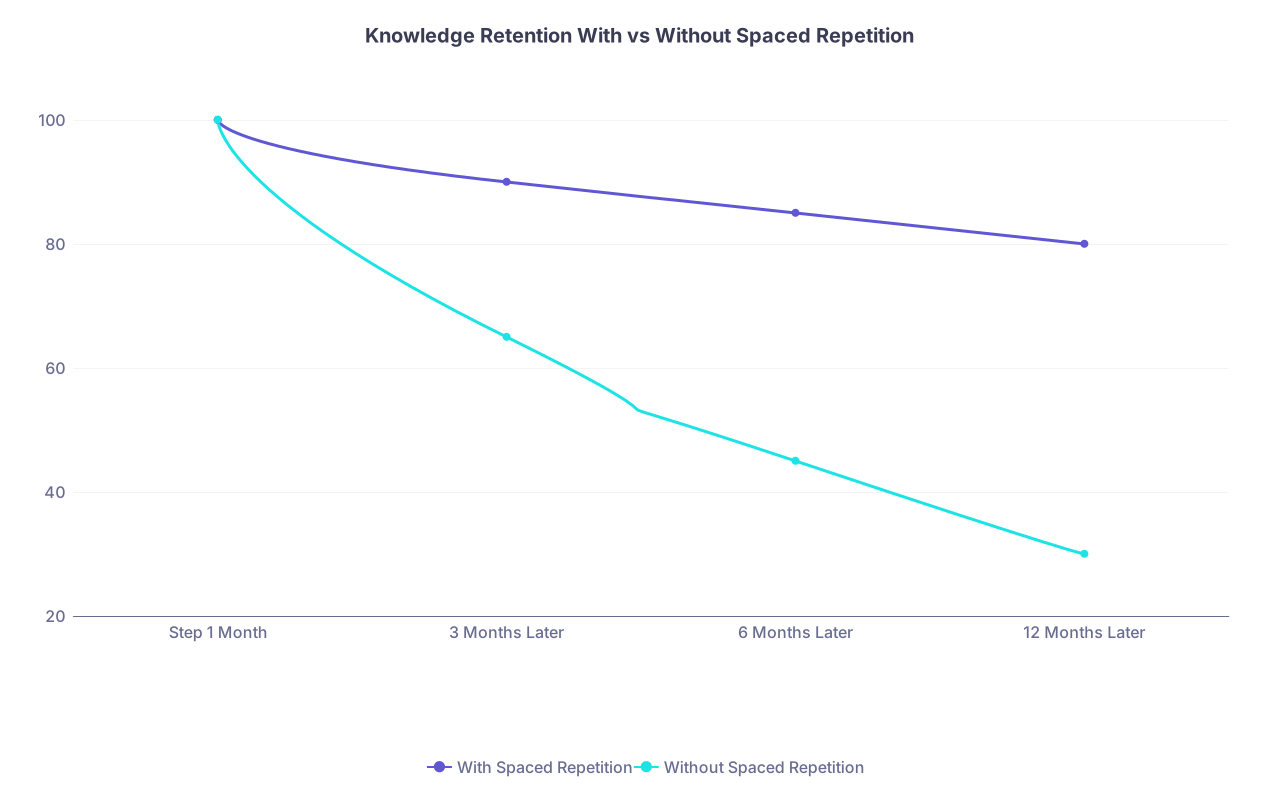
Mistake #7: Abandoning Anki/Spaced Repetition Right After Step 1
| Category | With Spaced Repetition | Without Spaced Repetition |
|---|---|---|
| Step 1 Month | 100 | 100 |
| 3 Months Later | 90 | 65 |
| 6 Months Later | 85 | 45 |
| 12 Months Later | 80 | 30 |
This one is painful, because I see it constantly.
You worked for months building decent Step 1 decks. You had a rhythm. You were retaining details well.
You pass Step 1.
Then you nuke your daily cards “for sanity,” tell yourself you’ll restart with “new, cleaner decks” for CK, and… you never really do. Maybe you dip into a few popular Step 2 decks later, but you never rebuild the same consistency.
Result?
- Your Step 1 content decays hard during M3
- Each shelf exam feels like re-learning the same material from scratch
- CK prep becomes this overwhelming mountain of “I used to know this, why is it all gone?”
This is exactly how people end up burning out with 2–3 month “panic” CK cramming marathons while on sub-Is. They’re trying to relearn two years of content in a short, chaotic, clinically busy window. It’s ugly.
Protective habit:
Right when you finish Step 1:
- Do not burn your spaced repetition habits to the ground
- Scale them back, yes, but don’t abandon them
- Convert your daily card load into a sustainable maintenance mode (even 50–100 cards/day) focused on high-yield, cross-cutting concepts you know will matter for CK and the wards: cardio, pulm, renal, endocrine, pharm, micro, EBM
Think of Step 1 as the big build, and M3 as maintenance + clinical layering. If you kill maintenance, the foundation rots. Then CK punishes you for it.
Mistake #8: Believing You Can “Flip the Switch” for Step 2 CK
The most seductive lie of the pass/fail Step 1 era is this: “I’ll really turn it on for Step 2. That’s the one that matters.”
No you won’t. Not if you’ve spent 18 months training low-effort habits.
You can’t:
- Ignore depth
- Cut corners on understanding
- Avoid hard systems
- Slack on question review
- Treat exam prep as separate from clinical thinking
…and then magically transform into a disciplined, deeply engaged learner the moment third year starts.
You’ll be tired. You’ll be under constant evaluation. You’ll have emotional load from actual patient care. You’ll have call, notes, presentations, and shelf stress. This is not the environment where people spontaneously discover a new peak-performance mode.
You bring the habits you built during Step 1 into your Step 2 season. For better or worse.
Protective habit:
Ask yourself now, before Step 1:
If I studied for CK the way I’m currently studying for Step 1…
- Would I be proud of that effort?
- Would I trust that process with my future specialty?
- Or would I be terrified?
If the honest answer is “terrified,” fix the process now. Not later.
Pulling It Together: Step 1 as CK Training Ground, Not Just a Hurdle
Step 1 going pass/fail changed one thing: the number on your score report.
It did not change:
- How much internal medicine you’ll be expected to know
- How deep your foundational knowledge needs to be to reason clinically
- How much Step 2 CK matters for competitive specialties
- How hard it is to rebuild gaps once you’re an exhausted M3
The biggest mistake you can make in the Step 1 P/F era is to treat it like a throwaway exam. It’s not. It’s your rehearsal for how you will:
- Learn large volumes of content
- Integrate basic science with clinical reasoning
- Use questions as teaching tools
- Build stamina and timing
- Maintain knowledge over years, not weeks
If you train those muscles badly now, Step 2 CK exposes all of it.
Your Next Step Today
Do one concrete thing right now:
Open your Step 1 study plan and mark three places where you’ve lowered your standards “because it’s just pass/fail.” Maybe it’s a weak subject you’re ignoring, lazy question review, or no timed blocks.
For each of those three, write a one-sentence fix. Not a fantasy, a realistic change starting this week.
If your Step 1 habits would horrify the version of you who has to sit for Step 2 CK, change them while you still have time.