
It is August 10th of your MS1 year.
Your class group chat is split between people flexing Anki streaks and others saying, “Relax, Step 1 is pass/fail now, it does not matter.”
Here is the uncomfortable truth: Step 1 going pass/fail did not make things easier. It just changed what programs look at. And it punished unfocused students who drift through MS1–MS2, then wake up in MS3 wondering why ortho, derm, or even solid IM programs want nothing to do with them.
You are not going to be that person.
You need a four–year roadmap. Month by month. What to do when so that by MS4 you are the student everyone describes as “a no–brainer to rank high.”
Let’s walk it forward.
Big Picture: What Actually Matters Post–Step 1 P/F
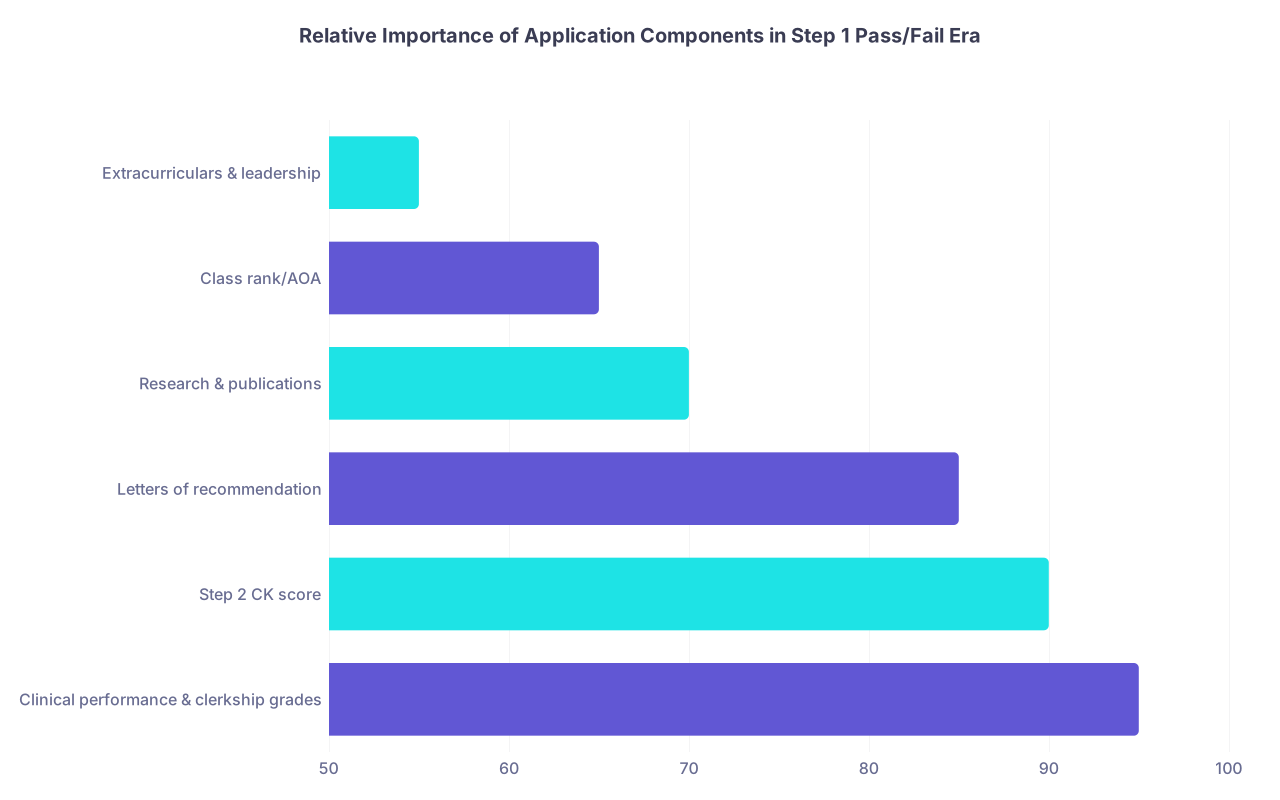
Before we go year by year, you need to know what residency directors actually care about now.
| Category | Value |
|---|---|
| Clinical performance & clerkship grades | 95 |
| Step 2 CK score | 90 |
| Letters of recommendation | 85 |
| Research & publications | 70 |
| Class rank/AOA | 65 |
| Extracurriculars & leadership | 55 |
Here is the hierarchy in the pass/fail era (for most competitive and mid–tier programs):
Clinical performance
- Clerkship grades
- Narrative comments
- Sub–I performance
Step 2 CK (now the main numeric filter)
- Your “new Step 1” for scoring purposes
Letters of recommendation
- Especially from well–known faculty in the specialty
Research
- More critical for competitive fields (derm, ortho, neurosurg, ENT, plastics, rad onc, IR, etc.)
-
- Still heavily used where available
Leadership & longitudinal involvement
- Signals maturity and consistency
Step 1 pass/fail did one thing for sure: it exposed lazy early years. The students who look best now are the ones who built a body of work over four years. Not the ones who just “crushed a test.”
So your roadmap is about stacking wins in the right order.
MS1: Foundation, Reputation, and Optional Research On-Ramp
August–September (MS1 Month 1–2): Set Your Operating System
At this point you should:
- Learn your school’s grading and ranking system
- Understand exactly how preclinical years feed into AOA/rank
- Decide how serious you are about competitive specialties (you can change later, but pick a default)
Concrete actions:
Map exams to resources
- Choose 1 primary text or platform for each course (e.g., BRS Physiology, Pathoma, Boards & Beyond, Sketchy, Anki).
- Stop bouncing between five resources “just to sample.” That wastes months.
Build a light board-style backbone
- For each block, add:
- Pathoma for path-heavy content
- Sketchy for micro/pharm
- UWorld only as a learning tool, not for score flexing
- For each block, add:
Establish professionalism early
- Be on time, answer emails, do not be the person faculty remember for complaining about attendance policies.
- People underestimate how far “reliable and low-maintenance” carries into letters later.
October–December: Academic Baseline + Low-Pressure Exposure
At this point you should:
- Prove to yourself you can be in the top half (or top quartile if you’re eyeing competitive fields).
- Start sampling specialties, not committing to them.
Actions:
- Track your exam performance
- Aim: comfortably above class average. If you are repeatedly at or below, you need to fix your study process now, not during Step 2.
- Shadow 2–3 half days
- One surgical, one medical, one wildcard (e.g., radiology, EM, anesthesia).
- Do not oversell this. This is data gathering, not resume building.
- Identify 1–2 potential research mentors
- Go to your school’s research day / website.
- Look at:
- Recent publications
- Current residents/fellows working with them
- Send 2–3 targeted emails, not 20 copy-paste messages.
January–March (MS1 Spring): Decide on Research and Step 1 Strategy
Step 1 may be pass/fail, but using Step resources early still pays off.
At this point you should:
- Decide whether you want a research year, summer project, or minimal research track.
- Build a sustainable Step–style baseline that will feed into Step 2 CK later.
Actions:
Start a small, realistic research commitment
- Ideal starter: chart review, retrospective cohort, or case series you can join.
- Expected output over 1–1.5 years: 1–2 abstracts, 1 paper or poster.
Light Step 1 alignment
- For each system you cover in class, do:
- 10–15 UWorld questions/week in tutor mode on that topic
- Make minimal Anki cards for your misses if Anki works for you
- You are not “studying for Step 1.” You are avoiding having to relearn everything from scratch.
- For each system you cover in class, do:
Self-assess specialty competitiveness
- If after 6–8 exams you are struggling to stay above average, be honest about ultra-competitive fields. You can still get there, but the lever will have to be Step 2 + research + insane clinical performance.
April–June (End of MS1): Lock In Summer and Close Gaps
At this point you should:
- Have summer plans finalized: research, clinical exposure, or both.
- Clean up any foundational weaknesses (physiology, micro, pharm).
Options for summer after MS1:
| Path | Best For | Main Goal |
|---|---|---|
| Full–time research | Competitive specialties | Abstracts, manuscripts, mentorship |
| Mix of research + clinic | Undecided but curious about fields | Exposure + productivity |
| Global health/Service | Primary care, EM, IM, peds | Longitudinal story + perspective |
If you are doing nothing structured with your summer, that is a mistake. It does not have to be elite NIH research, but “I just chilled” does not look great when others have a track record.
MS2: Quietly Preparing for a Strong Step 2 CK and Building a Track Record
Step 1 P/F means MS2 is no longer a “Step 1 sweat year” the way it used to be. But it is still where you build the knowledge that will decide your Step 2 CK ceiling.
July–September (Start of MS2): Step 1 Integration, Not Obsession
At this point you should:
- Treat Step 1 like a high–stakes course you must pass comfortably, not like the center of your universe.
- Start closing any content gaps that would hurt you in clerkships.
Actions:
- Boards integration per block
- UWorld: 15–20 Qs 4–5 days/week, mixed or by system.
- Review explanations thoroughly; do not chase percent correct.
- Meet with your research mentor
- What is the realistic output timeline?
- Try to have at least one abstract submitted before MS3 begins.
If your school schedules Step 1 late MS2 / early MS3, plan to be exam-ready 3–4 weeks earlier than your scheduled date so it does not invade clerkships.
October–December: Positioning Yourself for MS3 and Step 2
At this point you should:
- Have a plan for your clerkship order.
- Understand roughly when you will take Step 2 CK (usually late MS3 or very early MS4).
Key decisions:
Clerkship order strategy
- Many students do best with:
- Early: IM or FM (broad base)
- Middle: Surgery, OB/GYN
- Later: Neuro, Psych, EM
- You want at least 2 major core rotations completed before Step 2 CK.
- Many students do best with:
Step 1 timing
- Take it when:
- You are reliably passing NBME practice exams with margin.
- You can pass without sacrificing 3–4 months that would be better spent on clinical skills.
- Take it when:
Finish 1–2 tangible research outputs
- Abstract submitted
- Poster accepted for a conference
- Manuscript in draft or under review
January–Step 1 Date: Focused Pass, Minimum Distraction
Right before Step 1, your goal is ruthless: pass on first attempt with minimal time drain.
At this point you should:
- Do 4–6 weeks of more focused Step 1 prep.
- Keep perspective: an extra 4 weeks to chase a hypothetical higher pass margin is rarely worth it.
Actions:
- NBME practice exam every 1–2 weeks.
- Fill in only the patterns of weakness (biostats, micro, renal phys, etc.).
- Once you are clearly above the passing range with repeated practice, schedule the exam and move on.
Do not be the person who turns Step 1 P/F into a 3–month black hole that steals from clinical skill development.
MS3: The New Center of Gravity — Clerkships + Step 2 CK
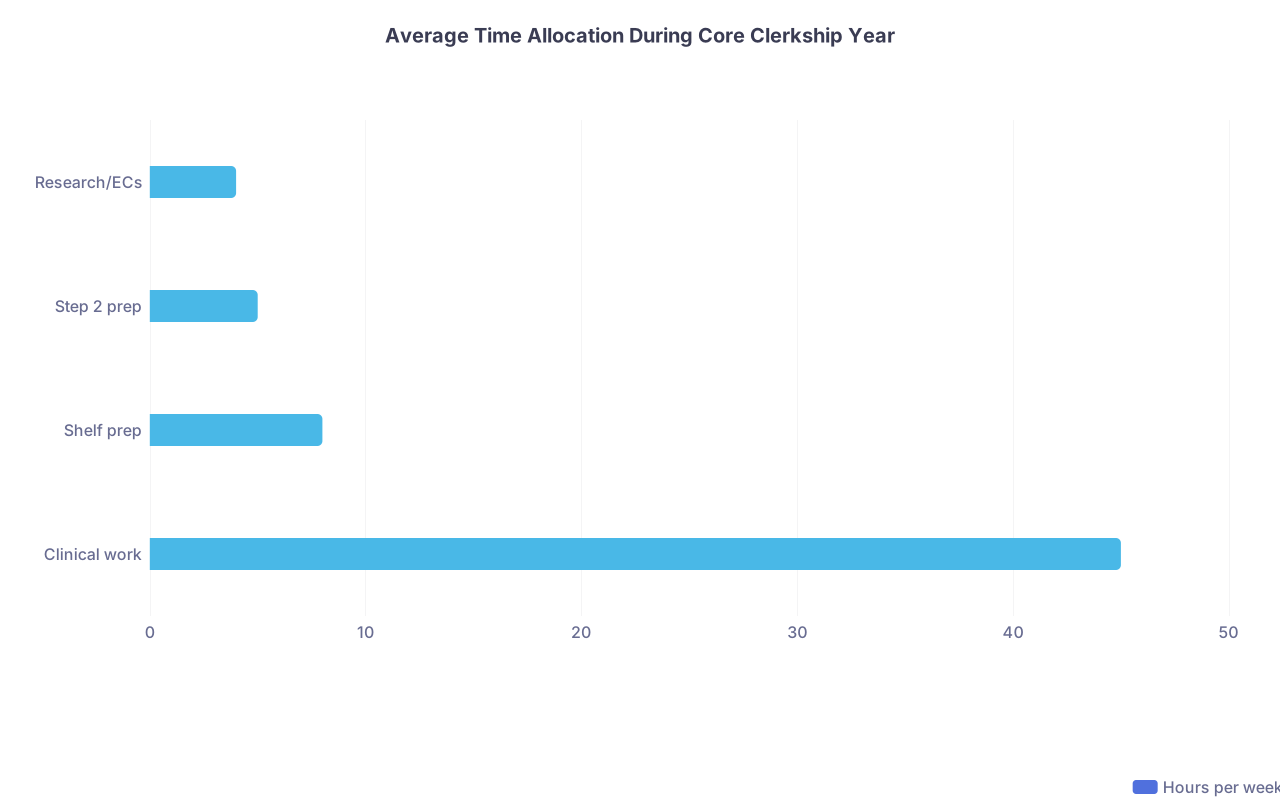
This is where careers are made or capped now. Program directors actually read your clinical evaluations. And they absolutely care about Step 2 CK.
| Category | Hours per week |
|---|---|
| Clinical work | 45 |
| Shelf prep | 8 |
| Step 2 prep | 5 |
| Research/ECs | 4 |
Before First Clerkship Starts (Gap Between MS2 and MS3)
At this point you should:
- Know your clerkship order.
- Have a Step 2 CK test window in your head (e.g., “late June after IM + Surgery”).
Actions:
- Quick pass through high–yield Step 2 resources (e.g., OnlineMedEd, AMBOSS, UWorld Step 2 CK starting slowly).
- Set a default routine:
- X questions per day
- Dedicated shelf resource per rotation (e.g., Case Files, UWorld blocks, NBME practice into last 2 weeks).
Each Core Clerkship: Month-by-Month Structure
Week 0–1 of Each Rotation
At this point you should:
- Learn the culture and expectations fast.
- Establish yourself as competent and low-drama.
Actions:
- Ask seniors: “What does an honors student look like on this service?”
- Write basic templates (H&P, progress notes) and get feedback early.
- Show up prepared, no excuses. Your first few days set your reputation.
Week 2–3: Turn into the “Go-To” MS3 on Service
Your goals:
- Be the student interns trust with work.
- Avoid stupid errors (not following up labs, not calling consults correctly).
Actions:
- Volunteer for extra tasks within reason:
- “I can draft that discharge summary.”
- “I will call radiology and clarify the protocol.”
- Keep a running patient list and to-do list; update it obsessively.
- Shelf prep: 10–15 questions per weekday, 20–40 on weekends.
Week 4–Last Week: Shelf Push + Letter Positioning
At this point you should:
- Maximize your shelf exam score.
- Identify which attendings could write strong letters.
Actions:
- Last 2 weeks: increase question volume; use at least 1 NBME practice shelf if available.
- If you clicked with an attending:
- Ask: “Could I follow up with you at the end of the year about a residency letter if my performance continues strong?”
- This plants the seed without forcing a decision right then.
Step 2 CK Timing and Strategy
Most students do best with Step 2 CK:
- After IM, Surgery, and at least one of OB/GYN or Peds.
- During a 4–6 week lighter block or study period.
At this point you should:
- Treat Step 2 CK as your single most important exam number.
- Aim to outperform your perceived class rank.
Actions:
- UWorld Step 2 CK: aim to complete the QBank once, with serious review.
- NBME + UWSA practice tests: 3–4 total spaced over the last 6–8 weeks.
- Pattern–fix in weak areas (OB, peds, psych, biostats).
Your Step 2 CK score is now one of the most powerful levers you control for how competitive you look on ERAS.
End of MS3: Clean Up and Aim at MS4
At this point you should:
- Have a realistic target list of specialties and programs (based on performance, letters, Step 2).
- Know which home attendings you want letters from.
Actions:
- Meet 1:1 with a specialty advisor. Show them:
- Step 2 CK score
- Clerkship grades
- Research output
- Intended programs (stretch / realistic / safety tiers)
- Ask them bluntly: “Where would you personally apply with this profile?”
MS4: Sub–Is, Away Rotations, and Converting to a Strong Application
This year is about proving you are the person they can trust as an intern.
April–June of MS3 (Planning MS4): Build the MS4 Skeleton
At this point you should:
- Plan your MS4 schedule around:
- Sub–Is in your specialty of choice
- Maybe 1 away rotation (for competitive fields)
- Time for ERAS, interviews, and a fallback plan if needed
Actions:
- For competitive specialties:
- Schedule one home sub–I early (July/August)
- One away rotation if your school and finances allow
- For most IM/FM/Peds/Neuro path:
- One home sub–I in that specialty
- One sub–I in a related field (e.g., cards consults for IM–interested student)
Early MS4: Performance on Sub–Internships
On sub–Is, you are being judged almost like an intern. The comments from these rotations end up in MSPE and letters.
At this point you should:
- Show you can function at intern level with supervision.
- Be proactive about feedback.
Actions:
- Day 1: ask residents what the best sub–I they have seen acted like. Then copy that.
- Anticipate needs: write orders (if allowed), pre–chart, have plans ready before rounds.
- Ask mid–rotation: “How can I be more helpful to the team?” Then actually change based on the answer.
ERAS Season: Packaging the Four Years
Your ERAS application is a reflection of thousands of small decisions. You want a clear story, not random scatter.
Key elements you should have by ERAS submission:
- Strong Step 2 CK score (for your target field).
- Consistently solid clerkship evaluations with honors in key rotations.
- 2–3 strong letters in your chosen specialty.
- 1–2 pieces of meaningful research or long–term involvement (maybe more for ultra–competitive fields).
- A coherent personal statement that connects the dots.
How the Whole Roadmap Fits Together
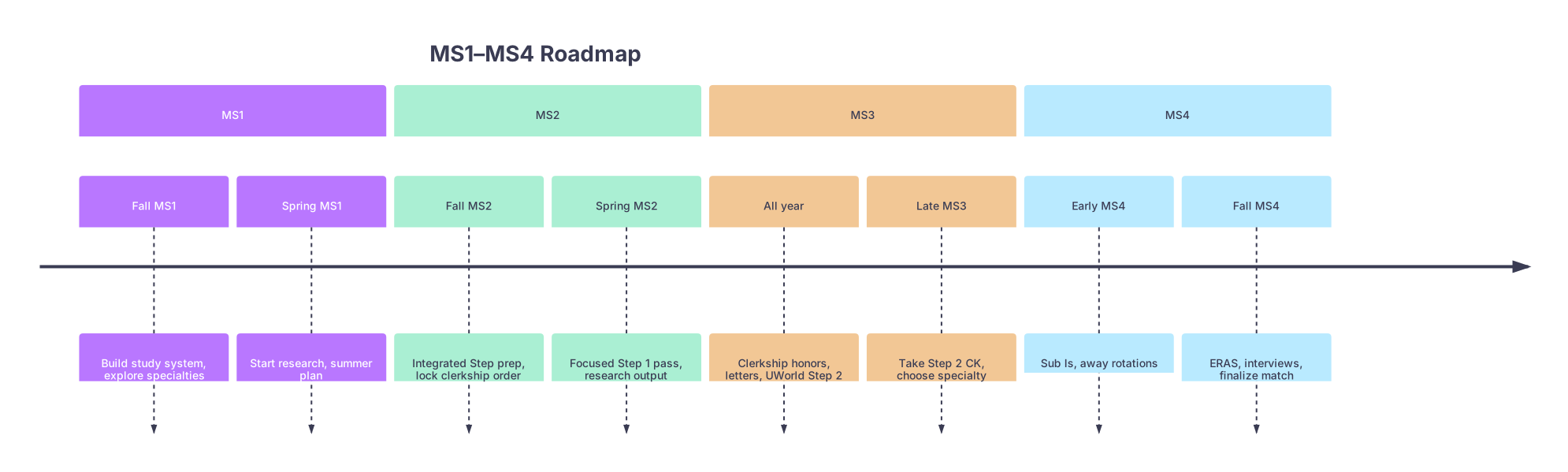
Here is the condensed timeline of leverage points:
| Period | Event |
|---|---|
| MS1 - Fall MS1 | Build study system, explore specialties |
| MS1 - Spring MS1 | Start research, summer plan |
| MS2 - Fall MS2 | Integrated Step prep, lock clerkship order |
| MS2 - Spring MS2 | Focused Step 1 pass, research output |
| MS3 - All year | Clerkship honors, letters, UWorld Step 2 |
| MS3 - Late MS3 | Take Step 2 CK, choose specialty |
| MS4 - Early MS4 | Sub Is, away rotations |
| MS4 - Fall MS4 | ERAS, interviews, finalize match |
Two Hard Truths and One Advantage
I will end bluntly.
Step 1 pass/fail did not remove competition. It moved it.
- Now it is in clerkship grades, Step 2 CK, and letters. You cannot cram those last minute.
Mediocre clinical performance is harder to hide than a bad test score.
- You can explain one rough exam. You cannot explain two years of “quietly disengaged” evaluations.
Your advantage is time.
- If you are reading this as MS1 or early MS2, you can still stack all the right dominoes.
Focus on:
- Using MS1–MS2 to quietly build foundations and relationships.
- Treating MS3 as your real “audition year” and Step 2 CK as your flagship number.
- Using MS4 to prove you are already operating at intern level.
Do that, and you will stand out in the Step 1 pass/fail generation without needing any miracle. Just deliberate moves at the right points in the timeline.