
The panic over losing Step 1 scores is wildly overstated—and dangerously misdirected.
Program directors did not suddenly stop caring about academics. They simply lost one blunt tool and will now dig harder into everything else you have done. If you do not control that story, they will invent one for you. That is how people with perfectly good records get quietly screened out.
This is fixable.
You need an academic narrative that says, clearly and credibly: “I can handle a demanding residency and your board pass rates are safe with me.” Here is how to build that story when you do not have (or do not want to highlight) a Step 1 score.
1. Understand What “No Step 1 Score” Signals To Programs
Let me translate the quiet part program directors often say out loud in closed meetings.
When they see no Step 1 score (or a bare “Pass”), their brain runs a quick diagnostic:
- Is this applicant academically safe?
- Will this person pass in‑training exams and boards?
- Are they hiding a fail?
- If I rank them, do I worry about remediation, extensions, or PR issues?
They are not sentimental about USMLE. They are anxious about:
- Board pass rates (publicly reported, affects recruitment)
- Remediation workload
- Night float coverage when someone is out repeating exams
- Whether this person can learn independently without hand‑holding
Your job is to feed them hard evidence that answers all four fears.
So stop hand‑wringing about “no numeric Step 1” and start treating your application like a risk‑reduction dossier. Every academic data point either:
- Lowers their anxiety, or
- Leaves a gap that their imagination fills in (never in your favor)
We are going to fill those gaps on purpose.
2. Build Your Core Academic “Safety Signals”
If Step 1 is pass/fail or missing, your other academic signals must be unmistakably solid. You need multiple lines of evidence pointing in the same direction.
Here is your checklist.
A. Step 2 CK: The New Gatekeeper
Step 2 CK is no longer “secondary.” It is your primary standardized metric.
You want your application to scream one of these messages:
- Safely above average for your specialty
- Clear upward trend from any earlier struggles
- In range and supported by strong clinical performance
If you have not taken Step 2 CK yet, your priority list is very short:
Schedule Step 2 CK early enough
Around June–August of the application year is ideal so programs see it early.Treat it as your flagship score
- Dedicated study period, not “when I have time between rotations”
- At least 3–4 NBME practice exams + UWSA usage
- Target: at or above your specialty’s typical match range, but more importantly, above your own school’s median
Document your improvement
Keep a simple record of practice scores to show trend if needed in an advisor letter or personal statement.
If Step 2 CK is already done and mediocre, do not panic. You double down on:
- Clerkship honors
- Shelf exam performance
- Clear upward trend from preclinical to clinical
We will get to spin strategy in a bit.
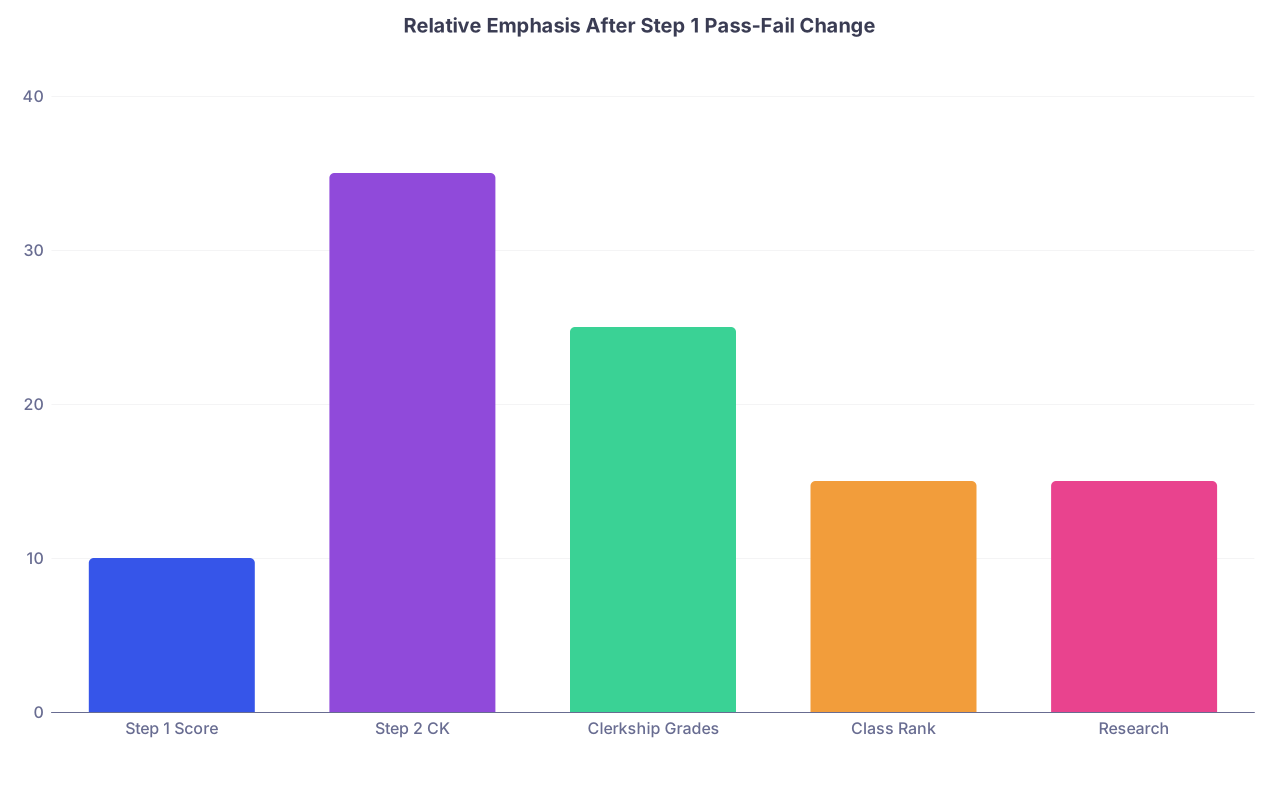
| Category | Value |
|---|---|
| Step 1 Score | 10 |
| Step 2 CK | 35 |
| Clerkship Grades | 25 |
| Class Rank | 15 |
| Research | 15 |
B. Clerkship Performance: Your Real‑World Transcript
Program directors trust how you perform on the wards more than how you did in a preclinical multiple‑choice bubble.
You want your MS3–MS4 transcript to show:
- Consistent Honors/High Pass in core rotations
- Strong performance in specialties adjacent to your target (e.g., IM + Surgery for EM applicants)
If your school does not give honors, then you rely on:
- Narrative evaluations
- Class quartiles
- Comments about “among the top students I have worked with this year”
Two tactical moves:
Mine your evaluations for academic language
Look for phrases like:- “Quickly mastered complex topics…”
- “Needed minimal supervision with new material…”
- “Excellent fund of knowledge for level of training…”
You will reuse these in your personal statement and LOR talking points.
Ask for letters from rotations where your learning curve was obvious
Not just where you were liked. Where you visibly grew and handled complexity.
C. Preclinical Performance and Trends
With no Step 1 number, schools and programs peek more at:
- Preclinical grades (especially in systems‑based courses)
- Any remediation, repeats, or professionalism flags
If you had early struggles, your story must be: “I fixed the problem and the data proves it.”
Acceptable narrative:
- First semester: borderline passes or a fail
- Later semesters: strong passes or honors
- Clinical year: solid performance, stronger Step 2 CK
Unacceptable narrative:
- Ongoing inconsistency with no clear turning point or explanation
You cannot rewrite your transcript, but you can structure how others interpret it. That is the entire point of a narrative.
3. Design Your Academic Narrative in One Sentence
You need one clean sentence that explains your academic story. Everything else hangs off this.
Examples:
- “My record shows a clear upward trajectory from an uneven preclinical start to strong performance in clinical rotations and Step 2 CK.”
- “I have consistently performed at the top of my class in clinically oriented assessments, which I believe better reflect my current readiness for residency.”
- “While my early coursework was average, my clinical grades and Step 2 CK demonstrate the level I function at now.”
Pick one template. Make it true. Then support it with evidence.
This becomes the backbone for:
- Personal statement paragraph on academics
- MSPE “Noteworthy Characteristics” language (if your dean is open to your input)
- Talking points for letter writers
- How you answer “Any academic challenges?” on interviews
If you skip this step, you will end up with scattered facts and no cohesive story. Program directors hate that. It feels risky.
4. Addressing a Step 1 Pass, Fail, or Missing Score
There are three main situations.
Scenario 1: Step 1 Pass, No Numeric Score (Most Current Students)
Your tasks:
Stop apologizing for the system change. You did not pick pass/fail. Programs know this.
Center Step 2 CK and clinical performance as your “board‑relevant” proof.
Use language that reframes the test landscape, for example:
“With Step 1 now pass/fail, my Step 2 CK and clerkship performance are the best reflections of my current medical knowledge and readiness.”
You do not write paragraphs explaining that Step 1 is pass/fail. Everyone knows. You just redirect their attention to the strongest metrics you have.
Scenario 2: Step 1 Fail → Pass (Legacy Cohort or IMGs)
This needs a clean, confident explanation. Not excuses. Not drama.
Your written narrative (one paragraph, max) should:
Acknowledge the fact
“I failed Step 1 on my first attempt due to [brief, factual reason].”Show concrete change
- Changed study method (question‑heavy vs passive reading)
- Sought help (learning specialist, tutoring, schedule adjustments)
- Adjusted life factors (health, hours, environment)
Point to results
- Passed Step 1 on second attempt
- Stronger performance in clinical courses
- Solid Step 2 CK
Bad version:
“USMLE Step 1 has always been challenging for me and I was going through a lot at the time.”
Good version:
“I underperformed on my first Step 1 attempt because I relied too heavily on passive review and left too little time for practice questions. After working with our learning specialist, restructuring my study schedule, and taking accountability for my process, I passed on my second attempt and have since achieved strong clinical grades and a Step 2 CK score of 24X.”
Own it. Show the correction. Move on.
Scenario 3: No Step 1 Attempt (Some IMGs or Unusual Paths)
You must head off the suspicion that you are avoiding the test because you cannot pass it.
You need:
- A timeline explanation (licensing path, country requirements, or curriculum)
- A plan (or completed Step 2 CK) that demonstrates equivalent rigor
For example:
“In my home country, USMLE Step 1 is not required for graduation, so I focused my efforts on clinical training and Step 2 CK, which I have completed with a score of 25X as part of my preparation for US residency.”
Then back it with strong clinical evaluations and letters that emphasize complexity and autonomy.
5. Converting Raw Data Into a Coherent Academic Story
Here is the mistake I see over and over: students recite their metrics like a resume, not a story.
You need to curate.
Step 1: Inventory Your Academic Evidence
Make a quick table for yourself:
| Category | Strong / Weak / Mixed | Notes |
|---|---|---|
| Step 1 | Pass / Fail / NA | |
| Step 2 CK | Strong / Weak / Mixed | |
| Preclinical grades | Strong / Weak / Mixed | |
| Clerkships | Strong / Weak / Mixed | |
| Shelf exams | Strong / Weak / Mixed | |
| Class rank/quartile | Strong / Weak / Mixed |
Be brutally honest. No wishful thinking.
Step 2: Pick Your “Anchor Data”
Choose 2–3 pieces of evidence that best support your one‑sentence narrative from Section 3.
Examples:
- Strong Step 2 CK + Honors in Medicine + Honors in Surgery
- Rising shelf scores across the year + strong NBME/COMAT trend
- Excellent class rank + strong narrative comments about knowledge
These become the anchor points you repeat across your application.
Step 3: Rewrite Experiences to Highlight Learning Capacity
In your experiences section (ERAS, etc.), do not just say what you did. Show how you learn and apply knowledge.
Bad entry:
“Assisted with patient care on a busy internal medicine ward. Wrote notes and presented on rounds.”
Good entry:
“Functioned as primary student on a high‑acuity internal medicine service, rapidly integrating new guideline‑based management plans and presenting concise assessments on rounds. Preceptor described my growth curve as ‘exceptional’ in end‑of‑rotation evaluation.”
Same job. Different academic signal.
You want repeated cues that say:
- Fast learner
- Integrates feedback
- Handles complexity
- Functions above training level
6. Use Your Personal Statement To Pre‑Empty Doubts (Without Whining)
Your personal statement is not primarily for your life story. It is a control document. Use a small but deliberate slice of it to lock in your academic narrative.
Template for a tight academic paragraph:
“The shift to a pass‑fail Step 1 era means my clinical performance and Step 2 CK are the best reflections of how I will function as a resident. I have consistently sought out high‑acuity rotations, earning Honors in Internal Medicine and Surgery, and scored 25X on Step 2 CK. I am the kind of learner who thrives when knowledge is tested in real patient care, and that is reflected throughout my MS3 and MS4 years.”
Notice what this does:
- Acknowledges the reality (Step 1 pass/fail) once, then moves on
- Points their eyes directly at your strongest metrics
- Connects test performance to how you work, not just how you bubble
If you must address a bump (Step 1 fail, weak early grades), keep it to 2–3 sentences max:
- What happened
- What you changed
- How you are performing now
Then get back to your strengths.
7. Arm Your Letter Writers With the Right Talking Points
Letters of recommendation can rescue a suspect academic record—or quietly confirm it.
Do the work for your letter writers. Send them a one‑page bullets sheet with:
- 2–3 clinical examples where you handled complex knowledge or multi‑problem patients
- Any tangible metrics (highest shelf in the block, above‑average performance, etc.)
- One line about your overall academic trajectory
For instance:
“If appropriate, I would appreciate any mention that:
- I learned quickly and required less supervision by the end of the rotation
- I handled complex patients safely (e.g., Mr. S. with cirrhosis + sepsis)
- My performance was in the top group of students you have worked with recently.”
You are not scripting their letter. You are reminding them what mattered. Most attendings will be grateful you made their job easier.
8. Leverage the MSPE / Dean’s Letter
The MSPE is the one document almost every program director actually reads carefully. This is where your academic story either coheres or falls apart.
You have more influence here than you think.
What you can usually influence:
- Noteworthy Characteristics section (often drafted with your input)
- Which rotations and comments are highlighted
- Whether key improvements are explicitly mentioned
Your move:
- Meet with your dean or student affairs office early.
- Bring your one‑sentence academic narrative and 2–3 anchor data points.
- Ask directly:
“Programs will not see a numeric Step 1 score. I want them to understand that my clinical performance and Step 2 CK demonstrate I am academically safe. Can we highlight X, Y, and Z so that is clear?”
Be specific. Deans are political, but they are not mind readers. If they agree with your framing and it is honest, they will usually support it.

| Step | Description |
|---|---|
| Step 1 | Inventory Academic Data |
| Step 2 | Define One Sentence Narrative |
| Step 3 | Select Anchor Evidence |
| Step 4 | Shape Personal Statement |
| Step 5 | Guide Letter Writers |
| Step 6 | Discuss MSPE Emphasis |
| Step 7 | Consistent Interview Answers |
9. On Interviews: How To Talk About a Missing or Weak Step 1
You will face some version of: “Tell me about your academic performance” or “Any challenges along the way?”
You must be ready with a compressed, confident script.
For a straightforward “no score / pass” situation
“With Step 1 now pass/fail, I focused on demonstrating my readiness through clinical performance and Step 2 CK. I earned Honors in Medicine and Surgery and scored 25X on Step 2 CK, and I felt that reflected well how I will function as a resident—strong knowledge base and able to apply it under pressure.”
Then stop talking. Let them ask a follow‑up if they care.
For a prior fail or early academic issue
Use a tight “3‑step” structure: Fact → Fix → Proof.
“I failed Step 1 on my first attempt. I realized my study approach relied too much on passive resources and not enough on timed practice, so I worked with our learning specialist to rebuild my strategy from the ground up. Since then, I passed Step 1 on my second attempt, honored my main clerkships, and scored 24X on Step 2 CK, which I think better reflects where I am now.”
No self‑flagellation. No long backstory about your roommate or the pandemic. Programs care about whether you learned to self‑correct.
10. Specialty‑Specific Reality Check
Not all fields weigh these issues the same. Some are blunt about it.
Here is a rough snapshot of how “no Step 1 number” shifts emphasis:
| Specialty | Step 2 CK Weight | Clinical Grades Weight | Research Weight |
|---|---|---|---|
| Internal Med | High | High | Medium |
| General Surgery | Very High | Very High | Medium |
| Pediatrics | Medium | High | Low-Medium |
| Radiology | Very High | Medium | High |
| Dermatology | Very High | Medium | Very High |
If you are aiming at a hyper‑competitive field (derm, plastics, ortho, ENT, ophtho), understand this:
- A stellar Step 2 CK often becomes non‑negotiable.
- Research productivity starts doing even more of the talking.
- Letters that call you “one of the best students I have worked with” matter more.
You cannot change that reality. You can only decide whether to:
- Double down and optimize every other part of the file, or
- Target slightly less competitive but still fulfilling specialties where your current profile is a better fit
I have watched very smart students waste years chasing a specialty that never had realistic odds. Do not be that case.
11. A Concrete 30‑Day Plan To Tighten Your Academic Narrative
If you want something you can actually do now, follow this:
Week 1: Assess and Decide
- Pull your full transcript, NBME scores, and current CV.
- Write your one‑sentence academic narrative.
- Identify your 2–3 anchor data points.
- Book a meeting with a faculty advisor or dean to sanity‑check your framing.
Week 2: Rewrite and Reframe
- Revise your personal statement to include a tight academic paragraph.
- Edit experience descriptions to highlight learning capacity and complexity.
- Draft a one‑page bullet sheet for letter writers.
Week 3: Coordinate and Clarify
- Email letter writers with your bullet sheet and CV.
- Meet with student affairs/MSPE writer; discuss specific language and rotations to highlight.
- If Step 2 CK is pending, lock in a study schedule based on current NBME data.
Week 4: Practice the Script
- Write out answers to:
- “Tell me about your academic performance.”
- “Any academic challenges you had to overcome?”
- Do 2–3 mock interviews (even with peers) focusing only on these questions.
- Adjust wording until you can say your narrative in under 60 seconds without rambling.
By the end of 30 days, you will not have changed a single grade. But you will have changed how those grades land in the mind of every reviewer. That is the entire game.