
You are sitting at your desk staring at ERAS. There is no Step 1 three‑digit score to hang your hat on. Just a “Pass.” Your friends two years ahead still talk about “my 251” or “my 228” like some kind of social currency. You are wondering what your application is even about now.
Here is the reality: in the pass/fail era, your CV is no longer background noise. It is the story. If you get this wrong, you disappear into the middle of the pile. If you get it right, you look like someone they need to interview.
I am going to walk you through how to build and shape a CV that actually pulls weight when Step 1 is off the table. Not theory. A practical blueprint.
1. Understand the New Scoring System: Your CV Is Now “Step 1”
Let me be blunt: Program directors still need a way to rank risk. Step 1 going pass/fail did not suddenly make them all “holistic saints.” They just shifted weight elsewhere.
Here is where your value signal now lives:
- Step 2 CK score
- Clerkship grades / class rank
- Research output
- Letters of recommendation
- Institutional reputation
- Concrete achievements (leadership, QI, teaching)
They use your CV to infer three things:
- Are you reliable and hardworking?
- Can you function on a real team and move projects forward?
- Do you have any actual impact or just titles and fluff?
The good news: you can engineer your CV to scream “yes” on all three.
/Service](https://cdn.residencyadvisor.com/images/articles_svg/chart-rough-weighting-of-key-factors-in-the-step-1-pass--7120.svg "Rough Weighting of Key Factors in the Step 1 Pass/Fail Era")
| Category | Value |
|---|---|
| Step 2 CK | 30 |
| Clerkships/Class Rank | 25 |
| Research & Scholarly Work | 20 |
| Letters & Reputation | 15 |
| [Leadership](https://residencyadvisor.com/resources/step1-pass-fail-era/building-a-safety-net-profile-for-competitive-fields-without-step-1)/Service | 10 |
Do not obsess over exact percentages. The point is simple: your CV content and framing now carry far more influence than they did when a 260 could bulldoze everything else.
2. Core CV Structure That Works in the Pass/Fail Era
You do not need to reinvent formatting. You do need to stop using generic, bloated templates.
Here is a structure that works for almost every specialty:
- Header
- Education
- USMLE / Licensing Exams
- Clinical Experience (Clerkships and Sub‑Is)
- Research & Scholarly Activity
- Leadership & Service
- Teaching & Mentoring
- Quality Improvement & Systems Projects
- Awards & Honors
- Skills (brief, targeted)
Now, where Step 1 used to be the shining number, your Research, Leadership, and Clinical sections must pull that weight.
Non‑negotiable formatting rules
- One font. One size range. Clean hierarchy.
- Reverse chronological order in each section.
- No blocks of dense text under bullets. 1–2 lines, max.
- Stop listing irrelevant stuff (high school awards, random hobbies disguised as leadership).
Your CV should read like a highlight reel, not a diary.
3. Turn “Random Activities” Into High‑Impact CV Entries
Most students dramatically under‑sell what they have done. Or worse, they list roles with no evidence of actual contribution.
The fix: convert positions into impact‑focused bullets.
Use this structure:
[Action verb] + [what you did] + [scale/scope] + [tangible outcome]
Example transformation:
Weak:
“Member, Surgery Interest Group”Strong:
“Coordinated 3‑session suturing workshop series for 40+ preclinical students, increasing skills self‑confidence scores by 35% on pre/post surveys.”
See the difference. Same role. Different value.
Apply this across your entire CV.
4. Step 2 CK and Clerkships: The New Academic Spine
Your Step 2 CK and clinical performance now serve as your academic backbone. Your CV should support and echo that.
Align CV with Step 2 and clerkships
If you have:
Strong Step 2 CK and strong clinical grades
→ Use CV to reinforce: “I perform when it counts.”- Under Clinical Experience: highlight honors, teaching roles on rotations, specific commendations.
- Under Research/QI: emphasize projects tied to patient care, guidelines, clinical pathways.
Average Step 2 CK but strong clinical grades
→ Sell yourself as the reliable, high-functioning clinician.- Highlight narrative comments (e.g., “consistently functioned at intern level” – paraphrased, not quoted).
- Emphasize team‑based projects, QI work, multidisciplinary committees.
Average clinical grades but strong Step 2 CK
→ CV must show discipline and delayed payoff.- Highlight longitudinal projects, exam‑heavy achievements, self‑directed learning initiatives.
Whatever your pattern, your CV and exams must tell a coherent story. No contradictions.
5. Research: From Zero to Interview Magnet
In the Step 1 pass/fail era, research is no longer just for “academic types.” It is a major differentiator, especially for competitive specialties.
Here is the uncomfortable truth: weak research sections are usually not a lack of opportunity. They are a lack of strategy and follow‑through.
Build a research engine in 6–12 months
If your research section is currently empty or anemic, use this approach.
Step 1: Pick a lane
Choose 1–2 focus areas. Example:
- Internal medicine → heart failure, medical education
- Orthopedics → sports injuries, outcomes research
- Psychiatry → early intervention, addiction
Scattershot topics look unfocused. Depth looks intentional.
Step 2: Get on projects fast
Stop emailing generic “I am interested in your work” messages. Instead:
- Read 1–2 recent papers by a faculty member.
- Email something like:
I read your 2023 paper on [topic] and noticed your group is using [method]. I have basic experience with [data tool / chart review / lit review] and would be glad to help with [very specific task] on any ongoing projects.
Make it easy for them to plug you in.
Step 3: Aim for multiple small wins, not one giant paper
You want volume plus variety of output types, not just one “maybe‑someday” RCT.
Categories you should target:
- Abstracts → regional, national conferences
- Posters → local research days, specialty meetings
- Case reports → especially if you are short on time
- Narrative reviews / brief reports
- Database / retrospective/chart review projects
| Output Type | Difficulty | Time to Completion | CV Impact |
|---|---|---|---|
| Case Report | Low | 1–3 months | Moderate |
| Poster Abstract | Medium | 3–6 months | High |
| Oral Presentation | Medium | 4–8 months | Very High |
| Retrospective Study | High | 6–12+ months | Very High |
| Review Article | Medium | 4–8 months | High |
Step 4: Write research bullets correctly
Again, impact first.
Weak:
“Assisted with data collection on heart failure readmissions.”Strong:
“Collected and cleaned EHR data for 280+ heart failure admissions to analyze 30‑day readmission predictors; abstract accepted to 2025 ACC regional meeting.”
You want:
- Sample size or scale
- Method or role (data analysis, first author, presenting author)
- Concrete outcome (submitted, accepted, presented, published)
6. Leadership and Service: Stop Listing Titles, Start Showing Leverage
Program directors are good at spotting hollow leadership. “President of 7 clubs” is a red flag, not a flex.
What actually matters:
- Did you build anything?
- Did you improve a process or experience?
- Did you affect more than a handful of people?
Rebuild your leadership section around outcomes
Take a standard line:
- “Vice President, Internal Medicine Interest Group”
Turn it into this:
- “Co‑led 8‑session career development series for ~120 preclinical students, coordinating 24 faculty speakers and doubling event attendance compared with prior year.”
Or:
- “Designed and implemented a structured near‑peer mentorship program pairing 45 M1s with 30 M3–M4 mentors; 92% of participants reported increased preparedness for clerkships.”
Notice:
- Concrete numbers
- Before/after or comparative impact
- Clear role (designed, implemented, coordinated, led)
7. Teaching, Mentoring, and QI: The Underused Power Trio
These three categories quietly separate mature applicants from the pack.
Teaching & Mentoring
If you have done any of the following, they belong on your CV:
- TA for anatomy, physiology, OSCEs
- Peer tutor (formal or structured informal)
- Workshop leader (suturing, ultrasound, note‑writing)
- Curriculum committee student rep with actual input
Again, specifics:
- “Facilitated weekly small‑group anatomy review for 20 first‑year students, creating 10+ original practice quizzes; 85% of attendees passed remediation exams.”
Quality Improvement and Systems Projects
If you want to signal “future attending who will fix our broken workflow,” this is where you do it.
Examples of strong QI entries:
“Co‑led a QI project to reduce unnecessary daily labs on a general medicine service, decreasing redundant CBC orders by 28% over 4 months.”
“Developed a standardized discharge checklist for CHF admissions; pilot implementation associated with 12% absolute reduction in 30‑day readmissions over 3 months.”
These bullets do not require randomized trials. They require:
- A clear problem
- A specific intervention
- A measurable outcome
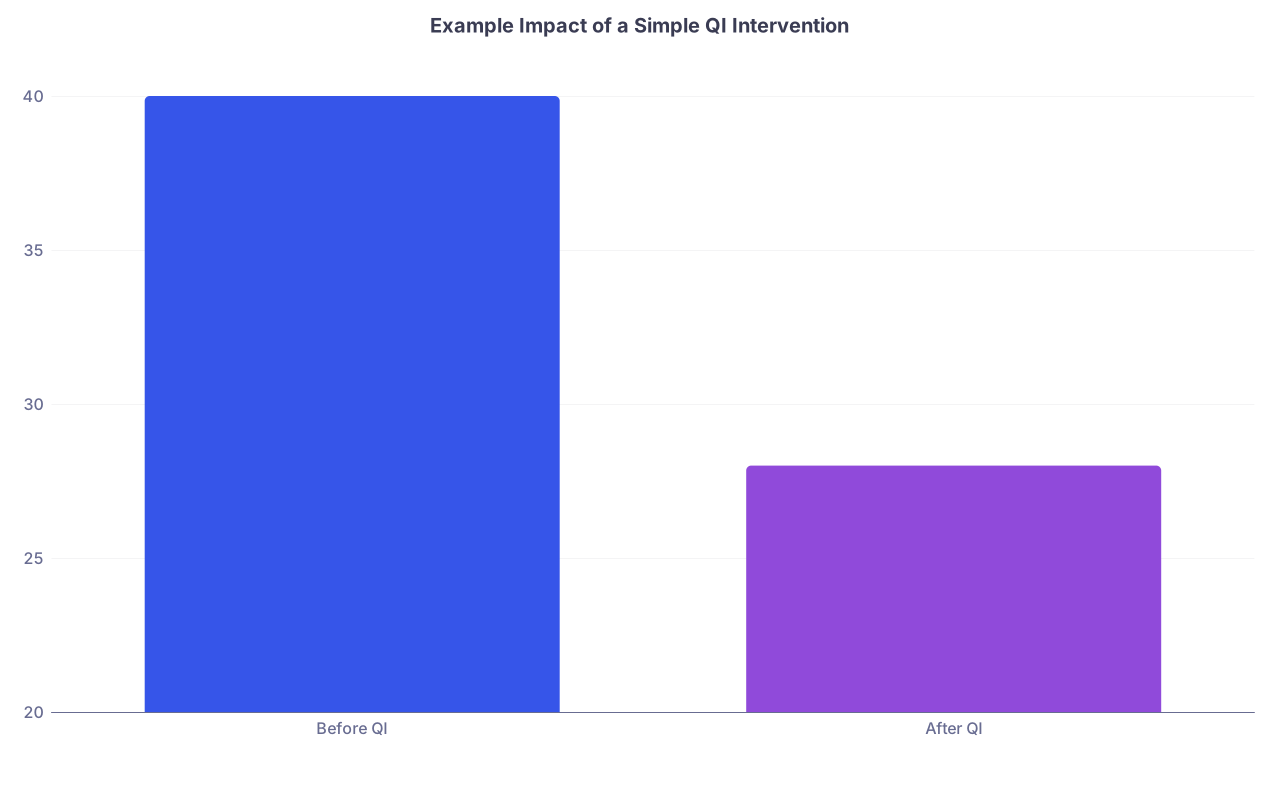
| Category | Value |
|---|---|
| Before QI | 40 |
| After QI | 28 |
(Example: number of redundant CBC orders per 100 admissions.)
8. Crafting a Specialty‑Targeted CV Without Lying
One of the dumbest mistakes I see: students using one generic CV for everything. If you are applying to neurology and psychiatry prelims and IM backups with the same exact emphasis, you are leaving a lot of points on the table.
You do not change facts. You adjust emphasis and ordering.
Example: Same student, two CV emphases
You are an MS4 with:
- 3 neurology abstracts
- 1 medical education project
- Some general IM QI work
- Tutoring and mentorship
For neurology:
- Move Research – Neurology above general research.
- Lead with neuro‑related abstracts, talks, and posters.
- Under leadership/service, emphasize neurology interest group work and stroke awareness volunteering.
For categorical IM (backup):
- Put “Clinical Experience” and “QI projects” higher.
- Highlight general medicine QI, hospitalist shadowing, inpatient research.
- Neuro stuff still there, but not front‑loaded.
The reader should be able to skim your CV and say within 10 seconds, “This person is oriented toward [specialty].”
9. Clean Up the Noise: What to Cut or Downplay
Your CV is not an archive. It is a weapon. Time to strip it down.
What to cut or minimize:
- High school anything (unless it is an international olympiad or equivalent top‑tier distinction)
- Unrelated small jobs (lifeguard, random part‑time roles) unless you can argue clear relevance
- One‑off volunteer events with no sustained engagement
- Generic “member” roles with zero impact or specificity
Convert “fluff” into one consolidated line if needed:
- “Various one‑day community outreach events, including health fairs and vaccine drives (2019–2023).”
Do not stack 9 separate bullets saying “Volunteer, Health Fair.”
10. Visual and Structural Details That Quietly Matter
No one will compliment you for good formatting. But they will silently punish you for bad.
Here is the minimum standard:
- Consistent date format (e.g., “Aug 2022 – May 2023” everywhere).
- Use either italics or bold for positions/roles, not both randomly.
- City, State for each institution. One line. Not three.
- Do not use tables or creative columns that break when PDF’d.
- 1–2 pages for med students. Three only if you have legitimate, substantial research output (and even then, trim hard).
And for the love of clarity: no colored fonts, no graphics, no headshots in the CV file.

11. How to Generate Real Content Fast If You Feel “Behind”
If you are reading this and thinking, “My CV is thin and I graduate in a year,” you are not doomed. But you do need a sprint plan.
Here is a 6–9 month aggressive build‑out strategy.
Month 1–2: Foundation and Commitments
- Meet with 2–3 research‑active faculty in your target specialty.
- Join 2 ongoing projects where you can realistically contribute quickly (data collection, chart review, lit review).
- Commit to 1 teaching/mentoring role (peer tutor, exam review, near‑peer OSCE coach).
- Identify 1 QI idea on a rotation and pitch it to a willing resident or faculty member.
Month 3–5: Convert Work to Output
- Push at least 1 abstract submission.
- Draft at least 1 case report or short report.
- Formalize your QI project (use PDSA cycles, simple measures).
- Run or co‑run at least 1 structured workshop or small group.
Month 6–9: Stack and Polish
- Present at a local/regional meeting if accepted.
- Get your name on 2–3 submissions (abstracts, posters, short papers).
- Collect concrete data for QI and teaching roles (attendance numbers, pre/post, etc.).
- Update your CV monthly; refine bullets for impact.
No, this will not magically give you a fellowship‑level portfolio. But it will transform a “meh” CV into one that looks intentional and upward‑trending.
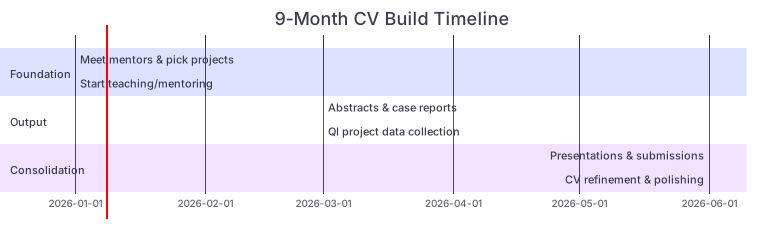
| Task | Details |
|---|---|
| Foundation: Meet mentors & pick projects | a1, 2026-01, 2m |
| Foundation: Start teaching/mentoring | a2, 2026-01, 2m |
| Output: Abstracts & case reports | b1, 2026-03, 3m |
| Output: QI project data collection | b2, 2026-03, 4m |
| Consolidation: Presentations & submissions | c1, 2026-06, 3m |
| Consolidation: CV refinement & polishing | c2, 2026-06, 3m |
12. Put It All Together: A CV That Replaces the Old Step 1 Signal
Here is what a high‑impact CV in the Step 1 pass/fail era actually signals to a program director:
Reliability
Longitudinal involvement, sustained commitments, follow‑through to completion (submissions, presentations, QI outcomes).Curiosity and initiative
Research that pushes beyond the minimum, leadership that built or improved something real.Clinical readiness
Strong clinical narrative across clerkships, QI tied to patient care, teaching peers on core topics.Fit for their specialty
Coherent focus in research, leadership, service, and electives that match their field.
That is what Step 1 used to give them in shorthand. Now your CV has to carry that load. If you design it deliberately, it can.

13. Concrete Next Step: Fix One Section Today
Do this right now. Not tomorrow.
- Open your current CV.
- Pick one section:
- Research
- Leadership
- Teaching
- QI
- For that section:
- Delete or compress one low‑yield line.
- Rewrite 3 bullets using the formula:
Action verb + what you did + scale/scope + tangible outcome. - Add one specific metric (number of people, percentage change, timeframe) to at least one bullet.
Save it as a new file: Lastname_CV_highimpact_draft1.pdf.
Next week, repeat with another section. Within a month, your CV will not look like the same person wrote it.