
The idea that “Step 2 CK is the new Step 1” is wrong—but not for the reason most people think.
Step 2 CK has not quietly replaced Step 1 as a 1:1 clone. What has happened is more subtle, and honestly, more dangerous: programs are trying to use Step 2 CK to fill the precision hole left by Step 1 going pass/fail, but the tool they are reaching for is noisier, later, and less standardized than the old Step 1 ecosystem.
Let me walk through what the early data actually shows, not the rumors bouncing around Reddit and resident workrooms.
What Changed When Step 1 Went Pass/Fail
Before we talk Step 2, you need to be brutally clear on what Step 1 used to be.
For about 20 years, Step 1 was:
- Massively over-weighted
- Taken early, with protected study time
- Supported by a huge industrial ecosystem (UWorld, Pathoma, Sketchy, dedicated 4–8 week study blocks)
- Used as an easy sorting tool by residency programs drowning in applications
Then in 2022, Step 1 went pass/fail for US MD/DO students. Result:
- The single cleanest national numeric filter vanished overnight
- Schools suddenly had to own more of the “are our students actually competent?” problem
- Programs started scrambling: “What do we sort by now?”
And that’s where Step 2 CK walked in.
Step 2 CK: What The Early Data Shows About Program Behavior
Early match cycles after Step 1 went pass/fail (2022–2024) make one thing obvious: Step 2 CK is now the primary standardized numeric metric in most specialties that still care about scores.
Notice the wording: primary metric, not perfect replacement.
Here’s what we see from NRMP reports, program director surveys, and institutional advising data:
More programs are requiring Step 2 CK at application or by rank list
Especially in competitive fields (derm, ortho, ENT, plastics, IR, neurosurgery). Internal med and peds are slower but moving the same way.Average Step 2 CK scores are creeping up in competitive specialties
Because if you remove Step 1 as the separating exam, the pressure doesn’t disappear—it slides downstream.Programs explicitly admit they use Step 2 CK to screen
In recent Program Director surveys, there’s a noticeable increase in “Step 2 CK score” cited as a factor to grant interviews. Many PDs openly describe Step 2 CK as “more important than before.”
Here’s a clean comparison of how the signal has shifted:
| Aspect | Old Step 1 Era | Post P/F Era (Early Data) |
|---|---|---|
| Primary numeric screen | Step 1 | Step 2 CK |
| Weight of Step 2 CK | Secondary | Elevated, often primary |
| Exam timing | Early MS2/MS3 | Late MS3, sometimes MS4 |
| Dedicated study time | Common, protected | Less consistent, more overlap with rotations |
And visually:
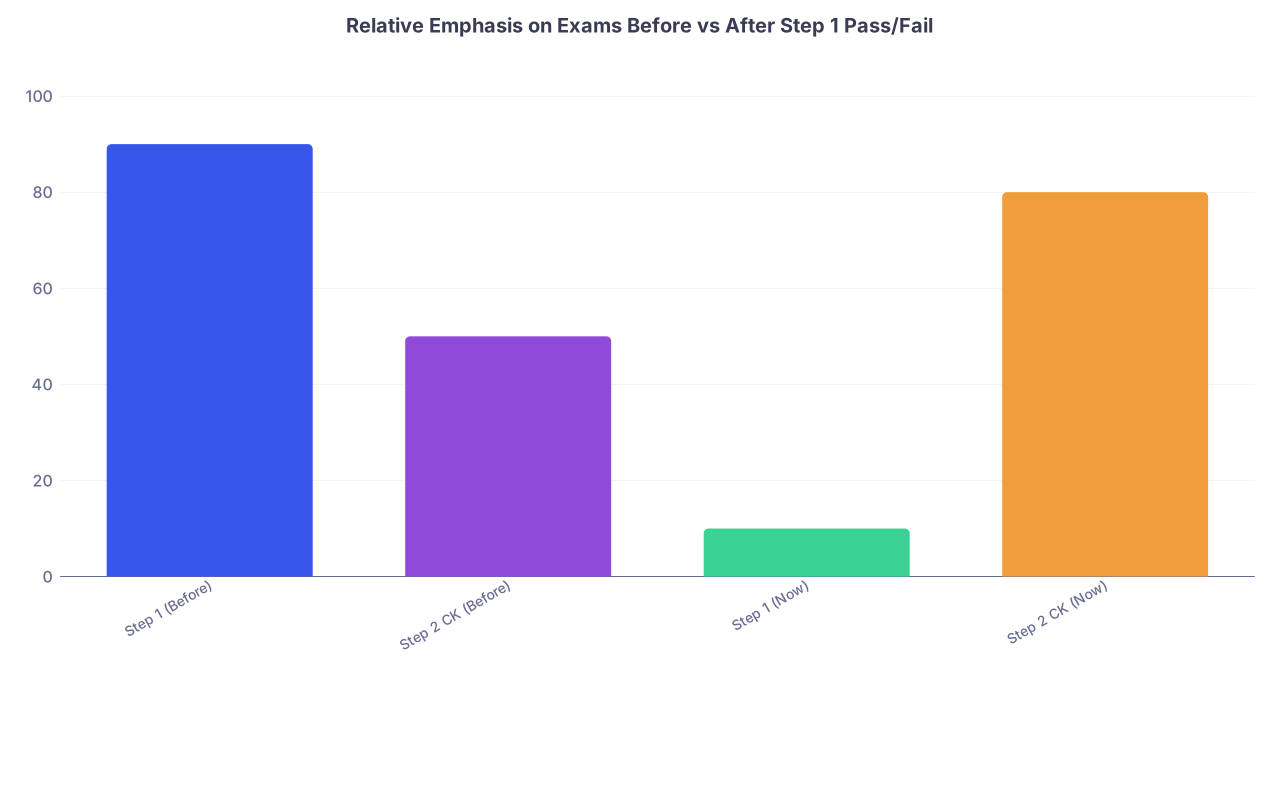
| Category | Value |
|---|---|
| Step 1 (Before) | 90 |
| Step 2 CK (Before) | 50 |
| Step 1 (Now) | 10 |
| Step 2 CK (Now) | 80 |
No, those numbers aren’t official—they’re conceptual. But the direction is accurate: Step 2 CK’s relative importance has climbed dramatically.
Myth: “Step 2 CK Is Just Step 1 But Later”
This is the lazy take I hear most often. It is also wrong.
Step 1 and Step 2 CK differ in at least four critical ways:
1. Content Scope and Nature
Step 1:
- Heavy basic science, abstractions, pathways, mechanisms
- High correlation with ability to grind Anki and UWorld for months
Step 2 CK:
- Clinically oriented, management-heavy
- Tests pattern recognition, prioritization, and applied reasoning more than raw memorization
The data back this up: correlations between Step 1 and Step 2 CK are strong but not perfect (historically around r = 0.6–0.7 in many institutional datasets). That means:
- A chunk of high Step 1 scorers underperform on Step 2 CK
- A non-trivial set of mid Step 1 scorers outperform expectations on Step 2 CK
So no, Step 2 is not just “Step 1 with a stethoscope.”
2. Timing in Training
This is the biggest structural difference.
Step 1 was taken early, often with 4–8 weeks clean time. Schools literally shut down to let people cram. Step 2 CK?
- Taken late MS3 or even early MS4
- Often squeezed between or during core rotations
- Prep time competes with shelf exams, fatigue, and actual patient care
That means any comparison like “Is Step 2 the new Step 1?” ignores a basic reality: it hits you when you’re already stretched thin. So making it the core filter is, bluntly, lazy policy by programs.
Here’s how the pressure is shifting across the training timeline:
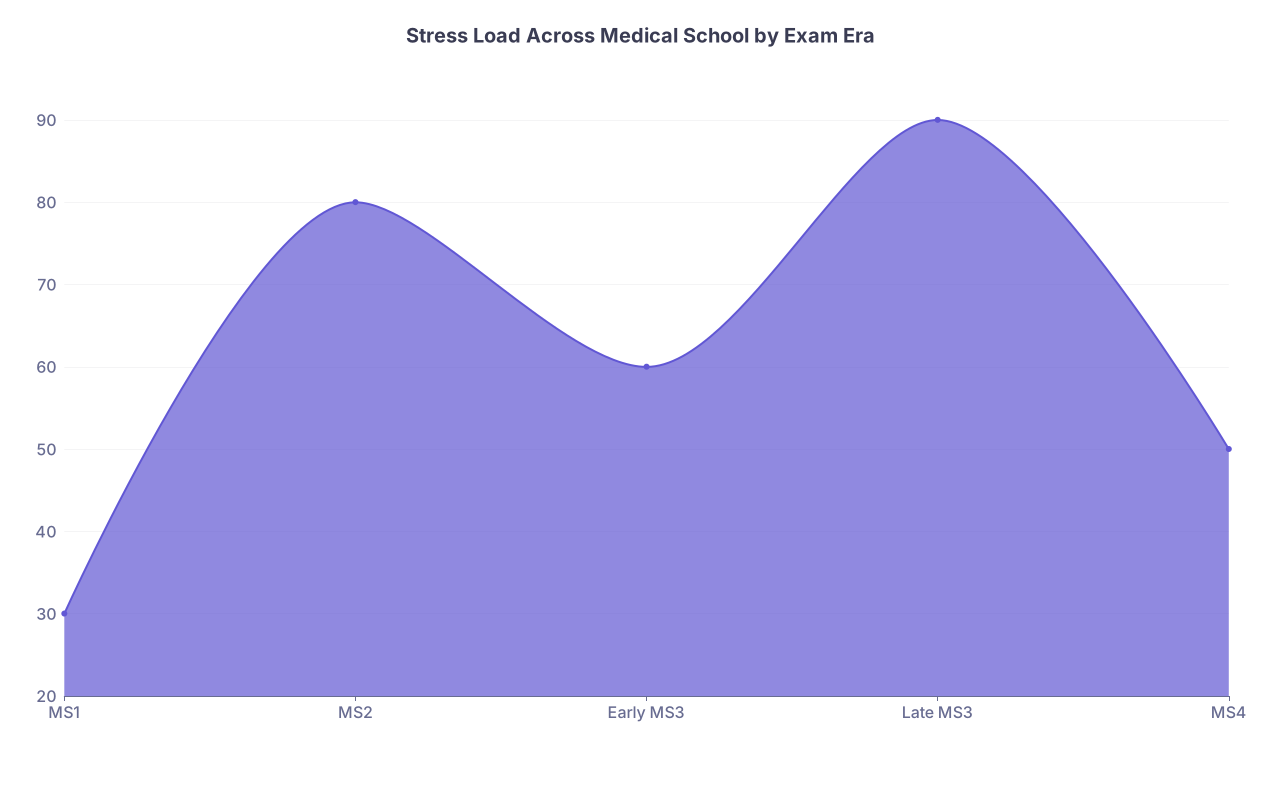
| Category | Value |
|---|---|
| MS1 | 30 |
| MS2 | 80 |
| Early MS3 | 60 |
| Late MS3 | 90 |
| MS4 | 50 |
Interpretation: before pass/fail, MS2 was the singular peak. Now, late MS3 with Step 2 CK plus rotations is where people crack.
3. Score Distributions and Signal Quality
Step 1 scores used to be:
- Broadly distributed
- Supported by massive prep infrastructure
- Very well studied across specialties (decades of data)
Step 2 CK scores:
- Still numeric, but with less historical use as a hard cutoff
- Affected more by clinical exposure variation between schools and hospitals
- More vulnerable to “hidden curriculum” — how aggressive your teams are, how much teaching you actually get
So Step 2 CK contains more noise from system differences, not just individual student ability.
One big meta-myth here: PDs talk about “objectivity” of Step 2 CK like it’s some platonic ideal. It is not. It’s just the last standardized number still standing.
What Competitive Specialties Are Actually Doing
Let’s zoom into where everyone freaks out: derm, ortho, ENT, plastics, neurosurgery, IR, rad onc, urology, ophtho.
Patterns from early post–P/F cycles:
- Step 2 CK is almost always required by rank list submission
- Many applicants feel forced to take it earlier in MS3 to have a score on ERAS
- Advising offices are seeing clear Step 2 CK “targets” creep into conversations (e.g., 250+ for derm/ortho/ENT at many places)
But here’s the uncomfortable truth: even in these fields, Step 2 CK has not fully replaced what Step 1 used to do.
Why? Because programs lost a sorting tool and a status signal. Step 1 top scores used to be currency. Now, PDs are rediscovering:
- Research output
- Letters from known faculty
- Sub-internship performance
- School reputation
- A way more chaotic mixture of “holistic” factors
So, no—you cannot just plug in Step 2 CK and re-create the pre–P/F ecosystem. The data on interview offers vs scores show more spread and more outliers now. The score still matters a lot—but it’s no longer the only clean gate.
Here’s a rough framework programs have drifted toward:
| Factor | Role After Step 1 P/F |
|---|---|
| Step 2 CK | Main numeric filter, especially for interview screening |
| Research | Major tiebreaker, especially first-author or specialty-specific |
| Letters | Increasingly important, especially from known faculty |
| Home/Sub-I performance | Critical for “would we work with this person?” |
That’s messier than the old “Step 1 ≥ X or auto-bin” world. Programs don’t like messy. But here we are.
The Doom Narrative vs What’s Actually Happening
There are two bad takes that dominate student conversations:
- “Step 2 CK is everything now. If I don’t crush it, I’m dead.”
- “Step 2 CK doesn’t matter; everything is holistic now.”
Both are wrong.
Here’s what the evidence actually supports, if you strip away the drama:
- Step 2 CK is more important than it used to be, especially in competitive and procedure-heavy specialties
- It is not a perfect predictor of matching; plenty of mid-score applicants match well with strong research, letters, and fit
- Some core fields (FM, IM, peds, psych) still use it, but often with softer thresholds and more context
- A growing number of programs are more willing to review applications before Step 2 CK, then use the score as confirmation or a mild filter, not the entire story
I’ve seen real outcomes like:
- Applicant with 236 Step 2 CK matching derm because of 5+ papers, strong home derm support, and excellent audition rotation feedback
- Applicant with 260+ Step 2 CK getting far fewer ortho interviews than expected due to minimal research, generic letters, and awkward communication skills noted on rotations
The “score = destiny” narrative is broken. But the “score doesn’t matter” narrative is fantasy.
How You Should Actually Think About Step 2 CK Now
Strip away the noise. Here’s a clean, evidence-based way to think about Step 2 CK in the post–Step 1 P/F era:
- It’s the only standardized national numeric metric most programs still get. They will use it.
- It’s harder to protect study time for, so planning matters more than raw grind.
- It interacts with everything else—research, letters, school, specialty choice. It doesn’t live in a vacuum.
- It has more upside for people who were “meh” basic-science test takers but clinically strong. You can outperform your Step 1 narrative here.
Here’s a realistic breakdown of how different fields treat Step 2 CK right now:
| Specialty Group | Role of Step 2 CK |
|---|---|
| Derm, Ortho, ENT, Plastics, NSGY | Very high; often practical cutoff ranges and early expectations |
| EM, Anesthesia, IR, Rads | High; strong score helps a lot, weak score can hurt but not always fatal |
| IM, Peds, OB/GYN, Psych | Moderate; used as one factor among many, rarely the sole determinant |
| FM, PM&R, Neuro | Lower to moderate; score still matters, but holistic review more common |
And to visualize how Step 2 CK stacks up against other factors in program director minds:
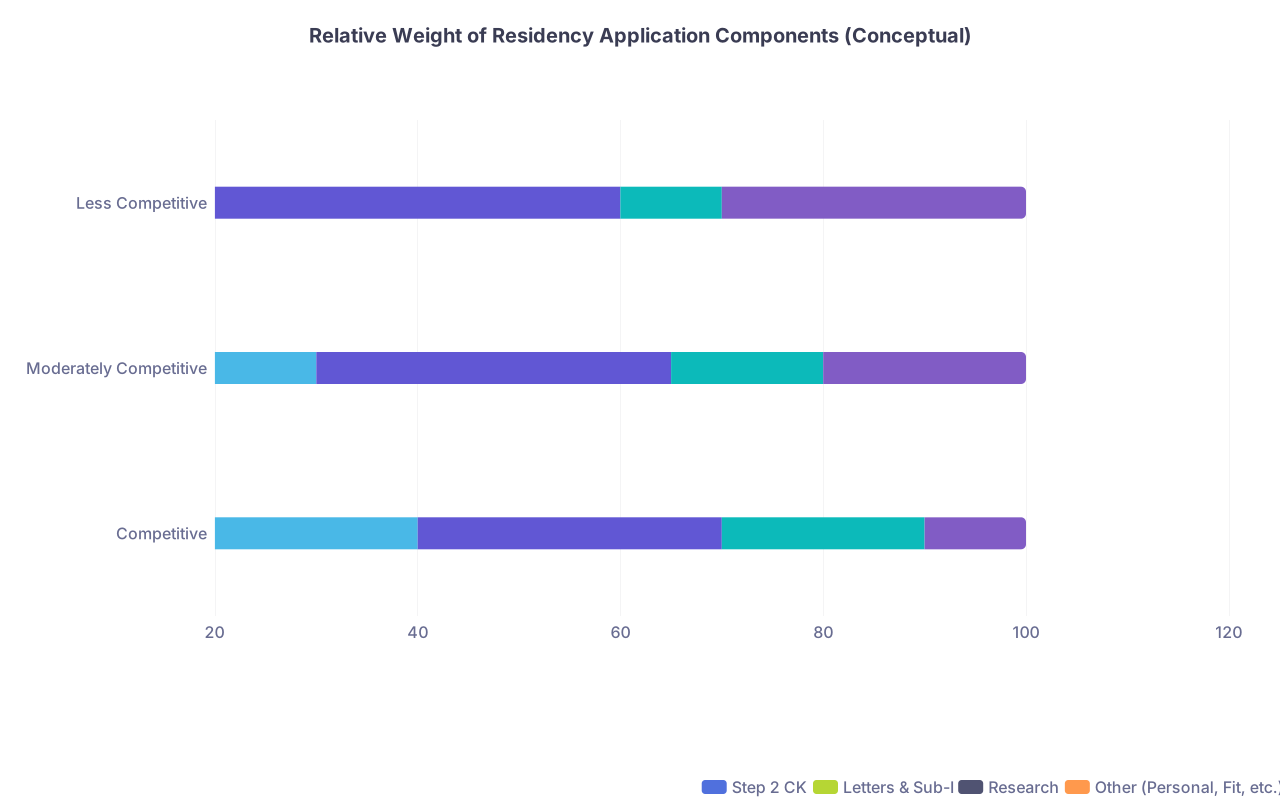
| Category | Step 2 CK | Letters & Sub-I | Research | Other (Personal, Fit, etc.) |
|---|---|---|---|---|
| Competitive | 40 | 30 | 20 | 10 |
| Moderately Competitive | 30 | 35 | 15 | 20 |
| Less Competitive | 20 | 40 | 10 | 30 |
Again, those numbers are conceptual, but they match what PD surveys and advising outcomes show: Step 2 CK is a big piece, but it’s not the only one.
Practical Implications For Current Students
Let me cut through the theory and talk tactics.
If you’re aiming for a competitive specialty
Step 2 CK is functionally “high stakes.” You don’t have to chase a mythical 270, but you do need to be in the ballpark your specialty considers serious. That means:- Plan your exam timing early in MS3 with your school and mentors
- Treat clerkships + shelves as Step 2 prep, not separate universes
- Avoid the fantasy that “research will completely make up for a very weak Step 2 CK”
If you’re undecided on specialty
You need a solid Step 2 CK score to keep doors open. There’s no downside to doing reasonably well, and massive downside to punting it “because I might just do FM.” People say that and then change their minds too late.If Step 1 was weak or barely pass
Step 2 CK is your best opportunity to rewrite your testing narrative. Programs know Step 1 went P/F; many also know schools handled that transition unevenly. A strong Step 2 CK (relative to your Step 1 context) is a real asset.If Step 1 was very strong (for older cohorts)
You don’t get to coast. Some programs are explicitly saying: “We care more about Step 2 CK now, because it reflects clinical readiness.” A big Step 1 and a modest Step 2 CK is not the end of the world, but it does raise questions.
Here’s a simple sanity check I tell students:
If the only clearly excellent thing in your application is your Step 2 CK score, you’re not competitive for the top specialties. If the only clear weakness is your Step 2 CK score, you may still be fine depending on the field and the rest of your application.
Where This Is Probably Headed
No crystal ball, but trends are obvious.
- Step 2 CK will stay numeric longer than Step 1 did. Someone has to be the number.
- More schools will move Step 2 CK earlier in MS3 so students have scores by ERAS. That means less protected study, not more.
- Some specialties will start using other “hard” filters (research productivity, home vs away rotator status, class rank, school tier) even more than they admit now.
- If Step 2 CK ever goes pass/fail, the entire game shifts to non-exam metrics and insider signals. That would help some people and absolutely crush others.
The biggest myth is that tests created the competitiveness problem. They did not. They just made it easy to quantify. The competitiveness remains; Step 2 CK is currently carrying a lot of that weight.
You don’t beat this system by pretending Step 2 CK doesn’t matter. You beat it by understanding exactly how much it matters for your goals—and then building the rest of your application aggressively enough that one number, either way, doesn’t decide your fate.
Years from now, you won’t remember your exact Step 2 CK scaled score. You will remember whether you let a single exam dictate your sense of what was possible.
FAQ (Exactly 4 Questions)
1. Do I absolutely need my Step 2 CK score back before applying to competitive specialties?
Not absolutely, but it’s strongly preferred. Many competitive programs will still look at applications without a Step 2 CK score if the rest of your file is strong (research, letters, school reputation), but a missing score creates uncertainty. In early post–P/F cycles, applicants with scores at submission were clearly more comfortable and often more competitive. If you can reasonably have a solid score back before ERAS, do it.
2. Is a single mediocre Step 2 CK score a death sentence for derm/ortho/ENT/etc.?
Not automatically. A “good but not elite” score (say mid-230s to low-240s) with excellent specialty-specific research, strong faculty advocates, and great sub-I performance can absolutely still match. The death sentence is usually “OK score + weak research + generic letters + no clear narrative,” not the score alone.
3. How much does Step 2 CK matter for primary care (FM, peds) and psych?
It matters, but not in the same way. In these fields, programs are more likely to use Step 2 CK as a basic competence check rather than a fine-grained rank sorter. A very low score can hurt; a solid score clears a bar; an exceptional score helps but doesn’t transform an otherwise weak application. Clinical performance, fit, and genuine interest carry more relative weight.
4. If I crushed Step 1 before it went P/F, can a lower Step 2 CK hurt me?
Yes, it can. Programs increasingly see Step 2 CK as the better reflection of day-one residency readiness. A large drop between Step 1 and Step 2 CK won’t automatically sink you, but it raises questions: burnout? poor time management? plateau in knowledge growth? You’ll want the rest of your application—rotations, letters, interviews—to clearly contradict any narrative that you are trending downward.