
Step 1 going pass/fail did not “fix” residency selection. It just hid one of the numbers and pushed programs to dig for others.
Let me be blunt: the idea that “no Step 1 score means less screening and more holistic review” is mostly fantasy. Some programs are trying. Many are not. And plenty of applicants are getting quietly filtered anyway—just with different levers.
You are not crazy if you feel like the game changed and then immediately re-rigged itself. That is essentially what happened.
What Actually Changed When Step 1 Went Pass/Fail
The dominant myth:
“No Step 1 score = less pressure, more fairness, more focus on you as a whole person.”
Sounds lovely. Not how this works in real life.
Here is what actually changed for many programs:
| Before P/F Era | After P/F Era |
|---|---|
| Step 1 score cutoff | Step 2 CK score cutoff |
| Heavy Step 1 emphasis | Heavy school/Step 2/research emphasis |
| Early Step 1-based filters | Later Step 2-based filters |
| Numeric Step 1 ranking tool | “Holistic” veneer with hidden filters |
Programs lost a single standardized number they trusted (sometimes too much). So they substituted:
- Step 2 CK scores
- School name and perceived prestige
- Class rank / quartiles / MSPE language
- Shelf exam performance (when available)
- Research metrics, especially for competitive specialties
- Letters from “known” faculty / home programs
And yes, some of these were always used. The difference now is they’re carrying more weight, and being used more aggressively upfront.
So did the stress disappear? Not at all. It just moved downstream.
Myth: “Programs Can’t Screen Without a Score”
They absolutely can. And they do.
Screening is not some optional evil. When popular specialties get thousands of applications for a handful of spots, they have to reduce volume somehow. Before: a Step 1 cutoff of 230 or 240 did the job. Now: Step 2 CK and other structural filters step in.
Here’s what I’ve watched programs actually do, in plain language:
- Require Step 2 CK at time of application for out-of-region or non-home students
- Quietly prefer home students and regional schools
- Sort by Step 2 CK and only manually review the top tier
- Use school tiers—top-20 and “known strong” programs reviewed first
- Use class rank deciles (top half only, say)
- Disfavor applicants without a home program in the specialty
The most honest PD I’ve heard on this said it outright:
“Step 1 went pass/fail. Our applicant volume didn’t. We just switched to Step 2 CK.”
And yes, that means some applicants are absolutely getting “screened out” despite having a big fat “Pass” on Step 1. Because “Pass” is not a differentiator. It is the baseline.
Step 2 CK: The New Blunt Instrument
The data backs this: specialties that were Step 1-obsessed did not suddenly go Zen. They just migrated to Step 2.
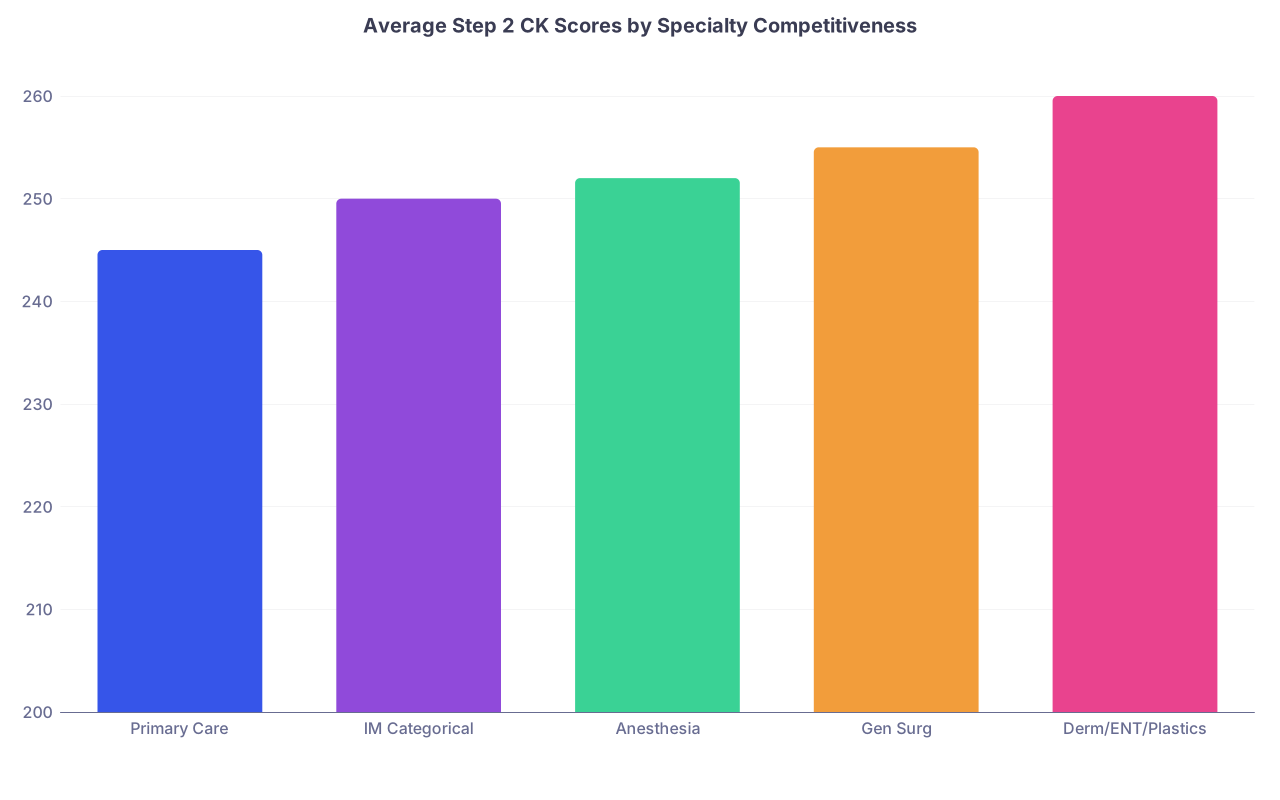
| Category | Value |
|---|---|
| Primary Care | 245 |
| IM Categorical | 250 |
| Anesthesia | 252 |
| Gen Surg | 255 |
| Derm/ENT/Plastics | 260 |
You’ll see slightly different numbers depending on the year and dataset, but the pattern is stable:
- Less competitive specialties cluster mid-240s
- Core competitive specialties hover around 250–255
- Hyper-competitive (derm, plastics, ENT, ortho, neurosurg) skew high 250s–260+
Programs do not publish hard Step 2 cutoffs as often as they did with Step 1. But when you listen to residents who sit on selection committees, you’ll hear the same story:
- “We started with everyone above 245 for serious consideration.”
- “Below 240 went into a second-tier group, rarely pulled from unless red flags explained.”
- “We had to pick some line to make the pile manageable.”
So the truth is nasty but simple:
No Step 1 score does not mean “no score.” It means Step 2 CK is now the primary standardized academic filter.
And because Step 2 CK is taken later, the stakes are arguably higher. Bomb Step 1 in the old era and you at least had Step 2 to show growth. Now? Many students relax early (“pass is pass”), then get hammered by the one scored exam that actually matters for residency.
Where Screening Really Happens Now
Let’s pull back the curtain on how many programs sort applications in the pass/fail era. It usually isn’t some elegant, fully-holistic committee meeting that deeply analyzes every applicant.
It’s more like:

| Step | Description |
|---|---|
| Step 1 | All Applications |
| Step 2 | Auto discard or hold |
| Step 3 | Initial Sort |
| Step 4 | Low priority pile |
| Step 5 | Faculty review for interviews |
| Step 6 | Interview offers |
| Step 7 | Complete? Letters, Step 2 |
| Step 8 | Meets Score/School Filters? |
Key points where people get quietly filtered:
“Complete” status
No Step 2 CK yet? Some programs will not touch your file, especially if you are not from their region or a top-tier school.Initial sort layer
This is where Step 2 CK, school name, and class rank function like old Step 1 cutoffs. Many never make it past this step.Low priority pile
You are technically “reviewed” but practically ignored unless interview slots are not filling or someone advocates for you.
Holistic review exists, but it is usually applied after these coarse filters. Not before.
Who Gets Hurt Most in the Pass/Fail Era
“No score” was sold as an equalizer. It is not. It shifted advantage, often in predictable, uncomfortable ways.
People who benefit relatively more:
- Students from highly-ranked or “famous” schools
- Applicants with strong home programs in their target specialty
- Those with big-name recommenders and research from well-known institutions
- Students who can afford away rotations in competitive specialties
People who are more likely to get screened out, even with a Step 1 Pass:
- DO students and IMGs without Step 2 done early
- Students from newer or lower-reputation MD schools
- Applicants with weaker preclinical performance or marginal Step 2 CK
- Career changers or non-traditional applicants without built-in networks
This is not hypothetical. Look at interview data from competitive fields. Even in the pass/fail era, many programs still list “preferred: Step 2 completed at time of application” and show match lists saturated with their own students, top-20 schools, and a handful of standout DO/IMGs with stellar Step 2 and research.
The inequity didn’t vanish. It just changed costumes.
The Hidden Risk: “Pass = I Can Chill Now”
There’s another quiet casualty in this new world: motivation and timing.
The narrative many students heard:
“Step 1 is just pass/fail now, so don’t kill yourself. Just pass and move on.”
I’ve seen the consequences of that.
What actually happens:
- Students under-prepare for Step 1, barely pass, and do not build the content foundation Step 2 assumes
- They push Step 2 CK later (end of 4th year or close to ERAS), leaving programs with no score at application time
- They underestimate how much Step 2 now functions as the main academic gatekeeper
Then they are shocked when interview season is thin. Or nonexistent.
From a program’s perspective: why take a risk on an unknown Step 2 score when they have 800 applications with known, strong scores? They do not owe you a benefit of the doubt. They are drowning in volume.
So yes, you may “only” need to pass Step 1. But if you are serious about a competitive specialty—or honestly, about avoiding unnecessary barriers in any specialty—you cannot treat Step 1 like a low-stakes quiz. That foundation shows up on every shelf and on Step 2 CK. Where the real screening is happening.
“But Don’t Programs Have to Do Holistic Review Now?”
They’re encouraged to. They’re pressured to say they do. That’s not the same as them abandoning filters.
What holistic review realistically looks like in many places:
- They define some minimum academic bar (Step 2 CK, class rank, school)
- Within that pool, they weigh things like narrative, leadership, adversity, unique backgrounds, mission fit
- For borderline academic profiles, true holistic review depends heavily on:
- A champion on the committee
- A program director who genuinely believes in taking a chance
- Concrete evidence of growth or exceptional fit
You do see programs explicitly seeking non-traditional candidates, first-generation students, or those with strong community ties. That’s real.
But none of that works if your file never makes it out of the giant spreadsheet sorting on Step 2 CK and “Completed at time of application: Yes/No.”
Holistic review can only operate on the applications that survive the first culling.
Practical Reality: How to Avoid Getting Screened Out
You can’t rewrite the system. You can absolutely play it more intelligently once you stop believing the “no score, no problem” myth.
Here’s the contrarian-but-accurate strategy:
Treat Step 1 like it still matters. Because it does—indirectly.
Your Step 1 prep is Step 2 prep. Weak Step 1 performance (even a low pass) often foreshadows mid-220s Step 2, which will screen you out of some programs and specialties. Use Step 1 as your deep content build, not as a box to check.Front-load Step 2 CK.
If you are not at a school with a golden name, having a strong Step 2 CK available when ERAS opens is one of the few ways you can force programs to see you as a serious, low-risk applicant. Taking Step 2 after you submit apps is strategically terrible for most people.Be honest about specialty competitiveness.
Trying to match derm, plastics, ENT, neurosurg, or ortho in this era with:- No Step 2 CK at application
- Average Step 2 lined up late
- No home program and minimal research
…is basically volunteering to be screened out.
Exploit fit and geography hard.
Because programs over-rely on school name and region, you should over-communicate your genuine ties: family, long-term location plans, previous degrees, service history. This doesn’t magically beat a 260+ Step 2, but it helps in mid-tier programs deciding between two similar profiles.Use away rotations strategically, not romantically.
Away rotations are one of the only ways a DO/IMG or “non-name” MD student can bypass school-based bias. A strong rotation and letter from that program often gets you into the “review seriously” or “interview” bucket despite not being from a top 20 school.Stop assuming silence means “holistic review failed you.”
In many cases, you were never really in play. You were filtered long before anyone knew your story. That’s not fair, but it is how systems under volume pressure behave.
The Future: Will This Get Better or Worse?
Here’s the uncomfortable outlook: unless something dramatic changes in how many students apply, how many programs exist, or how selection is regulated, the pressure to screen will only increase.
New possibilities that may emerge or intensify:
- Even heavier Step 2 CK emphasis, maybe even Step 2 cutoffs becoming open secrets
- More programs requiring Step 2 CK at time of application
- Greater weight on standardized letters (like SLOEs in EM) across more specialties
- More reliance on school-based ranking systems, which are wildly inconsistent and biased
- Some specialties experimenting with new standardized tests or signals, but those too will become filters
The most honest position you can take is this:
Pass/fail Step 1 removed a single harsh number. It did not remove the need to rank applicants. It did not erase competition. It did not magically force programs to deeply evaluate every file.
So no, “no score” does not mean “no problem.”
It just means the problems are less visible, more unevenly distributed, and easier for people to pretend are about “fit” instead of structural filtering.
The real power move in this era is refusing to buy the comforting story and instead responding to the reality: build a strong Step 2, time it strategically, know your specialty’s true competitiveness, and plan like the system will screen you unless you give it a very good reason not to.
Years from now, you will not remember your exact Step 2 CK number. You will remember whether you treated this opaque system like a black box lottery—or like a rigged game you learned well enough to beat.