
The idea that “Research is now mandatory because Step 1 went pass/fail” is lazy, wrong, and honestly a bit convenient for people selling panic and productivity porn.
The Core Truth: Step 1 Going P/F Did Not Suddenly Make Research a Requirement
Let me be blunt. Competitive specialties wanted research long before Step 1 went pass/fail. Uncompetitive specialties didn’t suddenly start rejecting people without PubMed links. And program directors did not wake up the morning after the scoring change and collectively decide: “Right, no score… guess we only take people with five first-author papers now.”
What actually happened is much less dramatic and much more nuanced:
- Research was already a major signal in certain specialties.
- Step 1 going pass/fail removed one blunt sorting tool.
- Programs are now leaning more on the same older tools: school reputation, letters, Step 2 scores, clerkship performance, AΩA, and yes, research—but in context, not as a hard gate.
The myth comes from students seeing a real shift (more attention to non-Step metrics) and then overgeneralizing it into: “No research = no residency.” That’s not what the data or directors are saying.
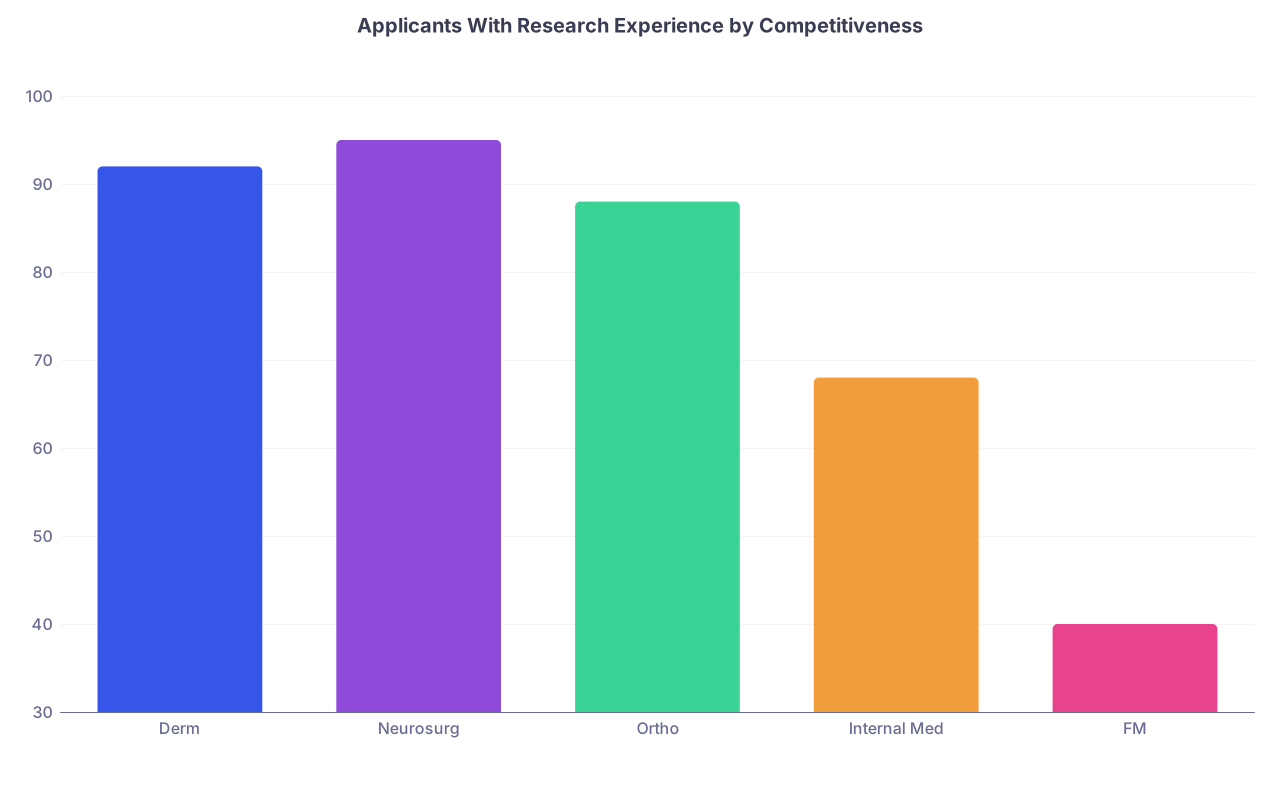
Let’s talk numbers before we talk fear.
| Category | Value |
|---|---|
| Derm | 92 |
| Neurosurg | 95 |
| Ortho | 88 |
| Internal Med | 68 |
| FM | 40 |
These are representative ballpark patterns based on NRMP data trends over recent years (exact numbers vary by year): competitive fields have always had high research participation. That didn’t start with Step 1 pass/fail.
You’re not living in a brand‑new world. You’re living in a slightly recalibrated version of the same one.
What Actually Changed With Step 1 Pass/Fail
Here’s the honest shift.
Before pass/fail:
- Step 1 = quick and dirty filter. Program admins could slice by “≥240” or “≥250” and call it a day.
- A strong Step 1 score could partially compensate for weak or average research.
After pass/fail:
- Step 1 = checkbox. Did you pass? Good. Move on.
- Step 2 CK (and sometimes shelf exams) now carry more weight.
- Programs are looking harder at patterns: consistency, rigor, and alignment with the specialty.
So yes, some programs have started paying more attention to:
- Research productivity
- Quality of letters
- Home sub‑I feedback
- Where and with whom you did your work
But “paying more attention” is not the same as “mandatory for everyone.”
Where Research Actually Became More Important
Two concrete shifts post–Step 1 P/F:
In ultra‑competitive specialties (derm, plastics, neurosurgery, integrated vascular, etc.), research became a more prominent tiebreaker because the most obvious numeric tiebreaker (a Step 1 score) disappeared.
In some mid‑competitive fields (radiology, EM in some regions, anesthesiology at top places), programs started leaning more on research signals to distinguish applicants from similar schools with similar Step 2 scores.
But this matters mostly in one scenario: applicants targeting top‑tier or hyper‑competitive programs and regions. Not everyone. Definitely not “research or doom.”
Specialty Reality Check: Who Actually Needs Research?
Let me kill the blanket statement and replace it with reality.
| Specialty Tier | Typical Research Expectation |
|---|---|
| Ultra-competitive (Derm, NSG, Plastics, ENT) | Strong research strongly expected |
| Competitive (Ortho, Rad Onc, IR, Urology) | Research helpful, often expected |
| Middle (Rads, EM, Anes, OB at strong programs) | Research helpful, not mandatory |
| Broad-access (IM, Peds, Psych, Neuro) | Nice to have, not required |
| Primary care–leaning (FM, Community IM/Peds) | Rarely needed |
Let’s translate that into honest language.
Ultra-Competitive Specialties
Derm, neurosurgery, plastics, ENT, integrated vascular/IR.
If you’re aiming for these, research didn’t just become “important” because of Step 1 P/F. It has been pseudo‑mandatory for years at most academic programs. Hop onto the NRMP Charting Outcomes data and you’ll see:
- Matched applicants often have multiple publications/abstracts/posters.
- Many did dedicated research years.
- A lot are coming from research‑heavy schools or have worked with “letterhead” attendings.
For these fields:
- Pre–Step 1 P/F: 245+ and thin research was sometimes survivable.
- Post–Step 1 P/F: You do not have that score crutch. So research stands out even more.
Here, yes—if you want a serious shot at big‑name academic programs—research is close to mandatory. But again: this isn’t a Step‑1‑went‑P/F phenomenon. It’s an older arms race that just lost one of its blunt metrics.
Competitive but Not Insane
Ortho, urology, rad onc, IR (without dual pathway), maybe some surgical subspecialties.
Research is strongly preferred, especially at academic programs. But you still see people match with:
- Solid Step 2 scores
- Strong home sub‑I performance
- Outstanding letters and clear clinical strength
- Limited but focused research, or even none if everything else is stellar and they target the right tier of programs
Here’s where the myth does the most damage: students think “no research = no chance,” then scramble into low‑quality, last‑minute resume padding. Which program directors can smell from a mile away.
Internal Medicine, Pediatrics, Psychiatry, Neurology
At the average program: research is a bonus, not a requirement.
At elite academic programs (think MGH, Hopkins, UCSF, CHOP):
- Research that matches the program’s focus can be a major plus.
- But applicants get in every year with modest or minimal research because they shine clinically, ace Step 2, and get strong letters.
You don’t suddenly need three first‑author papers to match community psych because Step 1 went P/F. That’s fantasy.
Primary Care and Community Programs
Family medicine, community internal med, community peds, lower‑acuity psych programs.
Research is nearly irrelevant for many of these places. They care more about:
- Reliability
- Communication skills
- Fit for primary care
- Some interest in underserved or local populations
If a community FM PD tells you, “We have to have research now because Step 1 is pass/fail,” they’re either parroting the panic or using it to signal “we’re more academic than we actually are.”
What Program Directors Actually Say (Not Reddit Version)
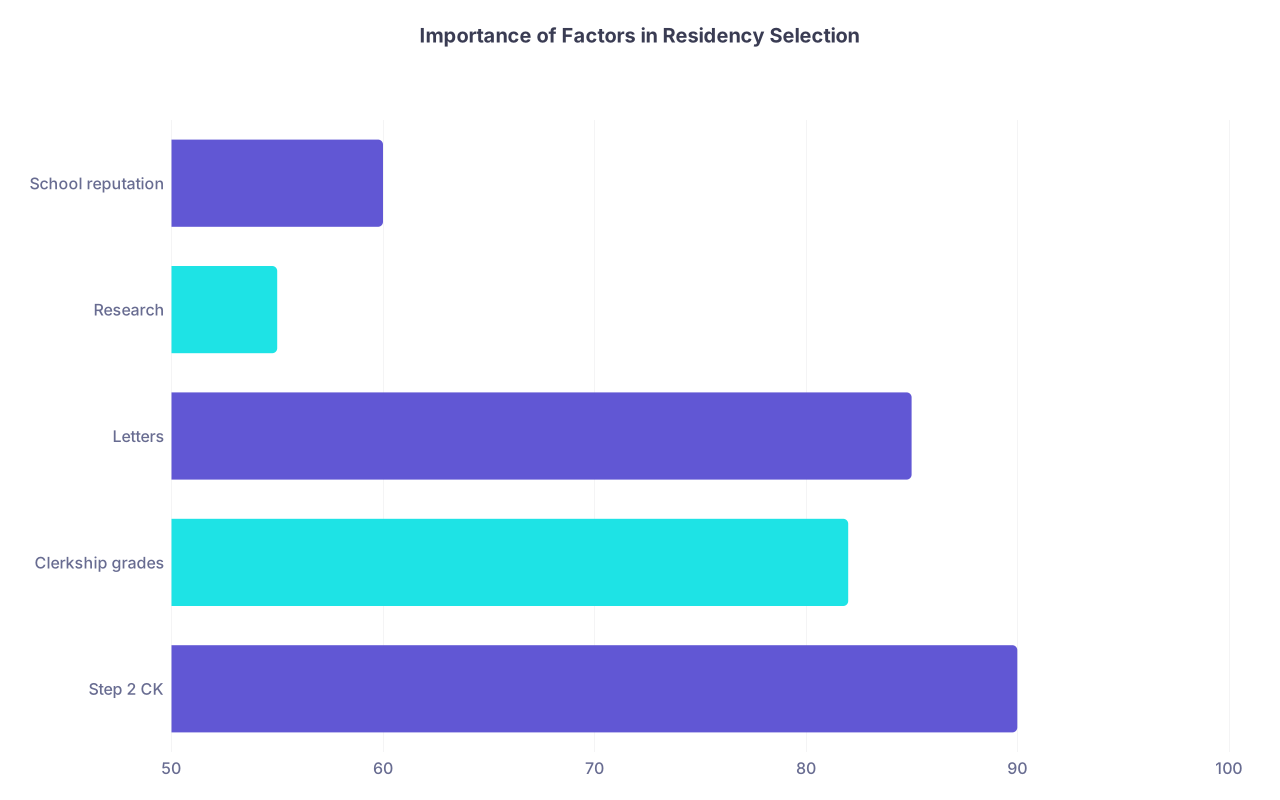
If you read the NRMP Program Director Survey and individual specialty PD surveys—rather than your group chat—you see a few consistent themes:
- Step 2 CK importance has risen.
- Clerkship grades and rank list in your class matter more.
- Letters and away performance are huge.
- Research is valued proportionally to the program’s academic orientation.
| Category | Value |
|---|---|
| Step 2 CK | 90 |
| Clerkship grades | 82 |
| Letters | 85 |
| Research | 55 |
| School reputation | 60 |
Again, ballpark, not exact numbers—but this is the shape of reality in surveys: research is meaningful, but it is not the top factor for most programs.
And ask real PDs off the record. I’ve heard versions of this more than once:
- “I do not care if you have 10 case reports if you look disorganized and unsafe on the wards.”
- “I’d take a clinically strong, non‑toxic student with zero pubs over a socially awkward ‘research star’ who can’t talk to patients.”
- “Half the CVs we see are inflated anyway. I trust letters and our own residents more than ‘submitted abstracts’.”
The myth exaggerates one real piece of the puzzle into the entire picture.
The Real Problem: Weaponized Anxiety and Bad Strategy
Here’s what I see too often now that Step 1 is pass/fail:
A student hears, “You need research now or you won’t match.” They panic. They:
- Grab onto any “project” they can find, often poorly designed or poorly supervised.
- Spread themselves across 5–10 half‑baked case reports or retrospective series they don’t understand.
- Burn hours chasing authorship politics instead of learning actual medicine.
- End up with a CV full of fluff and no deep understanding of anything.
Then they apply. PDs skim the CV, see a wall of micro‑projects from random institutions, and think: “Okay, someone told this kid they needed research. But I have no idea who they are or what they’re actually good at.”
Surface volume is not the same as signal. A single, well‑done project with a solid PI, where you actually know the methods and results, is more persuasive than eight poster‑only “in prep” ghosts.
So What Should You Actually Do?
You want a clean, rational strategy, not superstition.
1. Start With Your Target Field and Tier
Decide early what you’re realistically aiming for.
- If you’re flirting with derm, neurosurg, plastics, ENT, etc.—yes, lean hard into meaningful research early (M1/M2, or a dedicated research year).
- If you’re thinking IM but open to subspecialty fellowship at an academic center, one or two solid projects help.
- If you’re aiming for FM or community peds, research is optional. If you like it, do it. If you don’t, you’re not dead.
2. Chase Quality, Not Body Count
Prioritize:
- A strong mentor who knows you and will write you a real letter.
- A project where you understand the question, the data, and the limitations.
- Work that connects, even loosely, to your field of interest.
A single meaningful publication and a PI who genuinely likes you beats five posters where you were “3rd author—data entry.”
3. Don’t Sacrifice Clinical Performance for CV Theater
If your clerkship comments say “average,” your Step 2 is shaky, and you’re awkward on rounds, that’s a far bigger problem than not having a meta‑analysis on your name.
Your ordering of priorities post–Step 1 P/F should look something like:
- Pass Step 1. Early.
- Do very well on core clerkships.
- Crush Step 2 CK.
- Build strong relationships → strong letters.
- Then worry about research, tailored to the specialty.
Not the other way around.
4. Be Honest About What You Actually Enjoy
If you hate research with a visceral, physical reaction, don’t force yourself into a lifetime of it to chase a specialty that is 60% K‑award culture. You’ll be miserable.
You can:
- Match a great IM or peds program with minimal research and then pursue a clinically heavy fellowship.
- Build a career in EM, anesthesia, FM, hospitalist medicine, or community surgery with almost no research beyond residency.
- Focus on QI, teaching, leadership, or global health instead, which some programs value more than basic science output.
The Step 1 scoring change didn’t make everyone a future R01 PI by mandate.
The One Thing That Did Become “Mandatory”: Differentiation
Here’s where the myth has a tiny grain of truth.
Without a Step 1 number, you do need ways to stand out. But “stand out” does not automatically equal “research.”
You can differentiate by:
- Being the student everyone wants on their team because you’re reliable and think ahead.
- Getting an away rotation evaluation that uses the phrase “top 5% of students I’ve worked with in 10 years.”
- Building a niche: ultrasound skills, education, QI, advocacy, global health, informatics.
Research is one path. Not the only path.

| Step | Description |
|---|---|
| Step 1 | Student after Step 1 P/F |
| Step 2 | Research path + strong Step 2 |
| Step 3 | Focus on clinical excellence |
| Step 4 | Target academic programs |
| Step 5 | Selective research or QI |
| Step 6 | Community and primary care focus |
| Step 7 | Competitive specialty? |
| Step 8 | Academic interest? |
FAQ: Myth vs Reality
1. Do I absolutely need research now to match any residency because of Step 1 P/F?
No. That’s fiction. Many FM, psych, peds, and IM community programs will happily take a clinically solid, reliable, research‑light applicant. Step 1 going pass/fail didn’t suddenly change their mission.
2. If I want derm/neurosurg/plastics, is research basically mandatory?
For most serious academic programs in these fields, yes. It was already close to mandatory before Step 1 went P/F. Now, without a Step 1 score to wow people, strong research plus great mentorship and letters matters even more. This isn’t new—it just became more visible.
3. Is it better to have lots of small research items or one big, serious project?
One serious, well‑done, mentor‑backed project beats a graveyard of tiny, low‑impact, “in prep” CV fillers. Program directors know how easy it is to tack your name onto a case report. They’re looking for depth, not decoration.
4. I’m late (M3/M4) and have no research. Am I doomed?
No. If you’re not chasing the ultra‑competitive specialties, you can lean on strong Step 2, clerkship performance, letters, and clear fit. Even in competitive fields, a targeted, last‑minute project with a good mentor is better than panicked fluff.
5. So what’s the smart way to think about research in the Step 1 P/F era?
Treat research as a strategic tool, not a universal requirement. Align it with your intended specialty and program type. Prioritize clinical excellence and Step 2. If you love research or need it for your field, do it well and with intention. If you don’t need it, skip the manufactured panic and build strength where it actually counts.
Bottom line: Step 1 going pass/fail did not magically make research mandatory for everyone. It just pushed programs to look more carefully at the whole picture. Research is powerful—when it fits your goals and your field. It’s not a universal ticket. Nor is its absence a universal death sentence.