
Pass/Fail Step 1 did not make matching easier. It just changed who pays the price and how quietly that price is paid.
The narrative sounds nice: “Less stress, less number-chasing, more holistic review, better for wellness.” I’ve heard it from deans, on NRMP webinars, in applicant town halls. And every time, I watch the data and quietly shake my head.
Let’s walk through what has actually happened in the Step 1 pass/fail era—and why for many applicants, especially non-traditional and less “pedigreed” ones, the game got harder, not easier.
What Everyone Thought Would Happen (And Why That Was Naive)
The optimistic story went like this:
- Step 1 goes pass/fail
- Programs stop obsessing over a single score
- Holistic review blossoms
- Students relax, learn medicine “for the love of learning,” and wellness improves
- Matching becomes less cutthroat and more “fair”
That’s fantasy. Here’s the reality: you do not remove an objective metric from a high-stakes system and magically get kindness and equity. You just force people to substitute other metrics—usually ones that are noisier, more biased, and harder for students to influence.
The system still has the same constraints:
- Too many applicants
- Too few competitive spots
- Massive time pressure on programs to screen thousands of ERAS applications
So programs did what any rational group would do: they replaced one blunt tool (Step 1 score) with a different set of blunt tools.
What Actually Changed: The New Screening Stack
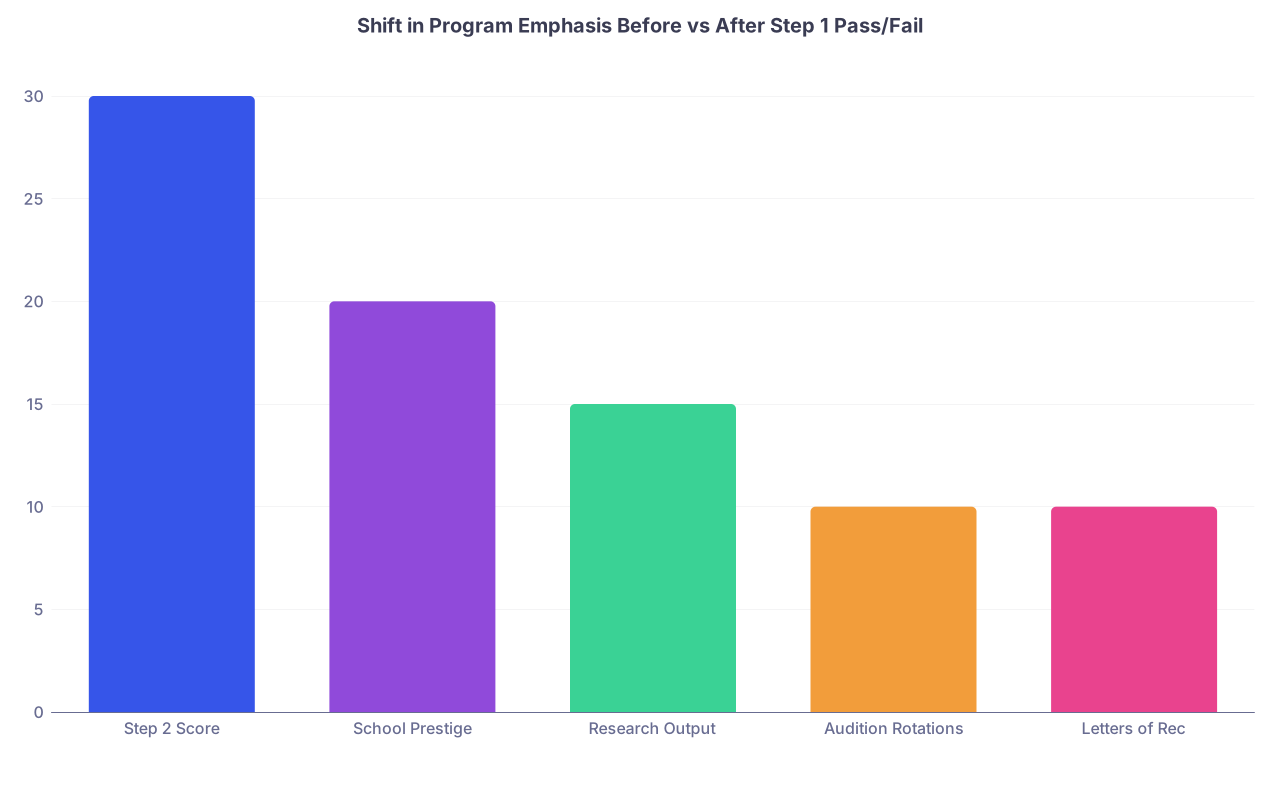
| Category | Value |
|---|---|
| Step 2 Score | 30 |
| School Prestige | 20 |
| Research Output | 15 |
| Audition Rotations | 10 |
| Letters of Rec | 10 |
No, programs did not suddenly become holistic Zen monks reading every personal statement with a cup of herbal tea. They swapped in a new stack of filters. Here’s what rose in importance:
Step 2 CK scores
Programs still need a knowledge/standardized benchmark. Step 2 CK became the new de facto “Step 1 score.”
The twist? The timeline is worse for you now. You’re often forced to:- Take Step 2 earlier
- Perform well with less prep time
- Have that score ready before programs decide whom to interview
So you didn’t lose the score pressure. You just shifted it to a test that’s closer to clinicals and closer to application season, with less room to recover from a bad day.
School prestige and “brand”
When one objective filter disappears, soft prestige fills the gap.
I’ve sat with faculty scrolling ERAS who literally said out loud: “We don’t have Step 1 anymore, so just sort by school and research.” That’s the “holistic” review you’re getting in some places.If you’re from:
- A lower-ranked MD school
- A DO school
- An international school
your Step 1 score used to be a chance to say, “Look again. I can hang.” That pathway is now weaker.
Research volume and “CV glitter”
With no numeric Step 1, programs lean harder on:- PubMed entries
- Abstracts, posters, and presentations
- Big-name mentors co-authoring your work
Who does that advantage? Students at research-heavy, well-funded schools with easy access to labs, protected time, and faculty with established reputations. It’s not merit-neutral; it’s network-heavy.
Home institution and away rotations
Rotations became even more critical signals:- Did you rotate with them?
- Did their own faculty see you?
- Did you do an away in that specialty to “prove” interest?
Good luck if your school is in a region with limited access, or if you do not have the money or flexibility to travel for multiple away rotations. That’s not a small number of students.
So matching didn’t get easier. It stratified more brutally along lines of school, connections, and early access to resources.
Who Actually Benefited (And Who Got Squeezed)
Let me be blunt: pass/fail Step 1 did help some people.
Who likely benefits:
- Students at strongly branded MD schools with built-in reputation
- Those going into less competitive specialties at their home institution
- Students who historically score poorly on standardized exams despite being strong clinically, and who have solid school support and letters
They lose the fear of a “bad number” defining them, and their school’s name plus decent Step 2 and good letters carry more weight.
Who got squeezed harder:
- DO students
- IMGs
- Students at lower-ranked or newer MD schools
- Career changers and non-trads without polished CVs
- Students without money for multiple aways and research years
Before pass/fail, I saw plenty of stories like:
- DO student: 252 Step 1, strong letters → matched competitive IM or anesthesia at an academic center
- Caribbean IMG: 245 Step 1 + 255 Step 2 + grind of aways → matched IM, then fellowship
Those kinds of “score-rescue” trajectories are harder now. Nothing impossible—but definitely harder.
Programs that used to say “We’ll look at you if you crush Step 1” can no longer offer that escape hatch. So they default back to school type, home vs away, and subjective impressions.
The Competitiveness Myth: “Specialties Will Chill Out Now”
The idea that pass/fail Step 1 would “de-escalate” competitiveness is fantasy. Let’s look at what’s actually happened in highly sought specialties: derm, ortho, plastics, ENT, ophtho, neurosurgery, IR.
Programs still have:
- The same number of spots
- Growing numbers of applicants
- Zero additional time to review apps thoughtfully
So what changed?
Signal inflation: Now you’re “expected” to have:
- More research (multi-year projects, not just a poster)
- More leadership roles
- More niche experiences in the specialty
- Earlier and stronger specialty commitment (mentors + home interest group + rotations)
Step 2 scoring arms race: You can see it in anecdotal program guidance:
- “We like to see Step 2 CK > 250 for serious consideration”
- Or “> 245 for interview competitiveness”
The number changed, but the underlying behavior didn’t. Programs still gate hard on tests; they just moved the gate.
Earlier lock-in: Because Step 1 used to be a big fork-in-the-road moment (“My score is X, what specialties make sense?”), students had a natural reality check. Now that checkpoint is fuzzier and later.
Result: more people apply broadly, more ERAS spam, more noise, and paradoxically, more hidden cutoffs.
No, ortho didn’t become friendly. Derm didn’t suddenly say “Sure, let’s read every app line by line.” The pressure just migrated and fragmented.
The Transparency Problem: Cutoffs Went Underground
Here’s something most preclinical students underestimate: opaque cutoffs are worse than clear ones.
In the old world:
- Program might say (publicly or through whispers): “We generally interview applicants with Step 1 > 235.”
- You could decide: worth applying or not worth burning money.
In the pass/fail world:
- Programs rarely publish any clear Step 2 cutoff
- They use school name, Step 2, research, and geography in a giant, hidden triage filter
- Applicants send 60–100+ applications because no one knows where they truly stand
This produces:
- More cost for you
- More noise for them
- More hidden heartbreak for marginal applicants who never stood a chance but had no way to know
The system didn’t become kinder. It became less transparent.
Did Wellness Really Improve?
This is the sales pitch that keeps getting repeated: “Students are less stressed. They’re more engaged learners now.”
Some stress did shift earlier:
- First- and second-year students aren’t living and dying by UWorld question percentages from day one.
- Students at strong schools feel a bit freer to focus on internal exams and clinical skills.
But the stress did not vanish. It moved.
Now the pressure concentrates around:
- Step 2 CK timing and performance
- Maximizing third-year clerkship grades (often highly subjective and politics-dependent)
- Hustling for research during M1/M2 because you know it matters more now
- Locking in mentors early because letters and connections carry more weight
I’ve watched M3s in the pass/fail era absolutely melt down over Step 2 because:
- They feel they “only have one shot” at a major standardized test now
- It happens during or immediately after demanding clinical rotations
- A weak Step 2 feels like a door slamming shut, with less time to rebrand
So yes, some preclinical pressure decreased. But high-stakes anxiety didn’t vanish; it pooled later in the pipeline where stakes are even more tangible.
What You Should Actually Do in the Pass/Fail Era
Let’s stop pretending the game is fair and start playing the game that actually exists.
1. Treat Step 2 CK as your new flagship score
You cannot coast through preclinical years because Step 1 is pass/fail and then magically spike Step 2. That fantasy dies fast.
- Build a solid knowledge base early; your Step 1 prep becomes foundation for Step 2.
- Schedule Step 2 strategically: not too late (you want it in before applications), but not so early that you’re unprepared.
- If you know you’re not a natural test-taker, consider this earlier and get extra support now, not in a panic six weeks before the exam.
2. Be brutally realistic about specialty choice
Look at actual data, not vibes.
| Specialty Type | Typical Signals Needed |
|---|---|
| Hyper-competitive | High Step 2, strong research, aways, big-name letters |
| Mid-competitive | Solid Step 2, good clinical grades, some research |
| Less competitive | Pass exams, decent Step 2, solid letters, good fit |
If you are:
- At a lower-prestige school
- With modest research
- Without strong home support in that specialty
then “I’ll just grind and stand out” is not a strategy; it’s a wish. You need to either:
- Build the missing pieces aggressively (research year, targeted aways, network-hard), or
- Pivot earlier to specialties where your profile is actually competitive
That’s not defeat. It’s strategy.
3. Understand how your school’s brand affects you
If you’re not at a top-branded school, your margin for error is thinner now.
You must:
- Nail Step 2 CK relative to your peers
- Secure genuinely strong letters from people who know you well
- Do aways strategically where you’re actually wanted, not just “big names you like”
If you are at a prestigious school, don’t get arrogant. You still need a solid Step 2 and a coherent story. But yes, you do have more buffer than the DO or IMG who used to rely on a 250+ Step 1 to get in the door.
4. Focus on things that actually move the needle
You don’t need 27 random club leadership roles. You need a clear, believable profile.
Prioritize:
- Strong clinical performance and narrative comments
- Focused, high-yield research or scholarly work (even if modest in quantity, make it coherent)
- Relationships with mentors who will write specific, detailed letters
- A Step 2 CK score that at least clears informal thresholds for your target tier
Stop doing things because “it might look good.” Start doing things that clearly support the specialty and type of program you want.
A Quick Reality Check Timeline
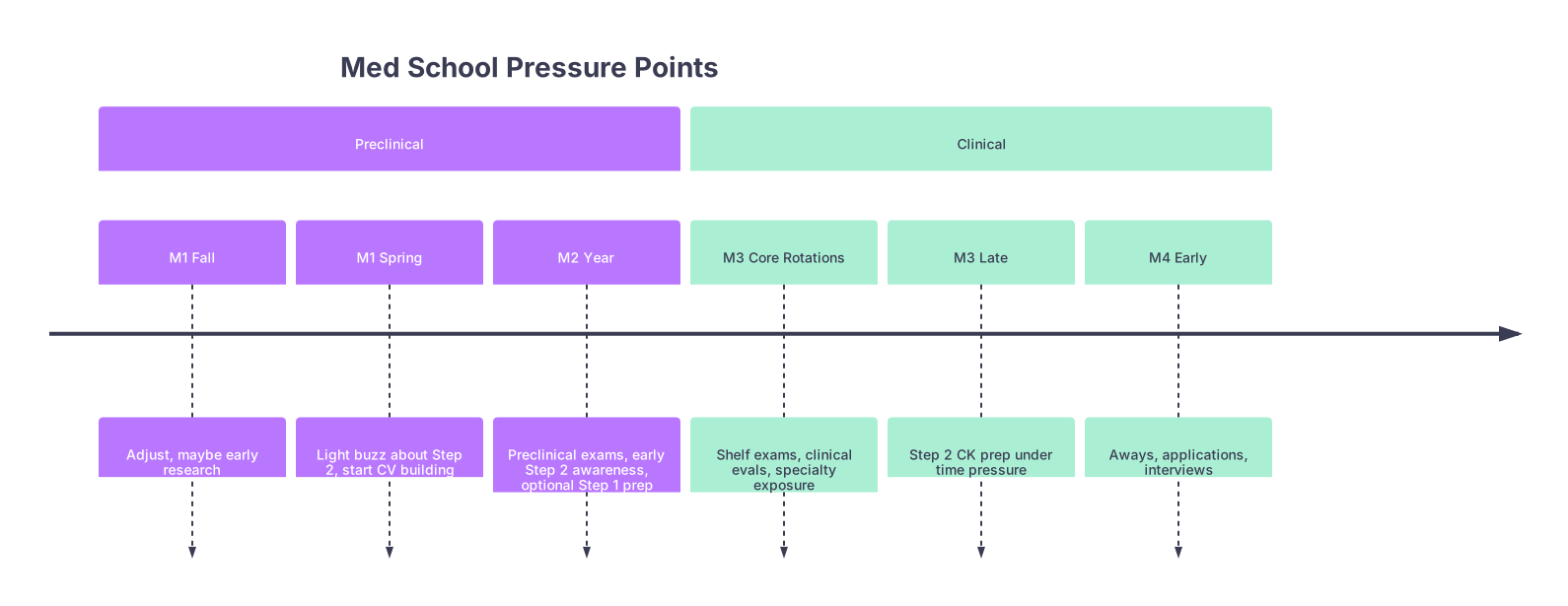
Here’s how the “new” application pressure actually feels over four years:
| Period | Event |
|---|---|
| Preclinical - M1 Fall | Adjust, maybe early research |
| Preclinical - M1 Spring | Light buzz about Step 2, start CV building |
| Preclinical - M2 Year | Preclinical exams, early Step 2 awareness, optional Step 1 prep |
| Clinical - M3 Core Rotations | Shelf exams, clinical evals, specialty exposure |
| Clinical - M3 Late | Step 2 CK prep under time pressure |
| Clinical - M4 Early | Aways, applications, interviews |
Notice where the peak is: M3–early M4. Exactly when you’re exhausted, on call, and trying to impress every resident and attending you meet.
The Bottom Line
Pass/fail Step 1 did not make matching easier for everyone. It:
- Shifted score pressure from Step 1 to Step 2 CK
- Increased dependence on school prestige, research access, and connections
- Made cutoffs more opaque and outcomes more tied to where you started
- Helped some students at strong institutions breathe a little easier early on
- Made it distinctly harder for DOs, IMGs, and lower-prestige schools to “score their way in”
You’re not crazy if this feels more chaotic and less fair. That’s exactly what happens when you remove a blunt objective filter from a high-volume, high-stakes system without fixing the underlying mismatch between applicants and positions.
You can still win in this environment. Plenty of students do. But you win by understanding the actual rules of the current game, not the marketing language people use to make themselves feel better about those rules.
Years from now, you won’t remember the slogans about “wellness” and “holistic review.” You’ll remember whether you saw the system clearly enough, early enough, to make ruthless, informed decisions about how to play it.