
Did Step 1 Pass/Fail Ruin My Chances at a Competitive Specialty?
What if the one thing that was supposed to “decrease stress” actually took away your only shot at standing out?
That’s the thought that keeps looping in my brain about Step 1 going pass/fail.
For years, everyone said the same thing: “If you crush Step 1, doors will open. Even for super competitive specialties.” Derm, ortho, plastics, ENT, ophtho, neurosurg… all had this tall, brutal, but at least clearly defined wall: a big three-digit score.
And now? No number. Just: Pass.
So yeah, if you’re sitting there thinking, “Did Step 1 pass/fail quietly kill my chances at a competitive specialty before I even started?” — same.
Let’s be honest and not sugarcoat: the change didn’t make everything easier. It just moved the pressure somewhere else. And if you’re like me, your brain immediately jumps to the worst case: “I’m going to get buried in a sea of ‘Pass’ and never stand out.”
Let’s pull this apart like someone who’s actually freaking out about it, not like a brochure written by a dean of student affairs.
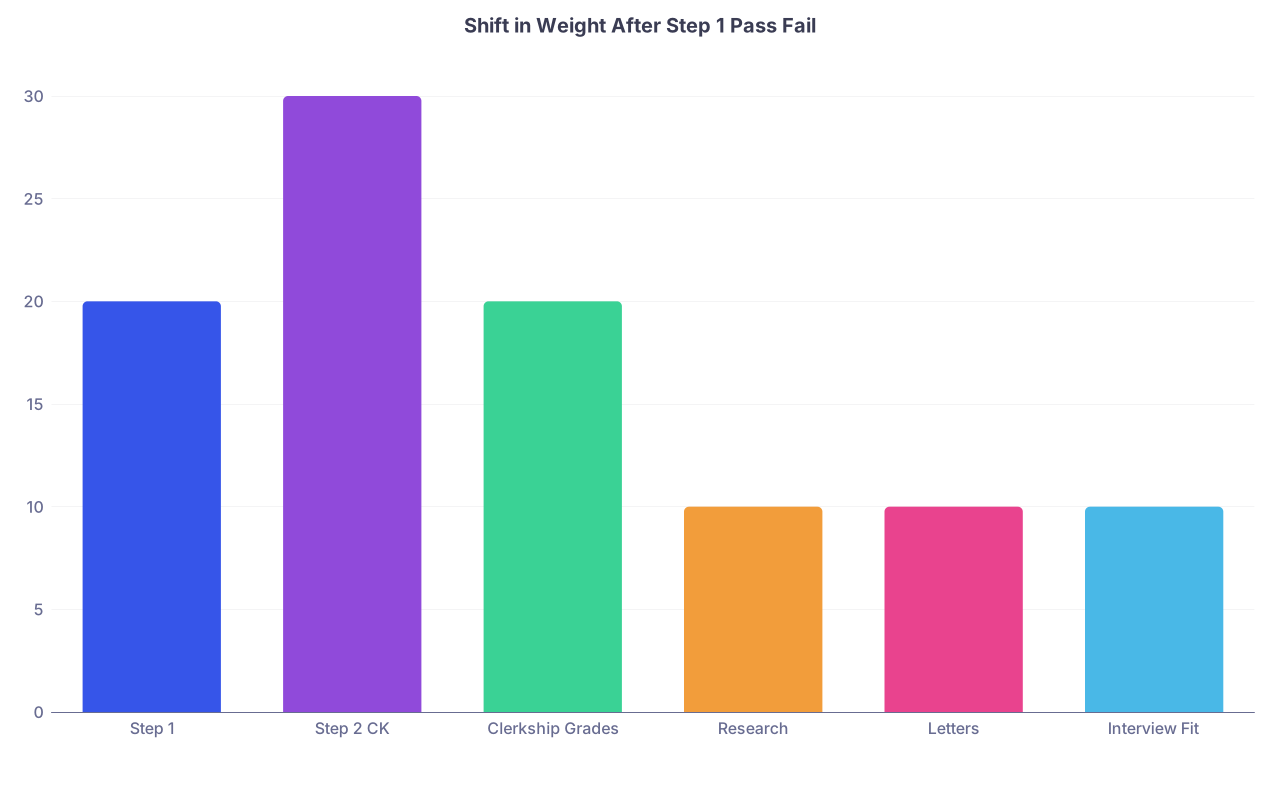
| Category | Value |
|---|---|
| Step 1 | 20 |
| Step 2 CK | 30 |
| Clerkship Grades | 20 |
| Research | 10 |
| Letters | 10 |
| Interview Fit | 10 |
What Actually Changed With Step 1 Pass/Fail?
The fantasy version that got sold to us:
“Step 1 pass/fail will reduce anxiety, improve wellness, and allow holistic review.”
The reality that a lot of upper-years and residents are whispering:
“They just shifted the obsession to other metrics.”
Here’s the core shift:
Before:
- Step 1 = giant filter. Programs could auto-screen by score. 250+? Your file got read. 220? Maybe not for derm/ortho.
Now:
- Step 1 is just: Did you survive or not.
- Step 2 CK, clinical grades, research, and “who you know” suddenly matter more.
- Competitive specialties are scrambling to find new ways to rank you… but they still have the same number of spots and even more applicants.
So no, Step 1 going pass/fail didn’t magically equalize everything. It just changed the game board.
But did it ruin your chances? Not exactly. It ruined a certain type of chance: the “I’ll brute-force this with a monster Step 1 score and overcome a weaker application otherwise” chance.
If you were counting on Step 1 as your primary redemption arc… yeah, that path is harder now.
If you’re an overall strong or even solid applicant who can grind clinically, write decently, and build relationships? You’re not doomed. You just can’t rely on one number to save you or sink you.

The Biggest Fear: “I Lost My Main Way to Stand Out”
This is the thought that keeps circling my head:
Without a Step 1 score, how the hell am I supposed to convince ortho/derm/ophtho/neurosurg that I’m not just “average”?
Because now every application reads:
- Step 1: Pass
- Step 1: Pass
- Step 1: Pass
And your brain goes, “Cool, so I’m invisible.”
Here’s the painful truth: a lot of us liked the idea of a numerical Step 1 more than we realized. Sure, it was horrible and high-stakes and soul crushing, but at least there was this delusional comfort: “If I kill it, I’m in the game.”
Now we’re forced to deal with the messier reality: standing out is less about one exam and more about the whole picture. Which is… harder to control. And that’s why it feels worse.
But programs are not sitting there saying, “Everyone is Pass. Let’s just pick randomly.”
They’ve already started shifting what they look at hardest:
| Factor | Importance Now (Competitive Specialties) |
|---|---|
| Step 2 CK | Very High |
| Clinical Grades | Very High |
| Letters of Rec | Very High |
| Research Output | High |
| School Reputation | Moderate–High |
| Step 1 Status | Low (as long as you passed) |
So no, you didn’t lose all ways to stand out. You lost the single sharpest weapon. Now you need a toolkit instead of a sniper rifle. Annoying? Yes. Impossible? No.
The New Monster Under the Bed: Step 2 CK
Let me just say the quiet part:
Step 2 CK is the new Step 1. With worse timing.
It’s now:
- Still a three-digit score.
- Closer to when you’re doing rotations and actually tired 24/7.
- More clinically oriented, which sounds nice, but also means you’re expected to be functional in real life and do exam questions at night.
Programs that used to use Step 1 score as a first-pass filter? Many are swapping in Step 2 CK without even pretending otherwise.
So the anxious thoughts kick in:
- “If I don’t demolish Step 2 CK, am I done for derm?”
- “What if my Step 2 CK is just… fine? Like 240s-ish. Is that death for ortho?”
- “Do I have to postpone my Step 2 just to study like I would have for Step 1?”
Here’s the ugly-but-honest breakdown:
- For super competitive specialties, Step 2 CK is now one of the main objective screens.
- Your Step 2 CK is also one of the few numbers that can separate you from a pile of “Pass” and “Honors/High Pass” comments.
- But Step 2 is not as all-defining as Step 1 once was, simply because everyone’s now desperate for more context: letters, performance, research.
The worst thing you could do is pretend Step 2 doesn’t matter because you’re “saving your energy” after Step 1 pass/fail. Programs are leaning on it hard. You can’t afford to be casual about it if you want competitive.
But at least here’s the tiny silver lining:
If you’re more clinically minded and hate hyper-memorization, Step 2 gives you a more fair shot than Step 1 ever did.
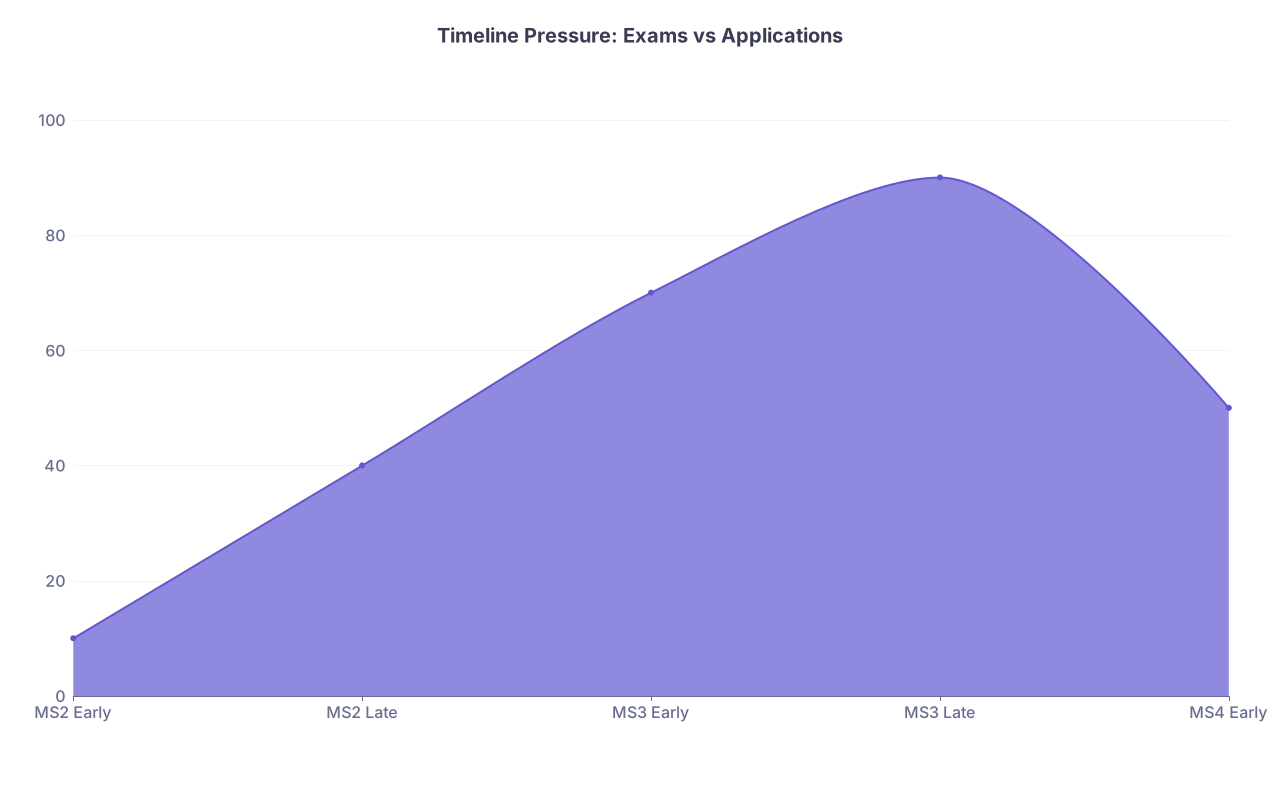
| Category | Value |
|---|---|
| MS2 Early | 10 |
| MS2 Late | 40 |
| MS3 Early | 70 |
| MS3 Late | 90 |
| MS4 Early | 50 |
“Holistic Review” Sounds Fake. Is It Real Now?
I’ll be blunt: a lot of what schools call “holistic” is PR fluff.
But in the post–Step 1 pass/fail world, programs actually have to lean more on the rest of your application, whether they want to or not. They can’t separate applicants by a simple score column anymore.
So what’s getting more attention now?
Clerkship Grades and Narrative Evaluations
Those little comments like “hard-working, reliable, great with patients” vs “quiet, reserved, needed some direction”…
Those get read. Especially in competitive fields.Class Rank / AOA / Quartiles
For schools that still use rankings, these matter more now. Programs are hungry for any way to stratify applicants.Letters of Recommendation
Not the generic “excellent student” ones. The ones that say:- “Top 5% of students I’ve worked with in 10 years.”
- “I would be thrilled to have them in our program.” Those phrases move needles more now than they did in the Step 1 era.
Research and Genuine Specialty Interest
Look — for derm, ortho, neurosurg, plastics, ophtho, ENT — research has always mattered.
Now it’s even more of a differentiator when Step 1 can’t do the sorting for them.
So yeah, “holistic review” still isn’t some soft, feelings-based process where they meditate on your soul. It’s still cold, still competitive. But it is more multidimensional now because they lost their favorite blunt instrument.

Did Step 1 Pass/Fail Help Some People More Than Others?
This is the part no one likes to say out loud, but it’s true.
Step 1 pass/fail helped:
- Students at historically strong or well-known schools.
- People with built-in institutional connections to big academic centers.
- Those whose entire application is already stacked: honors, research, letters, prestige.
Why? Because without a number to “prove” yourself from a lower-ranked or lesser-known school, reputation fills the gap. Programs will default more to:
- “What school is this?”
- “Do we know anyone there?”
- “Have we had good residents from that place before?”
So if you’re from:
- A newer med school.
- A DO program.
- An international school.
Yeah, your anxiety about “I lost my one giant scoreboard to show I can hang” is valid. Before, you could point to a 250+ and say, “Look, ignore my school, I can obviously do the work.”
Now? You have to do that proving across multiple dimensions instead of one big punch.
But this doesn’t mean you’re out. It means your margin for sloppiness is smaller. You can’t be “fine” in everything and hope a single metric will rescue you — because it doesn’t exist anymore.
You need:
- Strong Step 2 CK.
- Very good clinical performance.
- At least some research in your chosen specialty.
- 1–2 absolutely glowing letters from people who are known in the field, if possible.
Yeah, that’s a lot. But competitive specialties have always been a lot. The difference now is you can’t hide behind or be destroyed by a single test.

| Step | Description |
|---|---|
| Step 1 | Want competitive specialty |
| Step 2 | Remediate and reconsider timing |
| Step 3 | Plan Step 2 CK |
| Step 4 | Double down on research and letters |
| Step 5 | Strengthen research and away rotations |
| Step 6 | Apply broadly |
| Step 7 | Passed Step 1? |
| Step 8 | Strong Step 2 CK? |
The Dark Thought: “What If I Would’ve Crushed Step 1?”
This one hurts the most for me.
I know you’ve thought it too: “If they had just kept scores for one more year, I could’ve gone off. That could’ve been my ticket.”
You can’t prove that. I can’t either. But the fantasy is powerful.
Here’s the uncomfortable counter-question I had to ask myself:
Was I planning to put in Step 1 monster score effort… or just sort of hoping I’d rise to the occasion because the stakes were high?
Because the same level of grind that people used to pour into Step 1 is exactly what you now need to spread across:
- Step 2 CK
- Rotations
- Research
- Networking
- Personal statement and application polish
It’s not that your “chance” vanished. It’s that your chance got diluted into many smaller, less dramatic, less Instagrammable wins.
You don’t get the cinematic 260 score screenshot moment. You get a slow, unsexy accumulation of solid, consistent work.
Which, honestly, feels unfair. But program directors aren’t going back. Step 1 pass/fail is here. They’re not suddenly reintroducing three-digit scores just because we’re anxious and nostalgic for an exam we never even took in its old form.
So… Did Pass/Fail Ruin My Chances or Not?
Here’s my blunt answer:
- If your whole plan was “I’ll save everything by nuking Step 1 with a huge score and not worrying as much about research, relationships, or clinical stuff” — that path is basically gone.
- If you’re willing to attack multiple parts of your application with seriousness — your chances are not ruined. They’re just more work and less predictable.
Competitive specialties still need residents. They still need people who show up, care, and don’t crumble on call at 3 a.m.
Step 1 pass/fail:
- Removed one big way to differentiate.
- Forced programs to care more about Step 2, rotations, and letters.
- Tilted the field slightly toward people with stronger schools and networks.
It did not:
- Automatically kill the dreams of anyone not born into a top-10 med school.
- Turn derm/ortho/ENT/etc into secret invite-only clubs.
You’re not out of the game. You’re just not playing the game you thought you’d be playing when you first walked into MS1 orientation.
What You Can Actually Do Next (Instead of Just Spiral)
You can’t bring back 3-digit Step 1. You can’t change your school’s name, or magically erase how competitive some specialties are.
But you can move some real levers.
Today — like literally today, not “someday when I feel ready” — do this:
- Pick one competitive specialty you’re seriously considering. Just one.
- Email or message a resident in that field at your institution. Something simple like:
“Hi Dr. X, I’m an MS2/MS3 at [School]. With Step 1 now pass/fail, I’m really trying to figure out what actually matters to be a realistic applicant for [specialty]. Would you be open to a 15–20 minute chat sometime this month about what strong applicants in the current era actually look like?” - Put that on your calendar. Prepare 4–5 specific questions. Ask them how people from your school match. Ask what made the successful ones stand out post–pass/fail.
Don’t just stew in Reddit threads written by people you’ll never meet.
Open your email right now and draft that message to one resident or attending in your target specialty. The sooner you replace vague panic with specific intel, the less this Step 1 pass/fail thing feels like it ruined your chances — and the more it becomes just one annoying twist in a path you can still walk.