
It is late. You are sitting in the call room, refreshing your email. Again. Step 1 says “Pass” on your score report, and now every advisor keeps repeating the same two words: shadowing and research.
You start thinking: “Maybe if I just get on a couple of projects and follow a famous attending around clinic, I will be fine.” You open a dozen PubMed tabs, skim a few faculty bios, and send three generic emails asking if anyone “has any research opportunities available.”
Then nothing happens. Or worse, something does happen, and you commit to the wrong things, with the wrong people, for the wrong reasons. And you burn a year doing work that does not move the needle for residency selection committees that no longer see your Step 1 score.
Let me be direct: in the post–Step 1 score world, bad shadowing and bad research choices are not neutral mistakes. They are actively harmful. They waste your limited time, dilute your narrative, and make you look unfocused or unserious in the eyes of programs.
This is the landmine field you are walking into. Let’s mark the mines clearly.
How the Post–Step 1 World Actually Changed the Game
Before we get into mistakes, you need to understand the new playing field. A lot of students misunderstand this part and screw up everything downstream.
, Research, LORs, Clinical evals, Shadowing](https://cdn.residencyadvisor.com/images/articles_svg/chart-residency-application-emphasis-after-step-1-pass-f-2265.svg "Residency Application Emphasis After Step 1 Pass/Fail")
| Category | Value |
|---|---|
| [Step 2 CK](https://residencyadvisor.com/resources/step1-pass-fail-era/step-1-pf-study-habits-that-sabotage-step-2-ck-performance-later) | 35 |
| Research | 20 |
| LORs | 20 |
| Clinical evals | 20 |
| Shadowing | 5 |
What really shifted after Step 1 went pass/fail:
- Programs lost a clean, numeric early filter.
- Step 2 CK gained weight.
- Everything else that helps them rank you against hundreds of similar applicants became more important: research, letters, clinical performance, signals of genuine interest in the field.
Here is the mistake: many students heard “Step 1 is pass/fail now” and translated that to “I must fill my CV with shadowing and research to compensate.” That is sloppy thinking.
Correct translation is closer to: “With fewer hard numbers, programs will pay more attention to the quality and coherence of what I do. Not the raw quantity.”
So if your plan is “collect 6 shadowing experiences and 5 random poster abstracts,” you are already walking into the trap.
Shadowing: The Most Overrated, Misused Checkbox
Shadowing is not evil. But the way most students use it? Useless at best, suspicious at worst.
Pitfall #1: Treating Shadowing as a Volume Game
The classic mistake: “I shadowed 12 different specialties, that will show I am well-rounded.”
No. That shows you are indecisive, or worse, padding. Especially in the clinical years or when applying for residency, a long list of short, shallow shadowing stints throws a red flag.
Programs want to see:
- A coherent interest in the specialty you are applying to.
- Depth: sustained exposure, not tourist medicine.
- Evidence that you understand the day-to-day reality, not just one glam clinic day.
Two weeks with one surgeon who later writes a strong letter for you is far more powerful than “orthopedics 4 hours, ENT 3 hours, derm 6 hours, neurosurgery 2 half-days.”
Do not make the mistake of chasing variety over depth. After M2, the “exploratory phase” excuse fades fast.
Pitfall #2: Shadowing With Ghost Attendings
I see this constantly. A student proudly lists: “Shadowed Dr. X for 80 hours.” I ask: “Great, what did you actually do?” The answer is usually vague:
- “I rounded with the team.”
- “I watched procedures.”
- “I sat in on clinic.”
Then I ask, “Does Dr. X know you well enough to talk about your work ethic or judgment in a letter?” Silence.
If your shadowing does not lead to:
- A potential letter writer,
- A clear, specific insight about the specialty,
- Or a concrete experience you can describe in detail at interviews,
then it is weak. It is not that it hurts you; it just fails to help when you really need it.
Programs are tired of generic “I shadowed and confirmed my passion for medicine” statements. They are looking for candidates who can say, “I spent eight months consistently in Dr. Y’s clinic, saw how they handled [specific situation], and it changed how I think about [X].”
Pitfall #3: Using Shadowing to Avoid Real Work
Here is the ugly truth: shadowing is easy. Show up, stand in the back, nod, leave. No deliverables. No deadlines. No accountability.
So when students are anxious about Step 2, research, or real clinical performance, many of them retreat into endless shadowing. “I am doing something productive,” they tell themselves. No, you are hiding.
Shadowing does not:
- Improve your Step 2 score.
- Prove you can handle responsibility.
- Show that you can complete long-term work.
A program director will value a strong Sub-I evaluation or a completed QI project far more than your 40th shadowing hour. If shadowing starts to cannibalize study time or real clinical opportunities, you are making a very expensive mistake.
Research: Where Most Students Waste a Year
Now for the other landmine: research. Post–Step 1, there is more pressure and more confusion here than almost anywhere else.

Pitfall #4: Chasing “Research” Without Understanding What Counts
Not all research is equal in the eyes of residency programs. You know this in theory, but I see students act like any line on their CV is interchangeable: case report, bench work, QI, multicenter trial—they just want more bullet points.
What actually matters:
- Is it in or near your chosen specialty?
- Did you see it through to a visible endpoint (poster, presentation, publication, or at least a submitted manuscript)?
- Can you speak about it intelligently when grilled by an attending who actually reads the literature?
If you have five “ongoing” projects in three unrelated fields and zero completed outputs, committees will see it for what it is: scattered, non-committal, and probably superficial.
Do not let your CV become a graveyard of half-finished projects.
Pitfall #5: Saying Yes to the Wrong PI
This one burns people badly.
You get an email back: “Sure, we always have things for students to help with.” You get excited, say yes, and months later you realize:
- The PI is overextended and barely remembers you.
- There is no clear project ownership; you are just “helping.”
- Your name is buried in the middle of a 12-author list, if you get added at all.
- There are no clear timelines, no specific aim that is yours.
Then it is too late. You have sunk 6–12 months into something that gives you almost nothing tangible.
Signs you are about to make this mistake:
- The first meeting is vague: “We will figure out a project for you later.”
- There is no written plan or shared document outlining your role.
- You never get access to data, IRB materials, or project timelines.
- Nobody says the words: “If you do X, Y, and Z, you will be first/second author on [specific output].”
Pick PIs who are:
- Known to regularly publish with students.
- Specific about projects and expectations.
- Willing to meet periodically (even briefly) and actually review your work.
If your first conversation feels like you are begging and they are doing you a favor, that is the wrong power dynamic. You will be forgotten the moment a more aggressive student shows up.
Pitfall #6: Confusing Time Spent With Value Created
Another classic trap: “I did a year of research; programs will love that.”
Not necessarily. A “research year” without outputs is just a gap year with extra buzzwords.
| Type of Research Year | First-Author Outputs | Specialty Alignment | How Programs See It |
|---|---|---|---|
| Strong | 1–2 | High | Commitment + productivity |
| Moderate | 0–1 | Medium | Neutral to slightly positive |
| Weak | 0 | Low/unclear | Red flag: what did you do? |
I have seen students spend an entire year “helping with data collection” and end up with nothing listed as first or second author. On paper, they look worse than someone who stayed in school, crushed Step 2, and did one solid project to completion.
If you are going to do a research year:
- Get clear commitments about at least one project where you are lead or near-lead.
- Demand timelines: abstract by Month 3–5, manuscript draft by Month 9–12.
- Track your own progress aggressively; do not assume “things are moving” just because you show up to lab.
Otherwise, you are gambling a full year of your training for very little return.
The Step 2 Trap: Letting Shadowing and Research Eat Your Study Time
This is the part no one likes to admit. Step 2 CK is now the primary standardized number programs use to filter. You cannot afford to let it slide.
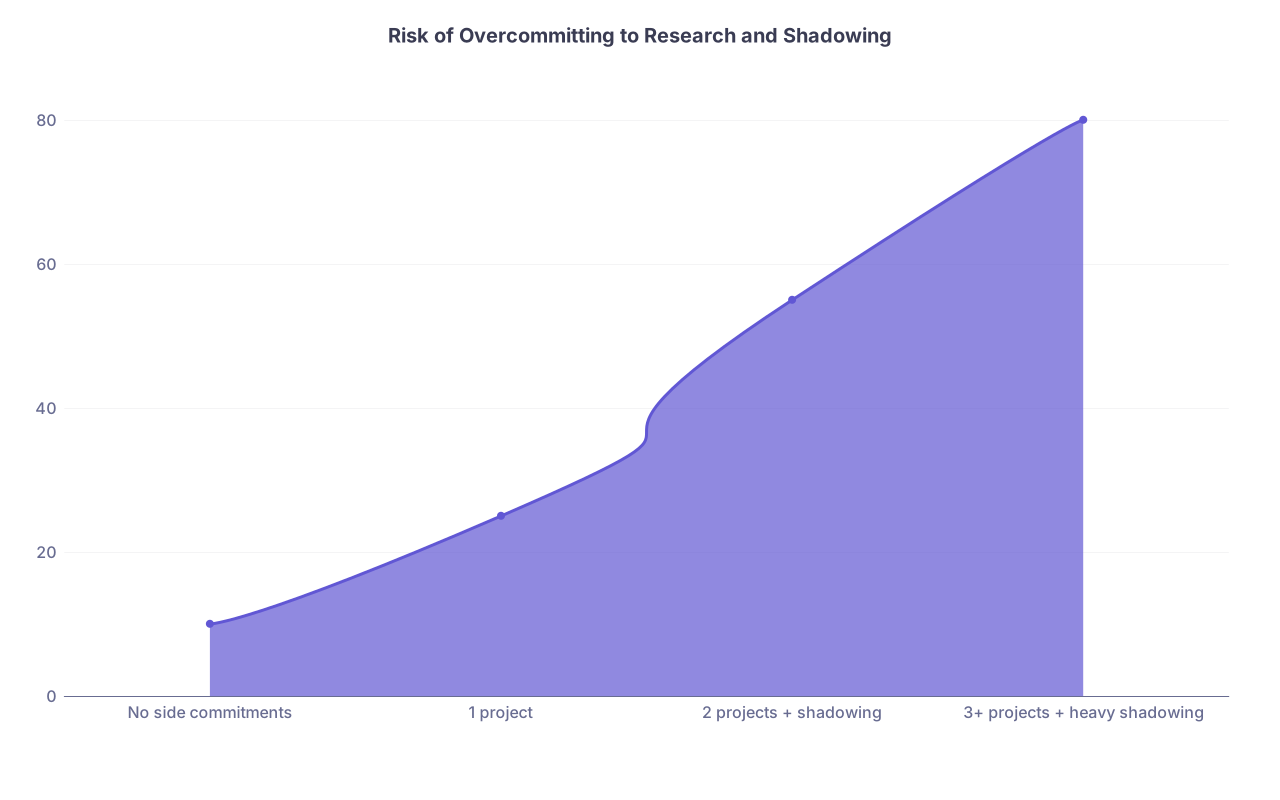
| Category | Value |
|---|---|
| No side commitments | 10 |
| 1 project | 25 |
| 2 projects + shadowing | 55 |
| 3+ projects + heavy shadowing | 80 |
Those percentages are not actual study data, but they match what I have seen: the more half-baked extracurriculars people pile on during their dedicated or pre-dedicated period, the higher the risk that Step 2 suffers.
Here is the common, disastrous sequence:
- Step 1: Pass.
- Mild relief → overconfidence.
- Take on 2–3 research projects + ongoing shadowing + maybe a longitudinal clinic.
- Push Step 2 studying “a bit later.”
- Realize too late that Step 2 is the new gatekeeper. Score ends up mediocre for your target specialty.
In competitive fields—derm, plastics, ortho, ENT—that one mediocre Step 2 can erase the benefit of all that weak research and scattered shadowing.
Harsh reality: a 10–15 point higher Step 2 score will open more doors than three extra “abstracts submitted” and 40 more hours of shadowing.
If an activity is actively cutting into quality Step 2 study time, you had better be very sure it is worth it. Most are not.
Making Shadowing Actually Work For You
Now, how to avoid the dumb mistakes and use shadowing properly.

Focus on Three Things: Depth, Relationship, Reflection
You want:
- Depth: repeated contact over time with the same attending or team.
- Relationship: someone who can credibly say, “I have seen this student work.”
- Reflection: specific, concrete stories you can use in personal statements and interviews.
That means:
- Pick 1–2 attendings in your field of interest and commit to regular shadowing/clinic attendance for months, not days.
- Show up prepared: read about their patients, their clinical interests, their recent publications.
- Offer small but real help (within your scope): organizing notes, pre-reading charts, following up on patient education materials.
Then pay attention. Take notes after each session. Not “I saw cool surgery.” Instead:
- “Observed Dr. A manage a difficult family meeting; learned X about communicating uncertainty.”
- “Watched how Dr. B handled an OR delay and team conflict; saw the reality of leadership under pressure.”
Those are interview stories. That is how shadowing becomes value.
Making Research Actually Work For You
Research is powerful when it does three things: aligns with your specialty, shows completion, and demonstrates you can handle real responsibility.

| Step | Description |
|---|---|
| Step 1 | Offered Research Opportunity |
| Step 2 | Low priority or decline |
| Step 3 | Ask for defined role or walk away |
| Step 4 | Request milestones |
| Step 5 | Commit and track progress |
| Step 6 | Aligned with target specialty |
| Step 7 | Clear project ownership |
| Step 8 | Timeline and output defined |
Key rules to avoid the usual landmines:
- If you cannot explain the project’s question and your role in two sentences, you do not understand it well enough. That will show in interviews.
- If there is no plausible endpoint (poster, presentation, paper, solid QI implementation) within 6–12 months, be skeptical.
- Quality beats raw numbers. One first-author paper or well-done QI project can outweigh five lines of vague “data collection assistance.”
And do not lie to yourself: “We are writing the manuscript” for 18 months straight is code for “this is probably never getting submitted.” Recognize a dead project and either resurrect it with urgency or cut your losses.
Balancing All of This Without Burning Yourself
You get one career. You do not need to win the “most busy MS2” Olympics.
Here is a saner benchmark for many students (not everyone, but a lot of you):
- During pre-clinical years: 1–2 research projects max, ideally one with clear completion; limited, exploratory shadowing.
- During core clinical year: focus on clerkship performance, Step 2 study; keep only research with clear short-term outputs.
- During specialty decision year: targeted shadowing in your field, 1–2 substantial research products aligned with that field.
If your weekly schedule has you:
- Shadowing 2 evenings,
- Doing research 3–4 other evenings,
- And “planning” to really get serious about Step 2/3 “soon”,
you are overcommitted and setting yourself up for mediocrity in the one metric programs still quantify heavily.
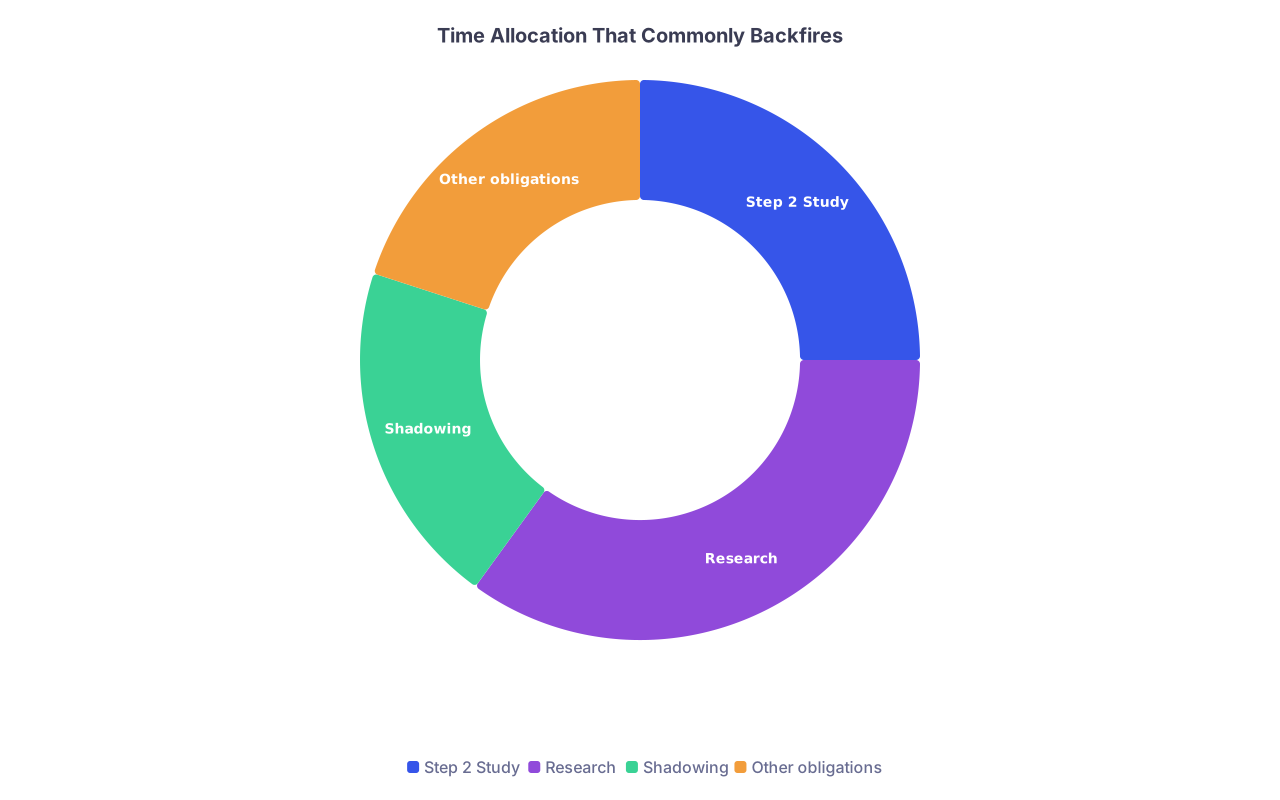
| Category | Value |
|---|---|
| Step 2 Study | 25 |
| Research | 35 |
| Shadowing | 20 |
| Other obligations | 20 |
That distribution looks impressive. It is also how students end up with lukewarm Step 2 scores and unimpressive outputs. They spread themselves too thin to be excellent at any of it.
Subtle Red Flags You Do Not Want on Your Application
A few patterns that quietly make committees uneasy:
- CV with 10+ “experiences” but almost no leadership or sustained involvement.
- Research spanning six unrelated areas with no clear concentration.
- A “research year” with nothing but “in progress” projects.
- Personal statement claiming deep interest in a field but only 5–10 scattered shadowing hours.
- Letters that describe you as “pleasant” and “interested” but never “reliable,” “driven,” or “critical thinker.”
These are the tells that you were in motion all the time, but not actually moving forward.
FAQs
1. Do I need a dedicated research year now that Step 1 is pass/fail?
Usually no. A dedicated research year is justified if you are aiming for very competitive specialties (derm, plastics, ENT, ortho, neurosurgery) and your application is otherwise borderline: mid-range Step 2, weak early research, or late specialty decision. Even then, the year only helps if you produce actual outputs. If you can get 1–2 solid first-author products without leaving the normal curriculum timeline, that is often just as good.
2. Is shadowing still important after I start clinical rotations?
It shifts in purpose. Before clinicals, shadowing helps you explore. After clinicals, it should be targeted: reinforcing your chosen specialty, strengthening relationships with potential letter writers, and giving you specific stories for your application. Ten more hours of random shadowing in a field you are not pursuing is wasted effort in the later years.
3. How many research projects should I list on ERAS?
List what is honest and defensible. There is no magic number. I would rather see 2–4 meaningful, clearly described projects (with your role and outcome) than 9 vague “ongoing” ones. If you cannot clearly remember and explain a project, cut it. The worst thing you can do is list fluff and then stumble when an interviewer asks, “Tell me about this study.”
4. What if my PI is slow and the paper is delayed past application season?
Then you emphasize what you can: abstracts, posters, local presentations, and your actual contribution. Label things accurately—“manuscript in preparation” is fine if it really is being written, but if nothing has been drafted, do not mislead. In your personal statement or experiences, you can still talk briefly about the scientific question and what you learned, but do not oversell the productivity.
5. How do I say no to new shadowing or research opportunities without burning bridges?
Be straightforward and respectful. Something like: “Thank you very much for thinking of me. Right now I am focusing on Step 2 and completing my current research commitments so I can produce high-quality work. I do not want to take on a new project that I cannot fully commit to.” Most attendings respect that. The people who do not respect boundaries are the same ones who would have happily used your time without giving much back.
Open your current CV or activities list today. Circle every shadowing and research item that has not led to a concrete product, relationship, or specific story you can tell. If more than half of them are just “filler,” you have your warning. Your next move is not to add more. It is to cut ruthlessly, double down on what actually matters, and stop making the mistakes that quietly sink people in the post–Step 1 score world.