
What if the “extra freedom” from pass/fail Step 1 quietly becomes the reason you struggle to match into the specialty you actually want?
Let me be blunt: pass/fail Step 1 did not give you free time. It shifted where the pressure lands. If you treat this as bonus vacation instead of reallocated responsibility, you will regret it around MS3–MS4 when everyone suddenly starts panicking about Step 2, research, and letters of recommendation.
This is where a lot of smart students miscalculate.
They think:
- “Residencies only care if I pass now.”
- “I will get serious before clerkships.”
- “I deserve a break after pre-clinicals.”
Then they wake up M3 with:
- a mediocre knowledge base
- weak or nonexistent research
- no meaningful mentorship
- and Step 2 suddenly carrying their entire application.
Let’s go through the biggest mistakes students make with this “extra” time in the pass/fail Step 1 era—and how to avoid being one of them.
1. Treating “Pass/Fail” as “Irrelevant”
The most dangerous thought I hear: “Step 1 is pass/fail, so it does not really matter anymore.”
Wrong. It changed how it matters, not if it matters.
Why this mindset hurts you
Your Step 1 base is your Step 2 ceiling.
Step 2 is now the objective filter. If your MS1–MS2 and Step 1 prep are lazy, Step 2 becomes an uphill sprint instead of a controlled climb. I have watched students with “I just need a pass” energy end up stuck at 230–240 on Step 2 when their peers break 250+ because those peers actually treated Step 1 content seriously.Your clinical performance depends on it.
Weak Step 1 knowledge shows up brutally on:- Shelf exams
- Inpatient presentations
- Sign-outs and handoffs
Residents notice when you do not know basic pathophys for a patient you prerounded on.
Programs still see your school’s Step 1 pass rate and rigor.
You think programs ignore Step 1? They do not. They look at:- school reputation
- historical Step 1 performance
- how prepared your med school’s grads have been on the job
If your school visibly drops in quality because everyone slacks, that stigma hits your entire class.
What not to do with this mindset
Do not:
- Stop doing Anki or active recall because “I’ll figure it out before Step 2.”
- Skip pathophys details and only memorize clinical buzzwords.
- Cram just enough to pass NBME-style questions and call it “efficient.”
Better rule:
Act as if Step 1 still gave a score—but your score shows up one year later on Step 2.
2. Wasting the Only Flexible Time You Will Ever Have
Here is the brutal truth:
MS1–MS2, especially with P/F Step 1, is the most flexible block of your entire training. And far too many students squander it.
They say things like:
- “I will start research in MS3.”
- “I will think about specialties later.”
- “I just want to survive pre-clinicals first.”
That procrastination is expensive.
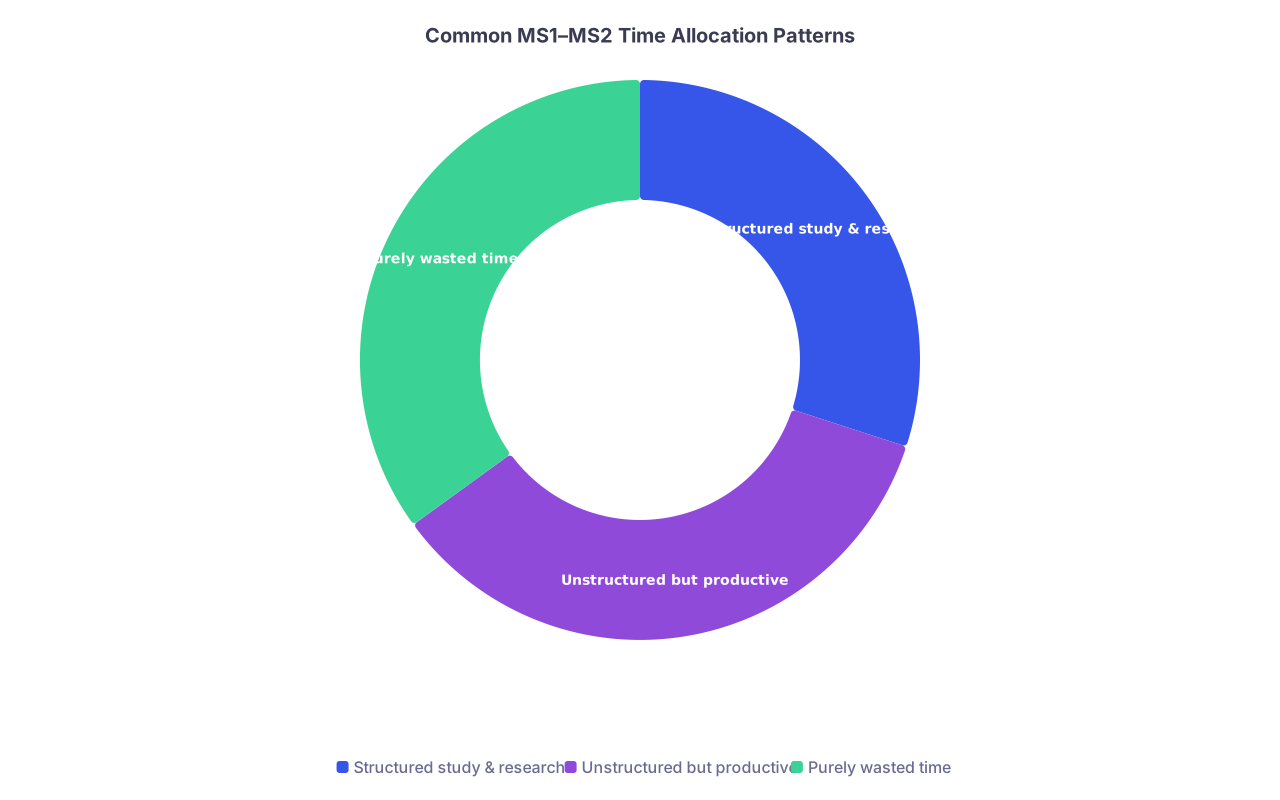
| Category | Value |
|---|---|
| Structured study & research | 30 |
| Unstructured but productive | 35 |
| Purely wasted time | 35 |
Where people waste this “extra” time
Low-value, high-time-drain activities
- Mindlessly watching low-yield YouTube med content
- Re-writing or beautifying notes instead of actually learning
- Endless group “study” sessions that are mostly gossip and shared anxiety
Unplanned social sprawl
I am not anti-social life. You need it. But unbounded:- nights out
- long gaming sessions
- daily 2–3 hour “relax time”
quietly eat 20–30 hours per week. That is a part-time job worth of focus, gone.
Pseudo-productivity
You know this one:- “Organizing” Anki decks for hours
- Buying planners, rearranging schedules, color-coding calendars
- “Researching” resources instead of using the ones you already have
What you should not assume
Do not assume:
- “I can cram research later during an easy rotation.”
You will not. Most rotations are not easy. The “easy” ones fill with life tasks you deferred. - “I will figure out Step 2 after I see real patients.”
Without solid preclinical knowledge, real patients are noise, not teaching tools.
Treat your MS1–MS2 weeks like this:
- Protected blocks for: knowledge building, early CV building, and exploratory experiences.
- Not: extended undergrad 2.0.
3. Ignoring Early Research and Mentorship
One of the most damaging misuses of the pass/fail Step 1 era: delaying research and mentorship until “after boards.”
There is no “after boards” anymore. There is just:
- before clerkships
- and after clerkships
and by the time you are neck-deep in wards, you will not have clean, uninterrupted time blocks to start things from zero.
Common mistakes here
Waiting for the “perfect” research project
Students reject:- chart review projects
- QI (quality improvement) projects
- case reports
because they want “high-impact basic science” or “R01-level” work.
Meanwhile, their classmates quietly stack 2–5 modest but completed projects and line up letters.
Not emailing faculty early
Students think they should:- finish some classes first
- get a Step 1 pass
- or “be more prepared”
before contacting mentors.
By the time they finally email, the best projects are full or near completion.
Talking to only one mentor and stopping
This is a big one. You:- meet one attending
- get vague encouragement
- they never loop you into active work
and you interpret that as “there are no opportunities here.” No. You just stopped too soon.
Habits to avoid
Do not:
- Tell yourself “I will become competitive with just a strong Step 2 score.”
For competitive specialties, scores alone are not enough. - Wait until MS3 to build specialty-specific relationships.
- Overcommit to a huge, long-shot basic science project as your only research outlet.
Smarter move:
- Start with small, finishable projects in MS1–early MS2.
- Add complexity later once you have proof you follow through.
4. Letting Your Knowledge Decay Between Blocks
The pass/fail change tempted a lot of schools to soften or de-emphasize high-stakes exams. That sounds great until you realize something ugly: you can get through pre-clinicals while forgetting a disturbing amount of content between blocks.
This is the student who says:
- “I did fine on each unit exam; I’m good.” While:
- failing or barely passing NBMEs
- repeatedly missing integrative or multi-step questions
- realizing late that systems never truly “ended,” they just stopped being tested locally.
How Step 1 used to protect people from themselves
When Step 1 had a numerical score:
- Fear forced students to constantly spiral back to old material.
- There was a guaranteed, high-stakes endpoint that punished knowledge decay.
Now, pass/fail:
- Removes the emotional forcing function.
- Encourages “I’ll review later” thinking—which often evolves into “I never reviewed at all.”

| Step | Description |
|---|---|
| Step 1 | Block exam passed |
| Step 2 | No spaced review |
| Step 3 | Forget prior systems |
| Step 4 | Weak NBME practice |
| Step 5 | Minimal remediation |
| Step 6 | Enter clerkships with gaps |
| Step 7 | Struggle on shelves and Step 2 |
| Step 8 | Limited specialty options |
Specific behaviors that erode your foundation
Avoid:
- Studying for block exams only with the block’s slides + a few question banks.
- Dropping Anki or spaced repetition immediately after each test.
- Never touching multi-system resources (UWorld mixed, NBME practice) until dangerously late.
You might pass Step 1.
You might even do ok on shelves.
But your Step 2, your confidence on the wards, and your actual ability to practice medicine will eventually show those cracks.
5. Overcorrecting into Unhealthy, Performative Hustle
Let us swing to the opposite mistake. Some students, terrified of “wasting” the new flexibility, turn their lives into a nonstop grind—and still manage to waste time in a different way.
They:
- Join 8 student orgs
- Sign onto 6 research projects
- Work as tutor, scribe, and TA
- Try to pre-study for every clerkship during MS2
And underneath the noise, their Step 1 knowledge? Shaky.
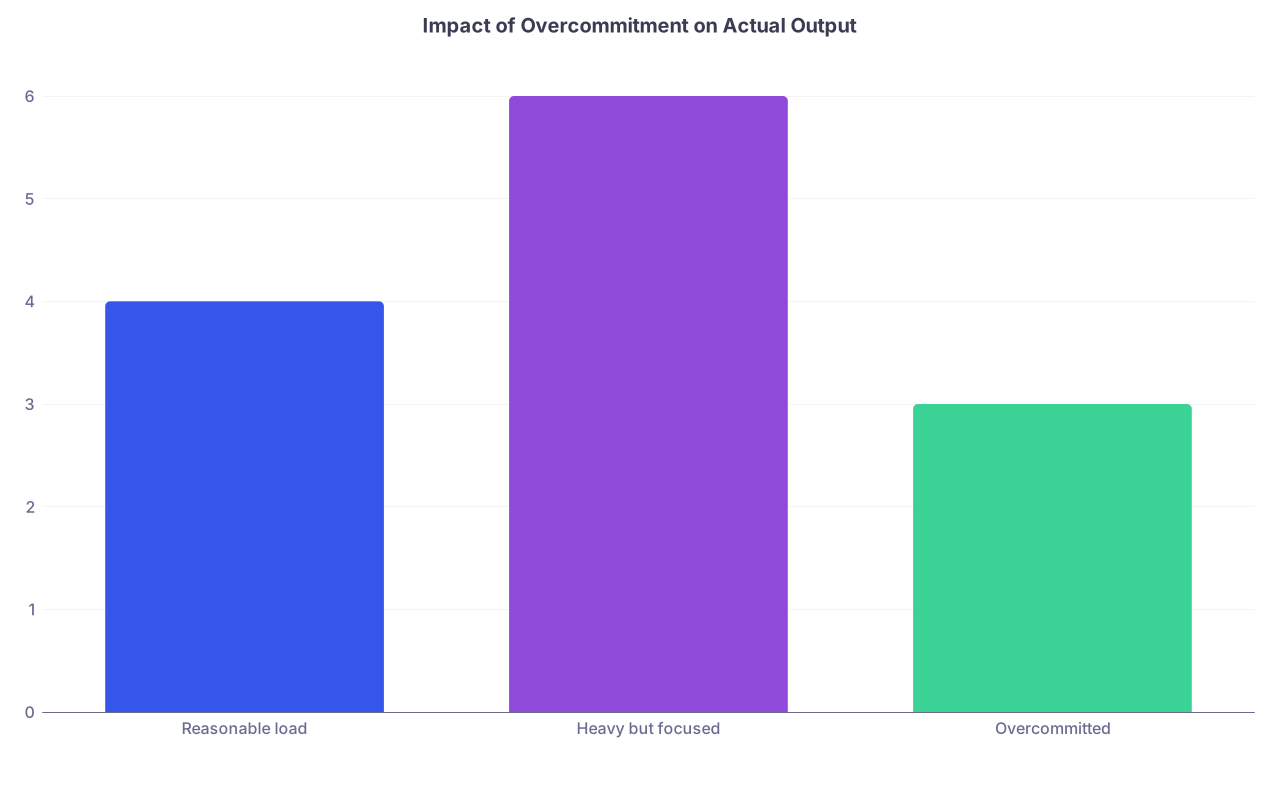
| Category | Value |
|---|---|
| Reasonable load | 4 |
| Heavy but focused | 6 |
| Overcommitted | 3 |
(Values here represent an approximate number of completed meaningful outputs—papers, presentations, projects—over 2 years.)
What goes wrong with the hyper-hustle
Shallow engagement
You “join” projects but:- never push them to completion
- cannot articulate your role
- have nothing concrete to list except vague “involvement”
No recovery time
Constant stress without rest:- worsens memory formation
- fuels burnout during clerkships
- makes you resent medicine before you even touch wards
Performative productivity
A lot of these choices are about looking busy:- padding your CV for peers, not programs
- saying “I am on three projects” instead of “I published one good paper”
Residency PDs can smell fluff activities. They care more about: - continuity
- depth
- completion than raw numbers.
Habits to avoid here
Do not:
- Fill every spare hour with “extras” while your fundamentals suffer.
- Say yes to every project because you fear missing out.
- Use busyness to cover up poor focus and inefficient studying.
Better approach:
- 1–3 meaningful ongoing commitments
- Heavy emphasis on actual mastery of core material
- Protected downtime that you guard as fiercely as study blocks
6. Completely Ignoring Specialty Exploration
A lot of MS1–MS2 students tell themselves:
“I will not think about specialties until I work with them on the wards.”
Sounds reasonable. It is also how you end up:
- discovering you love dermatology… in late MS3
- with zero derm research, zero mentors, and one away rotation slot left (already taken)
Or:
- deciding you actually want ortho
- right when you realize you have never touched ortho research and your Step 2 is average

Common early-exploration mistakes
Equating interest with commitment
Some students avoid exploring because they worry:- “If I join the neurology interest group, I am locked in.”
Completely wrong. Early exposure is reconnaissance, not marriage.
- “If I join the neurology interest group, I am locked in.”
Waiting for formal rotations to test interests
By then:- your schedule is less flexible
- your time is consumed by shelf prep
- opportunities require much more effort to engage
Relying only on online forums for specialty impressions
You read:- “Derm is impossible without 20 publications”
- “ENT requires a 260+”
and you self-eliminate before you even talk to a human in that field.
What not to do with your “extra” time
Do not:
- Spend zero time in interest groups, departmental talks, or shadowing.
- Make all specialty decisions based solely on competitiveness fear.
- Assume your Step 2 score will be known early enough to decide everything.
Use early time to:
- Try on identities.
- Listen to how attendings talk about their daily lives.
- See what actually fits your tolerance for call, OR time, clinic volume, procedure vs. cognitive work.
7. Letting Wellness Slide Under the Guise of “No Pressure Yet”
One of the most subtle misuses of this new era: using the lower perceived pressure of Step 1 to justify unhealthy habits that will wreck you later.
You hear:
- “I do not need strict sleep right now.”
- “I will fix my diet later once rotations start.”
- “I can deal with mental health after boards.”
Boards never “end.” Step 1 → Step 2 → Step 3 → in-service exams. There is no magical wellness window if you do not protect it now.
Self-sabotaging wellness patterns
Chronic sleep debt disguised as “grind”
- Studying until 2–3 am for normal preclinical weeks
- Using caffeine and energy drinks as baseline, not sparingly
Your memory worsens. Your Step 1 and Step 2 retention both get hit. This is not sacrifice; this is poor technique.
Zero boundaries with tech
Phone always on desk:- doomscrolling between cards
- “just checking” Instagram between UWorld blocks
You train your brain to fragment focus. That habit does not magically reverse when Step 2 suddenly becomes “serious.”
Ignoring emerging anxiety or depression
Many students think:- “I am just stressed from school; it will pass.”
Without: - talking to counseling
- exploring medication if needed
- building real support systems
They carry worsening symptoms right into clerkships, where the stakes (and the hours) are higher.
- “I am just stressed from school; it will pass.”
This is not “free time” to ignore wellness. It is the ideal time to:
- build sleep discipline
- set social media boundaries
- get therapy or counseling in place before you are drowning in clinical duties.
8. Mismanaging Step 1 Prep Itself Because “I Only Need to Pass”
Let me be clear: doing too little for Step 1 is one disaster. But there is another: using inefficient, panicked methods that waste months.
Typical missteps:
- Cycling through 4–5 different question banks “to be safe”
- Watching full-length lecture series twice
- Over-outlining First Aid as if it is a textbook
| Behavior | High-Yield or Wasted? |
|---|---|
| Single main Qbank + careful review | High-Yield |
| Two full Qbanks with shallow review | Often Wasted |
| Daily spaced repetition (Anki, etc.) | High-Yield |
| Rewriting lecture notes | Wasted |
| Targeted NBMEs with remediation | High-Yield |
Patterns I see that backfire
Resource-hopping
Students feel behind because they:- see peers using different resources
- watch YouTube influencers hawk new “must-have” tools
Result: they jump ship every few weeks, never get deep with any system, and stay mediocre across all of them.
All-video, no active recall
They:- binge Boards & Beyond / Pathoma / Sketchy
- feel “productive”
- can explain concepts but cannot answer a single NBME-style question under pressure
Panic compression
They under-prepare during preclinicals then:- attempt a 4–6 week “all-out” dedicated
- neglect sleep, nutrition, exercise
- hope adrenaline will cover for 2 years of weak habits
It doesn’t.
Even with pass/fail, Step 1 still demands:
- a clean, efficient, active-recall-based approach
- gradual ramp-up, not last-minute thrashing
9. Pretending the Match Hasn’t Changed Because Step 1 Did
Here is the quiet, uncomfortable shift: when Step 1 lost its score, something else had to take that weight.
That “something else” is:
- Step 2 CK
- your clinical grades
- your letters and research
If you treat Step 1’s pass/fail status as a license to disengage early:
- you arrive at the high-stakes stages underdeveloped and late
- you are competing against classmates who used that time strategically
You might not feel this in MS1. You will definitely feel it when:
- you are scrambling to pad your ERAS app in MS4
- specialties you might have loved are suddenly off the table
- PDs see an application that screams “late bloomer” in the worst way
FAQs: Early Habits in the P/F Step 1 Era
1. If Step 1 is pass/fail, should I still treat it like a scored exam?
Not exactly—but you should treat the content like it still matters deeply. Your mindset should be: “My Step 1 work is training for Step 2 and for wards.” You can dial down perfectionism around marginal details, but you cannot coast. Aim for the level of mastery that would historically have earned you a solid score, because that is what Step 2 will demand.
2. How much time should I realistically give to research during MS1–MS2?
Avoid both extremes—0 hours and 20 hours per week. A realistic target for most students: 3–6 focused hours weekly once you are stable with classes. That is enough to:
- move 1–2 projects forward
- get your name on a poster or abstract
- build relationships
without sabotaging your study bandwidth.
3. Is it a mistake to decide my specialty early in MS1 or MS2?
The mistake is not deciding early; it is locking in early. Exploring and leaning toward a specialty is smart. Tattooing it on your identity and ignoring all other fields is dumb. Use early years to test hypotheses: “I think I like anesthesiology—let me shadow, find a mentor, and do one project” rather than “I am definitely anesthesia and nothing else.”
4. What is the biggest misuse of time you see after Step 1 goes P/F?
The worst pattern is drifting: doing just enough to pass classes, no meaningful spaced repetition, no early research, no mentorship, no specialty exploration—while telling yourself you are “keeping options open.” You are not keeping options open. You are slowly closing them by failing to build any directional momentum.
5. How do I balance enjoying life now with not sabotaging my future self?
Use a simple rule: protect 2–3 non-negotiable academic pillars (consistent studying, spaced recall, 1–2 meaningful commitments like research or leadership), and then guilt-free enjoy what fits around that. The mistake is either:
- pretending you can “grind later” and doing nothing solid now
or - overstuffing your schedule so badly that you burn out and learn poorly.
Controlled, intentional use of time is the goal. Not joyless grind. Not careless drift.
Key points to walk away with:
- Pass/fail Step 1 changed the scoreboard, not the game. Your early habits still heavily determine your Step 2, clerkship performance, and match options.
- The extra “freedom” is fake if you use it to drift. Use MS1–MS2 to build knowledge, relationships, and direction—without overcommitting into performative hustle.