
It’s 9:30 p.m. You just finished another long call night on your third-year rotation. Step 1 is now pass/fail. Your upperclassman just told you “Bro, all that matters now is research.” An attending told you the exact opposite this morning: “Honors and great comments are what get you into residency.”
And you’re stuck in the middle, asking the right question:
Should you grind for research… or go all‑in on shelf honors?
Here’s the direct answer: for most students, third‑year clinical performance and shelf exams matter more day‑to‑day than padding another weak research line. But the “right” choice depends heavily on your specialty target and where you stand right now.
Let’s break it down properly.
The Hierarchy After Step 1 Went Pass/Fail
Residency programs did not suddenly become holistic saints because Step 1 went P/F. They just shifted what they screen with.
For most competitive and mid‑competitive specialties, the rough priority order now looks like this:
| Priority Tier | Main Signal |
|---|---|
| 1 | Step 2 CK score |
| 2 | MS3 clinical grades + shelf scores |
| 3 | Letters of recommendation + narrative evals |
| 4 | Research (quality and relevance) |
| 5 | Leadership, volunteering, extras |
So where do you aim your limited effort?
- If Step 2 is still ahead: your shelves double as Step 2 prep. Honors now = better Step 2 later.
- If you want a hyper-competitive field (derm, plastics, ENT, ortho, neurosurg, rad onc): research matters a lot more, but only if it’s real and relevant.
- If you’re vaguely interested in IM, peds, FM, psych, EM: clinical honors and strong evals are the currency. Research is nice, not mandatory.
Programs have replaced Step 1 with a combo of:
“Can this person crush Step 2?” → shelves
“Can they actually function on the team?” → evals
“Did they show scholarly commitment?” → research.
You don’t get to opt out of any of those completely. But you can choose which one to lean into right now.
When You Should Prioritize Shelf Honors
If I have to pick a default answer for most students: prioritize shelves and clinical performance.
You should strongly prioritize shelf honors when:
- You haven’t taken Step 2 yet
- You’re not sitting on a glaring research gap for your chosen specialty
- Your grades so far are average or slightly below average
- You’re not already failing or borderline on rotations
Because here’s the part nobody emphasizes enough: shelf prep is a force multiplier. It simultaneously:
- Boosts your clerkship grade
- Preps you for Step 2 CK
- Makes you not look clueless in front of residents and attendings
- Gives you confidence on the floor
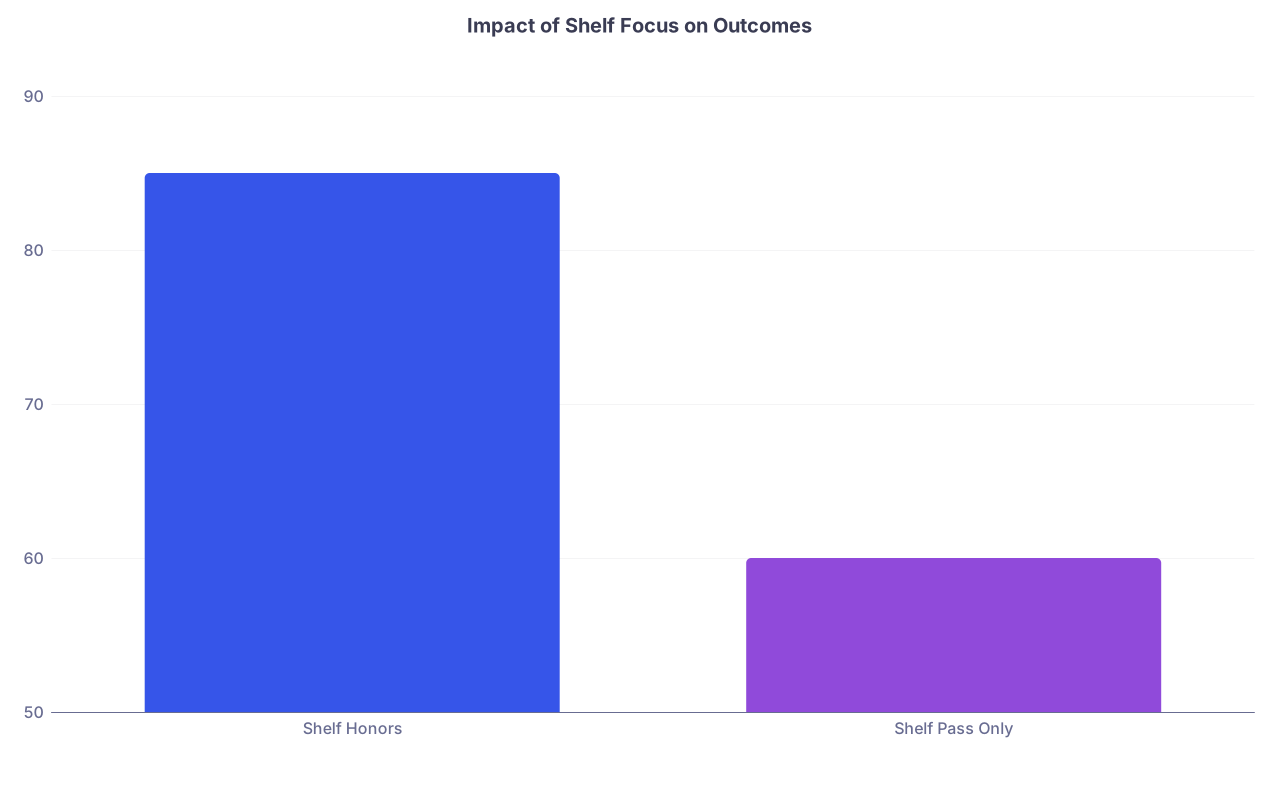
| Category | Value |
|---|---|
| Shelf Honors | 85 |
| Shelf Pass Only | 60 |
(Interpretation: students who consistently honor shelves tend to have much higher odds of strong Step 2 and better evals. This is representative, not literal data from one study.)
Concrete benefits of focusing on shelves
Let’s be specific:
- Your IM shelf prep (UWorld, Anki, NBME practice) basically is Step 2 content.
- If you’re borderline on a rotation (pass vs high pass vs honors), a strong shelf can push you up a full grade.
- In many schools, shelves are a fixed percent of the clerkship grade—20–40% is common. That’s not small.
So when you grind for honors:
- You’re building a Step 2 CK “base” topic by topic: IM → surgery → peds → OB → psych.
- You’re learning the language and frameworks attendings expect: “next best step,” “most likely diagnosis,” “initial workup.”
That turns directly into: better evaluations, more responsibility, and more trust—especially on home services where letters come from.
What this looks like in practice
If you prioritize shelves, your life looks like this:
- Daily: 40–60 UWorld questions in the relevant clerkship block.
- Weekends: 1 NBME practice exam every 2–3 weeks for high‑stakes rotations like IM or surgery.
- On service: reading about your actual patients through the lens of board-style thinking.
The payoff is compounding: by the time you hit Step 2 CK, you’re not starting from scratch. You’re just stitching together what you’ve already learned rotation by rotation.
If you sacrifice that for “maybe I’ll get my name somewhere at the bottom of this case report,” you’re trading a guaranteed high‑impact metric (Step 2 + grades) for a very low‑yield maybe.
When You Should Prioritize Research Instead
Now the flip side. There are situations where you should absolutely lean into research, even at the cost of a bit of clerkship perfectionism.
Choose research over that last marginal push for honors when:
You’re going for a research‑heavy competitive field
Dermatology, plastics, neurosurgery, ENT, radiation oncology, academic internal medicine (especially cards, heme/onc, GI aspirations).
These fields want to see real scholarly output. Abstracts, posters, at least 1–2 meaningful papers by the time you apply.Your Step 2 is likely to be “fine but not elite”
Example: you’re consistently scoring mid‑220s/low‑230s on practice. For derm or plastics, that’s not a flex. You need something else that says “this person contributes to the field.”You already have strong shelves or a high baseline
If you’re consistently hitting high passes/honors without killing yourself, then the marginal gain of squeezing out 1 more point on a shelf is low. Use that bandwidth for a focused project.You’ve secured a legit research mentor
Not a random “maybe we’ll find a retrospective for you someday” mentor. A person who says:
“Here’s the dataset. I need you to do X and Y in the next 8 weeks. If you do that, you’ll be second author on a paper we’re submitting in December.”
For these students, not doing research is a mistake. Programs in those specialties will expect:
| Specialty | Competitive Level | Typical Research Expectation |
|---|---|---|
| Dermatology | Very High | Multiple pubs, abstracts, posters |
| Neurosurgery | Very High | 5+ projects, some first/second author |
| Orthopedics | High | Several ortho-related outputs |
| ENT | High | ENT-focused projects strongly preferred |
| Internal Med | Medium | Some research helpful for academic tracks |
If that’s your lane, you cannot rely on “honors and vibes.”
How To Decide: A Simple Framework
Here’s the decision tree I actually walk students through.

| Step | Description |
|---|---|
| Step 1 | Choose specialty? |
| Step 2 | Prioritize research now |
| Step 3 | Prioritize shelves and evals |
| Step 4 | Split focus 60 shelves 40 research |
| Step 5 | Prioritize targeted research if needed |
| Step 6 | Competitive research heavy specialty? |
| Step 7 | Any meaningful research yet? |
| Step 8 | Step 2 CK taken yet? |
| Step 9 | Shelf performance so far? |
| Step 10 | Step 2 score strong? |
Translated into human language:
- Have you actually committed to a specialty?
- If no: default to shelves and good evals. You’ll need them regardless.
- If yes, is it a research‑heavy competitive specialty?
- If no (FM, psych, peds, EM, most IM, anesthesia): shelves > research.
- If yes (derm, plastics, NSGY, ENT, rad onc, some ortho):
- Do you already have 2–3 meaningful projects or pubs?
- If no: you must carve out real time for research.
- Do you already have 2–3 meaningful projects or pubs?
- Check your shelf/Step 2 trajectory:
- If your scores are weak or middling: fix that first. A couple of case reports will not save a 210 Step 2 for derm.
- If your scores are already strong: now research becomes a differentiator.
How To Actually Combine Both Without Burning Out
This isn’t binary. You rarely have to choose “only shelves” or “only research.” The trick is sequencing and protecting your peaks.
Use lighter rotations for research sprints
You’ll have rotations that are brutal (surgery, inpatient IM at some places) and others that are lighter (outpatient, psych, FM at many schools).
Use that to your advantage:
On heavy rotations:
Focus 90–100% on shelves, patient care, and not being a disaster. Research tasks limited to 1–2 small chunks per week if absolutely necessary.On lighter rotations:
You can afford 8–10 hours/week of research while still keeping up with 30–40 questions/day.
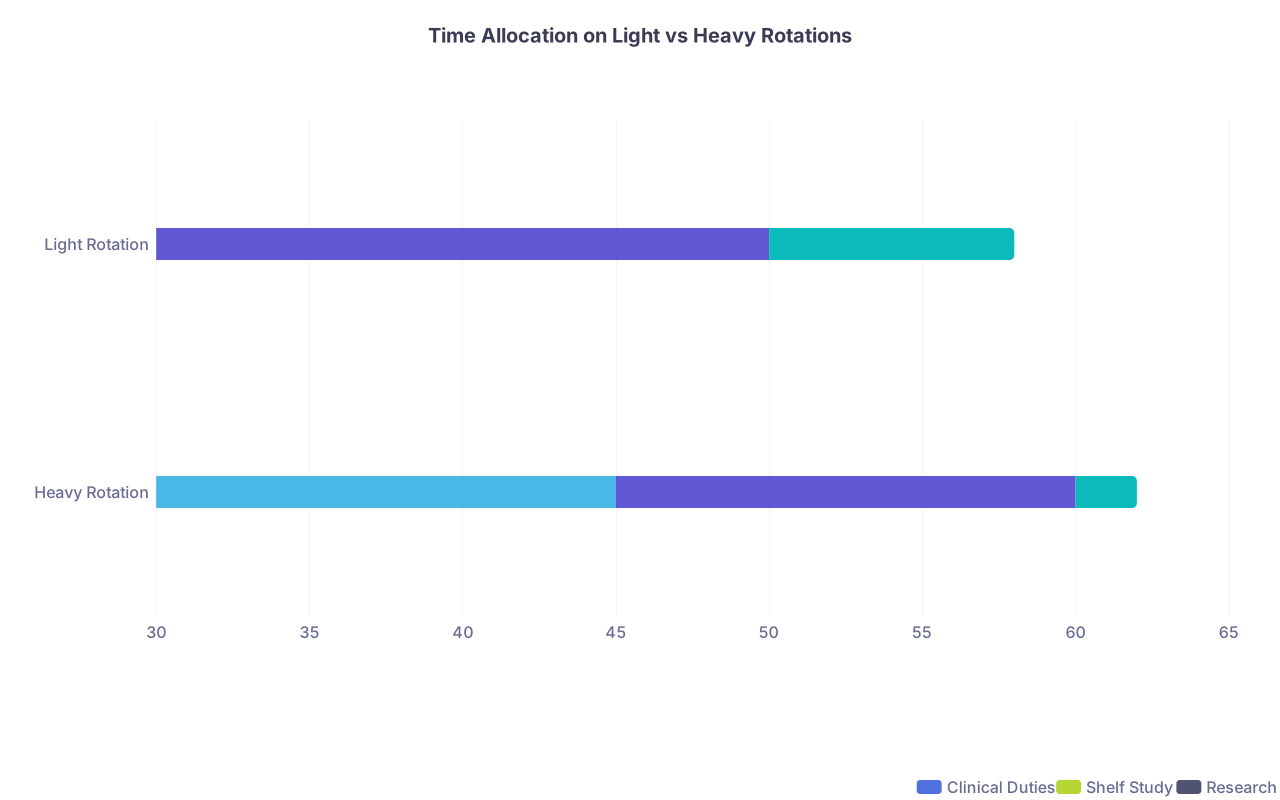
| Category | Clinical Duties | Shelf Study | Research |
|---|---|---|---|
| Heavy Rotation | 45 | 15 | 2 |
| Light Rotation | 30 | 20 | 8 |
(Assuming ~60 available working/study hours per week outside basic life needs.)
Set research goals that actually produce something
I’ve watched students “do research” for a year and come out with nothing because their goals were mush. Do this instead:
- Be crystal clear with your mentor: “What’s the concrete product and what’s the timeline?”
- Only commit to projects with a defined endpoint: abstract submission, poster, manuscript draft.
- Avoid getting spread across six tiny projects where you’re “helping with data” and end up on zero authorship lists.
Better to have two solid, finished projects than eight half‑dead ones.
Common Traps You Should Avoid
I’ve seen the same mistakes over and over.
Using “I’m doing research” as a way to avoid studying
If your practice NBMEs are weak but you’re spending 10 hours/week on research, you’re putting the cart 3 miles in front of the horse.Chasing random, irrelevant research
Derm programs don’t care that you did a case report on orthopedic hardware 2 years ago as much as you think. Relevance matters. Specialty‑adjacent is fine (e.g., rheum research for derm), random is less helpful.Assuming any research = good research
A single middle‑author paper from a giant database project is nice. It is not a magic bullet.Ignoring letters and narrative comments
Honors are not just a shelf score. Attending comments like “disengaged,” “not prepared,” “below level” will kill you faster than lack of a PubMed link.
Pragmatic Recommendations by Profile
Let me give you some straight‑up prescriptions.
If you’re undecided on specialty
- Prioritize: Shelves, Step 2 prep, being a strong team member.
- Do research only if: it falls into your lap and does not tank your studying.
- Goal: Keep as many doors open as possible. Good grades do that.
If you’re leaning competitive but not 100% sure
- First 2–3 core rotations:
Go hard on shelves. See where your strengths actually are. Maybe you fall in love with IM or EM and drop the derm fantasy. - Start 1 research project that’s somewhat general (quality improvement, IM subspecialty, outcomes study). Easy to pivot that into multiple fields.
If you’re dead set on derm/NSGY/plastics/ENT from day one
- You don’t get to ignore research.
- But you still must be solid clinically. Nobody wants a “smart but useless” intern.
- Plan:
- During M2: 1–2 serious projects started.
- During MS3 heavy rotations: protect shelf study, maintain minimal research progress.
- During MS3 lighter blocks and elective time: research sprint—abstracts, submissions, manuscripts.
Quick Reality Checks
Ask yourself these questions right now:
- If I took Step 2 CK in 3 months, would I be happy with where my knowledge is?
- If I applied tomorrow, could I honestly claim “demonstrated scholarly interest” in my target field?
- Which is more fixable later for me: research or knowledge gaps?
For most students, research is easier to ramp up quickly with the right mentor later on. Fixing bad foundational knowledge and a weak Step 2 trajectory is harder and takes longer.
That’s why my default bias is: protect your shelves and Step 2 first. Layer research on top once that foundation is solid—unless you’re clearly in a research‑intensive specialty lane and already have strong exam performance.

FAQ: Research vs Shelf Honors After Step 1 P/F
If I had to pick, is a strong Step 2 + good shelves better than great research with mediocre scores?
Yes. Programs will absolutely screen you out on weak Step 2 or a pattern of poor clerkship performance long before they admire your posters. Research is a booster, not a rescue device for bad exams in most specialties.How many publications do I “need” for a competitive specialty now?
For derm, plastics, neurosurg, and ENT, you should aim for multiple meaningful outputs—think 3–6 total items (abstracts, posters, manuscripts), not necessarily 6 first‑author NEJM papers. Quality and relevance matter much more than raw count. Being embedded with a productive mentor is the real advantage.Will not honoring every rotation kill my chances at a competitive residency?
No. A transcript with mostly high passes and some honors, combined with a strong Step 2 and good letters, is competitive. A perfect wall of honors looks nice but is not mandatory. A pattern of poor performance is the problem, not one or two non‑honors.Is it worth doing research in a completely unrelated field just to have something on my CV?
Sometimes, but it’s not ideal. One or two general projects (e.g., education, QI) are fine as evidence you can do scholarly work. But if you already know your target specialty, try hard to pivot toward something at least adjacent. Programs absolutely notice when all your research is off‑topic.What if my school doesn’t emphasize shelves or uses weird grading? Do programs understand that?
To a point. Programs know schools differ, but they still see your shelf scores (sometimes as percentiles) and your Step 2. If your school compresses everyone into “Pass,” your narrative comments and Step 2 become even more important. That actually strengthens the argument for solid exam performance.How early should I start research if I’m considering a competitive specialty?
Ideally by mid‑M2, latest early M3. That gives you enough time to cycle through at least one full project from start to some tangible endpoint. Starting your first project halfway through M3 and expecting a publication by ERAS is possible, but you’ll need an unusually fast mentor and project.I’m already behind on both shelves and research. What should I fix first?
Stabilize your clinical performance and exam trajectory first. If you’re barely passing shelves or getting concerning feedback, that’s an emergency. Once you’re in “solid pass/high pass” territory and your Step 2 practice tests are trending upward, then add a focused, small research project with a clear endpoint.
Key takeaways:
- For most students, shelf honors and a strong Step 2 trajectory are the primary levers; research is secondary but important for certain fields.
- If you’re targeting a research‑heavy competitive specialty and already have solid exam performance, you must carve out real time for focused, mentor‑guided research.
- The smartest move is usually sequencing: lock in your knowledge and clerkship performance first, then stack targeted research on top—rather than the other way around.