
What actually happens to your residency chances if you crush Step 2 CK but only barely passed a pass/fail Step 1 taken a few months earlier?
Let me answer the core question first, then we’ll unpack the nuance.
If you:
- have a solid foundation,
- can realistically score well on Step 2 CK,
- and are not completely burned out,
then yes—scheduling Step 2 CK relatively soon after a pass/fail Step 1 is usually smart. But “soon” doesn’t mean next week. It means strategically timed, not impulsively booked.
Let’s break down what’s actually smart—and what will quietly wreck you.
How Programs Now View Step 1 vs Step 2 CK (P/F Era Reality)
You’re in the Step 1 pass/fail era. That changed the game.
Before:
Step 1 was the first filter, Step 2 CK was secondary.
Now:
Step 2 CK is the main standardized metric. Step 1 is just “did you clear the bar.”
Here’s the honest hierarchy for most program directors I’ve talked to:
- Step 2 CK score
- Clerkship grades and narrative comments
- School prestige and letters
- Research / “fit” / personal story
- Step 1 status (pass vs fail; if pass, it’s mostly binary)
So if Step 1 is pass/fail and you passed, the question becomes:
“How fast can I get a strong Step 2 CK score on my application so programs have something numeric to judge?”
That’s the real driver behind doing Step 2 CK soon after Step 1.
The Core Tradeoff: Momentum vs Burnout
There are three main timing strategies students actually use:
| Strategy | Time After Step 1 | Typical Pros | Typical Cons |
|---|---|---|---|
| Immediate-ish | 3–6 months | Max momentum, strong recall | Risk of burnout, rushed clerkships |
| Standard | 6–10 months | Balanced study + rotations | Slight loss of Step 1 detail |
| Late | 10–14+ months | More clinical experience | Less time if score is weaker |
Momentum (why “soon” can be smart)
Right after Step 1 you:
- Still remember biochem, path, pharm mechanisms.
- Are in test-taking mode.
- Haven’t fully shifted into scattered clinical brain yet.
That is gold for Step 2 CK, which is basically:
Step 1 knowledge + real clinical presentations + management.
You’re building on what you just did, not trying to resurrect first-year stuff from the grave.
Burnout (why “too soon” is dumb)
Here’s what I see go wrong all the time:
- Student barely survives a brutal dedicated.
- Takes Step 1, passes.
- Books Step 2 CK 6–8 weeks after starting rotations because “momentum.”
- Is half-present on rotations, half-resentful of more UWorld.
- Scores 220s–230s when they had the potential for 250+ if they’d recovered and learned on the wards.
Your brain is not a machine. Go straight from Step 1 stress into Step 2 CK without decompression, and you’ll pay for it.
What “Soon After Step 1” Should Actually Look Like
“Soon” is not a number of weeks. It’s a combination of:
- Calendar timing (relative to clerkships and ERAS),
- Your mental energy,
- Your clinical exposure.
Let’s talk real timelines.
For US MD/DO aiming to apply right after 3rd year
Your goal is simple:
Have a strong Step 2 CK score in ERAS by the time programs start reviewing (August–September).
In practice, smart timing looks like this:
- Step 1: Late MS2 or early MS3 (pass/fail)
- Core clerkships: Internal medicine, surgery, peds, OB/GYN, psych, family
- Step 2 CK: End of MS3 or very early MS4
For a “soon after Step 1” strategy that is actually sane:
- Take Step 1 → 1–3 weeks rest + transition.
- Enter core clerkships (especially IM and surgery early).
- After ~6–9 months of rotations, schedule Step 2 CK with 4–6 weeks of lighter clinical time or a study elective at the end.
Is that “soon” in terms of raw months? Maybe not.
But in content terms, you’re building directly on your Step 1 base instead of trying to recover it a year and a half later.
Where it does become literally soon (3–6 months) is:
- If your school frontloads clinical exposure,
- Or you’re a super solid test-taker with strong Step 1-level fundamentals and good early clinical rotations.
Who Benefits Most from Earlier Step 2 CK?
If you see yourself in these descriptions, earlier Step 2 CK is often very smart.
- You’re a strong test-taker and did well on standardized exams before med school.
- You passed Step 1 comfortably (even if you do not know the exact score, your practice NBME/UWorld self-assessments were solid).
- You actually like clinical reasoning questions and multi-step vignettes.
- Your first few rotations (especially internal medicine) are earlier in the year and relatively well taught.
- You’re targeting moderately to highly competitive specialties that care a lot about Step 2 CK (EM, Anesthesia, IM academic track, most surgical subspecialties).
In that scenario, riding the momentum from Step 1 and using early clerkships as “applied learning” for Step 2 CK is very effective.
Who Should Not Rush Step 2 CK?
If any of this applies, “soon after Step 1” can quietly tank your ceiling.
- You crawled through Step 1 and felt one bad day away from failing.
- Your NBMEs for Step 1 were barely passing.
- You’re exhausted, cynical, or dreading more questions.
- You struggled on early clerkships with basic clinical thinking.
- You consistently run out of time on long, multi-step vignettes.
For you, rushing Step 2 CK is like starting a marathon dehydrated. You might finish. But you will not set your PR.
You need:
- More real clinical time to see patterns.
- A slower, deliberate build of your reasoning skills.
- Some emotional distance from Step 1 trauma.
This might push your exam closer to 8–12 months after Step 1. That’s still fine—if the final score is meaningfully higher.
The One Non-Negotiable: You Need a Good Step 2 CK Score
This is where students in the pass/fail era fool themselves.
“I’ll just take it earlier; even if I get a mediocre score, it’s OK because Step 1 is pass/fail.”
No.
A mediocre Step 2 CK is the new red flag.
Look at rough score bands and how they’re perceived:
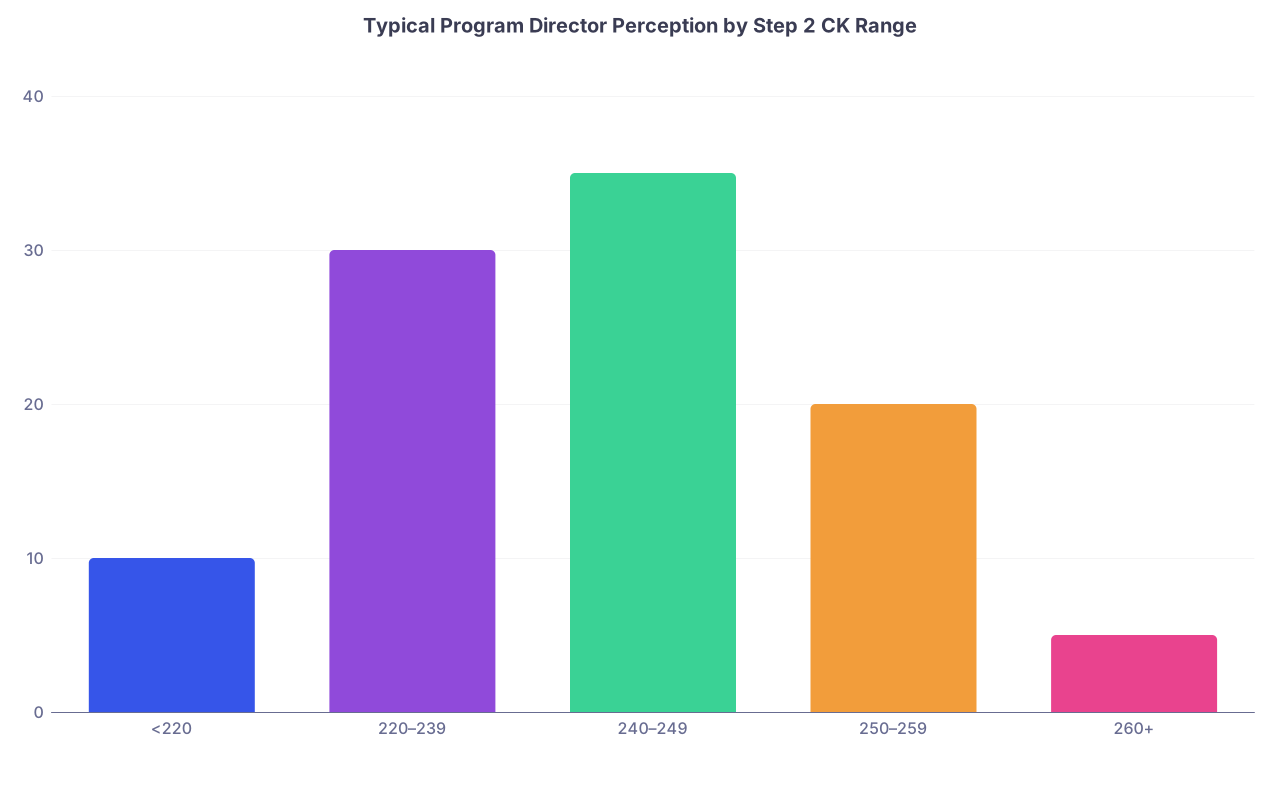
| Category | Value |
|---|---|
| <220 | 10 |
| 220–239 | 30 |
| 240–249 | 35 |
| 250–259 | 20 |
| 260+ | 5 |
Interpretation (not rigid, but very common):
- <220: Serious concern except maybe for least competitive fields or very strong contextual stories.
- 220–239: “OK but not a strength.” You need strong clerkships, letters, and fit.
- 240–249: Solid. Competitive for a wide range of programs in many specialties.
- 250–259: Strong. Opens doors, especially if rest of app is decent.
- 260+: Excellent. A clear asset anywhere.
So the real equation is:
Is taking Step 2 CK sooner going to give you a higher score
than taking it a bit later with better preparation and more clinical experience?
If yes → earlier is smart.
If no → earlier is self-sabotage.
How to Decide Your Timing in a Rational Way
Skip the vibes-based planning. Use data.
Step 1 practice performance
Look at your last 2–3 Step 1 practice exams (NBMEs/UWSAs):
- If those were equivalent to ~235+ in the old scoring system, you likely have enough base to consider earlier Step 2 CK—if you maintain that effort.
- If you were scraping passing, you probably need more time and repetitions.
Early clinical rotation feedback
Ask yourself bluntly:
- Do attendings and residents say you “think like an intern,” or are you constantly missing basic next steps?
- Are you comfortable presenting patients and planning workups?
If your clinical thinking is weak, Step 2 CK timing should be later. The test punishes shaky reasoning.
Practice Step 2 CK assessments
Do not schedule Step 2 CK without:
- At least 1 UWorld Self-Assessment (UWSA1/2)
- At least 1 NBME Step 2-style practice exam
Use a simple rule:
- If your practice scores are ≥ the score range you’d be content to apply with, you’re safe to proceed.
- If they’re 10–15 points below your minimum acceptable score, do not lock in a near-date just because “I want to be done.”
Practical Scheduling Scenarios
Let me give you real-world scenarios I’ve seen work (and fail).
Scenario 1: Smart “Soon After Step 1”
- Step 1: March, pass, strong practice scores.
- Start core clerkships: April (IM → surgery → peds → OB).
- UWorld Step 2 questions: Start lightly during rotations.
- Dedicated for Step 2: 4 weeks in December with a light elective.
- Step 2 CK exam: Early January.
Time between Step 1 and Step 2 CK: ~10 months.
This is “soon” in that the Step 1 foundation is still hot, but you gave yourself enough clinical exposure and a clean window for dedicated.
Scenario 2: Too-Rushed Disaster
- Step 1: May, barely passed.
- Rotations: June – ongoing.
- Books Step 2 CK: November, because “everyone else is doing it then.”
- Dedicated: 2 weeks max during a busy inpatient block.
- Outcome: 226 Step 2 CK. Student wanted 245+ for anesthesia. Now boxed into a narrower, less competitive list.
Same calendar gap. Totally different readiness.
So, Is It Smart To Schedule Step 2 CK Soon After a P/F Step 1?
Here’s the clean answer:
It can be very smart if:
- You had a solid Step 1 foundation (even if the score is hidden).
- You preserve momentum but do not sacrifice recovery.
- You get several months of core clerkships under your belt.
- You give yourself at least 3–4 weeks of real Step 2 CK-focused time (ideally more like 4–6).
- Your practice exams are in or near your target range before test day.
It is not smart if:
- You are scheduling based on anxiety, FOMO, or comparison.
- You’re treating “earlier” as more important than “higher score.”
- You’re burned out and secretly hoping to just get it over with.
- Your practice assessments clearly say “not ready.”
One harsh truth:
Program directors do not care that you were “tired” when you took Step 2 CK too early. They just see the number.
So if you’re going to ride the Step 1 → Step 2 CK momentum, do it deliberately. Not desperately.
A Simple Decision Flow
Use this quick mental flow:
Did you pass Step 1 with decent practice scores?
- No → Probably delay Step 2 CK, focus on rebuilding fundamentals and clinical reasoning.
- Yes → Go to 2.
Do you have at least 4–6 core clerkships done (including IM)?
- No → It’s likely too early, unless your school structure is very unusual.
- Yes → Go to 3.
Are your Step 2 CK practice exams in the ballpark of a score you’d be OK putting on ERAS?
- No → Do not rush. Fix the gap first.
- Yes → Booking Step 2 CK relatively soon is reasonable.
FAQ: Step 1 P/F and Step 2 CK Timing (7 Key Questions)
1. If I passed Step 1 but it was close, should I take Step 2 CK as fast as possible to “erase” that?
No. A weak Step 2 CK will confirm any concerns, not erase them. You’re better off strengthening your base and taking a bit more time so Step 2 CK is clearly a strength. Programs rarely ask “how well did you pass Step 1?”; they stare at your Step 2 CK score.
2. How long after Step 1 is “too long” to wait for Step 2 CK?
If you’re applying in the upcoming cycle, “too long” is anything that pushes your Step 2 CK score past early fall of your application year. If you’re not applying this year, there’s more flexibility. Content-wise, after ~14–18 months, your Step 1 recall fades significantly and you’ll have to re-learn more.
3. Does scheduling Step 2 CK early help with competitive specialties?
It helps only if the score is strong. Competitive fields (derm, ortho, plastics, ENT, rad onc) care much more about the number than about how early you took it. An early 228 helps you less than a later 252. Do not sacrifice peak performance for bragging rights on timing.
4. Should I study for Step 2 CK while studying for Step 1 to take it soon after?
Generally no. You’ll dilute your Step 1 focus, and Step 1 is still a gate. The smarter move is: crush Step 1, recover, then gradually fold in Step 2 CK-style questions during early clerkships. They overlap heavily, but the framing and management components are different.
5. If my school allows, is it smart to do a dedicated Step 2 CK elective right after Step 1?
Only if you’re also getting adequate clinical exposure either right before or right after that. Step 2 CK is not just a bigger Step 1; it expects real-world clinical pattern recognition. A pure “library only” approach right after Step 1 can work for test wizards, but most students benefit from some ward time first.
6. What if my Step 2 CK practice scores are all over the place—some high, some low?
Average them and look at the trend. If your most recent 2–3 full-lengths are increasing and clustered near your target, you’re probably safe. If it’s random (one good, one bad, no pattern), it usually means inconsistency in endurance, timing, or content gaps. Fix that before locking in an early exam date.
7. I’m burned out, but I’m afraid if I wait I’ll lose my Step 1 knowledge. What should I do?
Take a real break first—at least 1–2 weeks where you’re not grinding questions. Then return with a structured plan: light daily UWorld, mix of clinical work and review, and scheduled assessments. Losing some Step 1 detail is less damaging than going into Step 2 CK mentally fried and underperforming by 15–20 points.
Today, do this: open your calendar and block off a realistic 4–6 week window where you could give Step 2 CK your full attention. Then work backward and decide if your current plan gets you to that window ready—or if you need to adjust your timing before you regret locking in an early date.