
Being the first Step 1 pass/fail class neither automatically helps nor hurts you. It exposes your preparation—good or bad—more clearly.
Let me be blunt: programs will not give you a bonus or penalty just because you’re in the first true pass/fail Step 1 cohort. They will judge you on what they can see: Step 2 CK, clinical performance, letters, research, and how well you look compared to the people right next to you—your own classmates.
So the real question is not “Does being first P/F help or hurt?”
The real question is “How do I play this new game better than everyone else stuck playing it with me?”
I’ll walk you through that.
1. Big Picture: Does First P/F Help or Hurt?
Here’s the straight answer:
- It does not help you by default. Programs will not say, “Oh, this class had it harder, let’s be nicer.”
- It does not doom you either. Programs adapt quickly. They still need residents, and they’re already rewriting their filters.
- It changes which parts of your application carry the weight. That’s the entire story.
Before:
Step 1 score = giant sorting tool.
Now:
Step 2 CK, clerkships, and the narrative of your application = giant sorting tools.
If you’re the kind of student who:
- Test-worries but clinically shines,
- Builds relationships,
- Does decent research and shows up strong on interview days,
this era might actually be better for you.
If you’re the kind of student who:
- Was banking on a monster Step 1 score to compensate for being average in everything else,
this era is less forgiving.
So: being the first P/F class neither helps nor hurts in itself. It just amplifies your strengths and weaknesses in everything except Step 1.
2. What Actually Changes for You (And What Doesn’t)
Let’s be specific about what your class is really dealing with.

What’s less important now
Numeric Step 1 score
- Gone. No more “250 vs 235” discussions.
- But do not kid yourself: people will care whether you passed on the first try.
Pre-clinical GPA as a standalone filter
- Still matters, but less as a rigid cutoff.
- It’s more of a “signal” than a hard barrier in many places.
What’s more important now
Programs need something to stratify applicants. That “something” has become:
Step 2 CK
This is now the workhorse score. For many competitive specialties, it’s the new Step 1.Clerkship grades and narrative evaluations
Especially core rotations and sub-Is in your target specialty.Letters of recommendation
Program directors are saying this aloud on podcasts and webinars. Strong, specific letters matter more.Research and productivity in your chosen specialty
Not for every specialty, but for the competitive ones (derm, ortho, plastics, ENT, neurosurgery, rad onc, some GI/heme-onc fellowships later) this is big.Signals of genuine interest and “fit”
Away rotations, preference signals (like signaling systems in some specialties), and how well you communicate why this field and this program.
Here’s how the weight often shifts in practice:
| Component | Pre P/F Era Emphasis | P/F Era Emphasis |
|---|---|---|
| Step 1 Score | Very High | Pass/Fail only |
| Step 2 CK | Moderate | Very High |
| Clerkship Grades | Moderate | High |
| Letters | Moderate | High |
| Research | Variable | Higher in many |
3. How Programs Actually See Your Class
Here’s what I’ve heard and seen from PDs and faculty reviewing applications in this new environment.
They think in buckets:
“Reliable test taker?”
- Passed Step 1 first time?
- Step 2 CK ≥ their rough internal bar?
- Any ugly test failures or repeats?
“Safe to hire clinically?”
- Solid core clerkships, especially IM, surgery, peds, medicine subspecialties.
- Any professionalism flags? Remediations?
“Good potential colleague?”
- Letters that say something real.
- Interview performance.
- Track record of following through (research, quality improvement, teaching).
You’re in the first true P/F era, so there’s not an older P/F cohort to benchmark numerically against. That does create some uncertainty. But that uncertainty doesn’t become sympathy—it becomes stronger reliance on the pieces they know how to interpret:
- Step 2 CK scores vs their historical averages
- Your school’s reputation for clinical training
- Letters from names they recognize
Is that fair? Not always. Is it reality? Yes.
4. Does Being First P/F Help in Any Way?
There are a few legitimate advantages.
1. Less psychic damage from Step 1
You only need to pass. That removes:
- The obsession with 240+ or 250+,
- The extreme comparison culture,
- The “my career is over” spiral at 3 AM over a bad UWorld block.
That mental bandwidth can be redirected to:
- More meaningful learning,
- Earlier research engagement,
- Building relationships in your specialty.
If you use that freed-up energy well, it helps you.
2. More time to shape your story
Without a Step 1 score hanging over your head, you can:
- Join a lab in your first or second year,
- Get involved with a specialty interest group early,
- Shadow and show up in a department consistently so someone there knows you by name before MS3.
Older classes often waited until after Step 1 to “start thinking about” specialties. You don’t have that artificial delay.
3. Slightly more flexibility in how you study
Because you don’t need a 250, you can:
- Study to understand more and memorize slightly less trivia,
- Spend some time in foundational resources (path, phys, micro) with the long game in mind,
- Start sprinkling in clinically oriented thinking earlier.
That can pay dividends later on Step 2 and on wards.
5. Ways This Era Absolutely Can Hurt You (If You’re Not Careful)
Here’s where people misplay this transition.
1. Underestimating Step 1 because it’s “just P/F”
Programs don’t see your numeric score, but:
- Failing Step 1 is now more toxic, not less. If you fail a “just pass/fail” exam, it can look like a red flag for Step 2 and in-training exams.
- Barely passing often shows up later anyway—in lower Step 2 CK performance and weaker clinical confidence.
So treating Step 1 like a minor quiz is a mistake. Your goal might be “pass,” but your process should still aim at competence, not the minimum.
2. Delaying Step 2 CK planning
Many first P/F cohorts fall into this trap:
- They “take a breath” after Step 1,
- Start clerkships exhausted,
- Don’t map out Step 2 timing until late MS3,
- Then suddenly realize Step 2 is due early for competitive specialties.
Now that Step 2 is the flagship score, you need a real strategy and timeline for it from early in clinical year, not 2 months before you test.
3. Ignoring clinical evaluations
You cannot hide behind a 260 anymore.
Lazy on the wards? Don’t read? Show up late? That used to be partially shielded by a stellar Step 1. Not anymore.
Preceptors’ written comments and grade distributions matter more. If you’re unengaged or unpleasant to work with, it shows up in narrative evaluations and letters in a way that is very hard to fix.
6. How to Actually Use This Era To Your Advantage
This is where you should stop worrying about macro trends and start adjusting your own strategy.
Step 1: Treat “Pass” as the floor, not the target
Approach Step 1 with 3 goals:
- Pass on the first attempt.
- Build a knowledge base that makes Step 2 easier.
- Avoid burnout so badly that you implode before clerkships.
That means:
- Using Step 1 study to understand high-yield concepts, not just memorize questions.
- Using UWorld and NBME forms to track competence, not just “am I at 60%?”
- Stopping once your predictive metrics make passing very likely, instead of trying to push for an imaginary 250.
Step 2: Start thinking about Step 2 CK by early MS3
No, you don’t need a daily Step 2 study block from day one. You do need:
- A rough test window that aligns with your specialty plan.
- A sense of what score range is competitive in your field.
- An approach to shelf exams that feeds directly into Step 2 prep (not separate stacks of notes you never see again).
Many successful students handle it this way:
Shelf prep = Step 2 prep, just done organ system by organ system.
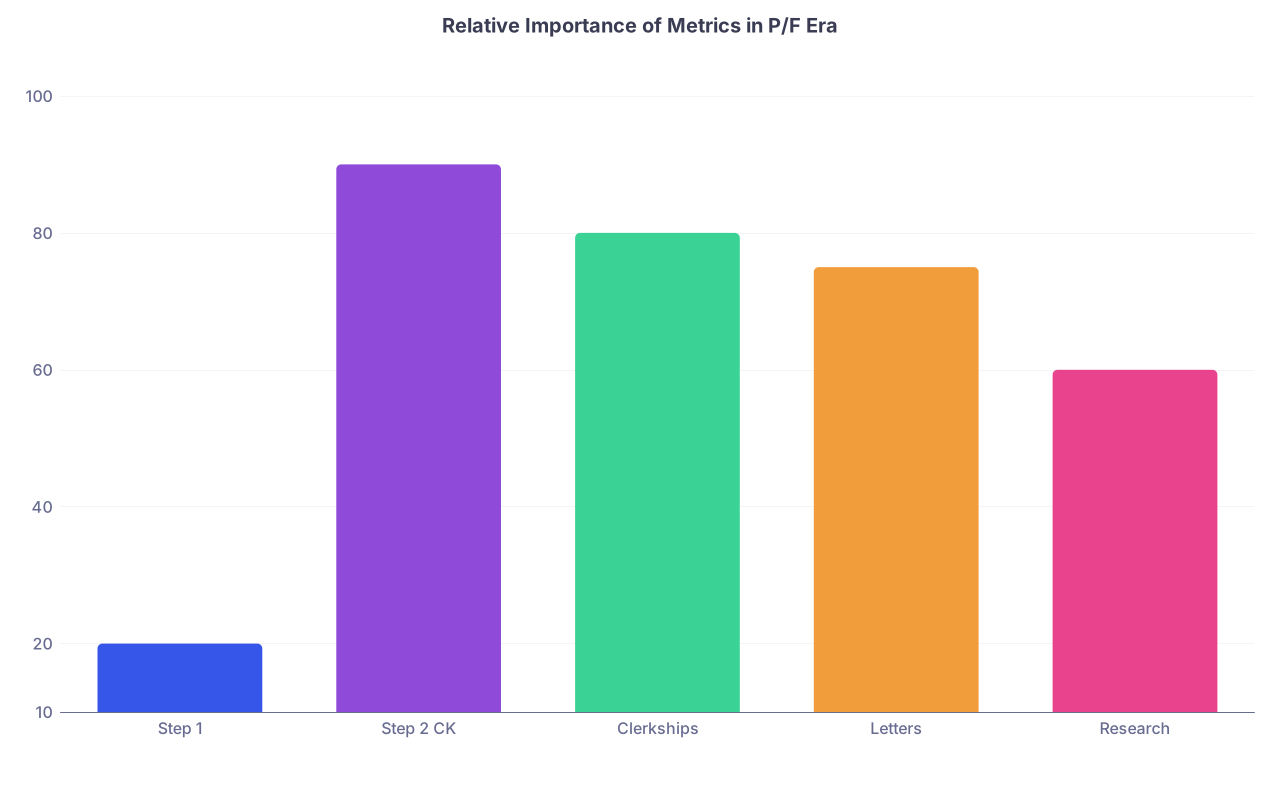
| Category | Value |
|---|---|
| Step 1 | 20 |
| Step 2 CK | 90 |
| Clerkships | 80 |
| Letters | 75 |
| Research | 60 |
(Those numbers aren’t exact; they’re a rough signal of relative weight.)
Clerkships: Decide to be “that” student
You know the one:
- Reads about every new patient that evening.
- Volunteers to call consults or present.
- Asks for feedback instead of hiding.
Those students get the best narrative comments and letters. You don’t have to be brilliant. You just have to be reliable, prepared, and not annoying.
Letters: Start early, not in panic mode
If you’re even considering a specialty:
- Go to their noon conferences occasionally.
- Ask to shadow once a month.
- Do a structured project with someone (case report, QI, poster, anything).
When it’s time for letters, you want people who can say: “I’ve seen this student over 18 months in multiple contexts, and here’s why they’ll succeed in our field.”
That’s gold now.
7. Specialty-Specific Reality Check
Quick reality snapshot for the P/F class:
Highly competitive specialties (derm, ortho, ENT, neurosurg, plastics, IR, rad onc)
Step 2 CK is crucial. Research is not optional. Fit and letters from known faculty can outweigh raw stats in borderline cases.Moderately competitive (EM, anesthesia, PM&R, rads, some IM subs)
Solid Step 2, no red flags, and being a normal, pleasant human on rotations go a very long way.Less competitive or broader-entry (FM, psych, peds, IM general)
You have more flexibility, but you still cannot ignore Step 2 or clerkships. Red flags matter everywhere.
Your status as “first P/F class” does not override those dynamics.
8. Bottom Line: Does It Help or Hurt?
Here’s the honest summary:
- Being first P/F does not automatically help you. Programs won’t curve your life because you lacked a Step 1 number.
- Being first P/F does not automatically hurt you. You’re not being compared head-to-head with numeric Step 1 classes in any meaningful way.
- It absolutely changes how you win. The spotlight has moved: Step 2 CK, clerkships, letters, and real engagement in your chosen field now carry what Step 1 used to carry.
If you:
- Pass Step 1 cleanly,
- Take Step 2 CK seriously and early enough,
- Treat the wards like an extended job interview,
- Get to know people in your target specialty and earn strong letters,
then being in the first Step 1 P/F class will not hurt you at all. For a lot of you, it’ll actually be the thing that prevented a single three-digit number from defining your entire career.
FAQ (Exactly 6 Questions)
1. Will programs secretly try to “reconstruct” my Step 1 score from school data or NBME practice tests?
No. They don’t get your practice tests, and most don’t get internal school exam data. They can’t see your numeric Step 1 score. What they can see is whether you passed on the first attempt, your Step 2 CK score, and your school’s overall reputation. They’ll infer your test-taking ability mostly from Step 2 CK and any failed attempts anywhere.
2. If I fail Step 1 once but pass on the second try, am I done for competitive specialties?
Not necessarily, but your path is steeper. A single failure in a pass/fail era raises eyebrows. You’d need a strong Step 2 CK score, excellent clerkship performance, and powerful letters to counterbalance it. Some ultra-competitive programs will filter you out. Others may still consider you if the rest of the application is stellar and you have advocates.
3. How high does Step 2 CK need to be now that Step 1 is P/F?
It depends on specialty and program tier. For many competitive fields, Step 2 CK has taken over the role of “quick academic cutoff.” That might mean >250 for the most competitive spots, high 230s–240s for many mid-to-high-tier programs, and more flexible ranges in less competitive areas. Check your specialty’s most recent NRMP Charting Outcomes and specialty-specific guidance.
4. Should I take Step 2 CK earlier because of the P/F change?
If you’re going for a competitive specialty, yes, you usually want Step 2 CK done by late summer / early fall of application year so programs see it when offering interviews. But not at the expense of adequate prep. A slightly later but stronger Step 2 score is usually better than a rushed mediocre one, as long as you still meet programs’ timelines.
5. Does my pre-clinical performance matter less now?
A bit less, but it’s not irrelevant. Pre-clinical honors and class rank can still show up on your MSPE (Dean’s letter). That can help at schools where these metrics are strong proxies for work ethic and knowledge. But compared to the old era, pre-clinical grades are now secondary to Step 2 CK, clerkship performance, and letters.
6. If I hate standardized tests, is this era better for me?
It can be, but only if you still respect Step 1 and Step 2. You’re freed from the crushing pressure of a single three-digit Step 1 score, which helps many students mentally. But you still need to demonstrate that you can pass high-stakes exams (Step 1, Step 2) and function well clinically. If you lean into building strong relationships, showing up on the wards, and crafting a coherent story, this era can absolutely be more forgiving than the test-obsessed past.
Key points to remember:
- Being the first Step 1 P/F class doesn’t inherently help or hurt you; it just shifts the weight to Step 2 CK, clerkships, and letters.
- Passing Step 1 cleanly and treating it as foundational—not disposable—sets you up for a stronger Step 2 and clinical performance.
- The students who win in this era are the ones who treat every rotation, every attending, and every project as part of their audition—not just a score.