
Does Step 1 Still Matter Now That It’s Pass/Fail?
What actually happens to your residency chances if you just “barely pass” Step 1 in the pass/fail era?
Let me answer the big question first, bluntly:
Step 1 still matters.
It just matters differently now.
If you’re looking for: “Oh, don’t worry, nobody cares about Step 1 anymore” — that’s fantasy. Programs, PDs, and advisors didn’t suddenly forget that Step 1 exists. They just lost a number. And when you take away the scoreboard, people start looking harder at everything else.
Let’s walk through what Step 1 means now, what changed, what didn’t, and what you should actually do about it.
, Clinical Grades, Letters, School Reputation, Research](https://cdn.residencyadvisor.com/images/articles_svg/chart-what-pds-say-matters-more-after-step-1-pass-fail-8984.svg "What PDs Say Matters More After Step 1 Pass/Fail")
| Category | Value |
|---|---|
| [Step 2 CK](https://residencyadvisor.com/resources/step1-pass-fail-era/is-it-smart-to-schedule-step-2-ck-soon-after-a-pf-step-1) | 90 |
| Clinical Grades | 80 |
| Letters | 75 |
| School Reputation | 55 |
| Research | 60 |
1. What Changed with Step 1 Going Pass/Fail?
Old world:
Program directors filtered apps with hard cutoffs.
“Below 240? Auto-screened out.”
Step 1 was the kingmaker. You lived or died by a three-digit score.
New world:
Step 1 is “Pass” or “Fail.” That’s it. No 250 vs 220. Just: did you clear the bar?
That means:
- Programs can’t rank you by Step 1 score anymore.
- They still see if you passed on first attempt.
- A fail is now more painful, because there’s no “but I improved to a 248 on the retake” number to soften it.
- PDs shifted their obsession to Step 2 CK, clerkship performance, and the rest of your file.
So, did Step 1’s role shrink? Sure.
Did it become irrelevant? Not even close.
You’ve basically moved from “Step 1 as ranking weapon” to “Step 1 as gatekeeper and signal.”
2. How Programs Actually Look at Step 1 Now
Here’s how I’ve seen PDs and selection committees talk about Step 1 in meetings post–pass/fail.
They ask:
Did they pass on the first attempt?
- Yes = move on.
- No = “We need a story here.”
Any red flags around timing or context?
- Very delayed Step 1.
- On LOA around that time.
- Sudden big academic issues.
Does this fit with the rest of their academic record?
- Strong pre-clinical + pass + solid Step 2 CK → “Looks consistent.”
- Weak pre-clinical + borderline passes + low Step 2 CK → “Pattern.”
If you passed normally and aren’t hiding a bunch of academic landmines, your Step 1 becomes mostly a checkbox for many programs: “Minimum bar cleared.”
Where it’s still a real topic of discussion:
- Fail or multiple attempts
- IMGs and Caribbean students
- Applicants to ultra-competitive specialties with any other weakness
In those rooms, Step 1 is now a context signal instead of a rank number.

| Step | Description |
|---|---|
| Step 1 | Review Application |
| Step 2 | Check Step 2 CK |
| Step 3 | Look For Red Flags |
| Step 4 | Focus On Clinicals and Letters |
| Step 5 | Application Needs Other Strengths |
| Step 6 | Consider Context and Improvements |
| Step 7 | Step 1 Status |
| Step 8 | Step 2 CK Strong? |
3. Step 1 vs Step 2 CK: Who’s the New Boss?
Short version: Step 2 CK is now the score that runs your life.
Programs did not suddenly become holistic saints. They replaced their Step 1 filter with Step 2 CK and beefed up attention to clinical performance.
Rough breakdown:
- Step 1: “Can you handle the basic science and test-taking required to be safe?”
- Step 2 CK: “Can you handle real clinical decision making and pressure?”
Most PDs I’ve talked with now treat Step 2 CK as:
- Their main numeric screening tool
- Their tie-breaker between otherwise similar candidates
- A must-have for interview consideration in competitive fields
If you want something like derm, ortho, plastics, ENT, neurosurg, rad onc — Step 2 CK is your new Step 1. Programs are absolutely sorting by this.
So where does that leave Step 1?
- You must pass.
- You want to pass once.
- Then you pour your neurotic energy into Step 2 CK.

4. Does Failing Step 1 Now Hurt More or Less?
This is the part nobody likes to say out loud:
A Step 1 fail still hurts a lot. In some ways, more than before.
Why?
In the score era, I saw students do this:
- Step 1: 203 (below many cutoffs)
- Step 1 retake: 226
- Then crush Step 2 CK: 245+
Programs could say, “They struggled, but they clearly improved.” They had numbers to see the trajectory.
Now?
All the committee sees is:
- Step 1: Fail
- Step 1: Pass
- Step 2 CK: 245
Better than nothing — but not as clean of a redemption arc.
Is one fail a death sentence? No.
But it comes with consequences:
- Some programs will auto-screen multiple attempts, even now.
- Highly competitive specialties may quietly move you to the “only if we’re desperate or know them personally” pile.
- You’ll need strong Step 2 CK and a coherent explanation in your MSPE and/or personal statement.
Bottom line:
In the pass/fail era, avoiding a Step 1 fail is still critical.
You don’t need to destroy the exam. You just really, really need to clear it on the first swing.
5. Competitive vs Less Competitive Specialties: Does Step 1 Matter Differently?
Yes. Specialty still changes the weight of everything.
Broadly:
Highly competitive (derm, ortho, ENT, plastics, neurosurg, IR, rad onc, some gas and rads spots):
- Step 1: Must-pass gatekeeper. A fail is a serious hit.
- Used as a subtle signal: did they pass comfortably on time?
- Step 2 CK, research, letters, and school reputation carry huge weight.
Moderately competitive (EM, anesthesia, rads, gas, OB/GYN, some IM programs):
- Step 1: Pass is usually enough, but fail may limit higher-tier programs.
- Step 2 CK becomes the main differentiator.
Less competitive (FM, psych in many places, peds, community IM):
- Step 1: Mostly binary — pass and move on.
- A fail can still cause issues, but more programs will listen to the story if everything else is strong.
Here’s a rough comparison:
| Specialty Tier | Step 1 Role Now | Step 2 CK Role |
|---|---|---|
| Ultra-competitive | Gatekeeper, red flag | Primary score filter |
| Moderately competitive | Gatekeeper, some nuance | Major decision factor |
| Less competitive | Mostly checkbox | Important but flexible |
Notice what’s not on that table: “Step 1 irrelevant anywhere.” Because it isn’t.
6. MD vs DO vs IMG: Does Step 1 Pass/Fail Hit You Differently?
Yes, absolutely. Not fair, but very real.
MD Students (US allopathic)
- Biggest change: you lost the chance to flex a “wow” Step 1 score.
- Programs will assume most MDs pass Step 1 on time.
- If you pass and have a solid Step 2 CK, you’re fine. Your school’s reputation and clerkship grades now weigh more.
DO Students
- Before: Strong Step 1 could “erase” some program bias.
- Now: That lever is gone. You can’t out-240 their skepticism.
- Step 2 CK becomes your best objective weapon.
- Step 1 fail as a DO? Very tough sell for some academic and competitive programs.
IMGs (including Caribbean)
This group probably got hit the hardest by the change.
In the old system, I watched IMGs with 250+ on Step 1 kick the door open at strong programs. They couldn’t ignore them.
Now:
- You lose the one number that historically impressed PDs most.
- Many programs quietly use “IMG + Step 1 fail” as an easy hard stop.
- You need:
- Clean Step 1 pass
- Very strong Step 2 CK
- US clinical experience
- Real letters from US faculty
Pass/fail didn’t equalize things. It removed one of the best tools nontraditional and non-US students had to prove themselves.
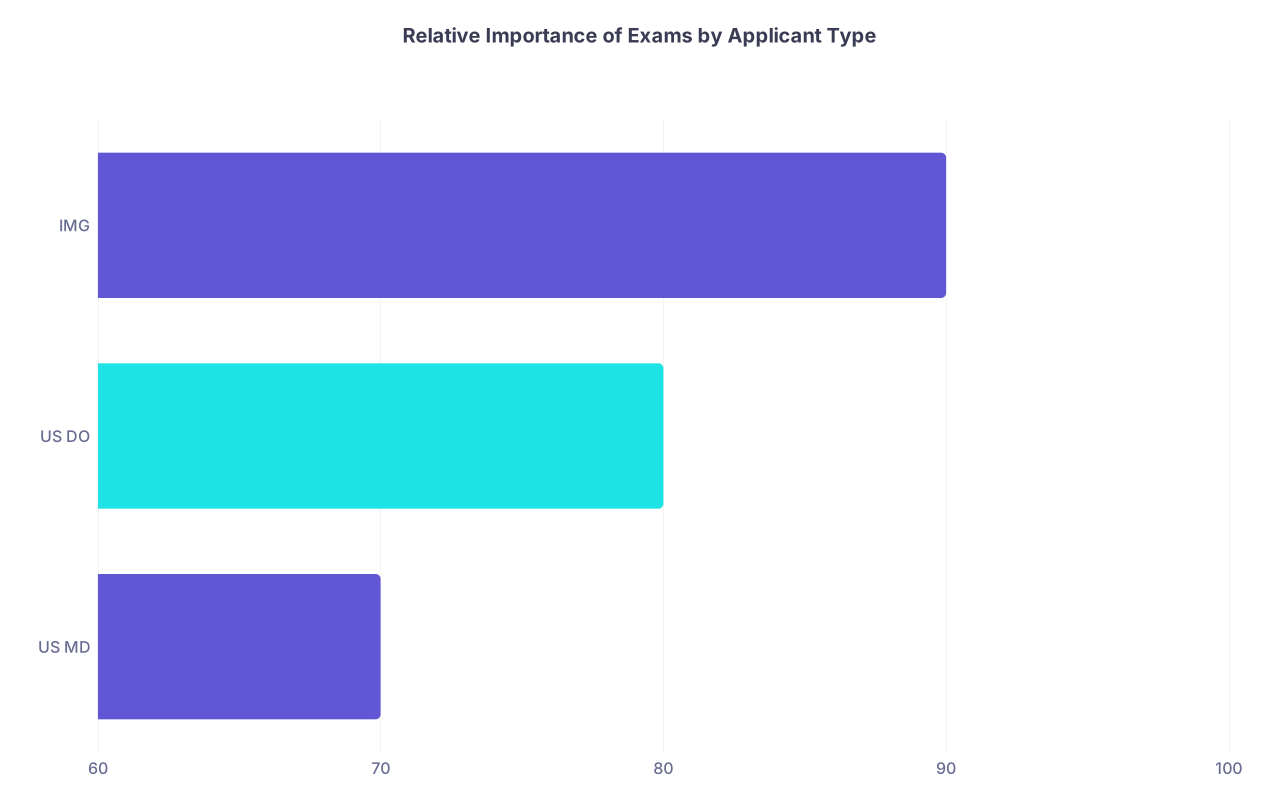
| Category | Value |
|---|---|
| US MD | 70 |
| US DO | 80 |
| IMG | 90 |
7. How You Should Study for Step 1 Now (Since It’s “Only” Pass/Fail)
Here’s where people do dumb things.
They think:
“It’s just pass/fail — I’ll do the bare minimum and save my effort for Step 2 CK.”
Then they:
- Cram
- Skim UWorld
- Ignore foundational understanding
- Pass (maybe) but learn very little deeply
And 6–9 months later they’re drowning prepping for Step 2 CK because their base is garbage.
Smart approach:
Aim to pass comfortably, not perfectly.
You don’t need a fake 260. You do need to feel like P = “I really know this,” not P = “I got lucky.”Use Step 1 to build the foundation for Step 2 CK.
Same systems. Same physiology. Same pharmacology. Just with more clinical framing later. If you actually learn now, Step 2 CK becomes much, much less painful.Avoid schedule brinkmanship.
If all your NBME or UWSA practice tests are borderline, pushing your exam and risking a fail is smarter than “rolling the dice.” One fail now creates a problem that follows you for years.Don’t martyr yourself chasing perfection.
If you’re consistently passing practice exams with a comfortable margin and your school isn’t killing you for a slightly earlier test date: take the exam, bank the pass, move on.
You’re playing for a clean transcript plus a strong Step 2 CK later, not leaderboard glory on Step 1.

8. What Matters More Now That Step 1 Is Pass/Fail?
Here’s where attention actually shifted:
- Step 2 CK – the new main exam metric
- Core clerkship grades – honors vs pass now really shows up
- Letters of recommendation – especially from people PDs know or trust
- Class rank/AOA/Gold Humanism – any sign you’re top tier in your class
- Research and productivity – especially for academic and competitive specialties
- School reputation and connections – like it or not, still in play
- Fit and professionalism – no one wants a high-score disaster on their team
Think of Step 1 now as your ticket into the room.
Everything above is what determines whether they actually invite you to the party.
9. Practical Game Plan by Year in Med School
Let’s keep this tactical.
Pre-clinicals (M1–M2)
- Learn the material like it’ll show up again on Step 2 CK. Because it will.
- Build a consistent Step 1 study habit: QBank + review + spaced repetition.
- Aim to be “NBME-passing” weeks before your exam date, not days.
Dedicated Step 1 Period
- Target: secure a first-attempt pass, ideally with a margin on practice tests (e.g., NBME scores comfortably above the passing line).
- Don’t burn yourself trying to reach an imaginary 260 — bank the pass and save energy.
Early Clinical Years (M3)
- Shift obsession to Step 2 CK and clerkship performance.
- Treat every rotation like an audition. Because PDs are reading those comments.
- Start courting letter writers early in the year.
Late Clinical / Application Prep (M4)
- Step 1: In the background now, as long as it’s clean.
- Step 2 CK: Have it done early with a result that supports your target specialty.
- Let your advisors be brutally honest: “With this profile, you’re competitive for X, reach for Y, don’t waste time on Z.”
FAQ: Step 1 Pass/Fail Era
If Step 1 is pass/fail, should I still use UWorld and take it seriously?
Yes. UWorld isn’t just about the exam; it’s your path to actually understanding medicine. A lazy pass now becomes a nightmare when you hit Step 2 CK and real patients. Use UWorld, NBME practice tests, and a structured plan — but aim for a safe pass, not hero numbers.Does a first-attempt pass look “the same” for everyone now?
Not exactly. A simple “Pass” doesn’t differentiate students, but PDs still look at context: did you take it on time, any academic issues, how do your pre-clinical grades look, what’s your Step 2 CK. Two “Passes” can signal very different stories depending on the rest of the file.Is it ever smart to delay Step 1 to get a stronger foundation?
Yes, if your practice tests are clearly below passing or wildly inconsistent. A delay to avoid a fail can be rational. The stupid move is forcing the exam when all signs scream “not ready” just to stay on some arbitrary schedule.Can a great Step 2 CK score ‘erase’ a Step 1 fail?
It can’t erase it, but it can soften it. Strong Step 2 CK shows you recovered and can handle difficult exams. Some programs will still hard-screen you out. Others will consider you if everything else is strong and the story around the fail makes sense. It narrows your options but doesn’t delete them.For competitive specialties, is Step 1 still a differentiator at all?
Not as a number, but as a filter and signal. A clean, on-time pass is expected. A fail or delay is a big deal. Competitive specialties then lean heavily on Step 2 CK, research, letters, and your school’s reputation. Step 1 now is more about avoiding a problem than winning a prize.As a DO or IMG, how should I think about Step 1 now?
As nonnegotiable. You absolutely need a clean pass, ideally on the usual timeline. You no longer have Step 1 as a show-off score to impress people — so Step 2 CK, US clinical experience, networking, and strong letters matter even more. A fail as DO/IMG can be brutal for your options in certain fields.What’s one concrete thing I should change in my planning because Step 1 is pass/fail now?
Stop thinking “I’ll coast through Step 1 and turn it on for Step 2 CK.” Instead, design your Step 1 prep to build a real understanding of pathophys, pharm, and core concepts, then reuse those resources and notes as your base for Step 2 CK. One integrated, long-term plan beats two frantic, disconnected cramming cycles.
Open your calendar right now and block off a 30-minute slot this week labeled: “Step 1 → Step 2 plan.” In that block, write down exactly how you’ll use Step 1 studying to make Step 2 CK easier, not harder. That’s how you stop this pass/fail change from quietly wrecking your future.