
The idea that “there are no cutoffs anymore because Step 1 is pass/fail” is a fantasy.
Programs still filter. They just filter on different (and sometimes harsher) things now. If you’re applying in the post–Step 1 pass/fail era, you need to know exactly what gets you screened in or out.
Here’s how it actually works.
The New Screening Reality: What Replaced Step 1?
Let me be blunt: programs did not suddenly develop the time or desire to holistically review 3,000 applications.
They replaced one blunt tool (Step 1 score) with a stack of other blunt tools:
| Filter Type | How Often Used* |
|---|---|
| Step 2 CK numeric cutoff | Very common |
| School type (US MD/DO/IMG) | Very common |
| Red flags (fails, remediations) | Very common |
| Class rank / MSPE language | Common |
| Research / publications | Specialty-dependent |
| Home / regional ties | Common |
*Based on program director survey trends + what I’ve heard repeatedly in committee rooms.
So what are the new “cutoffs” in practice?
1. Step 2 CK Becomes the De Facto Step 1
Step 2 CK is now the workhorse screening tool for many programs, especially competitive ones and anything academic.
Common patterns I’ve seen or heard from residents, PD talks, and application committee meetings:
- “We usually start at 240+ for interviews in our program, but we’ll look lower if other parts are strong.”
- “Below 220 and we rarely interview unless there’s a clear reason.”
- “We sort the list by Step 2 CK and work down until we run out of interview spots.”
Do programs publicly post these cutoffs? Almost never. Do they exist behind the scenes? Absolutely.
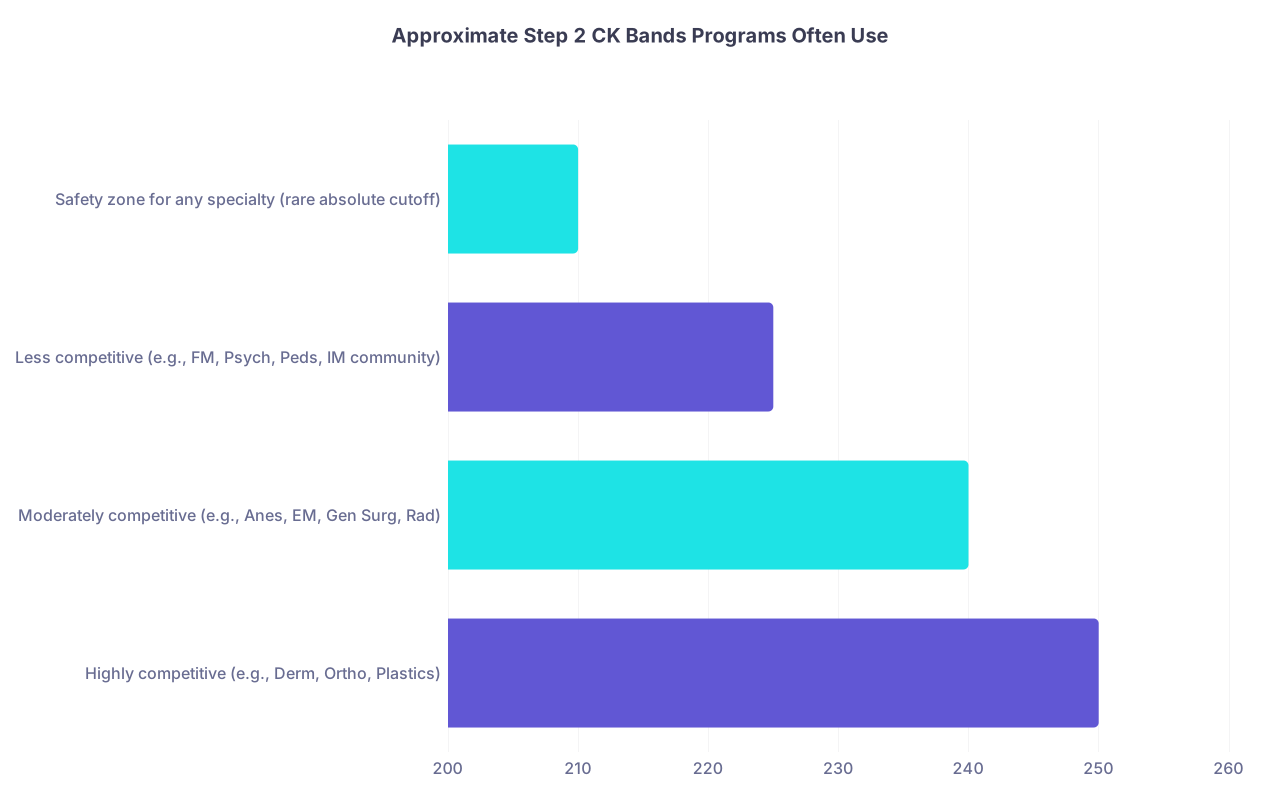
Typical (not universal) Step 2 CK rough zones:
| Category | Value |
|---|---|
| Highly competitive (e.g., Derm, Ortho, Plastics) | 250 |
| Moderately competitive (e.g., Anes, EM, Gen Surg, Rad) | 240 |
| Less competitive (e.g., FM, Psych, Peds, IM community) | 225 |
| Safety zone for any specialty (rare absolute cutoff) | 210 |
Do NOT obsess over exact numbers. The point is simple: Step 2 is the new sorting column.
Programs actually use it to:
- Set a hard floor (e.g., “we won’t review below 220”).
- Stratify (priority review for 250+, secondary review for 230–249).
- Break ties (two similar applicants, higher Step 2 usually wins).
If you’re still pre–Step 2: your test date and projected range matter more now than Step 1 ever did.
2. The “Invisible” Cutoffs: School Type and Citizenship
Nobody likes to talk about this, but it drives a huge portion of screening.
If a program is drowning in 3,000 applications, here’s the dirty sequence they’ll often run:
- Filter for US citizenship or permanent residency if they don’t want to sponsor visas.
- Prioritize US MD (and often US DO).
- Only then selectively review IMGs, often with stricter Step 2 expectations.
I’ve literally watched this happen on ERAS filters.
Think of it like tiers, not absolute bans:
| Tier | Applicant Type | Practical Impact |
|---|---|---|
| 1 | US MD | First review, lower score tolerance |
| 2 | US DO | Reviewed; some bias varies by program |
| 3 | US IMG | Higher bar for scores, research, ties |
| 4 | Non-US IMG on visa | Highest bar; often auto-screened out |
This is not “fair.” It’s just accurate.
Visa and IMG “Soft” Cutoffs
Common things I’ve seen:
- “We do not sponsor visas” = automatic filter in ERAS.
- “IMG-friendly” programs = still often expect higher Step 2 (e.g., 240+).
- Gaps after graduation (more than 3–5 years) silently kill a lot of IMG applications.
If you’re an IMG, your “cutoffs” are basically:
- A much higher Step 2 CK expectation.
- No unexplained gaps.
- Strong letters from US clinical experiences, if possible.
3. Academic Performance: MSPE, Class Rank, and Fails
With Step 1 gone, programs stare harder at your transcript and MSPE.
Here’s what they actually pull out of those documents:
- Any F, remediation, or leave of absence.
- Preclinical performance language (“consistently outstanding” vs “satisfactory”).
- Clinical evaluations and any “below expected” comments.
- Class rank or quartile if reported.
Programs rarely say “we will not interview anyone in the bottom quartile” out loud. But functionally, many do something very close to that when they have enough applicants.
Common “no-go” triggers I’ve seen:
- Multiple course failures.
- Repeated clerkship failures.
- Professionalism concerns explicitly mentioned in the MSPE.
- Unexplained leaves of absence.
These are not always absolute. But if your file has one of these, your Step 2 or other strengths need to be very strong to compensate.
4. Red Flags: The True Hard Cutoffs
There are a few things where most programs basically say, “we’re done here.”
These are the closest things to true, nearly universal cutoffs:
- Unexplained Step failures (Step 1 fail, Step 2 fail).
- Multiple exam failures.
- Documented professionalism violations.
- Dishonesty in the application (PDs talk; these stories spread).
Many programs will consider:
- A single Step 1 fail with a strong Step 2 CK and clear narrative.
- A leave of absence for health/family reasons, if well-documented and addressed.
- One bad semester early in preclinical if the rest of your record is strong.
But what they absolutely use as filters:
- “Any Step failure?” → auto-filter in many places.
- “Any professionalism issue?” → almost always fatal.
You won’t see that in their marketing material. You will see it in the actual committee behavior.
5. Specialty-Specific Cutoffs: It’s Not All the Same
Cutoffs are not uniform across specialties. Some lean heavily on metrics; others pretend they don’t, then still use them quietly.
Here’s a realistic snapshot:
| Specialty Type | Step 2 CK Role | Other Heavy Filters |
|---|---|---|
| Ultra-competitive | Hard Step 2 tiers | Research, school prestige, AOA |
| Competitive academic | Strong Step 2 emphasis | Research, letters, class rank |
| Bread-and-butter IM | Step 2 floor + holistic | IMG status, red flags, regional ties |
| Primary care (FM, Peds) | Lower numeric floor | Fit, mission alignment, geography |
| Psych | Mixed; still Step 2 floor | Red flags, narrative fit |
So “what is a cutoff?” depends heavily on the field.
Derm might treat <250 Step 2 as weak. Family medicine might consider 215 entirely acceptable if the rest of you fits their mission.
6. The Hidden Filters: Research, Letters, and Fit
Once you get past hard screens (Step 2, school type, red flags), the process looks less like “cutoffs” and more like “sorting.”
But there are functional thresholds:
Research
In some specialties and academic programs, lack of research is effectively a cutoff.
- Dermatology, plastics, neurosurgery, rad onc: no research → often dead on arrival.
- Academic internal medicine: often expect some research/quality improvement.
- Community FM, Peds, Psych: research is nice, not required.
The unwritten cutoff: “Do I see any commitment to this specialty beyond a checkbox?”
Letters
This is where things get truly subjective, but patterns exist:
- No letter from the specialty you’re applying to = soft cutoff in many programs.
- Only generic letters or no home department support letter raise big red flags.
- Weak language (“adequate,” “acceptable”) is a stealth cutoff no one names out loud but everyone reacts to.
Fit and Geography
Programs do not want people who will hate living there or clearly treat them as a backup.
Common soft filters:
- No apparent geographic connection and no mention of region → lower priority.
- Obvious “reach” applicant (super top-tier stats applying to a tiny community program) → they assume you’ll leave if you match somewhere higher.
Programs quietly ask: “Is there any reason this person would choose us?”
If the answer is clearly no, that’s its own kind of cutoff.
7. What You Should Actually Do Differently Now
Enough about how they think. Here’s how you should respond.
If You Haven’t Taken Step 2 Yet
Treat Step 2 like the new Step 1. Yes, really.
- Schedule it early enough for scores to be back before ERAS submission if possible.
- Aim above the rough floor for your specialty, not just “a pass.”
- If your school is lax about Step 2 timing, don’t be. Programs are less patient now; more are requiring Step 2 CK for ranking or even for interview offers.
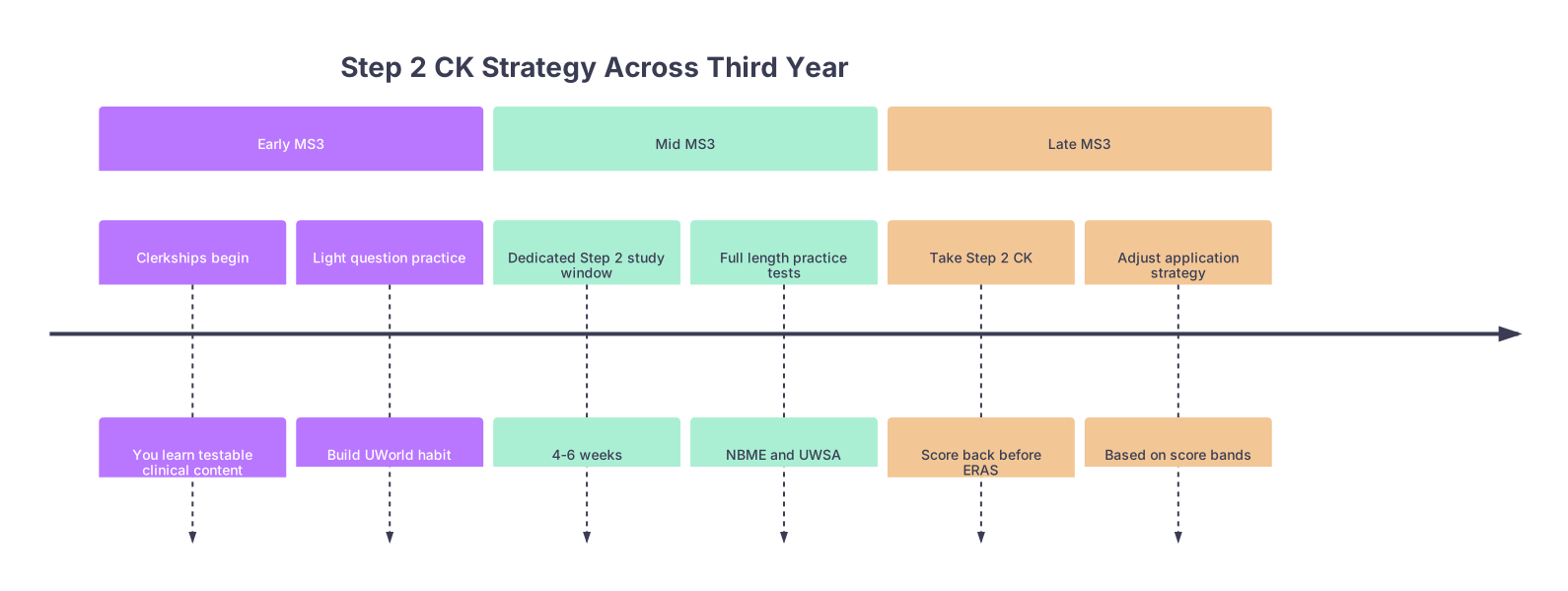
| Period | Event |
|---|---|
| Early MS3 - Clerkships begin | You learn testable clinical content |
| Early MS3 - Light question practice | Build UWorld habit |
| Mid MS3 - Dedicated Step 2 study window | 4-6 weeks |
| Mid MS3 - Full length practice tests | NBME and UWSA |
| Late MS3 - Take Step 2 CK | Score back before ERAS |
| Late MS3 - Adjust application strategy | Based on score bands |
If Your Step 2 CK Is “Average” or Lower
Then you have to play smarter on the other dimensions:
- Be brutally strategic about specialty and program list.
- Lean into geography and “fit” in your personal statement and experiences.
- Secure the strongest possible specialty-specific letters.
- Avoid obvious “reach-only” lists. You need a real spread of programs.
If You Have Red Flags
Do not ignore them. Programs won’t.
- Address Step failures or leaves clearly in your personal statement or secondary responses where appropriate.
- Make sure your dean’s letter explanation matches your story.
- Strengthen everything else: Step 2, letters, clinical comments, meaningful experiences.
The question in committees becomes: “Is there a coherent narrative that makes sense, or is this chaos?” Give them a coherent narrative.
8. The Bottom Line: Programs Still Need to Say “No” Fast
Cutoffs, in the post–Step 1 world, are more distributed and less transparent. But they’re still absolutely there.
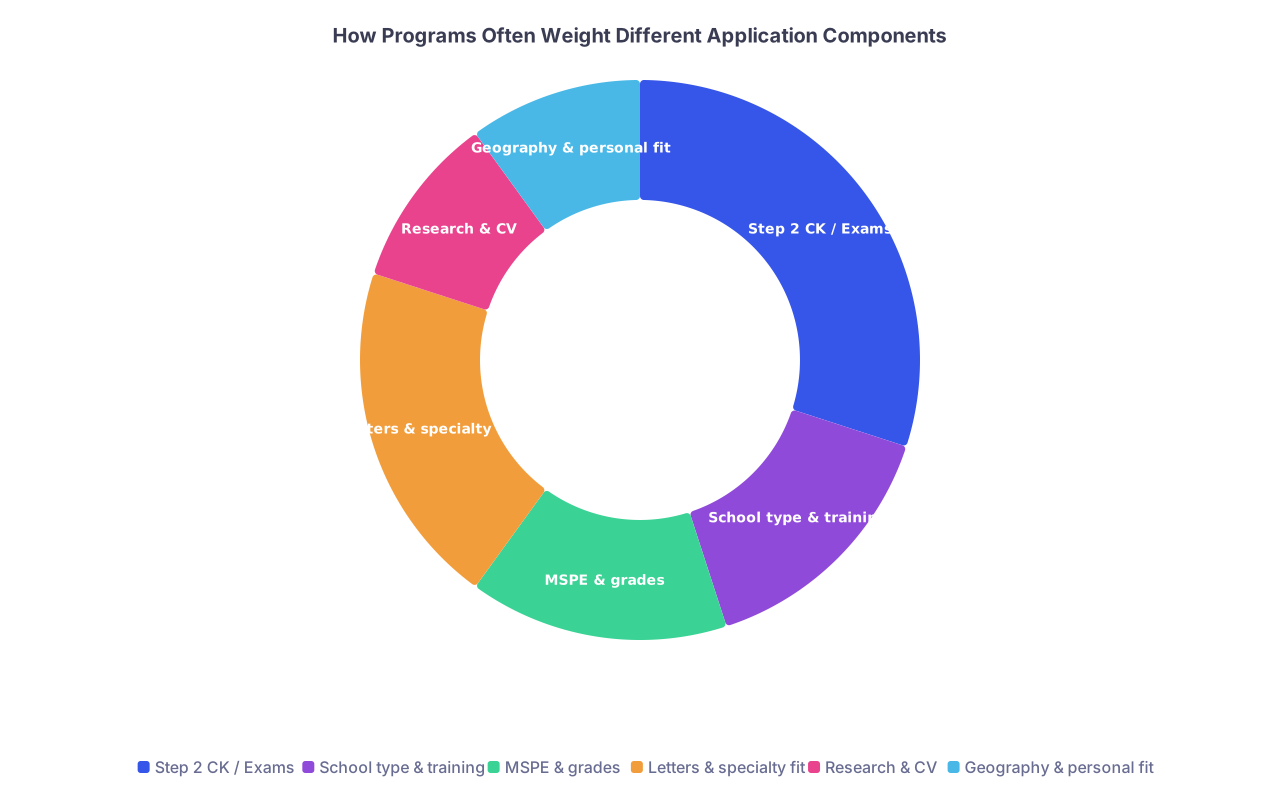
Think of your application like this:
| Category | Value |
|---|---|
| Step 2 CK / Exams | 30 |
| School type & training | 15 |
| MSPE & grades | 15 |
| Letters & specialty fit | 20 |
| Research & CV | 10 |
| Geography & personal fit | 10 |
Your practical “don’t get auto-screened” checklist:
- Step 2 CK at or above the rough floor for your specialty and applicant type.
- No unaddressed red flags.
- At least one strong letter in your chosen specialty.
- A program list that matches your profile (not fantasy-land).
- Some sign you might realistically want that program or region.
Programs are not looking for perfection. They’re looking for a reason to move you from “maybe” to “no” in under 30 seconds. Your job is to remove those easy “no’s.”
FAQ: Cutoffs in the Pass/Fail Step 1 Era
1. Do programs still use numeric cutoffs at all now that Step 1 is pass/fail?
Yes. They just shifted most of that weight to Step 2 CK and a few other harder filters (school type, red flags, graduation year). Plenty of programs start their review with a Step 2 CK floor and only make exceptions for special cases—home students, truly stellar research, or strong connections.
2. What Step 2 CK score is “good enough” to not be screened out?
It depends on specialty and your background. Roughly: for primary care/community IM, often 220–230+ keeps you in the game. For moderately competitive specialties and academic programs, think 235–245+. For ultra-competitive, >250 is common among serious applicants. These aren’t official cutoffs, but they’re the bands where you stop being auto-eliminated and start being meaningfully considered.
3. How badly does a Step 1 fail hurt now that it’s pass/fail?
It still hurts. A Step 1 fail is one of the few near-automatic red flags for many programs. The usual expectation to offset it: a solid Step 2 CK (often well above average), a clear explanation in your narrative, and no additional academic problems. One fail with a strong rebound can be survivable. Multiple fails? Much harder.
4. I’m an IMG. What are my real “cutoffs”?
Higher across the board. Many programs layer filters: must accept IMGs, must sponsor visas (if needed), must be within a certain number of years from graduation, and must have a high-enough Step 2 CK (often 240+ in competitive places). You’re also competing against US grads who may be considered first. That means your scores, letters (especially US-based), and lack of gaps all function as stricter cutoffs.
5. If my Step 2 CK is weak, can strong letters or research compensate?
Sometimes, but only if you clear the basic screens. If you’re below a program’s hard floor, they may never see your letters or research. If you’re slightly below their typical range, strong specialty letters, clear passion for that field, and meaningful research or leadership can absolutely get you pulled off the “maybe” pile. But no, a great personality plus a 205 won’t carry you into derm.
6. Are there any programs that truly do “holistic review” without cutoffs?
A few. Mostly smaller programs, some primary care–focused sites, and certain mission-driven institutions. But even they tend to have implicit floors (like “we generally don’t interview people who repeatedly fail exams or who are way below average on Step 2”). Holistic doesn’t mean blind to data; it means they’re willing to look past non-perfect numbers when the rest of the file is compelling.
Key points to leave with: Step 2 CK is now the main numeric gatekeeper, school type and red flags still quietly drive a lot of filtering, and “fit” plus geography act as stealth cutoffs once you’re past the exams. Build your strategy around not giving programs an easy reason to say no.