
The worst way to explain a delayed Step 1 is to pretend it’s not a big deal. Programs notice. They talk about it. You need to hit this head‑on, clearly and strategically.
Here’s exactly how to do that.
What “Delayed Step 1” Actually Signals To Programs
Let me be blunt: a delayed Step 1 is a yellow flag, not an automatic rejection. But if you don’t explain it, programs are free to assume the worst:
- Academic struggles you’re hiding
- Poor time management or professionalism concerns
- Personal chaos that might repeat in residency
Your job is to control the narrative instead of letting them write their own story about you.
Most common “delay” situations I see:
- You needed extra time and postponed the original test date
- You failed Step 1 and had to retake it
- Your school pulled you from the test because of low practice scores
- Health, family, visa, or administrative issues pushed your exam later
- COVID‑era disruptions or curriculum changes messed up the timeline
All are explainable. Some are cleaner than others. The key is the same:
Briefly explain what happened, show what changed, and prove it won’t hurt your residency performance.
Where To Explain It: ERAS, MSPE, Personal Statement
You’ve got a few places this can show up. Use them wisely.

| Step | Description |
|---|---|
| Step 1 | Delayed Step 1 |
| Step 2 | Brief ERAS explanation |
| Step 3 | MSPE and PS mention |
| Step 4 | Optional PS one line |
| Step 5 | Be ready to discuss at interviews |
| Step 6 | One time issue? |
1. ERAS Application
If there’s a clear date gap or you had to indicate more than one Step 1 attempt, you can address it in:
- “Education interruptions / leaves”
- “Additional Information” text box (if offered that year)
- Sometimes in “Other Awards/Accomplishments” if framed as “academic turnaround”
This is where I’d put a 2–4 sentence, factual explanation.
2. MSPE (Dean’s Letter)
Your school may already mention:
- Exam delays
- Remediation
- Leaves of absence
If they’ve described it reasonably and accurately, you don’t have to repeat the full story. You just need to align your explanation with that tone and content.
If the MSPE is vague or harsh, your own explanation becomes even more important.
3. Personal Statement
Don’t turn your personal statement into a Step 1 autopsy. For most people, this deserves:
- One short paragraph at most, or
- A single clean sentence showing growth, if it fits your story
Use the PS only if the delay is tied to a bigger theme of your development (burnout, mental health recovery, family caregiving, etc.) and you can do it without melodrama.
How To Structure Your Explanation (Template Included)
Think of your explanation like a well‑focused H&P:
- What happened (the “HPI”)
- What you did about it (the “intervention”)
- What’s different now (your “reassurance / prognosis”)
Do not:
- Rehash your entire emotional journey
- Blame everyone else
- Sound like you’re still not over it
Core 3‑Sentence Formula
Use this as your backbone and tweak:
- State the reason, briefly and neutrally.
- Describe the concrete actions you took.
- Connect it to current, objective evidence of your readiness.
Example (for postponed Step 1 due to readiness):
During my second year, my initial practice scores indicated I wasn’t ready to take Step 1 on my originally scheduled date, and my exam was delayed. I worked with my academic advisor to restructure my study schedule, increased faculty‑guided question review, and completed a formal remediation plan. I subsequently passed Step 1 and have since demonstrated consistent test performance, including [strong NBME scores/subject exams/Step 2 CK score of XXX].
Example Variations By Scenario
A. You Failed Step 1 Once, Then Passed
You absolutely should address this. Ignoring a fail is worse than talking about it.
I was unsuccessful on my initial attempt at Step 1 during a period when I was struggling with test‑taking strategy and time management. After that result, I completed a structured remediation program, met weekly with a learning specialist, and significantly increased my question‑based studying. I passed on my subsequent attempt and have since performed reliably on standardized exams, including a Step 2 CK score of XXX and strong clinical clerkship evaluations.
Notice what’s missing: excuses, drama, blame.
B. Health or Family Issue
You don’t need to give every detail, but you also shouldn’t sound mysterious.
My Step 1 exam was delayed due to an acute medical issue that required treatment and short‑term adjustment of my academic schedule. In collaboration with my school, I postponed the exam to ensure I could test safely and effectively, then completed my coursework and licensing exams without further interruption. This experience strengthened my ability to set boundaries, seek help early, and maintain consistent performance under stress.
Swap “medical issue” with “family emergency,” “bereavement,” or “visa/immigration issue” as appropriate.
C. School‑Mandated Delay Based on Practice Scores
This is extremely common now. Name it clearly, then show the turnaround.
My school requires students to meet specific NBME benchmarks before registering for Step 1. I initially did not meet the cutoff, and my exam was delayed while I participated in a structured remediation program. During that period, I increased my question volume, improved my study methods, and ultimately passed Step 1; since then I’ve demonstrated academic improvement with [honors in key clerkships / a Step 2 CK score of XXX].
What Programs Actually Want To See (And What Scares Them)
Residency PDs and selection committees are pattern detectors. They’re looking for:

Green Flags In Your Explanation
- Ownership: “I didn’t meet the benchmark” instead of “The school delayed me for no reason.”
- Specific actions: tutoring, question banks, schedule changes, remediation.
- Objective improvement: Step 2 CK, clerkship grades, later exams.
- Stability since: no repeated leaves, no additional delays, consistent timeline after that event.
Red Flags That Turn People Off
- Vague statements: “Due to personal reasons…” and nothing more.
- Over‑sharing in a way that suggests lack of boundaries.
- Blame: “Unfair testing conditions,” “The administration…” (once is fine, ranting is not).
- No evidence of change: poor Step 2, more delays, scattered performance.
If your Step 2 CK is strong, you’ve already done half the work. Programs heavily weigh Step 2 now, especially in the pass/fail Step 1 era.
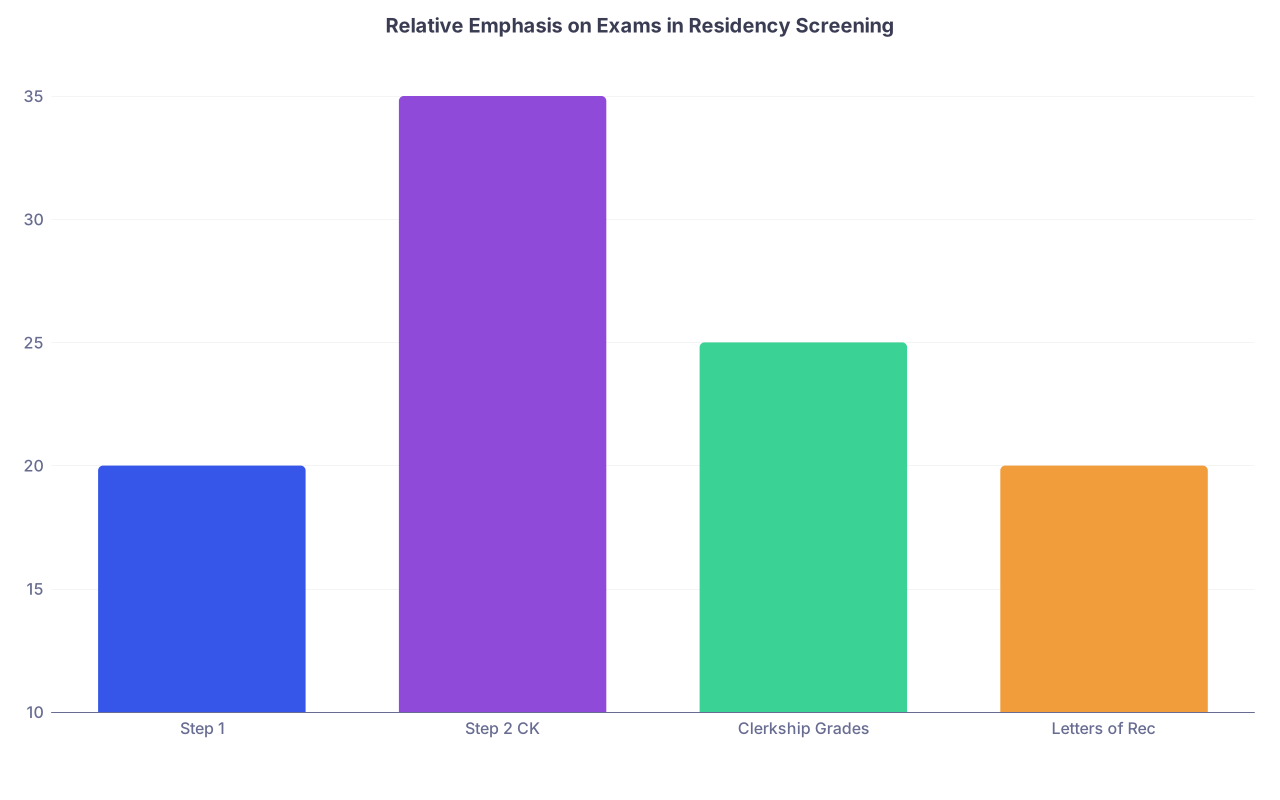
| Category | Value |
|---|---|
| Step 1 | 20 |
| Step 2 CK | 35 |
| Clerkship Grades | 25 |
| Letters of Rec | 20 |
(The numbers aren’t exact; I’m showing the trend: Step 2 CK and clinical performance carry real weight.)
How To Talk About It In Interviews
If you explain it well in writing, interview questions will be calmer and more focused. But you should still have a rehearsed, 30–60 second answer.
Use the same structure as your written statement, but conversational:
- Brief context
- What went wrong
- What you changed
- What your later performance shows
Sample spoken answer for a failed Step 1:
“During second year, I struggled with integrating large volumes of material and didn’t yet have an effective question‑based study system. That led to a failed Step 1 attempt. After that, I worked with our learning specialist, switched to primarily UWorld‑based studying, and built a more structured schedule. I passed on my next attempt, and since then I’ve scored well on shelf exams and Step 2 CK and have performed strongly on rotations. The big takeaway for me was learning to ask for help early and to adjust my approach when something isn’t working.”
Key point:
You talk more about what you learned than how bad it felt.
How Different Types Of Delays Are Perceived
Here’s a blunt comparison to keep your expectations realistic:
| Scenario | Typical Program Reaction |
|---|---|
| One-time postponement, then pass, strong Step 2 | Mild concern, often neutralized |
| One failed attempt, strong Step 2 | Yellow flag but very workable |
| Multiple failures, weak Step 2 | Major concern, limited options |
| Delay due to health/family issue, stable since | Usually very understanding |
| Administrative/visa delay, no academic issues | Minimal concern if documented |
You can’t change which box you’re in.
You can change whether they see you as someone who learns, stabilizes, and moves forward—or someone stuck in the past.
How Much Detail Is Too Much?
General rule: give enough detail that a skeptical PD doesn’t feel like you’re hiding something, but not so much that your application becomes a confessional essay.
Too vague:
“There were personal circumstances that delayed my Step 1 exam. I’ve grown a lot since then.”
Too detailed:
“My relationship ended suddenly, which triggered a depressive episode. I started three different medications over four months…”
Better middle:
“I experienced a significant mental health challenge that required treatment and a temporary adjustment of my academic schedule. With appropriate care and school support, I returned to full function, completed Step 1, and have had stable performance and no further disruptions since.”
Clear. Honest. Bounded.
Special Considerations in the Pass/Fail Era
Step 1 going pass/fail changed the psychology, not the reality. Programs still watch for:
- Timing of the exam: unusually late in MS2 or into MS3
- Number of attempts: this still shows
- Pattern of delay + weak Step 2 CK: that combination is rough
In the pass/fail era, your Step 2 CK score is now your best weapon to offset any Step 1 weirdness. If your Step 1 was delayed, you should be aiming for a decisive, above‑average Step 2 for your target specialty.
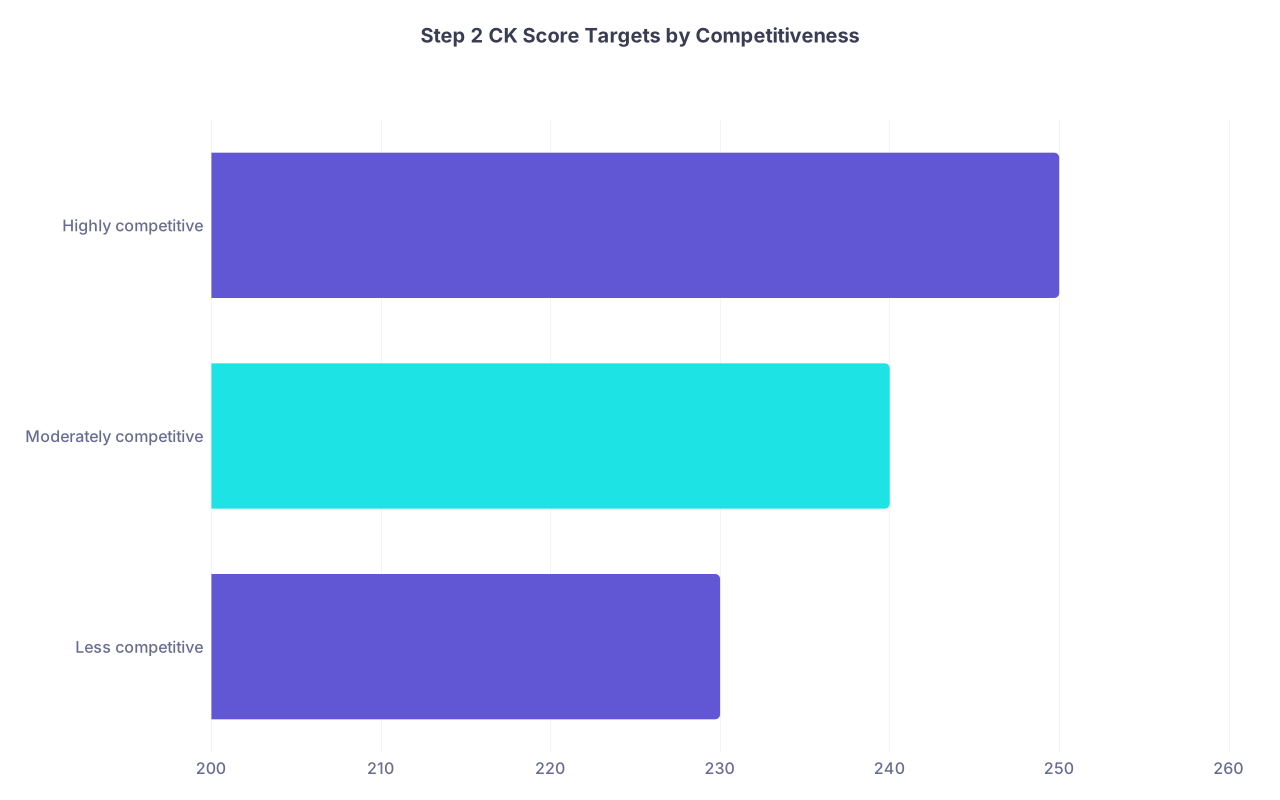
| Category | Value |
|---|---|
| Less competitive | 230 |
| Moderately competitive | 240 |
| Highly competitive | 250 |
Rough, generalized targets, not ironclad cutoffs. But you get the idea.
Example Paragraphs You Can Adapt
Here are a few plug‑and‑edit examples you can drop into ERAS or your personal statement and then customize.
Short ERAS “Additional Info” Style
My Step 1 exam occurred later than originally planned due to difficulty meeting my school’s initial readiness benchmarks. I worked closely with academic support services, adjusted my study approach, and successfully completed the exam. Since then, I have maintained consistent academic performance with [Honors in key clerkships / a Step 2 CK score of XXX].
Personal Statement One‑Paragraph Version
During my preclinical years, I faced a setback when I was not initially ready to take Step 1 on schedule. That experience forced me to confront gaps in my study approach and time management. With help from faculty and learning specialists, I developed a more disciplined, question‑based strategy that ultimately led to success on Step 1 and strong performance on subsequent exams and clerkships. More importantly, it taught me to seek feedback early, respond constructively to setbacks, and maintain resilience under pressure—skills I bring to residency.
For a Health‑Related Delay
My Step 1 exam was delayed due to a short‑term medical condition that required treatment and recovery time. In collaboration with my school, I temporarily adjusted my schedule, then returned to complete my preclinical requirements and Step 1 without further interruption. Since then, I have remained healthy and have successfully managed the demands of clerkships and Step 2 CK, reinforcing my ability to balance self‑care with professional responsibilities.
Don’t Forget The Rest Of Your Application
A clean explanation won’t save a weak overall application. But it can make a solid application feel coherent instead of risky.
If you’ve had a delayed Step 1, you should be doubling down on:
- Strong Step 2 CK score
- Consistent clerkship performance (no more surprises)
- Clear, focused letters that back up your reliability
- A personal statement that emphasizes growth, responsibility, and sustained effort
This is how you turn a potential liability into a “this person has been stress‑tested” story.


FAQ: Delayed Step 1 Explanations
1. Do I have to explain a delayed Step 1 if I ultimately passed?
If the delay is obvious in your timeline or linked to a failed attempt, yes, you should briefly explain it. If your school’s MSPE already clearly explains it and the delay was minor, you can sometimes let that stand—but I still recommend a short clarification in ERAS so programs hear it directly from you.
2. Should I talk about mental health as the reason for my delay?
You can, but do it carefully. Keep it high‑level (“mental health challenge,” “anxiety treated with counseling and medication”), focus on treatment and stability, and avoid graphic detail. Programs are more concerned about ongoing instability than about past, well‑managed conditions.
3. How long should my explanation be?
Think 2–4 sentences in ERAS, maybe a short paragraph in your personal statement if it ties into your growth narrative. If you can’t explain it cleanly in under 150 words, you’re probably oversharing or repeating yourself.
4. Is it better to blame the school’s policy or just own it?
Own your part. You can mention school policies (readiness benchmarks, etc.) as context, but the most mature, trustworthy tone is: “Here’s what happened, here’s what I did to fix it, here’s why it’s not an issue now.”
5. Can a strong Step 2 CK “erase” a delayed or failed Step 1?
Erase? No. Compensate? Often, yes. A strong Step 2 CK plus solid clinical performance convinces many programs that whatever caused your Step 1 delay has been addressed. Especially in the current pass/fail Step 1 environment, Step 2 is your best way to prove readiness.
Bottom line:
Explain the delay briefly and directly, show what you changed, and back it up with stronger, later performance. Don’t hide it, don’t dramatize it, and don’t center your whole application around it. Treat it as one chapter in your story, not the title of the book.