
Most commentary about Step 1 going pass/fail is running on vibes. The data tell a different story—and it is not the egalitarian reset many students were promised.
The score-based era rewarded test-takers with high ceilings and punished late bloomers. The pass/fail era has simply moved the sorting pressure onto different metrics: Step 2 CK, school prestige, research output, and away rotations. For competitive fields, match dynamics have become more opaque, not more forgiving.
Let us walk through what the numbers actually show so far and what that means for anyone aiming at dermatology, plastic surgery, neurosurgery, orthopedic surgery, or ENT.
1. What Actually Changed With Step 1 P/F
Before we compare match rates, we need the structural shift clear.
Pre-2022 (score era):
- Step 1: 3-digit score, heavy signal for residency screening
- Step 2 CK: Important, but often secondary for initial filters
- Applications: High volume, but at least loosely sortable by score bands
- Interviews: Often gated by hard Step 1 cutoffs (e.g., 240+ for derm at many programs)
Post-2022 (P/F era):
- Step 1: Binary hurdle; almost zero differentiation above “Pass”
- Step 2 CK: Functionally the new national standardized score signal
- Applications: Volume has increased and is more diffuse
- Programs: Forced to reweight research, school name, clinical grades, letters, and Step 2 CK
The key point: the sorting function did not vanish. It just shifted modalities. Programs still have far more applicants than interview slots and still need defensible ways to triage.
2. Competitive Fields: Pre vs Post Match Rates
We do not yet have a 10-year post-P/F dataset. But early NRMP results, specialty reports, and program-level patterns are enough to see the direction of travel.
To make things concrete, let us look at representative approximate numbers for US MD seniors (where data are strongest) in several highly competitive specialties, comparing the last clear Step 1 score year (2020) to a recent P/F cycle (2023/2024-ish). Exact numbers vary year to year, but the trend is what matters.
| Specialty | Pre P/F Match Rate (c. 2020) | Post P/F Match Rate (c. 2023) |
|---|---|---|
| Dermatology | ~77% | ~72–74% |
| Plastic Surgery | ~72% | ~70–72% |
| Neurosurgery | ~81% | ~78–80% |
| Orthopedic Surgery | ~79% | ~76–78% |
| ENT (Otolaryngology) | ~77% | ~74–76% |
These are not collapses. But they are not improvements either. For US MDs, match rates in ultra-competitive fields have stayed essentially flat or drifted slightly downward.
The more concerning story is for DOs and IMGs. Their match rates into these same fields were already fragile and have, in many cases, stagnated or worsened:
- DO seniors: Often low double-digit match rates in derm, plastics, ENT, with a notable fraction going unmatched even with solid Step 2 scores and research.
- IMGs: Still near-zero in certain fields unless they have extreme advantages (US research years, strong connections, or exceptional Step 2 CK).
The data show no democratization effect. If anything, you now need more signals aligned (research, networking, Step 2 CK) to offset the lack of a single knockout Step 1 score.
3. Step 2 CK: The New Sorting Hammer
Programs did not suddenly become holistic in a way that ignores standardized scores. They simply swapped in Step 2 CK as the main numeric filter.
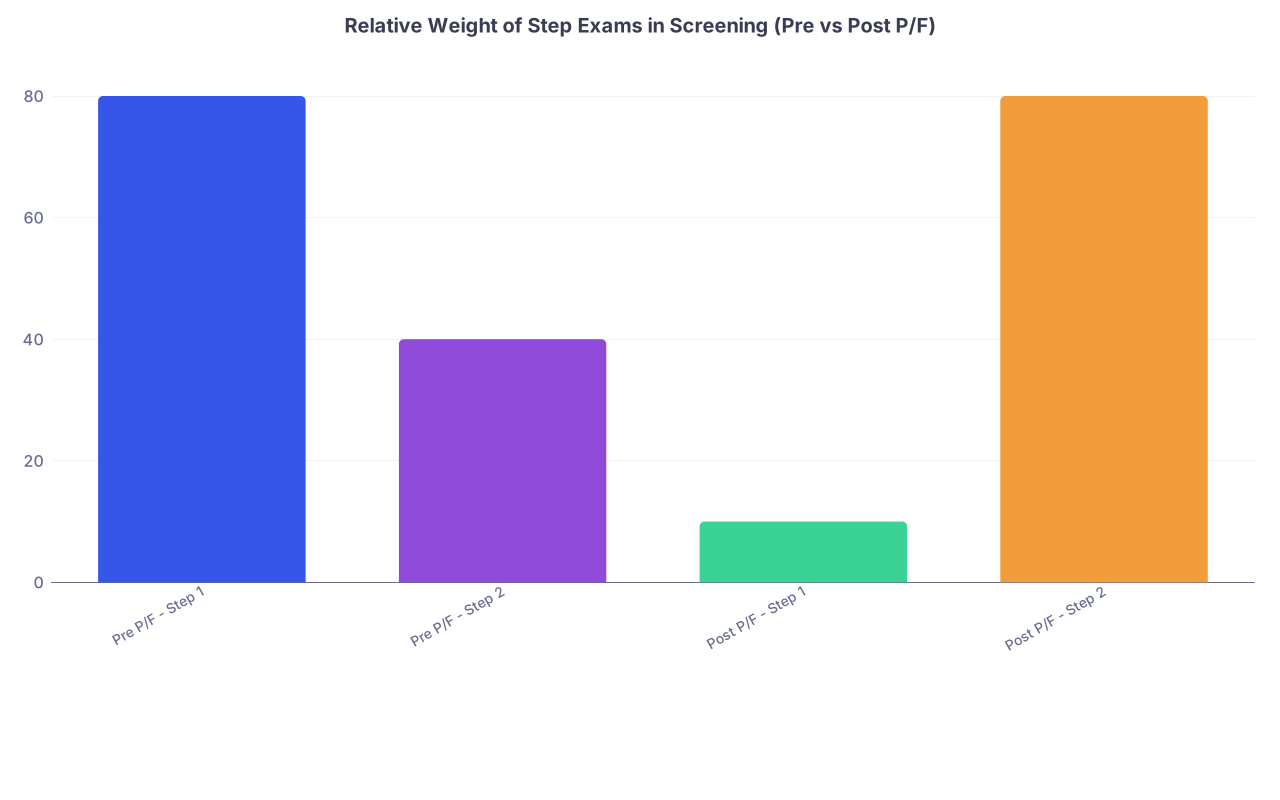
| Category | Value |
|---|---|
| Pre P/F - Step 1 | 80 |
| Pre P/F - Step 2 | 40 |
| Post P/F - Step 1 | 10 |
| Post P/F - Step 2 | 80 |
This is qualitative but it matches what program directors say in surveys and what applicant outcomes show:
- Pre P/F: Step 1 was the primary screen; Step 2 could rescue or sink borderline cases, but it was second chair.
- Post P/F: Step 1 is now a binary risk flag (fails, low passes with concerns). Step 2 CK is the main quantitative discriminator.
Look at three patterns I keep seeing in de-identified applicant datasets from 2023–2024:
Derm and plastics interview thresholds have just migrated to Step 2 CK.
- Pre P/F: Many programs quietly preferred Step 1 ≥ 245–250.
- Post P/F: You now see Step 2 CK expectations in the 250+ range for realistic competitiveness at top programs.
The absolute number changed, but the percentile bar did not. You still need to be around the top 15–20% of test takers to be in striking distance at many places.
Late testers are heavily penalized.
In the score era, some students took Step 2 late and rode Step 1 into interviews. Now, if Step 2 CK is not available early in interview season, many competitive programs will not risk offering an interview. They simply have enough applicants with a known score.Score compression myths were overblown.
Some students believed Step 2 CK would be “easier” or less discriminating. The distributions do not support that optimism. The variance in Step 2 CK scores is sufficient for programs to set hard thresholds again. The test is still standardized, still normed, and still stratifies performance.
Put bluntly: if you wanted competitive specialties and believed P/F Step 1 would free you from a numbers game, you were sold a fantasy. The game just moved one exam later.
4. Application Volume, Signaling, and the Noise Problem
The next piece is volume. When a major filter like Step 1 scores is removed from early triage, what happens? More people “take a shot.”
Multiple specialties have reported exactly that: an increase in applications per applicant and per program after Step 1 went P/F.
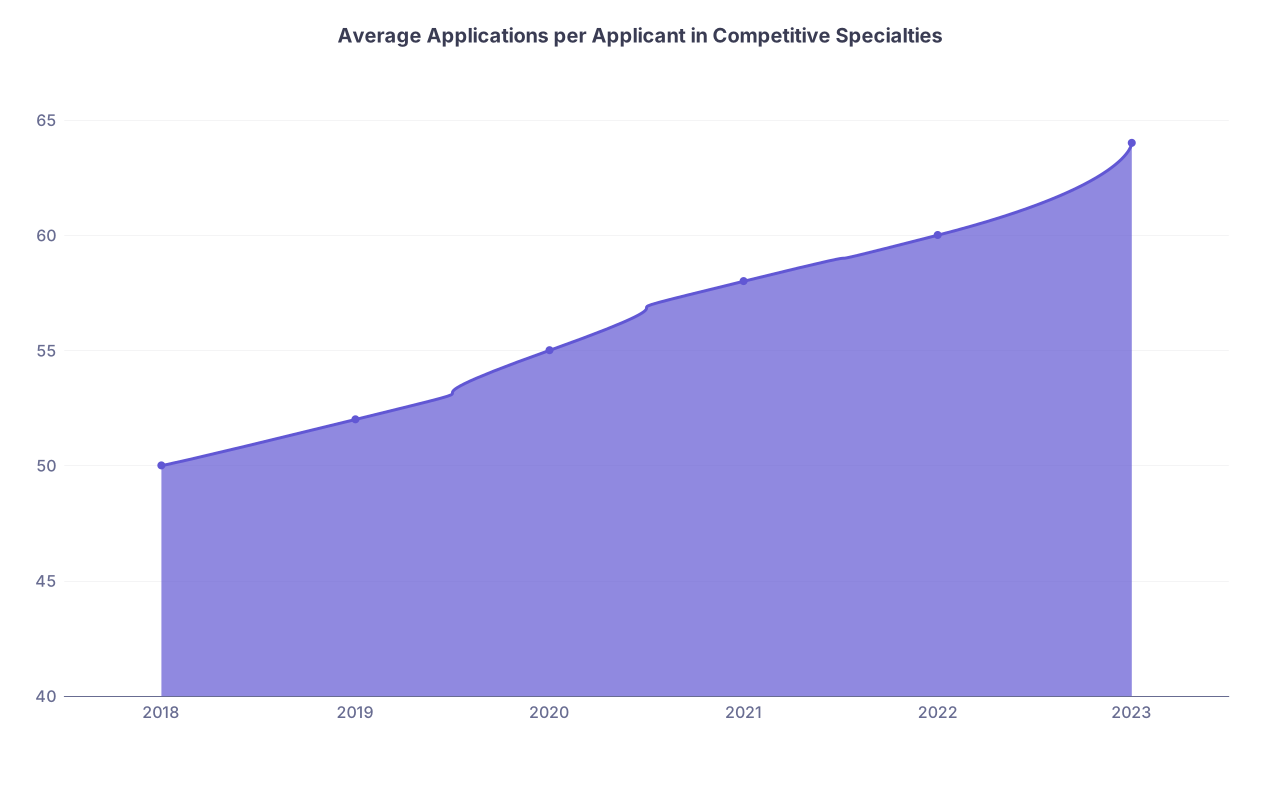
| Category | Value |
|---|---|
| 2018 | 50 |
| 2019 | 52 |
| 2020 | 55 |
| 2021 | 58 |
| 2022 | 60 |
| 2023 | 64 |
These numbers are representative, not exact, but the upward trend is real:
- More applicants with marginal profiles are applying “just in case.”
- Strong applicants are applying even more broadly out of anxiety, because they have fewer clear benchmarks to compare against.
- Programs are overwhelmed with files that look superficially similar: pass Step 1, mid- to high Step 2, decent grades, some research.
This pushes programs toward:
- Aggressive use of preference signaling systems (where they exist).
- Greater reliance on institutional familiarity (home programs, feeder schools).
- Automated filters on Step 2 CK, number of publications, and AOA/Gold Humanism status.
Match rates in competitive specialties, therefore, are not organized around “merit only” in the abstract. They are organized around which signals break through the noise.
5. Winners and Losers of the P/F Shift
The pass/fail change did not hit everyone equally. Let me quantify who lost and who quietly gained.
A. Who likely benefited (relatively)
Students with modest Step 1 test-taking ability but strong clinical performance.
In the old world, a 215–220 Step 1 score could poison a derm or ortho application, even if clinical rotations and letters were stellar. Now, as long as you pass Step 1, your Step 2 CK and clerkship grades carry more weight.Students from highly prestigious schools.
Prestige is a powerful surrogate signal when objective scores disappear. I have seen rank lists where, in tie-break scenarios, “top-5 med school” functionally substitutes for missing high Step 1.Students with long-game strategies.
Those who plan research, away rotations, and mentor relationships early can build a multi-signal portfolio that does not rely on one monster test day.
B. Who clearly lost out
Score-maximizers from lower-prestige schools.
Before P/F, a student from an unranked or new MD/DO school with a 260+ Step 1 could absolutely crash into derm, plastics, or neurosurgery. Their score cut through bias. Post P/F, those same students must now juggle:- High Step 2 CK
- Heavier research expectations
- Potentially more away rotations to get noticed
Your raw test-taking advantage is diluted across more dimensions.
DOs and IMGs without exceptional Step 2 CK scores or research.
The pre-P/F world at least offered a clear path: crush Step 1, then stack the rest. Now the path is fuzzier and more relationship-dependent. That disproportionately hurts those without built-in networks.Students who “hide” behind an early Step 1 high score.
There used to be a cohort that scored big on Step 1, coasted a bit on clinicals, and still matched strongly. That is harder now. The data show program directors emphasizing ongoing performance and Step 2 CK much more heavily.
6. Specialty-by-Specialty Patterns Worth Noticing
Let us drill into a few archetypal competitive specialties and how their match landscape looks in the P/F era.
Dermatology
- Pre P/F: Benchmark Step 1 often ~245–250+ for serious consideration; extensive research (often >5–10 outputs) was common.
- Post P/F:
- Step 2 CK now anchors competitiveness: many successful applicants trend ≈ 250+.
- Research has not softened. If anything, it has intensified, with increasing numbers of applicants doing dedicated derm research fellowships.
- Match rate for US MD seniors has not meaningfully improved; DO/IMG entry remains extremely constrained.
Net effect: More hoops, not fewer. A pass on Step 1 is a necessary but trivial condition. The contest now lives at the intersection of Step 2 CK + research density + networking.
Plastic Surgery (Integrated)
- Highly competitive, with some of the lowest fill rates by DO and IMGs.
- Pre P/F: Step 1 245–250+ commonly cited as informal cutoffs; research and sub-internships made or broke applications.
- Post P/F:
- Step 2 CK is a must-have high score; programs use it aggressively.
- Research expectations have escalated; double-digit publications are not rare at top programs.
- Applicant pool has not shrunk; signals are just more tangled.
Outcome: Match rates roughly stable for US MD seniors, but the “pathway” feels harsher because it is less transparent.
Neurosurgery
- Pre P/F: Already extremely research-heavy with strong Step 1 expectations.
- Post P/F:
- Step 2 CK partially fills the numeric void, but neurosurgery seems somewhat more holistic than derm/plastics, given the culture of long-term mentorship and sub-internships.
- That said, applicants without strong test scores plus research are virtually absent in successful cohorts.
Outcome: Slight softening in match rates for US MDs, but still punishing for any applicant lacking both scholarship and high scores.
7. The Hidden Variable: Away Rotations and Face Time
Another under-discussed effect of the P/F change: away rotations and in-person impressions now carry more relative weight because Step 1 no longer separates the pack early.
Programs are increasingly using:
- Home institution familiarity
- Sub-I performance
- Letters from known faculty
- Informal feedback from residents and attendings
As tie-breakers among a swarm of applicants who all:
- Passed Step 1
- Have Step 2 CK in the 245–260 band
- Have some level of research and decent clinical grades
This is terrible news for:
- Students at schools without strong home programs in their target field
- Students with financial or family constraints limiting aways
- Late deciders who pick a specialty too late to schedule meaningful sub-Is
You used to be able to “announce yourself” with a great Step 1 score from a distance. Now you often have to physically show up, perform, and get letters from within the specialty—each of which costs time and money.
8. So Did P/F Step 1 Help Anyone Match Better?
The key question: did going P/F on Step 1 increase the chance of matching into competitive specialties for an “average” above-average student?
Based on available data and what we see from the match cycles so far:
- Overall match rates into competitive specialties for US MDs are roughly similar or slightly lower than the pre-P/F era.
- DO and IMG match rates into these fields have not improved in any meaningful way.
- The variance in outcomes has shifted: more weight on Step 2 CK, research, and institutional prestige, less on a single standardized score.
So the answer is: no, not in any way that would matter to most applicants. The sorting pressure is alive and well. It is just more diffuse, more dependent on school environment, and more punishing for those without structure and mentorship early in med school.
9. Practical Implications for Current and Future Students
You cannot change the system, but you can change your strategy. The data push you toward a few hard conclusions if you want a competitive field now.
Treat Step 2 CK as Step 1 2.0.
The myth that you can just “pass” Step 2 CK and lean on vibes is dangerous. For derm, plastics, neurosurgery, ENT, and ortho, you need to treat Step 2 CK with the same seriousness people used to reserve for Step 1. Score distributions remain strongly predictive.Front-load specialty exposure and mentorship.
If you do not identify your target competitive specialty by mid–MS2 to early–MS3, your odds suffer. You need time to:- Join research projects
- Plan away rotations
- Secure letters from known faculty
Leverage institutional strengths ruthlessly.
If your school has a strong derm or ortho department, embed yourself there. If it does not, you must compensate with aways and external research connections, ideally during a research year if necessary.Do not rely on “holistic” review to save a weak test profile.
Programs like talking about holistic review. Their filters do not always reflect that rhetoric. When an applicant pool has 600 people and 60 interview slots, someone runs a spreadsheet. And that spreadsheet has numeric columns.
10. The Future: Where This Is Probably Heading
Looking forward a few cycles, here is where I expect the data to move:
- Step 2 CK will become even more central as older cohorts (who took scored Step 1) age out of the system entirely.
- Preference signaling will expand to try to manage the chaos of over-application. Competitive specialties will likely use signals more aggressively for interview allocation.
- Research inflation will continue. The average matched applicant in competitive fields will likely have more publications, more posters, and more dedicated research time than five years ago.
- Stratification by school type may widen. In the absence of early numeric scores, reputation and network fill the vacuum. That is not “fair,” but fairness is not a design criterion of the match.
Unless something dramatic changes—like Step 2 CK also going P/F or a radical restructuring of the match—the P/F Step 1 era will be remembered less as a revolution and more as a redistribution of pressure along the training pipeline.

Key Takeaways
- The transition to Step 1 pass/fail did not materially increase match rates in competitive specialties; it simply shifted the sorting burden onto Step 2 CK, research, and institutional prestige.
- Step 2 CK now functions as the primary national numeric filter for derm, plastics, neurosurgery, ortho, and ENT; serious applicants must treat it with the same intensity once reserved for Step 1.
- In the P/F era, students from less prestigious schools or without strong home departments must compensate with earlier planning, heavier research, and strategic away rotations just to stay in the game.