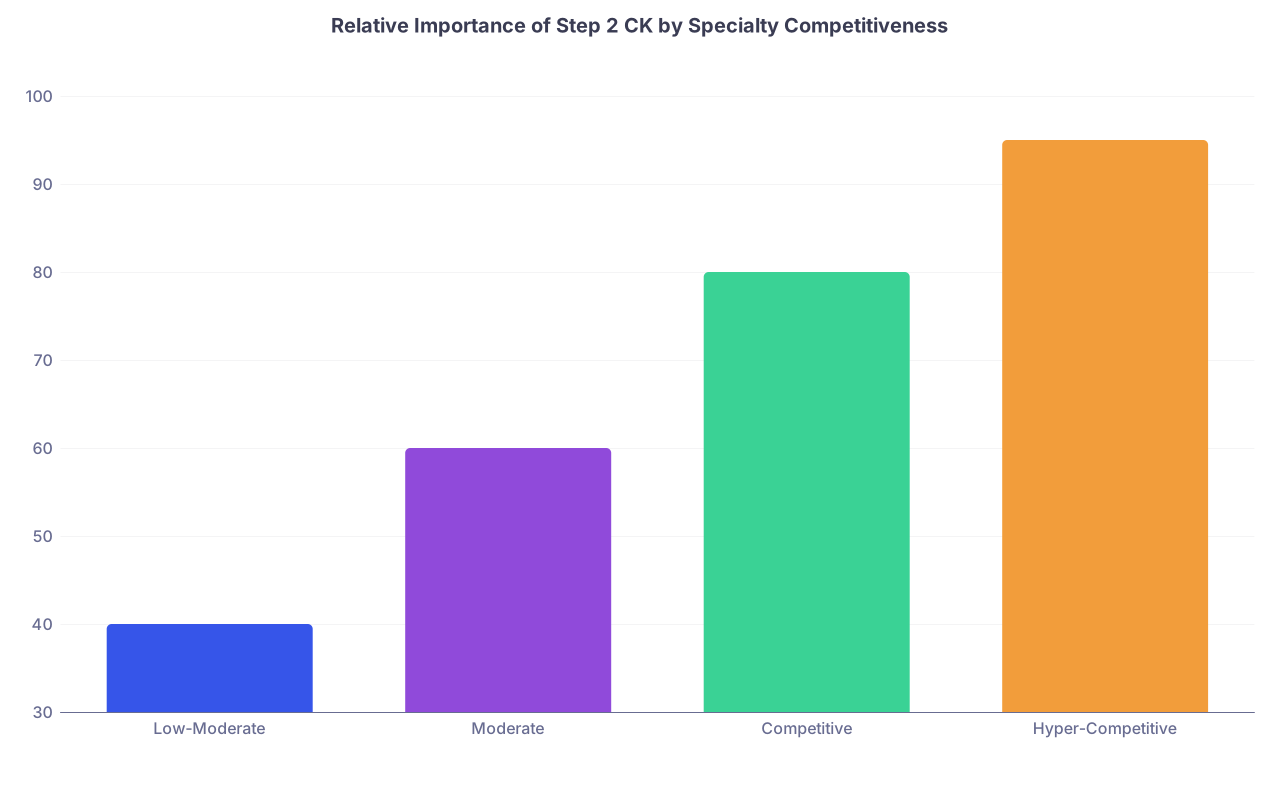
| Category | Value |
|---|---|
| Low-Moderate | 40 |
| Moderate | 60 |
| Competitive | 80 |
| Hyper-Competitive | 95 |
The idea that “Step 2 CK will just replace Step 1” is wrong. The data show something more brutal: Step 2 CK is becoming a primary numeric filter, and the thresholds are diverging sharply by specialty.
Programs are no longer asking, “Did you pass?”
They are asking, “Are you above our cut score?”
And that cut score is creeping upward every cycle.
Below, I will walk through what the numbers actually indicate: emerging Step 2 CK thresholds by specialty tier, how filters are probably being applied in real ERAS downloads, and what this means for US MD, DO, and IMG applicants in the Step 1 pass/fail era.
1. The New Reality: Step 2 CK As the First Gate
Step 1 went pass/fail. Programs did not suddenly develop infinite time or holistic zen. They still have:
- Hundreds to thousands of applications per cycle
- Limited faculty time
- Strong pressure to keep “objective” screening
So what happened? The data show three consistent shifts across NRMP, specialty surveys, and anecdotal program director behavior.
Step 2 CK is now the main standardized metric.
In the 2022 and 2023 NRMP Program Director Surveys, Step 2 CK jumped sharply in “importance” rankings, especially in competitive specialties that once leaned heavily on Step 1.Programs are explicitly adding Step 2 filters in ERAS.
I have seen real ERAS screenshots where coordinators apply filters like “USMLE Step 2 CK ≥ 240” or “≥ 250” as the first cut before a human even looks at the file.Timing pressure has increased.
More programs now “prefer” or “require” Step 2 CK at time of application, especially in competitive specialties and for IMGs.
This is not theoretical. It is a direct response to information loss from Step 1 going pass/fail. Step 2 CK became the new numeric signal.
2. Score Inflation and the New “Average”
To talk about thresholds, you need a baseline.
Historically (pre-pass/fail), Step 2 CK had:
- Mean around 245 (varied by year, usually mid-240s)
- Standard deviation roughly 15
Post Step 1 pass/fail, the trend is:
- Slight upward drift in the mean
- Noticeable inflation in the scores of applicants to competitive specialties
- Increased spread at the top (more 255–270+ scores in hyper-competitive fields)
Programs are reacting logically: if the applicant pool to a given specialty has become more Step-2-heavy and better prepared, thresholds ratchet up.
Think of it this way:
- 230 used to be “solid”
- 240 used to be “good”
- 250+ used to be “very strong”
Now, in many specialties, 230 is a risk, 240 is average for competitive fields, and 250+ is increasingly the informal filter line.
3. Emerging Thresholds by Specialty Tier
Exact numeric cutoffs are rarely published. But you can triangulate from five sources:
- NRMP Charting Outcomes trends
- Specialty match fill rates and applicant characteristics
- PD survey rankings of Step 2 CK
- De-identified program ERAS filter screenshots and coordinator comments
- Applicant outcome data shared informally (e.g., 255+ with 15+ invites vs. 235- with near-silence in the same specialty)
I will group specialties into four tiers and quantify realistic emerging Step 2 CK ranges as filters, not guarantees.
| Tier | Example Specialties | Common Filter Range |
|---|---|---|
| Hyper-Competitive | Derm, Plastics, Ortho, Neurosurg, ENT | 250–255+ |
| Competitive | EM, Anesth, Radiology, Urology, Ophtho, Gas-heavy IM | 240–250 |
| Moderate | IM categorical, Gen Surg, OB/Gyn, Peds | 230–245 |
| Low-Moderate | FM, Psych, Neuro, Path, PM&R | 220–235 |
3.1 Hyper-competitive specialties
Dermatology, Plastic Surgery, Orthopedic Surgery, Neurosurgery, ENT.
Historically, these lived and died by Step 1. Since Step 1 lost its granularity, they are using Step 2 CK like a scalpel.
Typical patterns I see in these fields:
- Filters around 250 for US MD, 255+ for DO/IMG at some programs
- Genuine concern if Step 2 CK is <240 regardless of other strengths
- Much higher expectation that Step 2 CK is available at time of application
Translated into thresholds:
US MD, strong research, home program:
Below 245 → some doors close
245–255 → in the conversation
255+ → above a lot of common filtersUS DO, no home program, limited connections:
Below 245 → very high risk
245–255 → need strong research + away rotations
255+ → now “statistically competitive,” though bias still existsIMG (even strong):
Many programs are quietly filtering IMGs at ≥250–255, sometimes higher.
So yes, in these specialties, Step 2 CK is absolutely a hard filter in many programs.
3.2 Competitive specialties
Emergency Medicine, Anesthesiology, Diagnostic Radiology, Urology, Ophthalmology, and “prestige-leaning” internal medicine (top academic IM programs, fast-track, physician-scientist tracks).
These fields have enough applicants to filter aggressively but are not quite as extreme as Derm/Plastics/Neurosurg.
Pattern:
- Many academic programs use filters around 240–245
- Community or less competitive programs closer to 230–235
- US MDs can sometimes overcome a sub-threshold score with strong letters, AOA, or school reputation; DO/IMGs less so
For example, I have seen:
- EM: Some urban academic programs running a “soft floor” around 240 for US MD, 245+ for DO/IMG
- Anesthesia: Filters around 235–240 at mid-tier, 245+ at the big names
- Radiology: Increasingly treats 245+ as the “safe” zone, especially with strong preclinical performance
Numeric translation:
- Safe-ish zone for interviews in most competitive specialties: ~245+
- Below 235: you will rely heavily on geography, connections, and less selective programs
3.3 Moderate competitiveness: IM, Gen Surg, OB/Gyn, Peds
This is where the nuance starts.
These specialties are broadly accessible, but the top programs in each are fiercely competitive.
Internal Medicine is the perfect example:
- Community IM: May interview 225–235 without hesitation if the rest of the app is solid
- Big-name academic IM (think MGH, UCSF, Hopkins): Often treat sub-240 Step 2 as a yellow flag, sub-230 as a red flag for US MDs; for DO/IMGs, the bar is higher
Similarly for General Surgery:
- Many programs: happy in the 230s, cautious below ~225
- Elite/big-city programs: often prefer ≥240 for US MDs, ≥245–250 for DO/IMGs
OB/Gyn and Peds:
- OB/Gyn has become more competitive and Step 2 CK heavy, especially at academic centers (235–245 common filter range).
- Peds is more forgiving numerically, but high-tier programs still differentiate >240 from <230.
3.4 Low to moderate competitiveness: FM, Psych, Neuro, PM&R, Path
These specialties are not “easy,” but numerically they are more forgiving, especially for US MDs.
Realistic patterns:
- Family Medicine: Many programs reviewing applicants in the 220–230 range; below 220 can still match, especially with strong clinical performance or underserved interest.
- Psychiatry: Rapidly rising interest; a Step 2 in the 230–240 range is becoming common among matched US MDs at academic sites.
- Neurology and PM&R: Roughly similar to mid-tier IM or slightly lower; 225–235 often adequate, though top programs may like 240+.
- Pathology: Often less score-driven; 220+ usually workable if the rest of the file is coherent.
The key: thresholds here are softer. But for DOs and IMGs, Step 2 CK still functions as a critical screening tool, especially in saturated markets.
4. US MD vs DO vs IMG: Different Curves, Different Cut Scores
Same score. Different meaning.
The way programs use Step 2 CK as a filter is not uniform across degree type or origin.
| Applicant Type | Typical Relative Threshold | Notes |
|---|---|---|
| US MD | Baseline | Many filters calibrated here |
| US DO | +5–10 points | Higher bar at many academic programs |
| US IMG | +10–15 points | Often strict CK floors or auto-filters |
| Non-US IMG | Highest bar | Some programs filter all below 250+ |
Concrete example from what I have seen:
- A program sets ERAS filter: “Step 2 CK ≥ 240, US Grads only.”
- Or: “Step 2 CK ≥ 245 for IMGs, no filter for US MDs but manual review.”
So:
- A 238 Step 2 CK for a US MD going into IM at a mid-tier program: probably fine.
- The same 238 as a non-US IMG: many programs will never open the application.
This is not fair. It is simply how many PDs and GME offices manage risk and volume.
5. How Filters Likely Work in Practice
Let me be explicit about what “filter” means technically.
Most programs use ERAS or an internal system to:
- Download all applications
- Apply filters: USMLE/COMLEX scores, degree type, visa needs, YOG (year of graduation), etc.
- Generate a reduced pool that ever reaches a PD or faculty reviewer
For Step 2 CK, I have seen or heard:
- Hard numeric filters: “≥ 240” or “≥ 230” applied globally
- Dual filters: e.g., “US MD or DO: ≥ 230; IMG: ≥ 245”
- Conditional filters: “If Step 2 CK not available, require strong class rank or school reputation”
If you are below that line, your chance of being reviewed may drop to near-zero at that program.

| Step | Description |
|---|---|
| Step 1 | All Applications |
| Step 2 | Moves to PD review |
| Step 3 | Auto-screened out |
| Step 4 | Has Step 2 CK? |
| Step 5 | Score above cutoff? |
| Step 6 | High priority school or connection? |
Notice the second branch. If you lack Step 2 CK at time of application, programs often substitute other signals: school rank, AOA, home rotation, or existing relationship.
But for most applicants without those advantages, no Step 2 CK = weaker initial signal, especially in the Step 1 pass/fail era.
6. Timing: When Step 2 CK Has to Be Done
Here’s where data and strategy collide.
In the Step 1 scored era, many students could safely take Step 2 CK later in the fourth year. Not now.
Patterns post-pass/fail:
Competitive specialties:
- Majority of successful applicants have Step 2 CK done by July–August.
- Some programs explicitly state they “require Step 2 at time of application.”
IM and Gen Surg:
- Increasing proportion of programs strongly favor applicants with Step 2 CK available at application submission.
Less competitive specialties:
- More flexible, but even there, having a Step 2 score early helps.
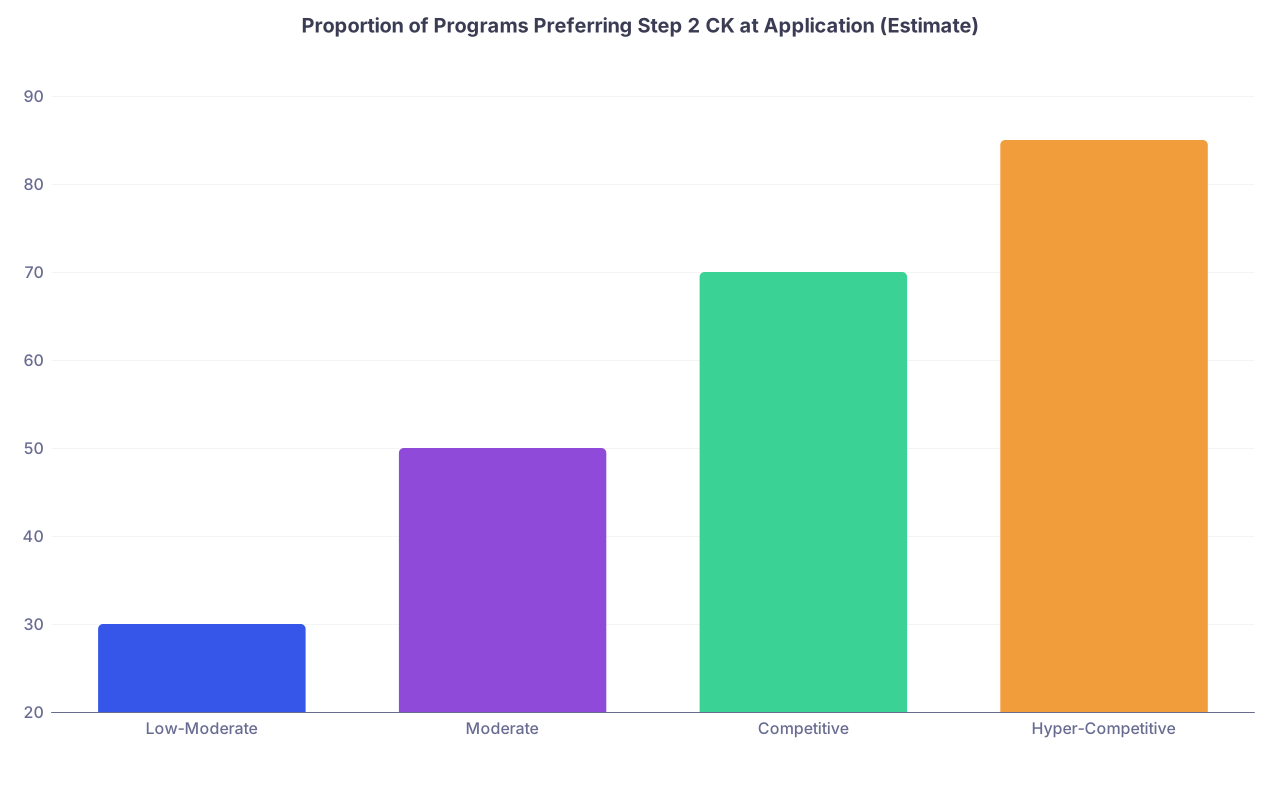
| Category | Value |
|---|---|
| Low-Moderate | 30 |
| Moderate | 50 |
| Competitive | 70 |
| Hyper-Competitive | 85 |
So the practical takeaway: delaying Step 2 CK into late fall of fourth year is now a serious strategic liability for anyone aiming above the most forgiving programs.
7. Subscores, Shelf Exams, and “Trend Data”
The more cynical programs do not just look at the raw Step 2 CK total.
Here is what some PDs and education committees are actually doing:
- Comparing clerkship shelf scores with Step 2 CK
- Looking at section performance (medicine-heavy vs surgery-heavy areas)
- Watching for trend lines: e.g., weak shelves, barely passed Step 1, then 260 Step 2 CK can look like a rescue; strong preclinical, mediocre CK can look like underperformance
But Step 2 CK total remains the main numeric staple because:
- It is standardized across schools
- It strongly correlates with standardized in-training and board exams
- It can be sorted, filtered, and graphed easily (and they do)
There is a subtle effect forming: in a pass/fail Step 1 landscape, a very high Step 2 CK (260+) is now an even stronger positive signal. It is one of the few clearly quantitative, national benchmarks left.
8. Where This Is Going in the Next 3–5 Years
Let me project, based on current patterns.
Step 2 CK thresholds will harden, not soften.
As more classes enter residency with only pass/fail Step 1, the institutional memory of “Step 1 as the main screen” will fade. Step 2 CK takes its place fully.More explicit cutoff communication.
Some specialties or programs will start publishing ballpark numbers: “Our matched applicants typically score above X on Step 2 CK” to reduce misaligned applications.Possible secondary metrics will rise:
- Shelf exam standardization (NBME subject exams as another signal)
- Program-generated “clinical performance indices” that combine clerkship grades, narratives, and exam scores
- More emphasis on Sub-I / away rotation evaluations as quasi-standardized performance measures
Step 2 CK prep will move earlier.
Students will increasingly front-load core clerkships and schedule Step 2 CK before or immediately after them, optimally around late M3 or very early M4.For ultra-competitive fields, dual filters may emerge.
Example:- “Must have at least honors in Medicine clerkship and Step 2 CK ≥ 255.”
You can already see the shape of this in some academic IM and Surg programs.
- “Must have at least honors in Medicine clerkship and Step 2 CK ≥ 255.”
9. How to Use This Data to Make Decisions
All the theory is meaningless if you do not adjust your own approach. Here is how I would operationalize this as a student planning in the Step 1 pass/fail era.
9.1 Know your target tier early
If your realistic goal is:
- Hyper-competitive: plan to aim for ≥255 Step 2 CK. Anything less and you are leaning more heavily on research and connections.
- Competitive: aim for ≥245–250.
- Moderate: aim for ≥235–240 to keep as many doors open as possible.
- Low-moderate: aim for at least ≥225–230, higher if DO/IMG.
You may overshoot. Good. Planning for a high target generally produces better preparation.
9.2 Do not gamble on a late Step 2 CK
If you are applying in a field that cares about numbers:
- Write a schedule that puts Step 2 CK before ERAS opens or close to it.
- Use clerkship shelf performance as a leading indicator: if your shelves are mid-60s percentile or higher, you can target Step 2 earlier; if not, you need more time and content repair.
9.3 Interpret your score in context, not in isolation
A 238 Step 2 CK means very different things:
- US MD, no red flags, solid letters, targeting IM or Peds: likely fine.
- DO, limited research, targeting competitive EM or Anesthesia in saturated regions: borderline.
- Non-US IMG, aiming at academic IM in major cities: likely below hidden cutoffs.
You need to combine:
- Specialty competitiveness
- Degree status
- Geographic constraints (wanting a single city or region raises bar)
- Non-numeric strengths (research, leadership, major institutional name)
Then decide: apply broadly, re-target to less competitive fields, or adjust expectations about program tier.
10. The Bottom Line: Step 2 CK Is the New Gatekeeper, But Not the Only One
Step 2 CK as a filter is not a vague fear. It is the operational reality of program directors trying to sort thousands of files with minimal time and legal pressure for objectivity.
The emerging data-driven picture looks like this:
Step 2 CK has become the primary standardized numeric screen, especially as Step 1 fades into pass/fail irrelevance. Thresholds are specialty- and degree-dependent, but filters around 230–255 are now routine.
Applicants are stratified by both score and identity (US MD vs DO vs IMG), with higher implicit cutoffs for DOs and IMGs, and extremely high expectations in hyper-competitive fields.
Timing and planning matter as much as raw ability. Sitting Step 2 CK early, aiming aggressively for tier-appropriate scores, and aligning your target specialty with your realistic numeric profile is now a core part of residency strategy.
If you treat Step 2 CK like a formality in the Step 1 pass/fail era, the data suggest you will get filtered. If you treat it as the new entrance exam, you give yourself options.