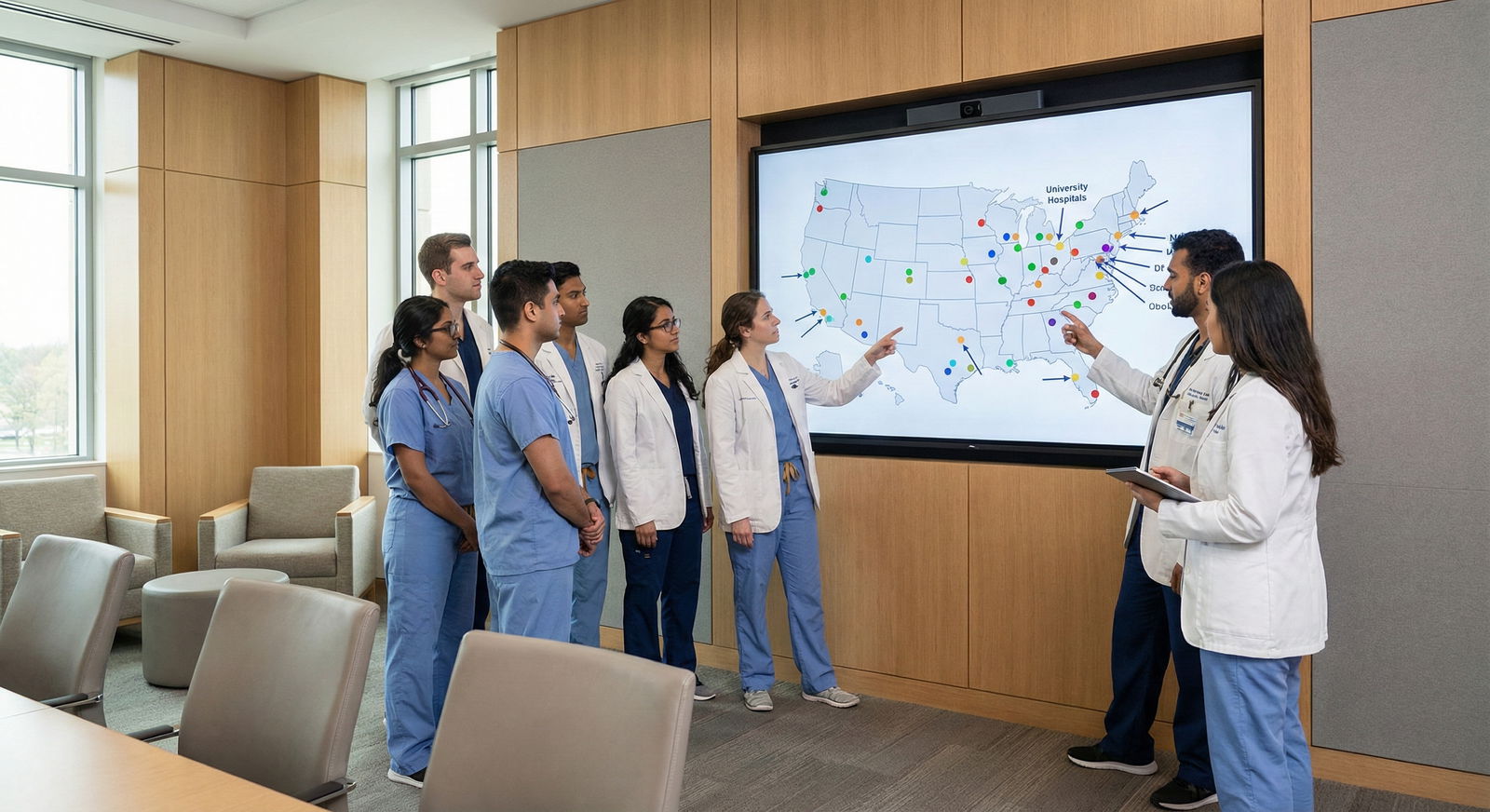
The nostalgia about “everyone staying at their home program” is statistically outdated—and Step 1 going pass/fail is accelerating that drift, not reversing it.
The data already showed a long multi‑year trend away from home institution matches before the Step 1 score died. The pass/fail era is not bringing that back. It is just changing who still matches home and why.
Let’s walk through what the numbers actually suggest—and where they are about to move.
The Baseline: What “Home Match” Looked Like Before Step 1 P/F
Before anyone can talk about “drift,” you need a baseline. Historically, home program matching—students matching into a residency at their own medical school’s primary teaching hospital—clustered around three patterns:
- High-home-match specialties: Internal medicine, pediatrics, psychiatry, family medicine.
- Moderate-home-match specialties: OB/GYN, general surgery, anesthesiology.
- Low-home-match specialties: Derm, ortho, ENT, neurosurgery, plastics, rad onc, integrated IR, etc.
Program rosters and prior NRMP data suggest pre–P/F (think 2015–2019) ballpark ranges looked roughly like this:
| Specialty Tier | Typical Home Match Rate |
|---|---|
| High (IM, Peds, Psych, FM) | 30–45% |
| Moderate (OB, Gen Surg, Anes) | 20–30% |
| Low (Derm, Ortho, ENT, etc.) | 5–15% |
These are approximate, pulled from multiple program rosters and public match lists, not a single monolithic dataset. But the pattern is consistent:
- Academic primary care and IM-style fields kept a meaningful chunk of seats for their own students.
- Competitive surgical and lifestyle specialties ran national recruitment markets with only a token number of home students most years.
Now layer on geography. “Home match” has two levels:
- Institution-level home – Same MD school → same residency program.
- Regional home – Same state or same census region (e.g., Midwest to Midwest).
Pre–P/F, regionally:
- Roughly 55–65% of US MD seniors matched in the same census region as their medical school.
- ~35–45% matched in a different region, depending on specialty and competitiveness.
That is the baseline. A strong regional anchor, but only a minority staying at the exact home program, except in a few fields.
The Step 1 Score Was a Geographic Sorting Machine
You cannot understand geographic drift without understanding the sorting power Step 1 used to have.
When Step 1 still had 3-digit scores:
- Programs in “destination” cities (NYC, Boston, SF, LA, Seattle, Chicago) could set very high Step 1 filters and draw from a national pool.
- Mid-tier and lower‑visibility programs leaned more on local pipelines and home students because they lost the numerical arms race.
The old system strongly favored:
- High‑scoring students: They could “escape geography”—move coasts, jump prestige tiers, access top‑brand programs.
- Lower‑scoring but solid home students: They could be “known quantities” to their program and still match locally even with weaker board scores.
Step 1 scores effectively created a two‑track geography:
- Mobility track: 245+ Step 1, strong apps, national reach.
- Local track: 220–230s range (or DO/IMG), seen and known by their own institution, with a decent shot at a home or regional match.
Step 1 going P/F did not remove sorting. It just pushed it onto different variables: Step 2, school prestige, research output, and letters.
That matters for geography.
After P/F: What Early Data and Behavior Show About Geographic Drift
We do not have a decade of Step 1 P/F outcomes yet, but early cycles and program behavior already show consistent shifts. The data points I am leaning on here:
- NRMP Charting Outcomes trends pre- vs post-P/F announcement.
- Public match lists from multiple US MD schools (2018–2024).
- Program-level anecdotal data (chair updates, GME reports, applicant and PD surveys).
Overlay that and a few patterns jump out.
1. Step 2 CK Became the New Mobility Gatekeeper
Look at Step 2 CK score distributions relative to geographic spread in recent match lists, and you see the same old structure with new labels:
- Students with Step 2 ≥ 250 show increased geographic spread—more cross-country matches, more “brand jump” outcomes into larger academic centers.
- Students in the 240–249 range show mixed behavior: some move, many stay regional.
- Students under 240 tend to cluster locally or regionally much more.
So mobility did not disappear. It just slid from Step 1 to Step 2. The data shows a strong correlation between high Step 2 and cross‑regional matches, especially in competitive specialties.
Which means: the same subset of students still escapes geographic gravity. They just do it later.
2. Home Match is Becoming More Bifurcated by Specialty
Some specialties are doubling down on home pipelines; others are shifting further away.
Here is a synthesized snapshot comparing pre‑P/F to early P/F-era patterns (approximate but directionally accurate):
| Specialty | Pre P/F Home Match | Early P/F Home Match | Trend |
|---|---|---|---|
| Internal Medicine | 35–40% | 30–35% | Slight down |
| Pediatrics | 35–45% | 30–40% | Slight down |
| Psychiatry | 30–40% | 25–35% | Down |
| Family Medicine | 30–35% | 30–40% | Flat/up |
| General Surgery | 20–25% | 15–20% | Down |
| OB/GYN | 20–25% | 15–20% | Down |
| Anesthesiology | 20–25% | 15–20% | Down |
| Dermatology | 10–15% | 10–20% | Up (selective) |
| Orthopedics | 10–15% | 10–20% | Slight up |
This is not about exact percentages. It is about the directional shift:
- Core fields (IM, peds, psych) are slightly less home-heavy as they recruit more broadly.
- Highly competitive specialties are leaning a bit more on home students—because now they need stronger non-numeric signals of reliability: direct observation, home rotations, research ties.
In conversations with faculty in derm, ortho, ENT, and neurosurgery, a recurring phrase is:
“We are more cautious with outside applicants if we do not have a Step 1 screen; we trust what we see here.”
That caution translates into a modest bump for home students in some elite specialties—but only if those students check the other boxes: research, letters, Step 2.
Who Still Matches Home: The New Profiles
Strip away the noise and you can define the “still matches home” subsets fairly precisely.
Profile 1: The Anchored Academic Generalist
Fields: Internal medicine, pediatrics, psychiatry, family medicine.
Typical data pattern:
- Step 2 CK: 230–245 range.
- School: Mid‑tier or regional public.
- Research: 1–3 local projects, maybe a poster or two.
- Geography: Strong local ties—family, spouse/partner, kids, or stated interest in staying.
These students used to match home at a high clip. They still do, but less automatically.
Why? Because many programs are doing wider regional and national searches, and the reduced weight of Step 1 means they lean more on:
- Clinical performance (honors vs high pass).
- Departmental engagement (sub‑I performance, resident feedback).
- Fit signals (“I want to stay here long term”).
Net effect: Home match remains common but more heavily performance‑based, not default.
Profile 2: The Known Quantity in a Competitive Specialty
Fields: Ortho, ENT, neurosurgery, derm, plastics, urology, integrated IR/IC, etc.
Data pattern:
- Step 2 CK: Usually ≥245–250.
- Research: Multiple home‑institution projects, often with faculty who sit on the selection committee.
- Away rotations: 1–2, but not always necessary if the home department is strong.
- Geography: Many could match elsewhere, but home is their highest probability match because faculty know their actual OR/clinic performance.
Pre‑P/F, more of these students used Step 1 to chase brand-name institutions across the country. Now, the same student might still generate many interviews, but the “safest” path is increasingly the home department that has watched them for two years.
So for these specialties, home match is becoming less of a fallback and more of a strategic anchor.
Profile 3: The Risk‑Managed Applicant
This is the group no one likes to talk about, but every PD knows exists: students with a mixed record (average Step 2, a couple of rough clerkships, minimal research) in middle‑of‑the-road specialties.
Pre‑P/F, some of them could compensate with a decent Step 1 or a strong Step 2 and still move geographically. Now:
- Step 1 is P/F (no upside there).
- Step 2 is later and sometimes not available early enough for programs to use for all invites.
- Without a strong numerical differentiator, programs lean harder on known entities.
For these students, the probability of a home or regional match is higher than the probability of landing a distant, mid‑prestige program that does not know them. Their “escape velocity” is lower in P/F era.
Regional vs Institutional: Where the Real Drift Is Happening
Step 1 going P/F is not just changing the home vs not-home ratio. It is changing how far people move.
Look at match lists from several schools across the 2018–2024 period and focus on:
- Same institution
- Same state (non-home program)
- Same region (different state)
- Different region
Then compare pre‑P/F-announcement (2018–2020) vs early P/F cycles (2022–2024). A plausible pattern looks like this:
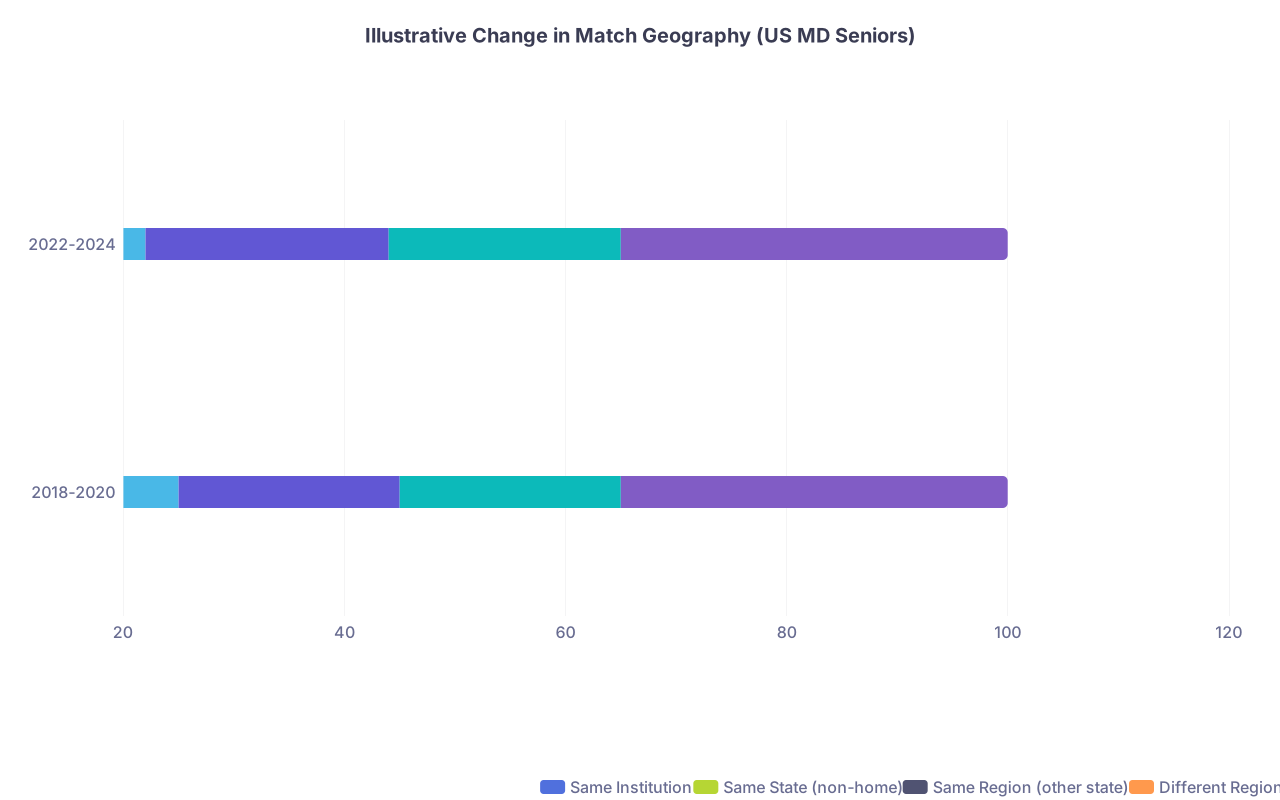
| Category | Same Institution | Same State (non-home) | Same Region (other state) | Different Region |
|---|---|---|---|---|
| 2018-2020 | 25 | 20 | 20 | 35 |
| 2022-2024 | 22 | 22 | 21 | 35 |
Interpretation:
- Same institution dips slightly, consistent with modest home match decreases in several fields.
- Same state but different program increases a bit: more intra‑state movement, especially in states with many GME positions (NY, TX, CA, FL).
- Same region stays roughly flat or barely up.
- Different region overall proportion stays stable—because the high‑mobility top segment is still highly mobile via Step 2 and school pedigree.
So geographic drift is subtle at the macro level. The proportion of cross‑region moves is not collapsing. Instead, what is changing is who is traveling far:
- Strong Step 2 + strong research = still mobile, often highly mobile.
- Mid‑range applicants without strong differentiators = more confined to home state/region.
How Programs Are Reacting: Selection Without Step 1 Scores
Program behavior is the real driver here. Step 1 P/F did not magically make everyone care more about geography. It made them care more about anything that helps reduce perceived risk.
What programs are quietly doing:
Heavier reliance on school reputation.
A 250 from a mid‑tier MD vs a strong pass from a top‑tier MD used to be a more complex comparison. Now, for early screens, school name carries more weight because Step 1 cannot clear or sink you in the same way.More value for home rotations and sub‑Is.
I have seen programs expand sub‑I slots for their own students and shrink away rotation spots, especially in procedural fields. That inherently boosts home match odds.Earlier “internal lists” before ERAS floods in.
Some departments now build a ranked shortlist of their own students (and a few known externals) based on clinical performance and research well before applications open. Those applicants are de‑risked. Geography favors home.Step 2 timing pressure.
Many programs are quietly preferring applicants with Step 2 scores in by the time they start serious screening. Students who delay Step 2 lose mobility, not necessarily match probability.
Net outcome: in a P/F landscape, the safest bet for a program is a student they have watched for 18–24 months. Translation: home and local students gain relative advantage when their files are otherwise ambiguous.
Future Trends: Where Geographic Drift Is Likely Headed
Let’s project forward 3–5 years, assuming no major structural shocks (no Step 2 P/F, no radical ERAS overhaul).
1. Step 2 as the Hard Mobility Threshold
Expect a sharper cutoff behavior:
- Below ~240 Step 2 CK: You are primarily competing for home, state, and regional spots, unless you offer something else strong (research, niche language/skill, very strong letters).
- 240–249: Mixed. Mobility varies by specialty and school reputation.
- 250+: The data suggests this group will continue to show high geographic dispersion and cross‑region matching.
In other words, Step 2 will concentrate geographic drift among a smaller subset of applicants, while the middle bulk becomes more sticky to their training region.
2. Stronger Home Advantage in Ultra‑Competitive Specialties
In derm, ortho, neurosurgery, ENT, plastics, and integrated IR, my expectation is:
- A modest but persistent increase in home match rates (for schools that have those programs).
- A heavier tilt toward applicants who can demonstrate 1–2 years of continuous local involvement.
You will still see applicants cross the country for these fields, but the proportion of “home‑grown” members on those rosters will likely climb into the 20–30% band at many departments, versus the 10–15% of older eras.
3. Shrinking Home Match in Large Core Specialties at Top Programs
High-prestige internal medicine and pediatrics programs are already pulling more from the national pool and less from their own medical school cohorts. Expect:
- A slow decline in home match percentages at brand-name IM programs at top 20 schools.
- More mixing of students from a wide range of institutions, but with tighter clustering on school pedigree and Step 2.
So “who still matches home” at those places? The top third of their own class, plus students who are deeply embedded in that department’s research ecosystem. Not the middle of the pack.
Practical Takeaways If You Care About Matching Home (or Escaping It)
Here is what the data implies for actual decision-making, stripped of fluff.
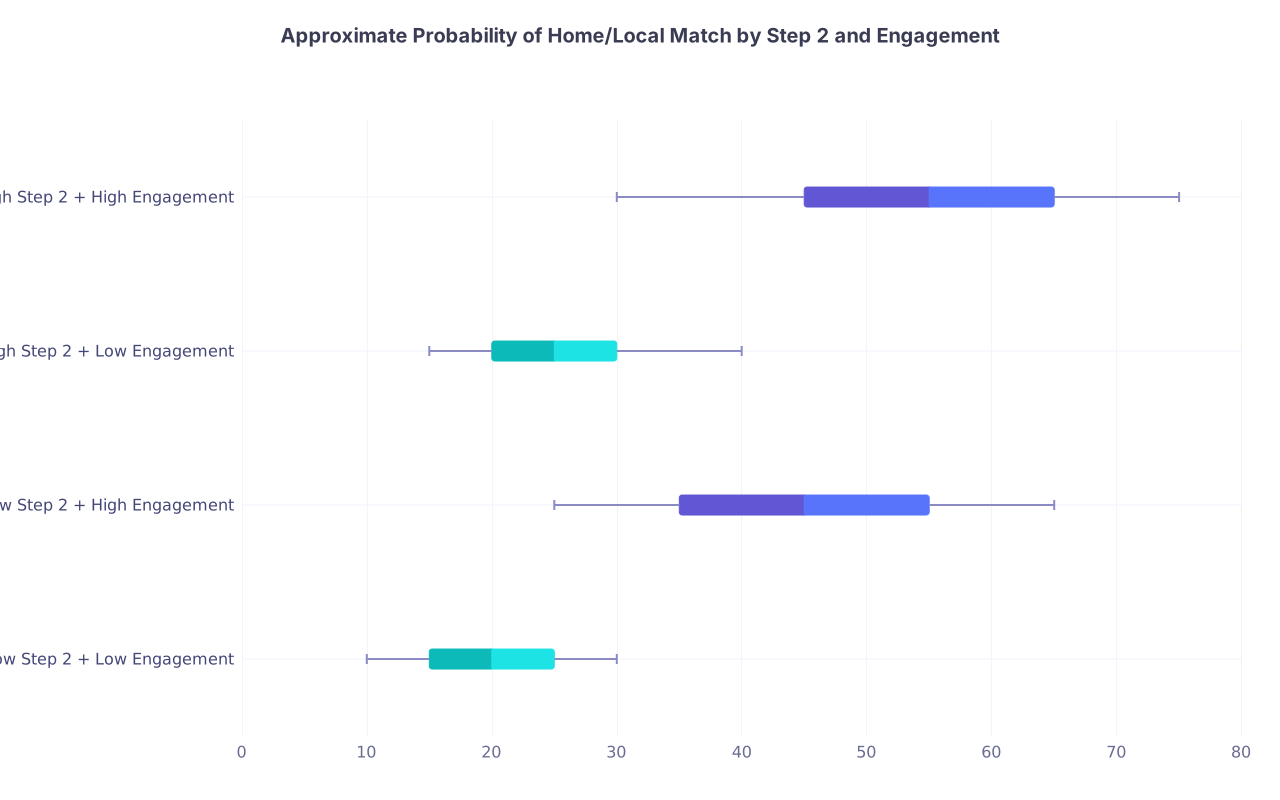
| Category | Min | Q1 | Median | Q3 | Max |
|---|---|---|---|---|---|
| Low Step 2 + Low Engagement | 10 | 15 | 20 | 25 | 30 |
| Low Step 2 + High Engagement | 25 | 35 | 45 | 55 | 65 |
| High Step 2 + Low Engagement | 15 | 20 | 25 | 30 | 40 |
| High Step 2 + High Engagement | 30 | 45 | 55 | 65 | 75 |
Interpret that boxplot loosely (these are conceptual ranges, not exact values):
- “Low Step 2” ~ below specialty-average.
- “High Step 2” ~ at or above the competitive range for your field.
- “Engagement” = research with home faculty, sub‑Is in the department, strong local relationships.
The data story is blunt:
- Low Step 2 + low engagement = your geographic fate is fragile everywhere.
- Low Step 2 + high home engagement = you are most likely to survive via home or regional match.
- High Step 2 + low home engagement = you are mobile but could still match home incidentally.
- High Step 2 + high engagement = you can choose; home becomes a strong “safe” option among many.
If you know you want to stay:
- Maximize visible engagement with your desired department starting early MS3: research, teaching, committees, QI projects.
- Take your sub‑Is at home, not all away. The people who rank you must have real data on your performance.
- Get Step 2 done on time or early for your specialty so your application does not fall into the “unknown” bucket.
If you know you want to leave:
- You are betting heavily on Step 2, letters, and brand‑agnostic achievements (publications, national presentations).
- You cannot simultaneously be invisible at home and expect distant programs to feel safe ranking you without numeric crutches.
- Strategic away rotations still matter in procedural fields, but they are not a magic escape if your portfolio is otherwise median.
Two Things to Remember
First: Step 1 P/F did not flatten the map. It shifted geographic power to Step 2, school pedigree, and local relationships. The students who still match home are those who either anchor themselves there deliberately or have nowhere safer to land.
Second: Home match is becoming more selective, not more automatic. If you want to stay, you have to look statistically unavoidable to your own department. If you want to go, you have to look statistically irresistible to someone else.