
The idea that your preclinical GPA quietly fades into the background in a pass/fail Step 1 world is dead wrong. If your GPA is mediocre, you are not invisible. You are exposed.
And that is actually good news—because exposed problems can be fixed.
You’re in this specific situation: preclinical GPA is average or below average, Step 1 is now pass/fail, and you’re trying to figure out whether you’re already sunk for competitive programs or if there’s a real playbook to recover.
There is. But it’s not the same playbook people used five years ago.
Let’s walk through exactly what to do, step by step, in your real-world context—not some fantasy where everyone gets AOA and 260s.
1. Understand How Mediocre Preclinical GPA Actually Hurts You Now
First, you need a clear mental model of the battlefield.
Pre-pass/fail Step 1 era:
A strong Step 1 score could launder a weak preclinical record. People with mid-class GPAs matched derm and ortho because they had a 255.
Now? That bailout button is gone.
Here’s how a mediocre preclinical GPA can hurt you in the pass/fail Step 1 landscape:
- It changes what your school writes about you in the MSPE.
- It shifts how programs interpret your entire academic profile.
- It increases the pressure on very specific downstream metrics (Step 2, clinical grades, research, letters).
For most schools, “mediocre” means something like:
- Straight “Pass” at a pass/high pass/honors school
- Mostly B/B- at a graded preclinical program
- Bottom half of class rank, or “meets expectations” language
Programs are not stupid. When Step 1 went pass/fail, they immediately started looking at:
| Factor | Relative Importance Now |
|---|---|
| Step 1 (Pass/Fail) | Baseline filter only |
| Step 2 CK score | Much higher |
| Clinical grades | Much higher |
| Class rank/MSPE words | Higher |
| Preclinical performance | Moderate |
Your preclinical GPA alone doesn’t kill you. But combined with a so-so Step 2, average clinical grades, and weak letters? You become an easy “no” in a pile of 3,000 apps.
So the game is:
Use everything after preclinical to rewrite your story.
2. Diagnose Your Situation Precisely (Not Emotionally)
You cannot fix a vague problem. “My GPA is bad” is not a diagnosis.
You need a technical readout of your situation. Think like a clinician.
Here’s the minimum data you should pull together:
- Exact preclinical GPA (or internal decile/quartile if your school gives it)
- How your school describes preclinical performance in the MSPE
- Any preclinical failures, remediation, or leaves
- Whether you improved or worsened over time
Then classify yourself:
| Category | Typical Pattern |
|---|---|
| Mild concern | Mostly passes, no failures, mid-class |
| Moderate | Several low passes/Cs, maybe one remediation |
| High risk | Multiple failures, repeat year, bottom decile |
Your category matters because it changes the level of aggression you need later.
If you do not know how your school reports ranking or GPA to residency programs, go ask your dean’s office or review past MSPE samples. I’ve seen students blindsided because their “we don’t rank” school quietly reports quartiles.
You want to know exactly what will hit a PD’s desk.
3. The Core Reality: Step 2 CK Is Now Your Lifeline
Let me be very blunt.
In a pass/fail Step 1 world, a mediocre preclinical record without a strong Step 2 CK is a massive liability, especially for competitive specialties or big-name academic centers.
If you’re thinking, “I’ll just be charming on interview day,” stop. You may never get to the interview if your application looks soft academically across the board.
Your job: turn Step 2 CK into your proof-of-concept.
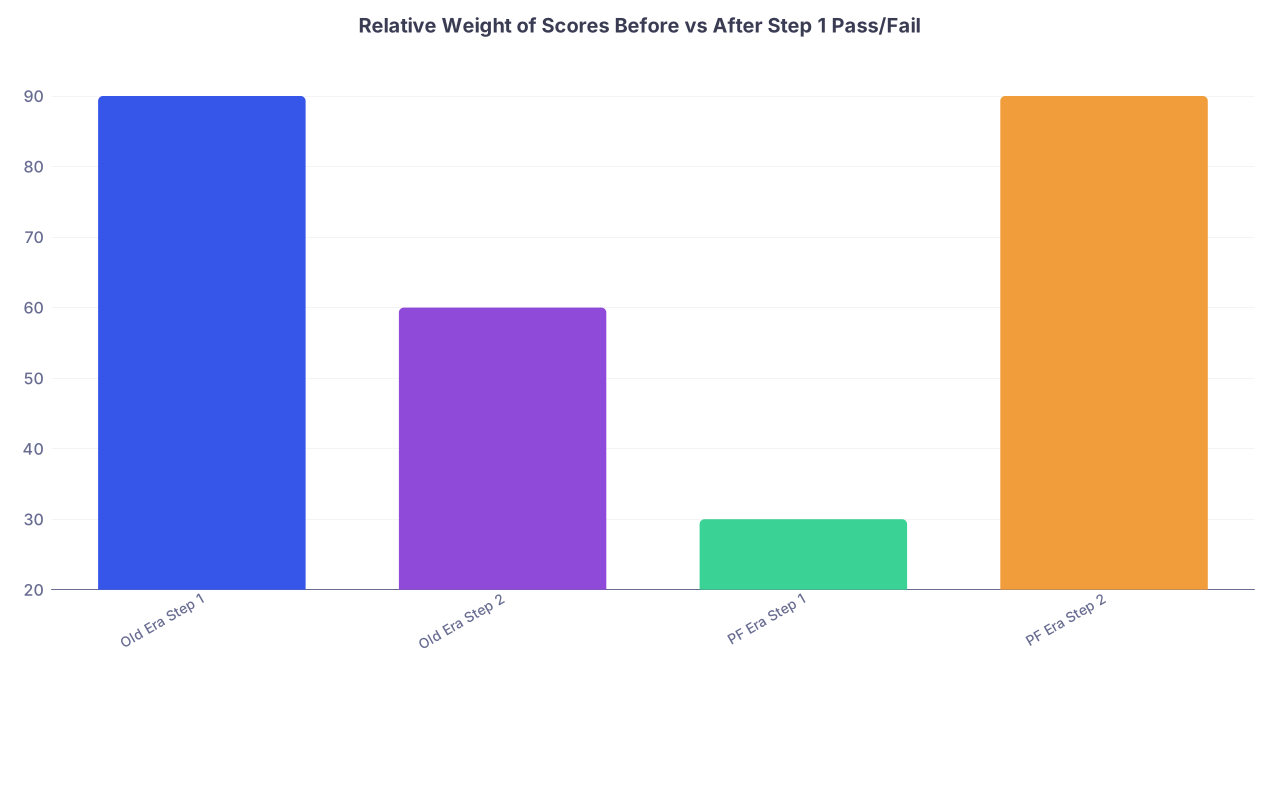
| Category | Value |
|---|---|
| Old Era Step 1 | 90 |
| Old Era Step 2 | 60 |
| PF Era Step 1 | 30 |
| PF Era Step 2 | 90 |
Yes, this is conceptual, not exact numbers. But the shift is real.
What to do in your situation:
If you haven’t taken Step 1 yet
Your #1 job is: Pass Step 1 on the first attempt with margin, while quietly building the foundation for Step 2.
Do not:
- Try to “overachieve” Step 1 with some imaginary high score. It’s pass/fail.
- Gamble with borderline prep because “it’s just pass/fail.” A fail now is devastating.
Do:
- Treat UWorld and NBME performance like a pre-Step 2 bootcamp.
- Build real systems mastery, especially in IM-heavy topics that will reappear in Step 2.
A clean pass on Step 1 + later strong Step 2 can absolutely overwrite a weak preclinical record.
If you’ve already passed Step 1
All pressure shifts to Step 2 CK. And yes, PDs know exactly why some students suddenly find religion about test prep after a meh preclinical run.
Your approach should be more disciplined than what you did preclinically:
- Start Step 2 prep mid-cores, not 4 weeks before the exam.
- Use every shelf exam as a rehearsal for Step 2.
- Ruthlessly identify weak systems/subjects early (psych, OB, heme/onc, etc.).
Put simply: you cannot be casual about Step 2. Not from where you’re starting.
4. Use Core Clerkships to Flip Your Academic Story
In the pass/fail Step 1 era, clerkship grades have become your new currency.
PDs know preclinical is mostly books. Clerkships show how you function around actual patients and teams.
If your preclinical GPA is mediocre, this is your redemption arc.
You want your transcript to scream: “Okay start, then took off when the patient care became real.”
Here’s the shift you need to make on rotations:
- Stop trying to look “smart.” Start trying to be useful.
- Show capacity for acceleration. People forgive slow starts if the trajectory is steep.
- Become the student where residents say, “Oh yeah, definitely take this one.”
Tactically:
- Show up early. Stay late sometimes— not until midnight every day, but enough that people notice you’re invested.
- Read on your patients that night. Not just UpToDate summaries—guidelines, NEJM, actual reasoning.
- Volunteer for the annoying jobs: calling outside hospitals, chasing labs, organizing signouts.
- Ask for mid-rotation feedback. Do not wait until the end when it’s too late.
You want at least one of:
- Honors in Internal Medicine
- Honors in Surgery
- Honors in your intended specialty (if you know it)
If your school has no honors system, your goal is outstanding narrative comments in the MSPE that make your preclinical mediocrity look like ancient history.
5. Letters of Recommendation: The Great Equalizer
Here’s something most anxious preclinical students don’t realize: a brutally strong letter can completely change how a PD sees your earlier performance.
I’ve sat in ranking meetings where someone said, “Preclinical grades are average, but did you read this IM letter?” and the entire room shifted.
You want letters that say things like:
- “Top 5% of students I’ve worked with in the last 5 years.”
- “I would be thrilled to have them in our program.”
- “They demonstrated growth and maturity that far exceeded many of their peers.”
Those phrases matter. A lot.
How to get there from where you are:
Identify letter targets early.
On each major clerkship, ask yourself by week 2: “Is there an attending or senior who has actually seen me work enough to vouch for me?”Tell them your story honestly.
“I had a rocky preclinical start. Since then I’ve been trying to push myself to show that clinically I can operate at a very high level. I’d be grateful for any feedback on what I can do better.”Ask for a strong letter, not just a letter.
“Do you feel you know me well enough and are comfortable writing me a strong letter of recommendation?”
If they hesitate, do not use them. You cannot afford lukewarm letters in your situation.
By the time PDs see your file, what you want is:
- Mediocre preclinical metrics
- Strong Step 2
- Very good or excellent clinical grades
- And letters that basically say: “This is who they really are now.”
That combination is absolutely competitive for many specialties and programs.
6. Choosing a Specialty: Brutal Honesty Time
You can’t talk about this without addressing the elephant: some specialties are unforgiving.
If your preclinical GPA is mediocre and you’re dead-set on derm, plastics, ortho, ENT, or neurosurgery, you’re signing up for a high-risk, high-stress path. Not impossible. But there’s no slack in the system for multiple weak signals.
Here’s the honest breakdown:
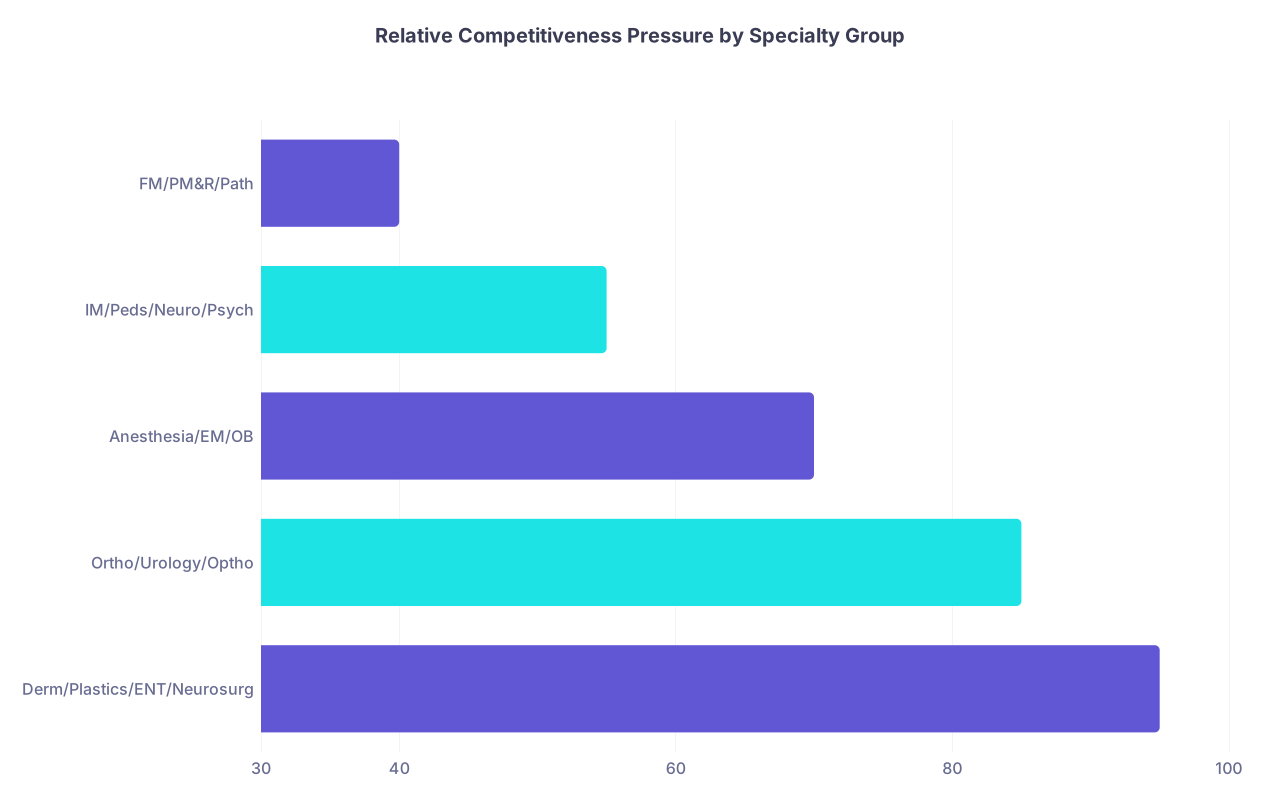
| Category | Value |
|---|---|
| Derm/Plastics/ENT/Neurosurg | 95 |
| Ortho/Urology/Optho | 85 |
| Anesthesia/EM/OB | 70 |
| IM/Peds/Neuro/Psych | 55 |
| FM/PM&R/Path | 40 |
Again, conceptual. But accurate in spirit.
From where you stand:
If you want ultra-competitive:
You must crush Step 2, crush clinical performance, get research, and probably do away rotations strategically. No room for wishful thinking.If you’re open to moderately competitive:
Anesthesia, EM (depending on how the market evolves), OB/GYN, some surgical subspecialties can still be realistic with a strong rest-of-application.If you’d be happy in core fields (IM, peds, psych, FM, pathology, PM&R):
Preclinical mediocrity plus strong later performance is very survivable. You may not match MGH cards, but you can absolutely build a good career.
You don’t have to decide today. But don’t live in denial for three years and then be shocked when your dream specialty doesn’t pan out. Build a Plan A and a serious Plan B by late third year.
7. Research and Scholarly Work: When It Actually Matters for You
If your GPA is mediocre, research is not optional for the competitive specialties. It’s margin.
But even for less competitive fields, some scholarly activity helps counter the impression that you just coasted.
You should think about research like this:
For derm/ENT/plastics/ortho:
You want multiple projects, ideally with at least one first- or second-author paper, poster presentations, or serious involvement with a known faculty mentor.For IM/Anesthesia/EM/OB:
One to three meaningful projects—doesn’t have to be Nature, but something you can talk about intelligently and that shows you can contribute academically.For FM/Psych/PM&R/Path:
Even a single quality project, QI initiative, or case series can be enough to show initiative.
The key for you:
Pick projects you can actually move to completion. A half-done “chart review we’ve been talking about” doesn’t help you.
And yes, research plus improved performance tells a story of growth. That’s the narrative you’re building.
8. How to Talk About Your Preclinical Mediocrity (Without Digging a Deeper Hole)
Programs might not ask. But some will. Or it’ll come up indirectly when they ask about “a time you struggled.”
Bad answer:
“I don’t test well.” (They will immediately think: great, enjoy fellowship applications.)
Better answer:
- Own it clearly.
- Show insight.
- Show a concrete pivot in behavior.
- End on evidence of change, not on excuses.
Example framework:
“Early in medical school, my performance was solidly middle of the pack. I underestimated how much deliberate structure I needed in my studying and I didn’t seek feedback early. What changed for me was [specific event/rotation]. I realized I needed to treat this like a job, not like college. I started [specific strategies], and since then I’ve [honors in X, strong Step 2, strong evaluations]. I’m actually glad it happened early, because it forced me to fix things before I was on the wards or in residency where the stakes are much higher.”
That’s believable. It shows maturity. And it reframes your GPA as “early growing pains,” not “fundamental ceiling.”
9. Strategic School Choices and Application Targeting
Last piece: if your preclinical GPA is mediocre, you can’t be naïve about where you apply.
A few tactical rules:
- Anchor your list with a solid core of realistic programs: your home institution, state programs, mid-tier academic centers, and strong community programs.
- For ultra-competitive specialties, apply broadly and include backup plans, dual apply if necessary.
- For less competitive specialties, you still need a spread of “reach / realistic / safe,” but the bar is lower.
If your school has advisors who sugarcoat everything, ignore them. Ask them direct questions:
- “With my preclinical performance, what Step 2 range and clerkship performance do you think I need for [specialty]?”
- “Where did students like me match in the last 3 years?”
- “What programs did not even offer interviews to similar applicants?”
If they hedge, push: “I’d rather hear the hard truth now than be the cautionary tale later.”
You’re not fragile. You’re trying to plan a life.
10. A Simple Reality Check Timeline
To keep yourself on track, here’s a rough “if I’m in your shoes, what I’m checking when” flow:
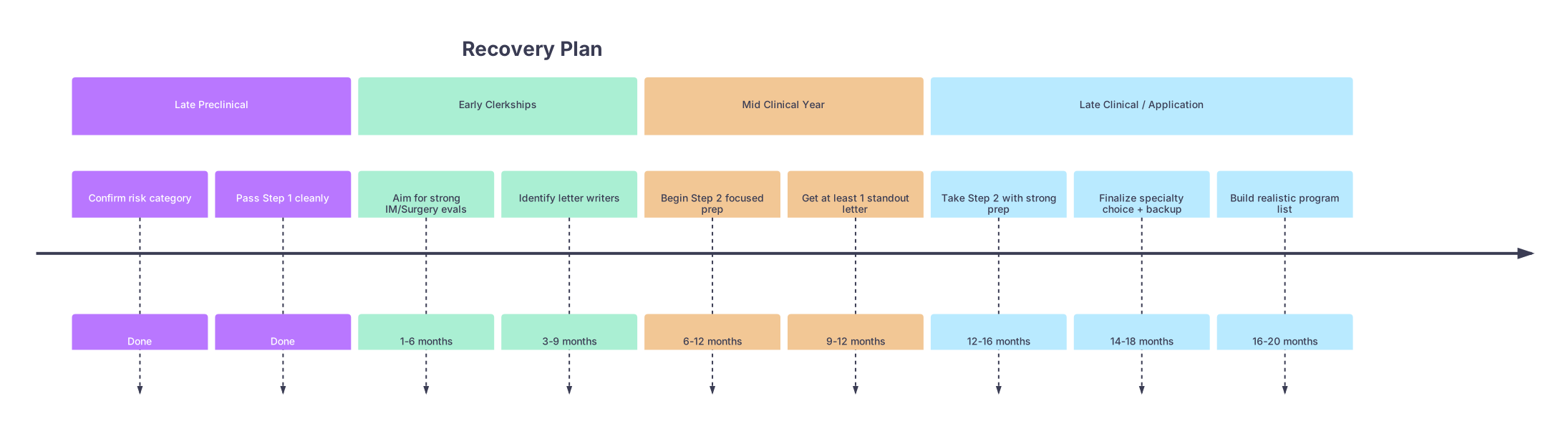
| Period | Event |
|---|---|
| Late Preclinical - Confirm risk category | Done |
| Late Preclinical - Pass Step 1 cleanly | Done |
| Early Clerkships - Aim for strong IM/Surgery evals | 1-6 months |
| Early Clerkships - Identify letter writers | 3-9 months |
| Mid Clinical Year - Begin Step 2 focused prep | 6-12 months |
| Mid Clinical Year - Get at least 1 standout letter | 9-12 months |
| Late Clinical / Application - Take Step 2 with strong prep | 12-16 months |
| Late Clinical / Application - Finalize specialty choice + backup | 14-18 months |
| Late Clinical / Application - Build realistic program list | 16-20 months |
You’re not going to fix preclinical history overnight. You’re going to bury it under a mountain of better data.
FAQs
1. My preclinical GPA is mediocre and I’m at a lower-ranked med school. Am I basically done for competitive specialties?
No, but your margin for error is razor thin. Lower-ranked school + mediocre preclinical performance means you absolutely must excel in the things PDs can’t ignore: Step 2 CK, clinical grades, letters, possibly home or regional connections, and often research. Matching derm/plastics/ENT/neurosurg from that position is rare but not impossible if you become one of the top students in your clinical class and get strong mentorship. For moderately competitive fields, it’s much more realistic if you execute well from here on out.
2. Should I delay Step 2 CK to give myself more time, or take it early to show I’ve improved?
If you’re starting from a shaky academic foundation, you prioritize being prepared over being early. An early mediocre score hurts more than a later strong score with a short gap between test date and ERAS submission. That said, you don’t want to be taking Step 2 in October of application season. Ideal window: late spring to midsummer before you apply, with at least some shelf exams under your belt and a clear, data-driven sense that you’re scoring in your target range on practice tests.
3. Is it worth explaining personal issues that affected my preclinical GPA (family illness, mental health, etc.)?
Yes—if they were significant, time-limited, and you can clearly show recovery. Use the “adversity” or “extenuating circumstances” sections if available, and keep it concise and factual. Do not turn it into a saga or an excuse. The key is: here’s what happened, here’s what I did about it, and here’s the concrete evidence that it’s resolved (improved grades, Step 2, clinical evaluations). Programs are actually quite understanding when there’s a coherent story and sustained improvement.
4. If my preclinical GPA is weak, should I consider taking an extra research year to bolster my application?
Maybe—but not automatically. A research year helps most if: (1) you’re aiming for a very competitive specialty, (2) you can join a productive mentor/group likely to yield actual publications or strong letters, and (3) you’re also planning to come back from that year and perform at a high level on Step 2 and clerkships. A research year does not magically erase mediocre performance if you return and continue being average. It’s a multiplier for people who are already on an upward trajectory, not a bandage.
5. How do programs actually see my preclinical performance—do they look at raw GPA or just MSPE language?
Depends on your school. Many programs rely heavily on the MSPE (Dean’s Letter) summary and any decile/quartile information provided. Some schools send explicit class rank or performance distributions; others say “no rank” but hint at it in the MSPE. Very few PDs are manually calculating GPAs from individual course grades. What really matters is: how does your school package you? That’s why you need to know early how they report performance and then shape everything after preclinical—Step 2, core clerkships, letters—so the overall picture looks like a student who started modestly and finished very strong.
Your preclinical record is written. That part of the story is closed. But the story itself is not.
From here on out, every decision you make—how you study for Step 2, how you show up on the wards, how aggressively you pursue strong letters and mentors—either reinforces the idea that your early mediocrity defined you, or proves that it was just your warmup.
Get your data. Build your plan. Execute it like your future depends on it—because it does.
Once you’ve done that, we can talk about the next phase: how to actually play the interview trail and ranking game in a way that maximizes every inch you’ve fought to gain. But that’s a story for another day.