
You're sitting in your interview. Suit pressed. Hands steady, mostly. Then the interviewer leans back, glances at your AMCAS or ERAS, and says it:
"So, I see you were Vice President of your AMSA chapter. Tell me about your biggest accomplishment in that role."
(See also: 7 AMSA and SNMA Résumé Mistakes That Make Your Leadership Look Fake to ensure your experience narrative is polished and professional.)
(See also: How PDs Quietly Weigh AMSA vs SNMA vs AAMC on Your Application to understand how these roles factor into your match potential.)
And your brain goes white. Not because you didn't do the job. You showed up. You attended the meetings. You sent the emails. You maybe organized one event that twelve people came to. But "biggest accomplishment"? Nothing jumps out. You feel like a fraud holding a title that sounds bigger than what you actually did.
Here's the truth: most premed leaders feel this way. And most of them are wrong to feel that way. Let's fix this.
(See also: What Faculty Really Notice About Your AMSA Involvement on CVs to better align your resume with what evaluators prioritize.)
The 'Empty Resume' Panic: Reality Check
First, let's kill the imposter syndrome before it kills your interview.
You got the title. You did the work. But because you didn't launch a free clinic, lobby Congress, or triple your chapter's membership, you're sitting there convinced you faked your way through a leadership role. That's not imposter syndrome talking, well, it is, but it's imposter syndrome with bad information.
Here's the reframe: leadership in student organizations is 90% invisible work and 10% visible results. Interviewers know this. They've sat on the other side of that table for years. They've seen the Regional Director who organized a health fair for 500 people. They've also seen the Regional Director who spent an entire year just keeping a dysfunctional executive board from imploding. Both are leadership. One just photographs better.
Stop comparing your internal experience of chaos and fumbling against someone else's highlight reel. You don't know what their "successful" event looked like behind the scenes. Half those glossy Instagram posts about chapter achievements are covering for three months of organizational dysfunction.
Assess your actual scope honestly. Were you the person who kept meetings from running two hours over? Were you the one who managed the tension between the President and the Secretary who couldn't stand each other? Did you handle the logistics nobody thanked you for, room reservations, budget tracking, food ordering, follow-up emails? That's not nothing. That's the scaffolding that held the organization together.
The problem isn't that you didn't do enough. The problem is you haven't learned to see what you did as valuable. That's fixable. Right now.
(See also: Which SNMA Roles Look Strongest on Med School and Residency Applications? to identify high-impact committee contributions.)
(See also: 7 Data-Backed Ways to Turn Passive AMSA, SNMA, or AAMC Membership Into Real Impact for strategies to quantify your contributions.)
Mining for Gold in Routine Meetings
Let's dig into the actual work. Most of your AMSA or SNMA "leadership" probably looked like this: you sat in meetings, discussed plans, sent some emails, maybe pulled off a small event, and dealt with people problems. You think this is boring. Interviewers think this is real life.
Identifying invisible work. Here's what nobody puts on their resume but interviewers love hearing about:
- Conflict resolution. Did two e-board members disagree about event direction? Did you mediate? That's leadership. "Our community health chair wanted a blood drive and our advocacy chair wanted a legislative call-in day. I worked with both to create a hybrid event that served both goals."
- Administrative heavy lifting. Did you manage the chapter budget, track volunteer hours, or maintain the member database? That's operational competence. Medicine runs on operational competence.
- Team coordination. Did you recruit volunteers, manage a committee, or onboard new members? That's people management. Physicians do this daily with care teams.
Turning low-impact meetings into process improvement narratives. Let's say your big contribution was that you noticed meetings were unproductive, so you proposed an agenda template. That sounds small. But frame it properly and it becomes: "I identified that our executive board meetings lacked structure, resulting in decisions being deferred week after week. I introduced a standardized agenda and timeboxing approach that cut our meeting times by 30% and allowed us to finalize our annual health fair planning three weeks ahead of schedule."
(See also: How to Avoid Weak 'Membership Only' Entries for AMSA, SNMA, and AAMC to ensure your experience stands out during review.)
Same action. Completely different impression.
Using STAR to elevate mundane attendance into advocacy. STAR = Situation, Task, Action, Result. Let's say you "just attended" AMSA's regional conference. That's not a story. But if you attended, noticed that your chapter had zero representation in the minority mentorship pipeline, came back, and pitched a mentorship pairing system to your e-board, that's a story. The conference wasn't the achievement. The follow-through was.
You don't need to have done something extraordinary. You need to have noticed something, done something about it, and learned something from it. That's the formula. Most of your "nothing" stories have this structure hiding inside them. You just haven't excavated it yet.
The Pivot: From 'What I Did' to 'Who I Am'
Here's where we get strategic. When an interviewer asks about your AMSA or SNMA role, they're not actually asking for a project report. They're asking: Who are you? What do you care about? How do you operate?
Your job is to pivot from activities to identity.
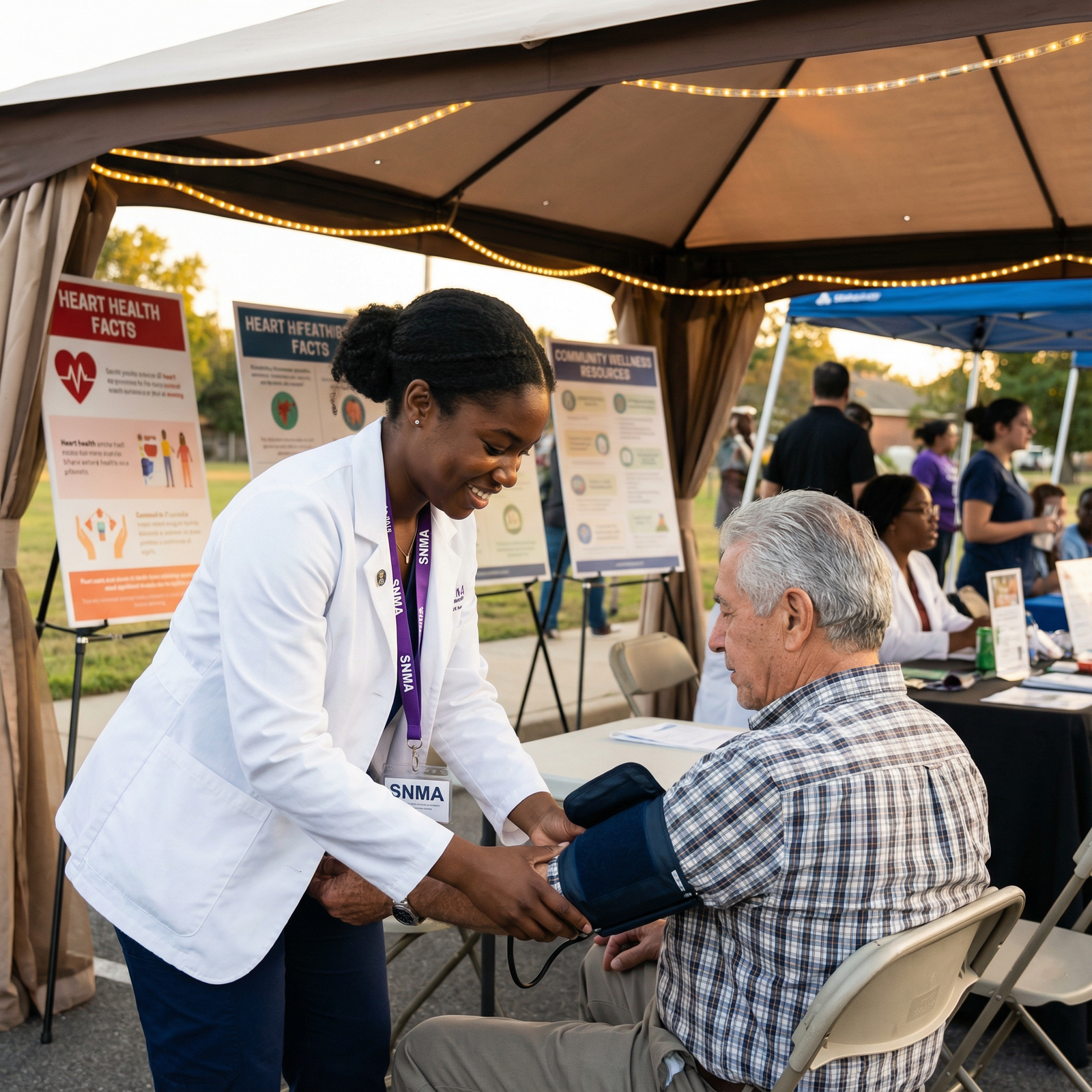
Using AMSA/SNMA values to discuss health equity. Both organizations have explicit missions. AMSA focuses on physician activism, health equity, and medical education reform. SNMA focuses on supporting underrepresented minority medical students and addressing health disparities in minority communities. If your concrete accomplishments were thin, lean into the mission.
Don't lie. Don't claim you did things you didn't. But do connect your presence in the organization to the broader values it represents. "I joined SNMA because I'm committed to addressing health disparities in underserved communities. My chapter didn't have the resources to run a free clinic, but I used my role to ensure our community health events were held in neighborhoods with the highest need and partnered with local churches to reach patients who wouldn't otherwise engage with the healthcare system."
That's real. That's honest. And it tells the interviewer something about your values that a list of accomplishments never could.
Connecting organizational presence to clinical philosophy. The best pivot I've seen? A student told me she was "just the Secretary" of her AMSA chapter. She felt useless. We reframed it: "As Secretary, I was responsible for maintaining communication between our executive board and 200+ members. I learned that in organizations, just like in medicine, information gaps create trust gaps. When I kept members informed about decisions and opportunities, engagement went up. When communication broke down, people disengaged. That experience directly shaped how I think about patient communication: transparency builds trust, and trust drives outcomes."
Boom. She just connected being a Secretary to being a better future physician. That's the pivot.
When they ask about your biggest accomplishment. If you truly don't have one flashy achievement, here's your framework:
- Name the challenge, not the trophy. "My biggest accomplishment wasn't a single event. It was helping our chapter navigate a period of low morale and engagement after our most active members graduated."
- Describe your specific contribution. "I focused on rebuilding our committee structure and creating clear role descriptions so newer members understood how they could contribute."
- Share the honest result. "We didn't dramatically grow our membership, but we stabilized it and set up the next leadership team for success."
- State what you learned. "I learned that leadership in continuity matters more than leadership in bursts, and that sometimes the most important work is building infrastructure that others will benefit from."
That answer is better than 80% of the "I organized a health fair" answers interviewers hear. It's honest, self-aware, and demonstrates maturity.
Quantifying Impact: The 'Before and After' Strategy
Even if your results were modest, numbers help. Not big numbers. Honest numbers.
Using metrics to prove small-scale value. Did event attendance go from 8 to 15 during your tenure? That's a 87.5% increase. Say it. Did you maintain membership when three comparable chapters on your campus saw declines? That's retention. Say it. Did you increase social media engagement from 50 to 120 followers? That's growth. Say it.
The number doesn't need to be impressive in absolute terms. It needs to show direction and intentionality.
The before-and-after comparison. This is your secret weapon. Compare the state of the organization when you took over versus when you left. Even if both states were modest:
- "When I took over as Community Health Chair, we had one recurring partnership with a local clinic. When I passed the role on, we had three."
- "When I started, our mentorship program had 4 active pairs. When I left, it had 9."
- "Our chapter hadn't hosted a legislative advocacy event in two years. I organized one."
Small deltas. Clear direction. That's all you need.
Addressing gaps without sounding defensive. Sometimes the honest answer is: "I wanted to accomplish X, but we faced Y barrier, and we couldn't get there." That's fine. Say it. But frame it forward:
"We attempted to establish a pipeline program with a local middle school, but the school district required background check processing that took longer than our academic year allowed. I documented the process and the contacts we'd established so the next chair could pick up where we left off. I learned that institutional partnerships require longer timelines than a single leadership tenure, and that part of leadership is setting up the next person for success even when you can't finish the job yourself."
That's not failure. That's professional maturity. Interviewers eat this up because it demonstrates exactly the kind of systems thinking they want in future physicians.
Final Action Plan: Your Interview Cheat Sheet
Let's get you ready. Here's your concrete prep.
Preparation checklist:
Three stories. Prepare three specific stories from your AMSA/SNMA experience:
- A time you handled a conflict or team dysfunction
- A time you identified a problem and took initiative to address it
- A time you failed or fell short and what you learned from it
Three lessons. Distill three transferable lessons:
- What you learned about communication
- What you learned about working within constraints
- What you learned about your own leadership style
Three future applications. Connect each lesson to how you'll apply it in medical school or clinical practice:
- How you'll approach team-based care
- How you'll advocate for patients within complex systems
- How you'll handle situations where you can't control all the variables
The art of the redirect. When an interviewer pushes for details you don't have, "Can you tell me more about the specific outcomes of that mentorship program?", don't fabricate. Redirect honestly:
"The program was small and we didn't have formal tracking in place, which is honestly something I'd do differently if I had the chance again. What I can tell you is that based on informal feedback from both mentors and mentees, the relationships were valuable. The mentor I was paired with is still someone I reach out to for advice."
Honest. Forward-looking. Self-aware. Done.

Final mindset shift. Stop thinking "I didn't do enough." Start thinking: "This is what I learned about leading within a complex, under-resourced system." That's not spin. That's the reality of student organizations. They're messy. They're underfunded. They're run by people who are also taking orgo, studying for the MCAT, and applying to medical school. Doing anything at all in that environment is an achievement. Doing it with integrity and learning from it is leadership.
Your AMSA or SNMA title isn't empty. You're just looking at it wrong. The stories are there. You lived them. Now go tell them.
Key Takeaways
- You don't need grand successes to demonstrate leadership, you need stories of how you handled challenges, friction, and constraints. That's what real leadership is.
- Interviewers value your ability to articulate growth and organizational awareness far more than a list of awards or event headcounts. They're evaluating a future colleague, not reviewing a grant report.
- Focus your answers on team culture, communication, and process improvements. These are universally applicable skills that translate directly to clinical environments where you'll work with interprofessional teams under pressure.
Your Action Steps
- Write out your three stories today. Use the STAR framework. Don't edit for impressiveness, edit for honesty and specificity.
- Pull your before-and-after numbers. Even if they're small. Attendance, partnerships, events, engagement metrics. Get them on paper.
- Practice your redirect. Record yourself answering "What was your biggest accomplishment?" with an honest, modest answer. Listen back. Adjust until it sounds confident, not apologetic.
- Identify one thing you'd do differently. Every leader has one. Being able to name it shows maturity. Being unable to name it shows you're either dishonest or lacked engagement.
- Rehearse the pivot from activity to values. "I did X" should always connect to "because I care about Y." That's what makes your answer memorable.